Eighty years on: Remembering the defeat of fascism – or witnessing its return?

Spread the love

Original article by Biljana Vankovska republished from peoples dispatch under a Creative Commons Attribution-ShareAlike 4.0 (CC BY-SA) license.
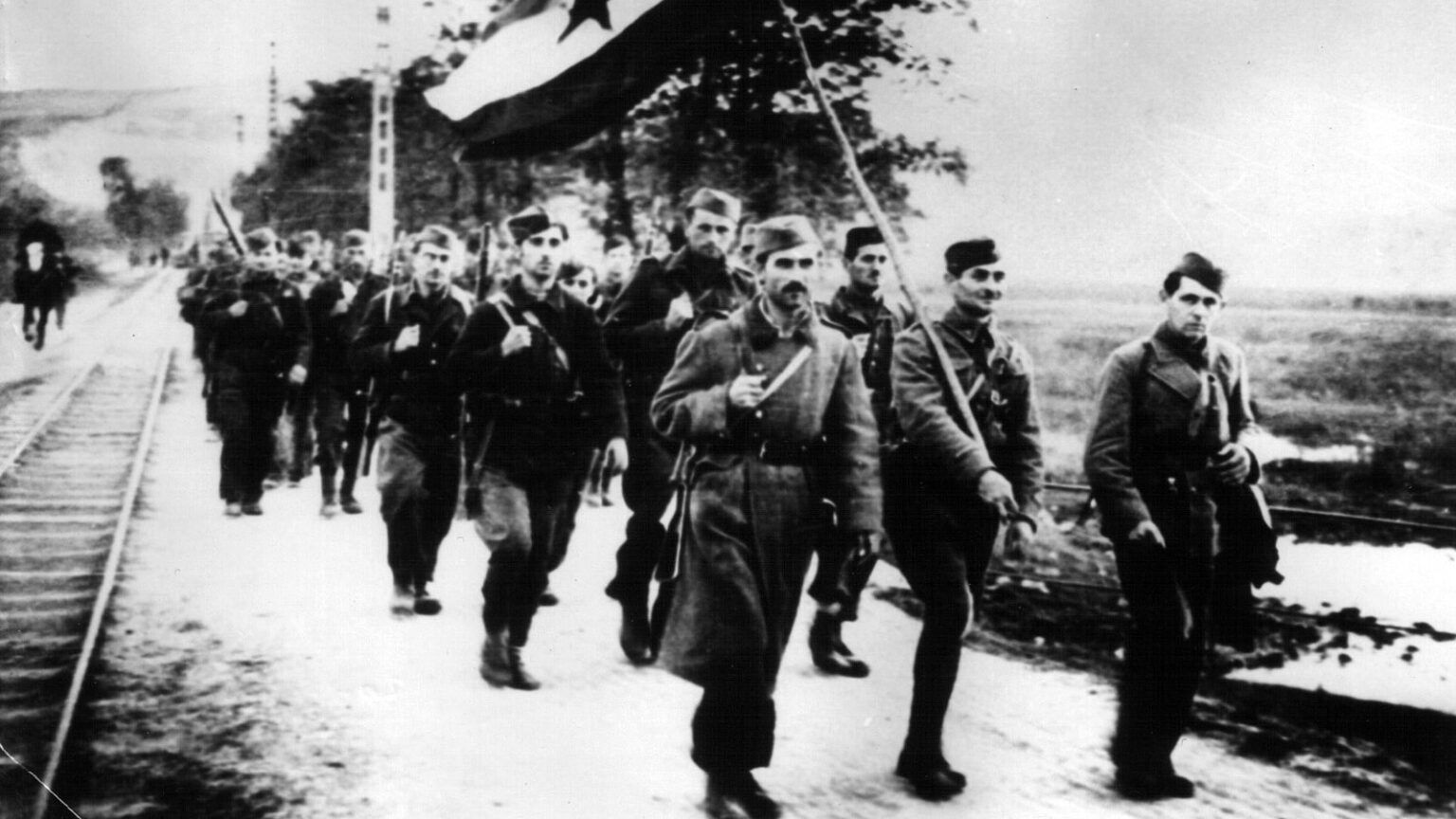
Entrance of the 7th Vojvodina Brigade of Yugoslav partisans in liberated Novi Sad, 23 October 1944. Photo: Wikimedia Commons

Neo-fascism merely adapted, disguised, and reshaped itself according to the times. In some states, we now see historical revisionism – and even glorification of local fascist or Nazi collaborators.

As we approach a major anniversary – 80 years since the defeat of fascism – a strange silence hangs over my country, Macedonia, and the broader region we now call the territory of former Yugoslavia. National authorities have been under sustained external (Western) pressure for years: May 9 must no longer be associated with the victory over fascism. Year after year, in both public memory and the education system, May 9 has been rebranded as Europe Day.

Older generations still remember, but what do younger ones know about Yugoslavia’s enormous human sacrifice, second only to the USSR, in the struggle against Evil? Almost nothing. We, the older ones, might suffer from the absence of dementia – we stubbornly remember the times when our fathers and grandfathers gave their lives for ideals that today’s youth barely even hear about.

This imposed forgetfulness on younger generations, however, goes so far that TV segments show young people unable to answer the simple question: Who was Josip Broz Tito? In Macedonia, more and more students know nothing about October 11, 1941, the Day of the Macedonian Uprising against fascism. Yet they excel in competitions where they display near-perfect knowledge of Europe. The irony is painful: the roots of patriotism and links to the most glorious moments of our not-so-distant past are not only being severed but portrayed as harmful.

A mythical and quasi-religious connection is being nurtured toward a mirage called Europe – meaning, of course, the European Union – which is idealized as a promised land, waiting with open arms. But this is no coincidence. Through its entire state-building apparatus, the EU seeks to rewrite history and implant it in the minds of new generations. In that version of history, any connection to the brutal colonial past is erased. More importantly, a veil is drawn over the fact that Europe’s imperial ambitions led to two world wars. The Second World War, whose anniversary we now mark quietly – even clandestinely, behind the EU’s back – was the anticlimax of capitalism, its degeneration into Nazism and fascism. This was not merely the result of individuals like Hitler or Mussolini, but of structural conditions that emerged from the womb of the post-World War I capitalist crisis.

The EU, falsely presenting itself as the embodiment of “Europe”, has been busy remodeling its image – until the start of the special military operation in Ukraine, it even tried to portray itself as a normative power, winning hearts and minds through soft power. It was even awarded the Nobel Peace Prize for past deeds. Yet its present and future seem to signal the revival of the very seed of evil it once claimed to oppose. The latest deep cycle of capitalist crisis first resulted in a divorce from democratic principles, but now it does not hide its hyper-imperialist and militaristic aspirations – for the sake of “self-defense” from an imagined Russian threat. Colloquially, many of us use the new word “Rusophrenia”: a belief that Russia is about to collapse and to take over the world at the same time. This term describes well the irrational view of Russia that is now entrenched in Western public opinion. It helps legitimize the new wave of militarization, even at the expense of the social well-being of Western citizens.

The rehabilitation of fascism began with its erasure from memory. Then came the glorification of the Euromaidan in Ukraine – the so-called pro-European revolution of 2014. A strange amnesia is spreading through the so-called Western world. As said, May 9 was kidnapped, and with it, textbooks, symbolic acts, and commemorations were gradually stripped of any connection to the true military victors of World War II: the Red Army and the Soviet people, who sacrificed more than 27 million lives. (Yugoslavs sacrificed more than a million people.)

It was the Soviets who liberated Berlin – twice. The final time, it was done by Mikhail Gorbachev, at a cost that Russia continues to pay today. Even the UN Secretary-General now avoids naming the Red Army soldiers who freed prisoners from the most notorious concentration camps.

It is Moscow and its allies who now stand as the only ones acting in the spirit of Orwell’s assertion that “in a time of universal deceit, telling the truth is a revolutionary act”. That truth will ring out loudly during the parade and major celebration on Red Square.

What is happening in what used to be Yugoslavia? In countries where generations were raised on narratives of brotherhood and unity, on the heroism of partisans who fought on the right side of history? First came the erosion of sovereignty and the right to self-determination. As the new religion – NATO and the EU are the only alternative and always right – was internalized, governments began distancing themselves from that part of our history. They turned instead to ancient glories or to painting a glowing future in union with the West.

To be red, to be a partisan, to be anti-fascist – gradually became suspicious, even dangerous. Our government now prides itself on alliances with the West (though it’s increasingly unclear – whose West? America’s or Europe’s?), and in distancing itself from those we once fought alongside. Former occupiers are now called “administrators”. Busts of partisans gather dust.

Anti-fascism has become uncomfortable to display – lest our Western allies recognize themselves in the mirror. So, silence prevails. Europe, the EU, is still celebrated – even as it re-militarizes, tramples basic values and human rights, and tacitly supports genocidal regimes. Confusion reigns over what to celebrate, what to remember, and why. Because, in an Orwellian world, war is peace, and peace is war.

Commemoration and historical memory matter. But just as vital is the ability to see, with eyes wide open, that the serpent’s egg still lives – and could hatch again into what millions across the world gave their lives to defeat eighty years ago. The bitter truth is that fascism was never fully defeated – except on the battlefield in 1945. Social scientists know well that the roots of fascism cannot be destroyed by arms alone. Neo-fascism merely adapted, disguised, and reshaped itself according to the times. In some states, we now see historical revisionism – and even glorification of local fascist or Nazi collaborators.

That is why the Russian initiative at the United Nations is significant. On 17 December 2024, during the 79th session of the UN General Assembly, the Russian Federation proposed a resolutionCombating glorification of Nazism, neo-Nazism and other practices that contribute to fueling contemporary forms of racism, racial discrimination, xenophobia and related intolerance. It was co-sponsored by 39 states from various regions. At last, it received 119 votes in favor, while 53 voted against. Regrettably, my country was among the latter – even though its very right to self-determination and statehood within Yugoslavia was born of the anti-fascist struggle. Perhaps for global politics, it is even more telling to examine who else voted against the resolution: Ukraine, the US, the UK, Germany, Italy, Belgium, Norway, the Netherlands, Finland, Sweden, Japan, Canada… Look at the new geopolitical map of the world, and it all becomes self-evident and telling.

According to some sources, Soviet Marshal Georgy Zhukov said, “We have liberated Europe from fascism, but they will never forgive us for it.”

They haven’t, as we now clearly see.

Biljana Vankovska is a professor of political science and international relations at Ss. Cyril and Methodius University in Skopje, a member of the Transnational Foundation of Peace and Future Research (TFF) in Lund, Sweden, and the most influential public intellectual in Macedonia.

This text was originally published by the Valdai Club and reproduced by Globetrotter.

Original article by Biljana Vankovska republished from peoples dispatch under a Creative Commons Attribution-ShareAlike 4.0 (CC BY-SA) license.

Publication should be regarded as worthy of debate rather that endorsement of the views of the author by the https://onaquietday.org blog.
Continue ReadingEighty years on: Remembering the defeat of fascism – or witnessing its return?

Italy marks 80 years since liberation with calls against genocide and militarism

Spread the love

Original article by Ana Vračar republished from peoples dispatch under a Creative Commons Attribution-ShareAlike 4.0 (CC BY-SA) license.

Source: Potere al Popolo Bologna e provincia/Facebook

On the 80th anniversary of liberation from Nazi-fascism, left forces in Italy mobilize against genocide, armament, and the Meloni government

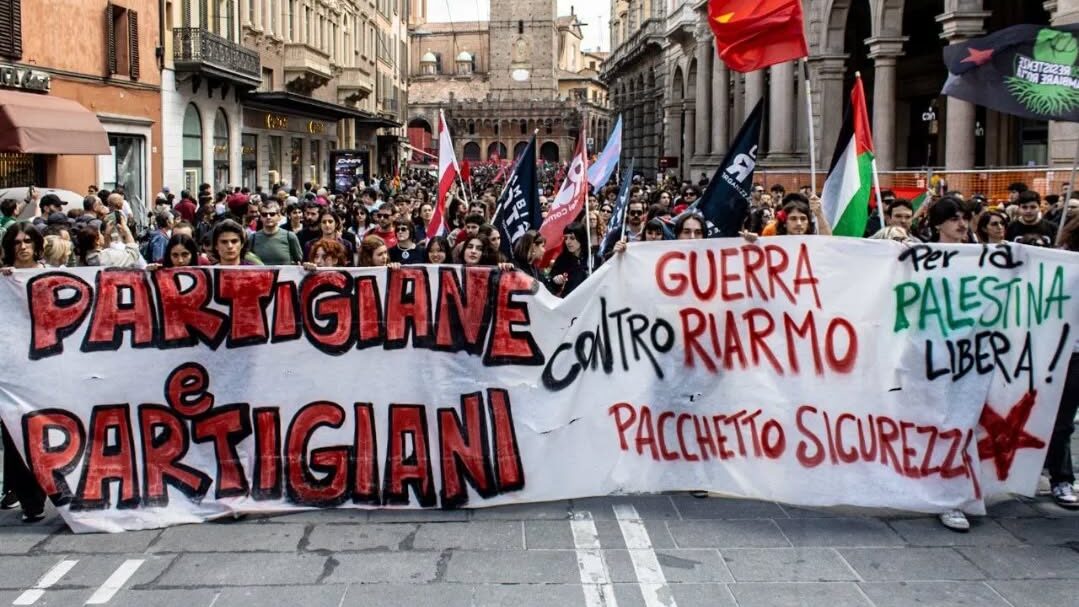
In the coming weeks, many European countries will mark the 80th anniversary of liberation from Nazi-fascist occupation. Italy is among the first, with dozens of events organized for April 25 – Liberation Day – despite ongoing attempts by the Meloni government and right-wing forces to rewrite or erase the memory of the Resistance. For most grassroots groups, this year’s events aim to locate the values that inspired partisan fighters in the 1940s into today’s context, marked by an aggressive rearmament agenda, support for Israel’s genocide in Gaza, and domestic repression of civil rights.

“Eighty years ago, our grandparents freed us from the grip of fascism. But remembering the past is not enough, especially not in the stale, institutional way the Democratic Party and center-left do,” Giuliano Granato of Potere al Popolo said during the demonstration in Naples. Along similar lines, the Unione Sindacale di Base (USB) stated that April 25 should not be reduced to a mere ritual or commemoration. “It should actualize the values and ideals of the partisan Resistance, which freed, perhaps not once and for all, this country from the barbarity of war and Nazi-fascism and provided an inescapable push toward better democratic, working, and living conditions for the people of this country,” the trade union declared in its call to action.

Against Israeli genocide

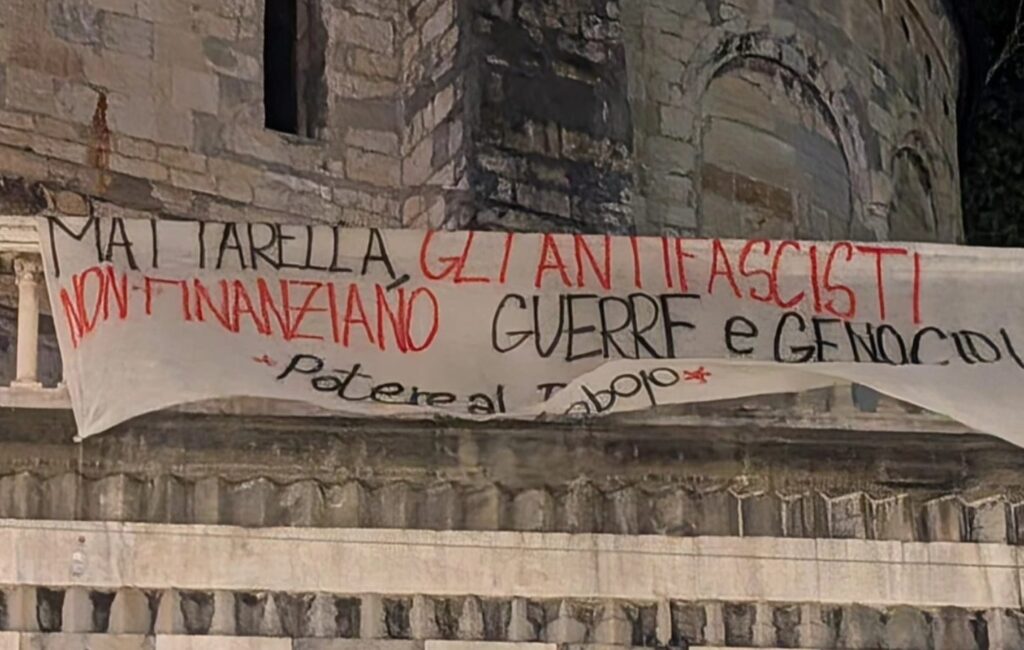
These values, according to USB, Potere al Popolo, and other left groups, must necessarily include opposition to genocide. In many cities, protesters have insisted that Italy’s ongoing ties with the Israeli occupation are unacceptable. These ties, they argue, are evidence that the political establishment has failed to grasp the true meaning and importance of the Resistance. Ahead of Liberation Day, the Genoa chapter of Potere al Popolo organized an action addressing President Sergio Mattarella, criticizing him for formally honoring the Resistance while remaining silent on the genocidal war against Palestinians and on the breakdown of democratic rights under the current government.

Potere al Popolo Genoa with banner reading: “Mattarella, antifascists don’t finance wars and genocide.” Source: Potere al Popolo Genoa/Facebook

“To do so [speak of the Resistance] after cozying up to the president of the criminal state of Israel, effectively supporting the ongoing genocide of the Palestinians, is an insult to those who, since the days of the partisan struggle, have fought against all genocide,” Potere al Popolo Genoa stated. “To honor the Resistance while equating the Soviet communists who liberated much of Europe from Nazism with the Third Reich is an insult to history and memory.”

Against armament

Equally prominent as the call to stop the genocide and sever ties with Israel is the demand to reject Europe’s new armament agenda, which will come at the cost of public services, education, healthcare, and climate justice. Giorgia Meloni’s administration and mainstream opposition parties alike have supported this agenda in different ways, endorsing increased spending on so-called defense and entertaining proposals for a joint European army. These priorities stand in stark contrast with the interests of Italy’s working class and the vision of a more just society that accompanied the antifascist Resistance.

Read more: Movement against increased military spending grows in Italy

“The rearmament plan launched by the EU represents the latest folly of a continental political class disinterested in building a present and future of peace and prosperity for the peoples of Europe,” warned USB. Similarly, Potere al Popolo called on people to rally around an alternative set of priorities: “We don’t need more money to enrich the arms industry. We need money for wages, for health care and services, for envisioning an ecological revolution and addressing the real challenge of our time, which is the climate crisis.”

Against new iterations of fascism

Meanwhile, Giorgia Meloni and her ministers are pursuing a different kind of battle, one aimed at minimizing the role of the antifascist struggle, led largely by communists, in shaping modern Italy. While the mainstream opposition tends to fixate on this behavior by the right wing, Granato warns that doing so risks missing important pieces of the puzzle.

“For us, Giorgia Meloni is simply following the path she’s always been on, one clearly tied to the rise of neo-fascism. After the defeat of Nazism, the slogan of the Italian Social Movement [neo-fascist party] was ‘neither renounce nor restore’ – and that’s exactly what Meloni is doing today. She doesn’t outright deny their fascist roots, but she also doesn’t walk around openly glorifying Benito Mussolini,” Granato told Peoples Dispatch.

The most recent attempt of the right to undermine the legacy of the Resistance came in the wake of the death of Pope Francis, when the government declared a record five days of mourning and called for “sobriety” at all public events. Many understood this to be an attempt to minimize April 25 events. Liberal and right-wing local administrations seized the opportunity to scale down and cancel rallies, while far-right media ran headlines such as April 25: Day of mourning. “Sure, they can claim they were referring to the death of the pope, but the truth is, they’ve been waiting 80 years for an excuse to print something like that, because for them, April 25 has always been a defeat,” says Granato.

Progressive forces, however, resisted, criticizing the government for using the death of a pope who – unlike the administration, called for peace and solidarity – to advance its agenda. They also refused to limit the day’s activities to commemorations, echoing the partisans’ revolutionary vision of a radically different society. “We don’t stop at the official ceremonies, not just because they’re cold and formulaic, but because we believe the fight for liberation and resistance isn’t over,” Granato explains. “Just like many partisans understood back then that toppling fascism wasn’t enough, we believe that defeating the Meloni government wouldn’t be enough either.”

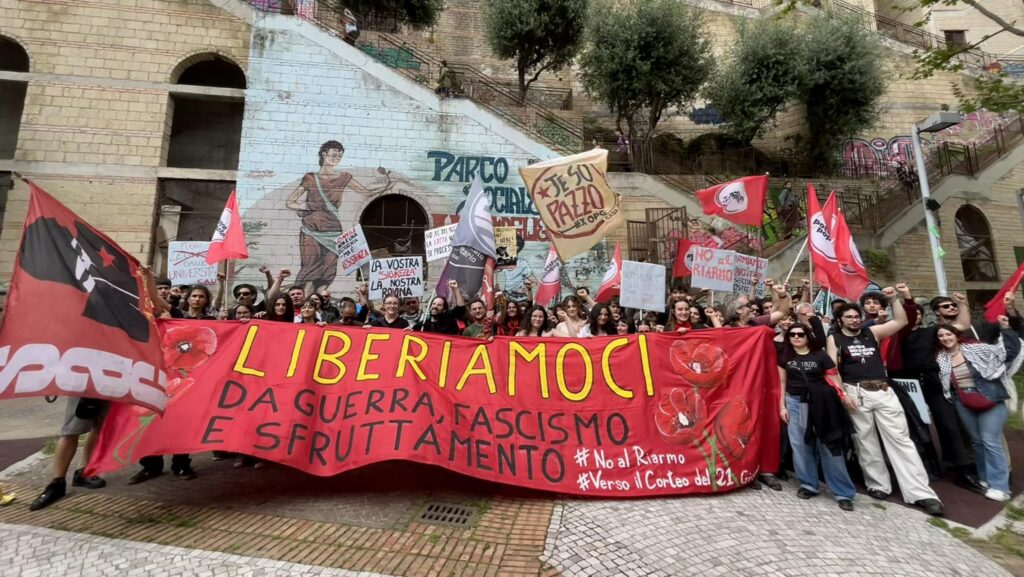
A group of protesters after the central demonstration in Naples, April 25, 2025. Source: Ex-OPG Je so’ pazzo/Facebook

Instead, Granato calls on the people to work together to free themselves from contemporary forms of danger and oppression: first and foremost genocide and militarization. “We worked to make today a day of liberation from militarism and genocide and to link it to the mobilization we are building, including a national assembly in Rome on May 24, and a mass demonstration on June 21, just days before the NATO summit in The Hague,” he adds.

“We believe militarism has always been a tool of fascism. The militarization of Europe today goes hand-in-hand with growing authoritarianism at home and worsens conditions for the working class across the continent.”

Original article by Ana Vračar republished from peoples dispatch under a Creative Commons Attribution-ShareAlike 4.0 (CC BY-SA) license.

Continue ReadingItaly marks 80 years since liberation with calls against genocide and militarism

The War on Gaza and Israel’s Fascism Debate

Spread the love

https://www.versobooks.com/en-gb/blogs/news/the-war-on-gaza-and-israel-s-fascism-debate

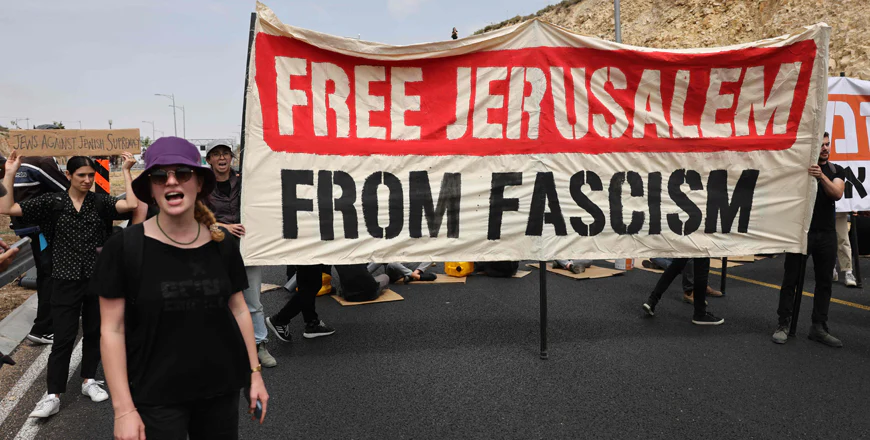
Western critics of Israel’s apartheid policies and far-right government are frequently accused of antisemitism, but leftist and left-liberal Israelis have been decrying the country’s descent into fascism for years. In this article, Alberto Toscano argues that fascism is embedded in the logic of Israel’s colonial project.

Green-lit by Western governments and described by myriad human rights law experts as demonstrating clear ‘genocidal intent’, the State of Israel’s retaliation against Hamas’s Al Aqsa Flood October 7 attack has also elicited talk of fascism in multiple quarters. In a collective statement, the Birzeit University Union of Professors and Employees has spoken of ‘colonial fascism’ and of the ‘pornographic call to death of Arabs by settler Zionist politicians across the political lines’; in their own declaration, the Communist Party of Israel (Maki) and the left-wing coalition Hadash ‘put the full responsibility on the fascist right-wing government for the sharp and dangerous escalation’; meanwhile, Colombia’s president Gustavo Petro described the onslaught on Gaza as the ‘first experiment to deem all of us disposable’ in a ‘global 1933’ marked by climate catastrophe and capitalist entrenchment. Even quoting these lines probably falls foul of the IHRA definition of anti-Semitism, which has served as an important instrument in efforts to curtail peaceful international solidarity activism against Israeli apartheid, especially in the guise of the Boycott, Divestment and Sanctions movement. 

And yet the recognition of an incipient fascism in the latest Netanyahu government and even Israeli society at large seems, if not mainstream, certainly prominent in public discourse in Israel itself, not least in the wake of protests against the recent judicial reforms aimed at eviscerating the vaunted autonomy of Israel’s Supreme Court. Four days before the Hamas attack, the newspaper Ha’aretz published an editorial under the heading ‘Israeli Neo-Fascism Threatens Israelis and Palestinians Alike’. One month earlier 200 Israeli high school students declared their refusal to be conscripted thus: ‘We decided that we cannot, in good faith, serve a bunch of fascist settlers that are in control of the government right now.’ In May, a Ha’aretz editorial opined that the ‘sixth Netanyahu government is beginning to look like a totalitarian caricature. There is almost no move associated with totalitarianism that has not been proposed by one of its extremist members and adopted by the rest of the incompetents it comprises, in their competition to see who can be more fully full fascist,’ while one of its editorialists described an ‘Israeli fascist revolution’ ticking off all items in the checklist, from virulent racism to a contempt for weakness, from a lust for violence to anti-intellectualism. 

These recent polemics and prognoses were anticipated by prominent intellectuals like the renowned historian of the far Right Ze’ev Sternhell, who wrote of ‘growing fascism and a racism akin to early Nazism’ in contemporary Israel, or the journalist and peace activist Uri Avnery, who escaped Nazi Germany at age ten, and who, not long before his death in 2018, declared that 

the discrimination against the Palestinians in practically all spheres of life can be compared to the treatment of the Jews in the first phase of Nazi Germany. (The oppression of the Palestinians in the occupied territories resembles more the treatment of the Czechs in the “protectorate” after the Munich betrayal.) The rain of racist Bills in the Knesset, those already adopted and those in the works, strongly resembles the laws adopted by the Reichstag in the early days of the Nazi regime. Some rabbis call for a boycott of Arab shops. Like then. The call ‘Death to the Arabs’ (‘Judah verrecke’?) is regularly heard at soccer matches.

But the fascism ‘godfathered’ by Netanyahu cannot just be reduced to fundamentalist settlers and their stratagems of dispossession (including the deep tendrils into the state of Smotrich’s settler NGO, Regavim, and its lawfare against Palestinian land and property rights); it is also firmly anchored in the business interests and legislative maneuvers of billionaires who, in Israel as in India or the US, are happy to combine national-conservative mobilisations against decadent metropolitan ‘elites’ with the ruthless defense of profit and privilege. In a recent interview, the Israeli Holocaust historian Daniel Blatman observed

Do you know what the biggest threat is to the continued existence of the State of Israel? It’s not Likud. It’s not even the thugs who run wild in the territories. It’s the Kohelet Policy Forum [a reference to a conservative, right-wing think tank supported by wealthy U.S. donors]. […]  They are creating a broad social and political manifesto which, if adopted eventually by Israel, will turn it into a completely different country. You say “fascism” to people and they picture soldiers cruising the streets. No. It won’t look like that. Capitalism will still be extant. People will still be able to go abroad – if they are allowed into other countries. There will be good restaurants. But a person’s ability to feel that there is something protecting him, other than the regime’s good will – because it either will or not protect him, as it sees fit – will no longer be there. Israeli society was ripe to receive the present government. Not because of Likud’s victory, but because the most extreme wing pulled everyone after it. What was once extreme right is today center. Ideas that were once on the fringes have become legitimate. As a historian whose field is the Holocaust and Nazism, it’s hard for me to say this, but there are neo-Nazi ministers in the government today. You don’t see that anywhere else – not in Hungary, not in Poland – ministers who, ideologically, are pure racists.

Its insights notwithstanding, this passage also painfully demonstrates what liberal Israeli polemics against the rise of fascism bracket. Namely, Palestinians. Soldiers do cruise the streets in Israel and occupied Palestine. Millions of people ruled by Israel cannot go abroad. Or indeed return home. The ‘pure’ racism voiced without compunction by the likes of Smotrich and Minister of National Security Itamar Ben-Gvir is a product of the racism that structures and reproduces colonial domination, for bad faith liberals as much as for giddy fascists. 

https://www.versobooks.com/en-gb/blogs/news/the-war-on-gaza-and-israel-s-fascism-debate

Continue ReadingThe War on Gaza and Israel’s Fascism Debate