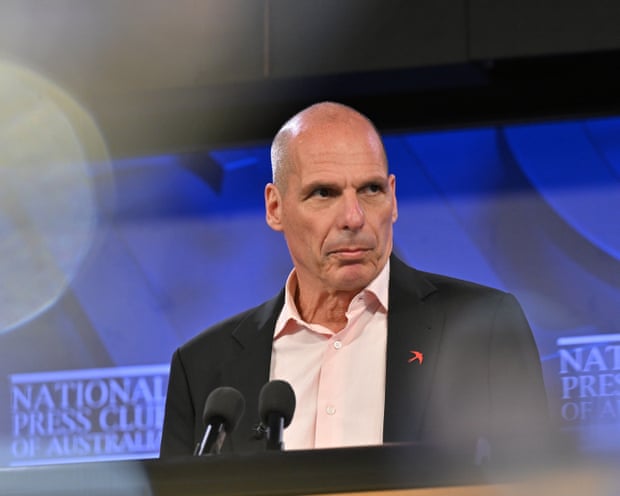
Yanis Varoufakis: ‘My ridiculous prosecution must be seen within the wider, west-wide surge of an insidious new form of fascism.’ Photograph: Mick Tsikas/AAP
Greek leftwing intellectual and former minister says his indictment is indicative of far-right turn in western politics
Yanis Varoufakis, the leftwing firebrand who briefly served as Greece’s finance minister, has criticised his “ridiculous prosecution” for allegedly promoting the use of recreational drugs after his public admission that he once took an ecstasy pill almost 40 years ago.
The 64-year-old, who reminisced about the experience on a podcast, was charged on Wednesday with “inciting others in the illegal use of narcotics”. If convicted he faces a prison term of at least six months and up to €50,000 (£44,000) in fines. A court hearing has been scheduled for December.
On Friday, Varoufakis described the indictment as indicative of the far-right turn in politics across the west.
“My ridiculous prosecution must be seen within the wider, west-wide surge of an insidious new form of fascism,” he wrote on X, highlighting what he claimed was the appointment of “neo-fascists” to top posts in the centre-right Greek government.
“In this context, I am honoured by their determination to persecute me – as it grants me the privilege of calling upon people of good conscience, from around the world, to stand together, to oppose them.”
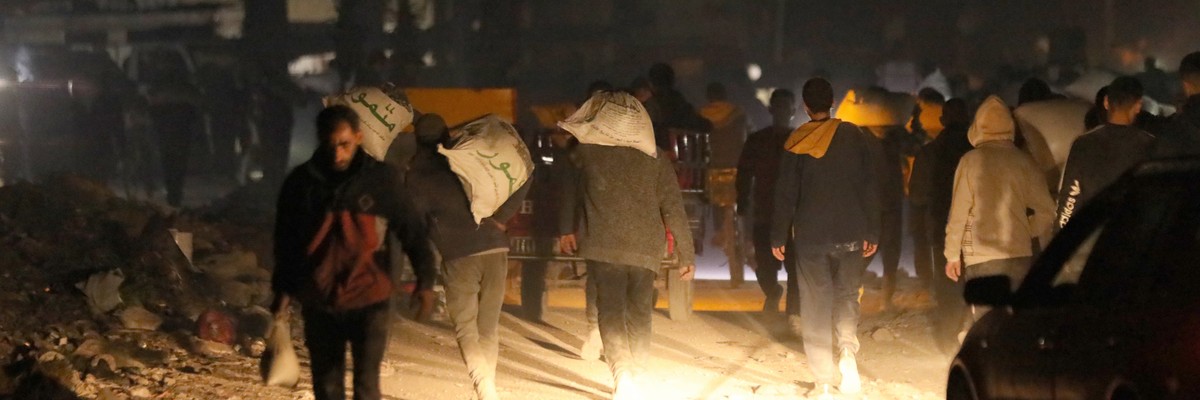
Palestinians receive humanitarian aid supplies brought by trucks to Gaza City on March 13, 2024. (Photo: Dawoud Abo Alkas/Anadolu via Getty Images)
“Our governments did nothing to hold Israel accountable last time it attacked desperate hungry people seeking aid in Gaza,” said one aid campaigner. “So why wouldn’t it do the exact same thing again?”
Gaza health officials said Thursday that Israeli forces killed at least 20 people and injured over 150 more as they waited for humanitarian aid in the northern part of the Palestinian enclave, where deliveries of food, medicine, and other necessities have become virtually impossible due to Israel’s persistent obstruction and attacks.
Mohammed Ghurab, the director of emergency services at a hospital in the area, told AFP that there were “direct shots by the occupation forces” at people waiting for a truck carrying food. Northern Gaza is in the grip of famine-like conditions, and desperate people there have resorted to eating weeds and livestock feed amid Israel’s suffocating blockade.
Dozens of people, including children, have died of starvation and dehydration in northern Gaza in recent weeks.
Thursday’s attack took place at the Kuwaiti Roundabout in Gaza City, according to the territory’s health ministry, which said nearby hospitals were “unable to deal with” the influx of wounded patients.
Horrific video footage posted to social media shows bloody bodies lying motionless amid debris. Middle East Eye reported that “a truck transporting aid into Gaza” later “collided with a vehicle carrying victims” of Thursday’s attack to a hospital.
“Eyewitnesses said the area was struck by what they said sounded like tank or artillery fire,” CNN reported. “The incident at the Kuwaiti Roundabout followed earlier violence at the same site on Wednesday, where large crowds were waiting for a food distribution. At least seven people were killed and 86 others injured after Israeli troops opened fire.”
A day earlier, Israel allowed an aid convoy to enter Gaza’s north directly through an Israeli border crossing for the first time since the Hamas-led October 7 attack.
Ziad Saeed Madoukh, who was shot in the foot during Thursday’s attack, told the Euro-Mediterranean Human Rights Monitor that Israeli forces started “heavily firing live ammunition towards the crowd of civilians as soon as aid trucks approached” the roundabout.
“Another survivor of today’s massacre, Ibrahim Al-Najjar, was shot in the hand by Israeli forces,” the rights group said. “Al-Najjar told Euro-Med Monitor’s team that he tried to get a bag of flour for his children at the Kuwait Roundabout, but that he and others were subjected to live ammunition and artillery shells despite gathering in an area previously designated as safe by Israel’s army.”
The Israel Defense Forces (IDF) denied attacking Gazans at the aid distribution point and said it was “analyzing” the incident.
Thursday’s bloodshed drew comparisons to the February 29 attack in which Israeli forces opened fire on crowds of starving Gazans trying to get their hands on bags of flour. The attack was later dubbed the “flour massacre.”
“Our governments did nothing to hold Israel accountable last time it attacked desperate hungry people seeking aid in Gaza,” said Rohan Talbot, director of advocacy and campaigns at Medical Aid for Palestinians. “So why wouldn’t it do the exact same thing again?”
Prior to Thursday’s attack—described as “another flour massacre”—Gaza authorities estimated that Israeli forces had killed at least 400 people waiting for humanitarian aid deliveries. Between mid-January and the end of February, the United Nations documented at least 14 instances of Israeli forces opening fire on crowds gathered to receive humanitarian aid.
“This is something that is preventable and shouldn’t be happening,” Shaina Low, communications adviser for the Norwegian Refugee Council, told Al Jazeera.
Asked Wednesday about Israel’s repeated attacks on Palestinians awaiting aid, U.S. State Department spokesperson Matthew Miller said that “we want to see it investigated promptly, and, if appropriate, see accountability.”
“We also press them to take measures to keep it from happening again,” said Miller, who did not warn of any consequences for Israel’s military if it continues to massacre desperate civilians.
A group of senators warned earlier this week that it is a violation of U.S. law to arm a government that is obstructing the delivery of humanitarian assistance.