‘Political Stunt Wrapped in Badges’: New Orleans Readies Resistance as Trump Operation Begins

Spread the love

Original article by Brett Wilkins republished from Common Dreams under Creative Commons (CC BY-NC-ND 3.0).
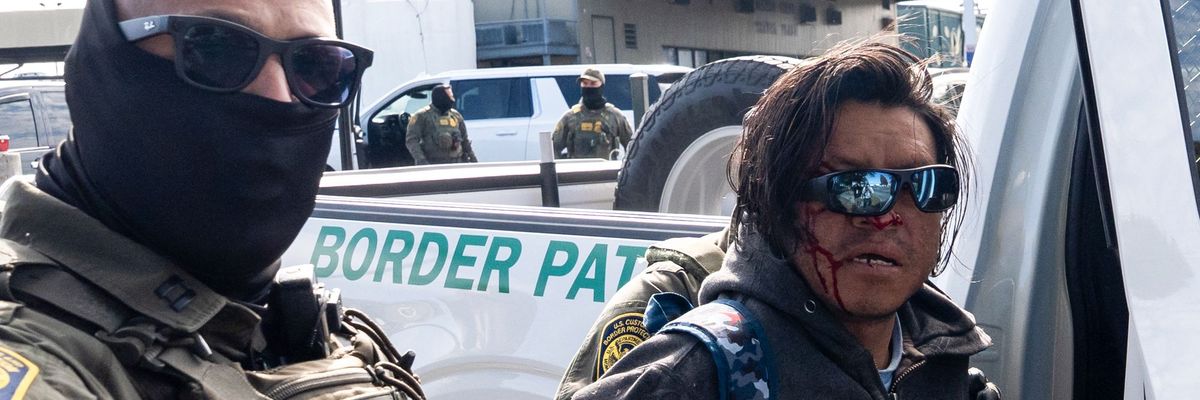
A [man] with a bloody face and sunglasses askew suggests a violent arrest by masked US Customs and Border Patrol agents in New Orleans on December 3, 2025. (Photo by Adam Gray/AFP via Getty Images)

“Our city is not a stage for political theater,” said the Democratic congressman representing New Orleans. “Our people are not props.”

The Trump administration on Wednesday launched a major operation against what it said are “criminal illegal aliens” in New Orleans but that critics contend is political theater targeting what the Louisiana city’s mayor-elect called people “just trying to survive and do the right thing.”

The Department of Homeland Security (DHS) said in a statement that it launched Operation Catahoula Crunch—which some Trump administration officials are also calling “Swamp Sweep”—because New Orleans is a sanctuary city that refuses to cooperate with the anti-immigrant crackdown ordered by President Donald Trump.

The blitz—which began on the same day as a similar operation in Minneapolis and follows federal invasions of cities including Charlotte; Chicago; Los Angeles; Memphis; Portland, Oregon; and Washington, DC—is expected to involve at least hundreds of federal agents and National Guard troops and reportedly aims for 5,000 arrests in Louisiana and Mississippi.

“Sanctuary policies endanger American communities by releasing illegal criminal aliens and forcing DHS law enforcement to risk their lives to remove criminal illegal aliens that should have never been put back on the streets,” Assistant Homeland Security Secretary Tricia McLaughlin said Wednesday.

While McClaughlin claimed the targets of the operation will be “monsters” that “include violent criminals who were released after arrest for home invasion, armed robbery, grand theft auto, and rape,” examination of detention statistics of similar operations in other communities has shown that a large percentage of those swept up have no criminal record.

Academic studies and analyses by both left– and right-wing groups and have repeatedly affirmed that undocumented immigrants commit crime at a dramatically lower rate than native-born US citizens. The libertarian Cato Institute last week published data showing that nearly three-quarters of the 44,882 people booked into Immigration and Customs Enforcement (ICE) custody since October had no criminal conviction and just 5% had been convicted of violent crimes.

Detention data published last month by the Department of Justice revealed that just 16 out of 614 people arrested in the Chicago area during DHS’s Operation Midway Blitz had criminal histories that present a “high public safety risk.”

Elected officials representing New Orleans called the DHS operation an unnecessary and unwelcome stunt.

“It’s one thing if you would have a real strategic approach on going after people… who have criminal felonies or are being accused of some very serious and violent crimes. But that’s not what the public is seeing,” Democratic New Orleans Mayor-elect Helena Morena told the Washington Post on Wednesday.

“They’re seeing people who are just trying to survive and do the right thing—and many of them now have American children who are not causing problems in our community—treated like they are violent, violent criminals,” she added.

Moreno’s website published a “know your rights” resource page with tips from the National Immigrant Justice Center—a move that could possibly run afoul of a state law cited by Republican Louisiana Attorney General Liz Murrill to threaten felony prosecution of people who nonviolently resist Trump’s crackdown. On Wednesday, the American Civil Liberties Union filed a federal lawsuit arguing that the law is a violation of the right to free speech.

Congressman Troy Carter (D-La.) said in a statement Tuesday that “if the administration truly wants to support public safety in New Orleans, they can help us recruit and retain well-trained local officers, invest in modern policing tools, and build transparent partnerships with city and parish leaders.”

New Orleans welcomes partnership. We do not welcome occupation.What we are seeing unfold in our community is not public safety; it is a political stunt wrapped in badges, armored vehicles, and military uniforms.

Congressman Troy A. Carter, Sr. (@reptroycarter.bsky.social) 2025-12-03T14:35:30.453Z

“Dropping armed federal agents and National Guard troops into our communities without coordination is not cooperation—it is chaos,” Carter continued. “As Congressman for New Orleans, I want to be clear: We will always stand for the rule of law. We will always stand for safe communities. And we will always stand against tactics that terrorize families and undermine public trust.”

“Our city is not a stage for political theater,” he added. “Our people are not props. If the administration wants to be a partner, then act like one; share the plan, respect local law, and work with us, not around us.”

Hundreds of New Orleans residents took to the streets Monday night despite cold, heavy rain to protest the impending DHS operation. Demonstrators shared umbrellas and held signs showing support for immigrants. They chanted messages, including “No ICE! No fear! Immigrants are welcome here!” and “Chinga la Migra”—roughly translated as “Fuck the Border Patrol.”

“We have to fight for the rights of everyone. I’m out here to support the immigrant community because it’s an integral part of New Orleans. New Orleans was built by immigrants,” protester Jamie Segura told Gambit.

Addressing the crowd at Monday’s rally, resident Mitch Gonzalez said: “This is my home. My trans sister was kidnapped and taken from me. Now she has to fight from Mexico, not even her home country, because they’re snatching people.”

https://twitter.com/i/status/1995859350053601339

As New Orleans residents anticipated the impending operation, mutual aid groups kicked into action in defense of immigrant communities, citing effective rapid response efforts in Chicago.

“What we’ve learned is that even a street witness who is not recording makes these interactions less traumatic and less violent,” Beth Davis, press liaison officer at Indivisible NOLA, told the Washington Post on Wednesday. “So we need to get eyes on these people.”

The New Orleans branch of Democratic Socialists of America—which is hosting training sessions—said ahead of the federal blitz: “We call upon all of New Orleans to get organized and resist this fascist occupation. Protect your neighbors and make these troops and federal agents feel unwelcome in every part of our city.”

Other Orleanians prepared by closing or displaying signs telling the federal invaders that they are not welcome.

“We’re going to make sure that any hotel that they stay at, any neighborhood that they try to terrorize, we’re going to bring as many people there to stop them in their tracks, whether it’s in New Orleans, Los Angeles, Chicago—anywhere in this country,” Antonia Mar of Freedom Road Socialist Organization told Verite News during Monday’s protest.

Suggesting that the crackdown could backfire, Mar added that “if there’s one thing Trump does well, he gets people organized against him.”

Original article by Brett Wilkins republished from Common Dreams under Creative Commons (CC BY-NC-ND 3.0).

Orcas discuss how Trump was re-elected and him being an obviously insane, xenophobic Fascist.

Continue Reading‘Political Stunt Wrapped in Badges’: New Orleans Readies Resistance as Trump Operation Begins

20 years since Katrina: How the US refused Cuban doctors as New Orleans drowned

Spread the love

Original article by Manolo De Los Santos republished from peoples dispatch under a Creative Commons Attribution-ShareAlike 4.0 (CC BY-SA) license.

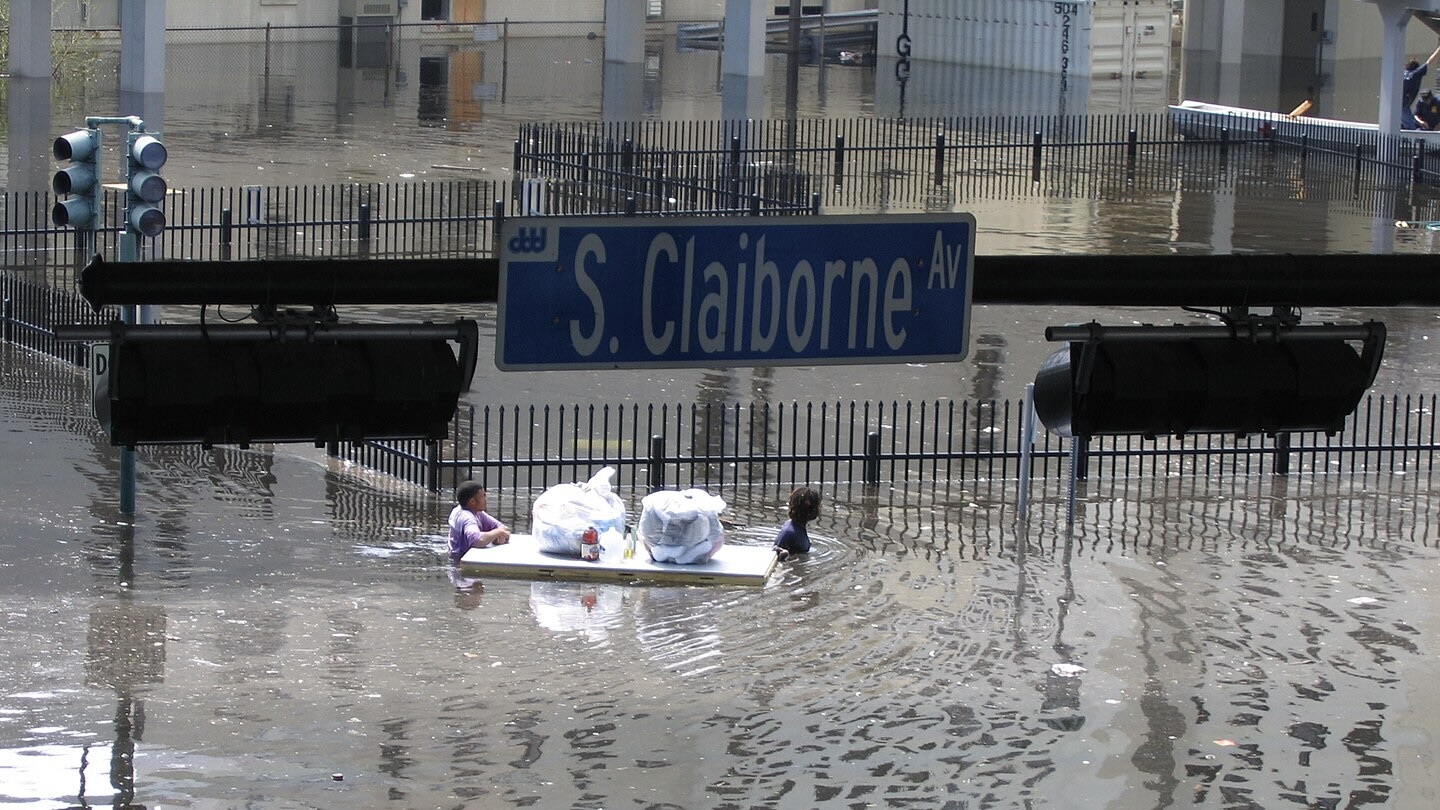
Flooding in downtown New Orleans after Hurricane Katrina on August 31, 2005. Photo: Wikimedia Commons

As the people of New Orleans suffered from mass devastation and state neglect following Hurricane Katrina, Cuba’s offer of solidarity was rejected

Two decades ago, Hurricane Katrina ripped through the Gulf Coast of the United States, a Category 5 monster that exposed the raw nerves of inequality, racism, and governmental neglect in the United States. While the storm itself was a force of nature, the true disaster was the response – or lack thereof – from the world’s wealthiest nation. Yet, amidst the chaos and despair, a beacon of international solidarity shone brightly, emanating from an unexpected place: Cuba.

The images are seared into collective memory: rooftops submerged, desperate cries for help echoing through flooded streets, and the Superdome stadium transforming into a squalid shelter. New Orleans, a city with a majority Black population and a vibrant hub of Black culture, bore the brunt. As the levees broke, so too did the illusion of American exceptionalism. Over 1,800 people died, and millions were displaced. The federal government’s response was not only slow but also virtually nonexistent in the crucial initial days. President George W. Bush, vacationing at the time, seemed detached, famously remarking to his FEMA director, “Brownie, you’re doing a heck of a job,” even as the crisis deepened.

Cuba’s hand of friendship

In New Orleans, as desperately overworked healthcare providers struggled with a critical lack of medicine, equipment, and personnel, the Cuban government made its formal offer on September 2. The Senate Majority Leader at the time, Bill Frist, a physician himself who was visiting the flooded city, acknowledged the crisis, stating, “The distribution of medical assistance continues to be a serious problem,” and confirmed reports that scores of people were dying as a result. As the US government faltered, a small island nation, blockaded and vilified by Washington for decades, extended an immediate and comprehensive offer of aid. Fidel Castro announced that Cuba was ready to send a medical brigade of 1,586 doctors, equipped with 36 tons of medical supplies, to assist the victims of Hurricane Katrina. This wasn’t a conditional offer, nor was it for profit. It was a gesture of unconditional solidarity, rooted in the values of the Cuban people, in offering help to those in need, whether suffering from natural disasters or colonialism.

“We would be honored to send our doctors,” Fidel declared. “We could move them by air in groups of 100, and they could arrive within 12 hours of permission being granted.” The doctors were prepared to work in the most challenging conditions, bringing not just medical expertise but field hospitals of their own and decades of experience in providing free and socialized healthcare to millions of people in Africa, Asia, and Latin America. They were even willing to brave the dangerous waters to reach those stranded. This was the nascent stage of what would soon become the Henry Reeve International Medical Brigade, a testament to Cuba’s unwavering commitment to global health.

The Henry Reeve Brigade

The Henry Reeve Brigade, named after a young American volunteer from Brooklyn, New York, who fought for Cuban independence in the 19th century, was officially formed shortly after Katrina. Its mission: to provide medical assistance in disaster situations and serious epidemics anywhere in the world. While the Bush administration ultimately rejected Cuba’s offer of aid for Katrina, citing “logistical challenges,” the reason given was a lack of full diplomatic relations with Cuba, a claim that rang hollow given the Bush administration had just accepted aid from Taiwan, with which the US also lacks full diplomatic relations. It was a thinly veiled excuse rooted in geopolitical animosity.

Still, the brigade went on to become a global force for good. From the devastating earthquake in Pakistan in 2005 to the cholera epidemic in Haiti, and most recently, the global COVID-19 pandemic, the Henry Reeve Brigade has been deployed to over 40 countries, treating millions and saving countless lives. These doctors often work in remote, dangerous, and impoverished areas, where most Western charities and aid organizations usually fear to stay. They embody the Cuban principle of prioritizing human well-being over profit or political gain. They are a living, breathing condemnation of the often generalized idea in the United States that healthcare is something to profit from.

The contrast between the US government’s response to Katrina and Cuba’s offer of aid couldn’t be starker. For decades, US foreign policy has been predicated on the idea that Cuba is a threat to US democracy, even landing on the US State Sponsors of Terrorism list. Yet, when its own citizens were drowning, Washington chose to maintain its Cold War attitude over the necessity of saving the lives of its own citizens. A Katrina survivor, recounting the harrowing days after the storm, once lamented, “Where was our government? We were left to die.” This sentiment encapsulates the raw betrayal felt by many of the city’s Black residents.

The rejection of Cuba’s aid wasn’t just a missed opportunity; it was a damning indictment of the US’s priorities. While ordinary Americans were suffering, the Bush administration was more concerned with maintaining its anti-Cuba stance than with saving lives. This is the inherent flaw of a system that prioritizes capital over human lives, that sees solidarity as a weakness rather than a strength.

From Katrina to today: the enduring relevance

Twenty years later, the lessons of Katrina and Cuba’s offer of aid remain profoundly relevant. In today’s political climate, the US continues its aggressive stance against Cuba, even attempting to discourage other countries in the Global South from accepting Cuban medical brigades. The Trump administration, for example, actively campaigned against countries receiving aid from Cuban doctors, labeling them as “human trafficking” – a cynical and baseless accusation designed to undermine Cuba’s international standing and maintain the brutal economic blockade.

Read more: Why Cuban doctors deserve the Nobel Peace Prize

Yet, despite these efforts, Cuba’s medical internationalism continues to inspire. In the midst of the COVID-19 pandemic, as wealthy nations hoarded vaccines and medical supplies, Cuba developed its own vaccines and continued to send its doctors to the most remote corners of the globe.

As people across the Gulf Coast commemorate the 20th Anniversary of Hurricane Katrina, may the example of the Henry Reeve Brigade be a powerful reminder of Cuba’s solidarity with the people of the United States.

Manolo De Los Santos is Executive Director of The People’s Forum and a researcher at Tricontinental: Institute for Social Research. His writing appears regularly in Monthly Review, Peoples Dispatch, CounterPunch, La Jornada, and other progressive media. He coedited, most recently, Viviremos: Venezuela vs. Hybrid War (LeftWord, 2020), Comrade of the Revolution: Selected Speeches of Fidel Castro (LeftWord, 2021), and Our Own Path to Socialism: Selected Speeches of Hugo Chávez (LeftWord, 2023).

Continue Reading20 years since Katrina: How the US refused Cuban doctors as New Orleans drowned