Activists from Ocean Rebellion with a large sculptural bottom trawling fishing boat on the banks of the river Clyde, as Glasgow prepared for the Cop26 summit, October 30, 2021
MPs have called on the government to ban damaging activities like bottom-trawling, dredging and mining in protected English waters.
The practices are still permitted across Britain’s 178 marine protected areas (MPAs), but spurred-on by footage from Sir David Attenborough’s new film on oceans showing the heavy metal chains of a bottom trawl net scooping up species indiscriminately, calls for bans have intensified ahead of next week’s UN ocean conference in Nice, France.
Now the cross-party Environmental Audit Committee (EAC) has added its voice to the chorus for action, slamming the government’s “failure to effectively manage gaps in the network of marine protected areas” by allowing these damaging activities to take place, despite Labour water minister Emma Hardy recently telling the committee they were “committed” to ending the practices in MPAs.
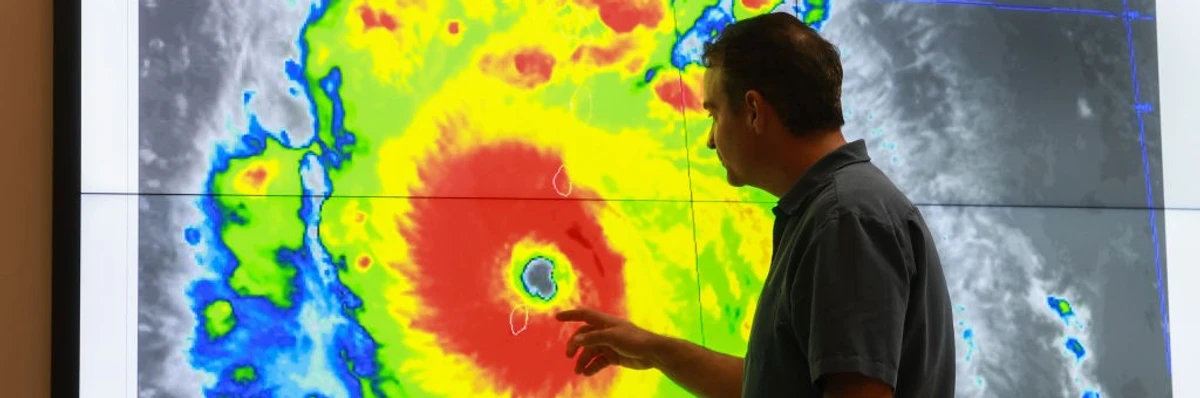
John Cangialosi, senior hurricane specialist at the National Hurricane Center, inspects a satellite image of Hurricane Beryl on July 1, 2024 in Miami, Florida. (Photo: Joe Raedle/Getty Images)
“Beryl isn’t ‘unbelievable,’” one expert said. “it’s what happens when you heat up the planet with fossil fuel pollution for decades.”
As Hurricane Beryl barreled toward Jamaica on Tuesday after killing at least four people in the Caribbean’s Windward Islands, climate scientists warned the record-breaking Category 5 storm is a present-tense example of what’s to come on a rapidly heating planet.
Even before the Atlantic hurricane season began on June 1, the U.S. National Oceanic and Atmospheric Administration predicted an 85% chance of above-normal activity and 17-25 total named storms this year. Matthew Cappucci, a meteorologist for The Washington Post‘s Capital Weather Gang, highlighted some records Beryl has already broken.
“There is a strong, well-documented link between the effects of human-induced climate change and the development of stronger, wetter storms that are more prone to rapidly intensify,” he wrote Tuesday. “Beryl sprung from a tropical depression to a Category 4 hurricane in just 48 hours, the fastest any storm on record has strengthened before the month of September.”
Hurricane Beryl has achieved the following: – Earliest Category 4 on record in Atlantic – Earliest Category 5 on record in Atlantic – Fastest intensification before September in Atlantic – Southernmost Category 4 on record
— Matthew Cappucci (@MatthewCappucci) July 2, 2024
Beryl is also the earliest Category 4 and 5 hurricane on record in the Atlantic, Cappucci pointed out. Previously, the earliest storm to reach the top level of the Saffir-Simpson Hurricane Wind Scale was Emily, in mid-July of 2005.
The Capital Weather Gang reported that Beryl “strengthened more Monday night, its peak winds climbing to 165 mph. It has surpassed Emily (2005) as strongest July hurricane on record. It’s early July but Atlantic is acting like late August.”
Certified consulting meteorologist Chris Gloninger emphasized that “the climate crisis has led to well-above-average ocean water temperatures and helped this storm explode.”
As Stefan Rahmstorf of the Potsdam Institute for Climate Impact Research and Potsdam University explained: “The heat in the upper ocean is the energy source for tropical cyclones. This heat is at record level, mainly caused by emissions from burning fossil fuel. That’s why an extreme hurricane season has been predicted for this year. It’s off to a bad start!”
Colorado State University meteorologist Philip Klotzbach on Monday shared graphics showing that “Caribbean ocean heat content today is normally what we get in the middle of September.”
One reason why #Hurricane#Beryl intensified to a Category 5 hurricane over two weeks earlier than any other Atlantic Cat. 5 on record is due to extremely high ocean heat content levels. Caribbean ocean heat content today is normally what we get in the middle of September. pic.twitter.com/dmEY7EFrLs
While some expressed disbelief over the storm, CNN extreme weather editor Eric Zerkel stressed that “Beryl isn’t ‘unbelievable’ or ‘defying all logic,’ it’s what happens when you heat up the planet with fossil fuel pollution for decades. The oceans store roughly 90% of that excess heat. The ocean is as warm as it typically is… when Category 4 storms form. June is now August.”
Acknowledging Beryl’s strength, Steve Bowen, a meteorologist who serves as chief science officer at the global reinsurance firm Gallagher Re, concluded that “this is a massive warning sign for the rest of the season.”
Looking beyond this hurricane season, which ends in November, University of Hawaii at Mānoa professor and [C]Worthy co-founder David Ho said, “Let’s remember that things are just going to get [worse] as we continue to consume nearly 100 million barrels of oil every day.”
The “historic” storm is sparking calls for action to phase out fossil fuels across the globe. Noting how Beryl “is breaking records and leaving a trail of destruction throughout the Caribbean,” the U.S.-based Sunrise Movementargued that “we must prosecute Big Oil for their role in causing devastation like this.”
In response to a climate scientist who shared a photo of some damage Beryl has already caused, Rahmstorf expressed hope that people around the world won’t “wait with voting for climate stabilization until extremes hit their homes.”
Let's hope that most people do not wait with voting for climate stabilisation until extremes hit their homes. Because then it's too late. https://t.co/0tjusPJuIu
— Prof. Stefan Rahmstorf 🌏 🦣 (@rahmstorf) July 2, 2024
Beryl made landfall Monday as a Category 4 hurricane on Carriacou, a Grenada island, and also affected St. Vincent and Grenadines. According to The Associated Press, at least four people were killed.
The U.S. National Hurricane Center said Tuesday afternoon that on its current path, “the center of Beryl will move quickly across the central Caribbean Sea today and is forecast to pass near Jamaica on Wednesday and the Cayman Islands on Thursday. The center is forecast to approach the Yucatan Peninsula of Mexico on Thursday night.”
“The science we need for the ocean we want” – this is the tagline for the UN Ocean Decade (2021-2030), which has just held its first conference in Barcelona, Spain. Marine scientists from around the world, including me, gathered alongside global leaders to chart the progress of this ten-year mission to improve ocean health and marine biodiversity. That includes finding ways to better protect the seabed which we still know relatively little about.
Some areas of sediment on the sea floor hold large stores of carbon. Without greater protection, disturbance from bottom-trawling fishing practices for example, could release some of that stored carbon back into the atmosphere.
I joined discussions in Barcelona that have led to the launch of a new sustainable ocean planning initiative, to be coordinated by Julian Barbière, global coordinator of the Ocean Decade. This aims to encourage commitment to sustainable management of 100% of sea area under a nation’s jurisdiction.
With this in place, there’s scope to reimagine the role of the ocean in our wider climate system and recognise that all marine natural systems sequester and store carbon in their soils and sediments.
I’m here on behalf of the global ocean decade programme for blue carbon – that’s any carbon that is stored in the ocean. This project is one of the UN’s 50 programmes aimed at delivering transformative ocean science solutions for sustainable development, connecting people and our ocean. That’s a big ask.
My work focuses on the extraordinary ability of coastal ecosystems – such as mangroves, salt marshes and seagrass – to sequester or store organic carbon in unusually high densities. Our blue carbon team of international research scientists from more than 20 countries is beginning to define emerging blue carbon ecosystems such as kelp forest and sub-tidal sediments as solutions to manage the climate and biodiversity crises.
The 360 million sq kilometres of ocean and sea floor, from coastal seagrass meadows to the sediment that slowly accumulates within the deepest trenches, are massively overlooked as a precious carbon store. Oceans hold vast stores of carbon – the top metre of the ocean holds an estimated 2.3 trillion metric tonnes.
The seafloor is not a resource to be relentlessly exploited, but a vulnerable repository of global biodiversity and carbon that needs protecting. These highly productive, yet vulnerable, ecosystems have been greatly affected by habitat loss and destructive practices such as deforestation of mangroves for shrimp aquaculture in the relentless development of the world’s coastal zones.
Blue carbon has huge potential to provide ocean-based solutions to help mitigate climate change, and thankfully, at the global scale at least, these losses have slowed in recent years.
The potential for blue carbon to reduce greenhouse gas emissions is relatively modest, but healthy, restored ecosystems have the potential to store an extra 2.96 million tonnes of carbon annually. Certain countries, such as Indonesia, offer huge potential as blue carbon hotspots where the protection and restoration of nature are an opportunity, for both the environment and local communities.
Carbon credits, the means by which additional carbon can become a source of investment income in that community, are gaining much interest. Off the coast of Kenya, the community-based Miko Pamojo project enhances direct benefits to local people from mangrove restoration.
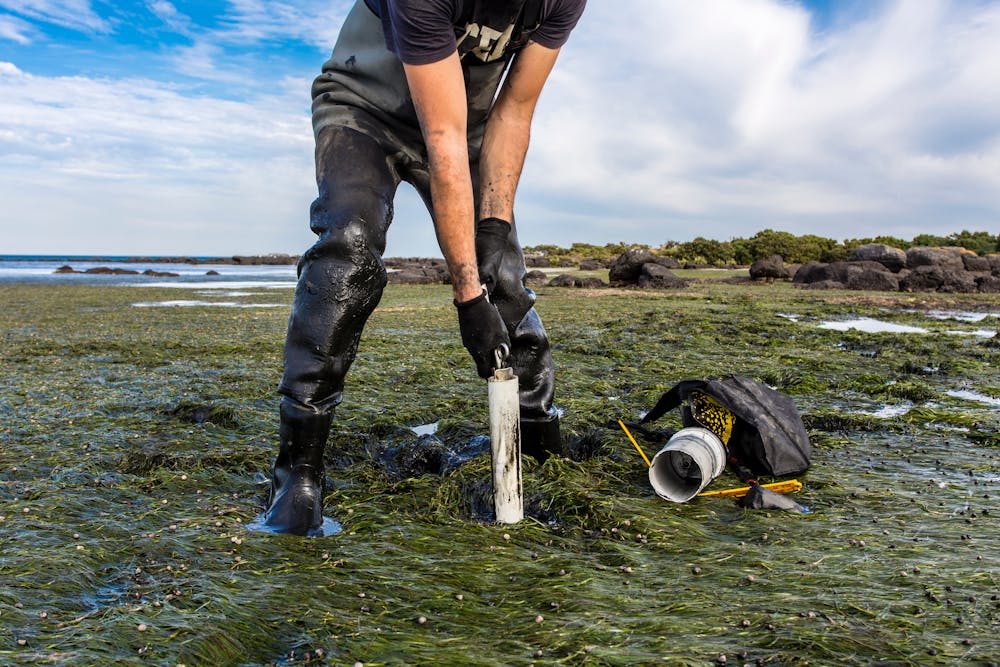
Collecting a sediment core to assess carbon sequestration rates in the sediment of a tidal seagrass bed. I. Noyan Yilmaz/Shutterstock
Blue carbon ecosystems can help countries meet their climate obligations and have been attracting considerable interest. However, if nations want these ecosystems to continue to provide a whole range of services our governments must protect them and, where possible, restore lost habitats.
Most governments have been stubbornly slow to prioritise ocean-based solutions high up on the agenda of global climate negotiations. At this conference, I’ve heard more people, including Unesco’s director general Audrey Azoulay, driving home the need to protect and effectively manage our ocean resources.
Members from the traditional owners of the Great Barrier Reef spoke of “country” from a perspective of a long and sustained human relationship with nature and are intimately connected to the ocean. There is a growing recognition and respect for this indigenous knowledge and our need to integrate that into a sustainable ocean future.
Reimagining the ocean’s role
It makes sense to start by protecting these natural systems that already hold vulnerable stores of carbon – this is sensible risk management.
As nations continue to exploit the marine environment for fishing, fossil fuels and even precious metals which are now being mined from the sea floor in certain places, it is time to rethink the value of these vast natural stores of ocean carbon.
Space science gets way more funding than our oceans, yet vast areas of the global deep ocean remain largely unmapped. “Life below water” is by far the least funded of the UN’s 17 Sustainable Development Goals. That needs to change through a sustained and increased investment in ocean science and greater recognition for the value of our blue economy – defined by the UN as the sustainable use of the ocean’s resources for economic growth, improved livelihoods and jobs.
Stepping back to pause and preserve what already exists in the ocean can help the planet, and us, build resilience and create a healthier and more sustainable marine environment. The seabed forms the foundation for an interconnected ocean ecosystem and acts as an important long-term global sink for carbon that involves the whole ocean and its exchanges with the atmosphere and wider Earth system.
While plans are finally moving in the right direction, there are huge challenges ahead. To paraphrase Cynthia Barzuna, director of ocean action 2030 at the World Resources Institute, “there is no wealthy ocean without a healthy ocean”. The biggest takeaway from the Barcelona conference is that a sustainable ocean future depends on a shared vision that works for all of us and marine life too.
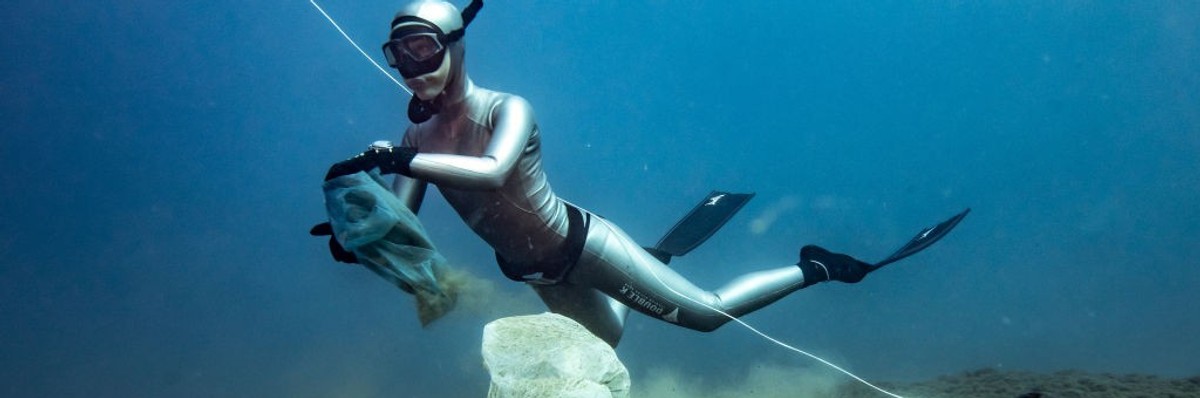
A diver removes plastic waste from the sea floor in Hatay, Turkey on December 2, 2022. (Photo: Sebnem Coskun/Anadolu Agency via Getty Images)
“Every minute, a garbage truck’s worth of plastic enters the ocean,” researchers said.
The amount of plastic waste littering the Earth’s ocean floors could be up to 100 times the quantity floating on the surface, according to a study published this week.
Researchers at the Commonwealth Scientific and Industrial Research Organization (CSIRO)—an Australian government agency—and the University of Toronto in Canada found that up to 11 million tons of plastic are polluting the planet’s ocean floors, including microplastics and larger objects like fishing nets, cups, and bags.
“We know that millions of tons of plastic waste enter our oceans every year but what we didn’t know is how much of this pollution ends up on our ocean floor,” CSIRO senior research scientist and study co-author Denise Hardesty said in a statement. “We discovered that the ocean floor has become a resting place, or reservoir, for most plastic pollution, with between 3 to 11 million tons of plastic estimated to be sinking to the ocean floor.”
"Every minute, a garbage truck's worth of plastic enters the ocean."
Study leader Alice Zhu, a doctoral candidate at the University of Toronto, said that “the ocean surface is a temporary resting place of plastic so it is expected that if we can stop plastic entering our oceans, the amount would be reduced.”
“However, our research found that plastic will continue to end up in the deep ocean,” Zhu stated. “These findings help to fill a longstanding knowledge gap on the behavior of plastic in the marine environment.”
“Understanding the driving forces behind the transport and accumulation of plastic in the deep ocean will help to inform source reduction and environmental remediation efforts, thereby reducing the risks that plastic pollution may pose to marine life,” she added.
The study is part of CSIRO’s Ending Plastic Waste program, whose goal is “an 80% reduction in plastic waste entering the Australian environment by 2030.”
Humans produce approximately 440 million tons of plastics annually, or roughly the combined weight of every person on the planet. Plastic pollution harms not only the environment and ecosystems, but also human health and economies.
Plastic use is expected to double by 2040. Negotiations on a global plastics treaty have made little progress amid lobbying by the fossil fuel and petrochemical industries.

 Activists from Ocean Rebellion with a large sculptural bottom trawling fishing boat on the banks of the river Clyde, as Glasgow prepared for the Cop26 summit, October 30, 2021