Nayib Bukele’s El Salvador Dictatorship: Made in Israel

Spread the love

Original article by Alan Macleod republished from MPN under a Creative Commons Attribution-NonCommercial-ShareAlike 3.0 International License.

Nayib Bukele may be Palestinian, but the dictatorship he has built in El Salvador is very much made in Israel. From arming his security forces to supplying him with weapons and high-tech surveillance tools, MintPress explores the Israeli influence helping to prop up the man who calls himself “the world’s coolest dictator.”

Arming a Dictatorship

Since Bukele’s ascension to the presidency in 2019, Israeli exports to El Salvador have been rapidly advancing, growing at an annual rate of more than 21%. This increase consists primarily of weapons. Salvadoran forces are well supplied with Israeli hardware. The military and police use the Israeli-made Galil and ARAD 5 rifles, the Uzi submachine gun, numerous Israeli pistols, and ride in AIL Storm and Plasan Yagu armored vehicles.

Some equipment Salvadoran forces use comes free, courtesy of Israeli sources. In 2019, an Israeli NGO, the Jerusalem Foundation (a group that builds illegal settlements on Palestinian land), announced that it would donate $3 million worth of supplies to the Salvadoran police and military.

For others, however, the Bukele administration is paying top dollar, meaning that this relationship is extremely profitable for the high-tech Israeli defense sector.

In 2020, the Salvadoran police paid around $3.4 million for one year’s use of three Israeli spyware products. These tools include GEOLOC, a program that intercepts calls and texts from targeted phones, and Web Tangles, which uses individuals’ social media accounts to build up files on people, including using their photos for facial recognition. A third, Wave Guard Tracer (marketed in some regions as Guardian), tracks users’ movements through the GPS on their phone.

Perhaps the most notorious piece of spyware used, however, is Pegasus, developed by the NSO Group, an outgrowth of the Israeli Defense Forces’ Unit 8200. The app hit the headlines in 2022, when it was revealed that repressive governments the world over had used it to surveil thousands of public figures, including kings, presidents, politicians, activists, and reporters. El Salvador was one of the most heavily penetrated nations.  A report from Citizen Lab found that the Bukele administration was using it to secretly monitor dozens of public figures critical of the president, including 22 journalists from the independent outlet El Faro.

Incarceration Nation

Bukele has used these Israeli tools and weapons to crack down on dissent and opposition to his rule. Since 2022, when he declared a State of Exception, suspending rights and civil liberties, he has imprisoned at least 85,000 people, a staggering figure for such a small country. Today, around 2% of the adult population — along with over 3,000 children — languish behind bars in dangerously overcrowded jails.

The most well-known of these is the Terrorism Confinement Center (Centro de Confinamiento del Terrorismo, or CECOT), which is by far and away the largest prison in world history. Built to incarcerate over 40,000 people, it is to this center that the Trump administration has been sending migrants rounded up by ICE. In a meeting with Bukele in the Oval Office, President Trump stated that U.S. nationals would be sent there next.

El Salvador holds vastly more people in prisons per capita than any other country, and conditions are among the worst in the world. Food is sparse, lights are kept on 24 hours a day, and cells are frequently packed with more than 100 occupants. Those incarcerated at CECOT are allowed no contact with the outside world, not even with their families or lawyers.

Often, the first thing a Salvadoran family hears about their disappeared relative is news that he died while incarcerated. Torture is commonplace. Osiris Luna, the director of El Salvador’s prison system, has even been sanctioned by the U.S. government for his role in “gross human rights abuses.”

Bukele has justified the mass imprisonment of his countrymen as a necessary step to break the power of organized gangs and drug cartels. Yet a significant portion of those held are his political opponents. Among those detained are union leaders, politicians, and human rights defenders.

Facing the threat of imprisonment or other punishment, El Faro has moved its operations to neighboring Costa Rica.

A Palestinian Who Loves Israel

Amid the chaos, Bukele has fired tens of thousands of public service workers and reduced taxes on the business community. He has also reoriented El Salvador’s foreign policy from a progressive, anti-imperialist stance to allying itself with right-wing governments around the world, including Israel.

Despite coming from a prominent Palestinian family that emigrated from Jerusalem in the early 20th century, throughout his political career, he has made a point of vocally supporting Israel, its culture, and its foreign policy. As far back as 2015, when he was Mayor of San Salvador, the Israeli Embassy had identified him as a “partner for cooperation.”

Three years later, in February 2018, he visited Israel on a trip organized by Deputy Minister for Foreign Affairs, Tzipi Hotovely, and American Jewish Congress President, Jack Rosen. There, he participated in a security conference attended by Prime Minister Benjamin Netanyahu and President Reuven Rivlin, and made a public appearance at the Western Wall.

https://cdn.iframe.ly/api/iframe?_showcaption=false&app=1&url=https%3A%2F%2Fwww.instagram.com%2Fp%2FBfEiHGhHVEz%2F&key=bab15327a66f873fa9c0d80b90a8205a

In the wake of the October 7 assault, Bukele voiced his support for Israel and condemnation of Hamas. “As a Salvadoran of Palestinian ancestry, I’m sure the best thing that could happen to the Palestinian people is for Hamas to completely disappear,” he wrote, describing Hamas as “savage beasts” and comparing them to MS-13, one of El Salvador’s most violent gangs.

El Salvador is home to a large Palestinian population; some 100,000 live in the small country. And yet, the Central American nation is far from a stronghold of support for anti-colonial struggles. Palestinians in El Salvador have generally done very well and entered society’s upper echelons. Bukele is actually the third Palestinian to become president.

Historically, the Latin American business community has sided with conservative or reactionary forces, and the Palestinian diaspora has shied away from supporting resistance movements in the Middle East.

“Bukele’s culture is not so much Palestinian as it is neo-fascist. That’s his culture. So he is going to identify with repressive governments around the world,” Roberto Lovato, a Salvadoran-American writer and professor at the University of Nevada, Las Vegas, told MintPress News.

The country is also home to a large and active evangelical Christian community, for whom Israel’s rise is a key issue. Despite being the son of the country’s most notable imam — one who claimed his son is a practicing Muslim — Bukele has positioned himself as a Christian conservative, and his evangelical supporters say he was chosen by God to rid the nation of gang violence. “I believe in God, in Jesus Christ. I believe in His word, I believe in His word revealed in the Holy Bible,” he said.

Dirty Wars and Dirty Politics

The connections between Israel and El Salvador, however, predate Bukele by decades. During the 1970s and 1980s, the country was a hotspot in the Cold War, and U.S.-backed death squads battled the leftist FMLN rebels. The military regime killed around 75,000 civilians in a dirty war that scars the region to this day. The violence was so extreme and so well-publicized that even the United States sought to distance itself from it. Into that void stepped Israel, providing 83% of El Salvador’s military needs from 1975 to 1979, including napalm. In return, El Salvador moved its embassy to Jerusalem, legitimizing Israel’s claim to the city.

Lovato, a former member of the FMLN, told MintPress that the country was turned into a “laboratory for repression.”

During the Civil War, the U.S. government aligned a whole panoply of different practitioners of torture and mass murder. You had trainers from Taiwan, Israel, and other countries going to El Salvador to train the Salvadoran government to do what they had learned how to do.”
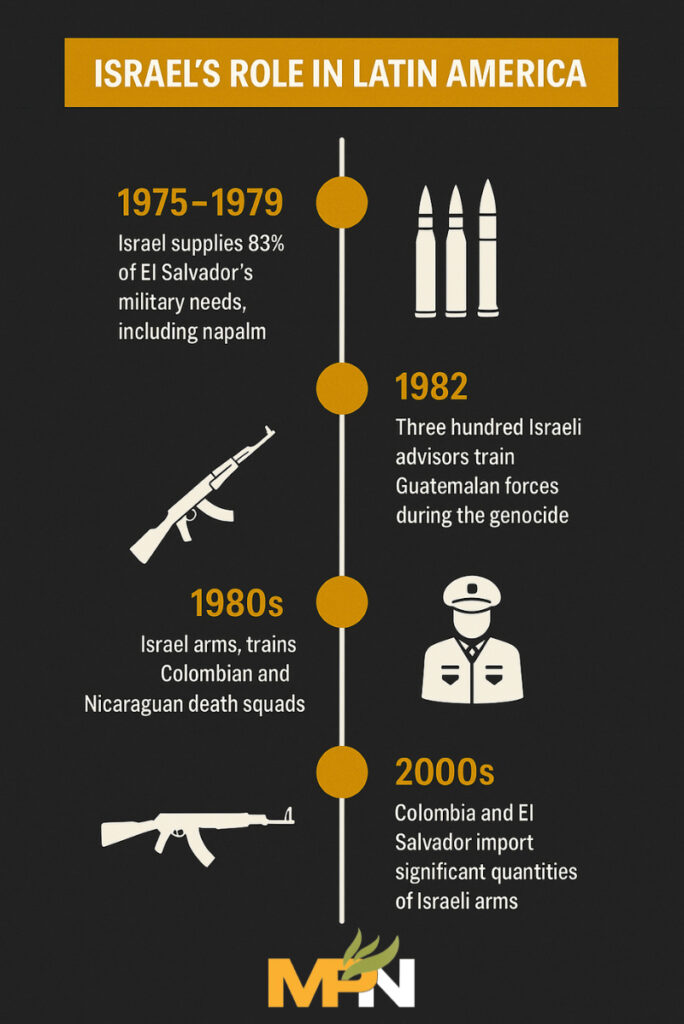
Timeline infographic showing Israel’s military and intelligence support to Latin American regimes from the 1970s to the 1990s, including Guatemala, Colombia, Chile, Argentina, and El Salvador.

One of the most notable individuals who received Israeli training was Major Roberto D’Aubuisson, leader of a far-right death squad. D’Aubuisson is known to have ordered the assassination of Archbishop Oscar Romero. Nicknamed “Blowtorch Bob” for his penchant for using the tool on his opponents’ genitals, his death squad is thought to have killed some 30,000 people, many of whom were tortured to death. Thus, it is no stretch to say that El Salvador’s repressive state apparatus has long been sustained by Israeli money, tech, and know-how.

But this is far from an isolated example. Indeed, Israel has supplied weapons and training to repressive governments around the world, honing the skills acquired suppressing the Palestinian population and taking them global.

In Guatemala, Israel sold planes, armored personnel carriers and rifles to the military, and even built them a domestic ammunition factory. General Efraín Ríos Montt thanked Israel for its participation in a coup that brought him to power in 1982, stating that it went so smoothly “because many of our soldiers were trained by Israelis.” Around 300 Israeli advisors worked to train Ríos Montt’s forces into genocidal death squads who systematically killed over 200,000 Mayans. A sign of the deep connections between the two groups is that Ríos Montt’s men began referring to the indigenous Mayans as “Palestinians” during their attacks.

It is a similar story in Colombia, where the country’s most notorious death squads were trained by Israeli operatives, such as General Rafael Eitan. To this day, Colombian police and military make extensive use of Israeli weaponry. So normalized has the Israeli influence become in Colombian society that, in 2011, sitting President Juan Manuel Santos appeared in an advertisement for Israeli mercenary firm Global CST. “They are people with a lot of experience. They have been helping us to work better,” he stated.

Israel also armed and supported the military dictatorships of Chile and Argentina in the 1970s and 1980s, even as the latter explicitly targeted over 1,000 Jews in the largest slaughter of Jews since the Holocaust.

In Nicaragua, Israel supplied the Somoza dictatorship, helping it carry out a dirty war. In Rwanda, it sold weapons to the Hutu government as it was carrying out a genocide against the Tutsi population. Israeli weapons were used by Serbia during the Yugoslav civil war in the 1990s. And successive administrations in Tel Aviv also helped sustain the Apartheid government of South Africa, sending it weapons and sharing intelligence with it.

Therefore, it should come as little surprise that Bukele’s administration has sought and established such close ties to the Israeli government. These weapons and techniques, honed on the Palestinian population, are going global, helping a government thousands of miles away crack down on civil liberties. While Bukele — a Palestinian — is very much in charge of El Salvador, it is clear that his dictatorship has a distinct Israeli flavor.

Feature photo | Illustration by MintPress News

Alan MacLeod is Senior Staff Writer for MintPress News. He completed his PhD in 2017 and has since authored two acclaimed books: Bad News From Venezuela: Twenty Years of Fake News and Misreporting and Propaganda in the Information Age: Still Manufacturing Consent, as well as a number of academic articles. He has also contributed to FAIR.orgThe GuardianSalonThe GrayzoneJacobin Magazine, and Common Dreams. Follow Alan on Twitter for more of his work and commentary @AlanRMacLeod.

Original article by Alan Macleod republished from MPN under a Creative Commons Attribution-NonCommercial-ShareAlike 3.0 International License.

Climate Science Denier Donald Trump says Burn, Baby, Burn.
Elon Musk urges you to be a Fascist like him, says that you can ignore facts and reality then.

Continue ReadingNayib Bukele’s El Salvador Dictatorship: Made in Israel

Wiz Acquisition Puts Israeli Intelligence In Charge of Your Google Data

Spread the love

Original article by Alan Macleod republished from MPN under a Creative Commons Attribution-NonCommercial-ShareAlike 3.0 International License.

Google recently announced it would acquire Israeli-American cloud security firm Wiz for $32 billion. The price tag — 65 times Wiz’s annual revenue — has raised eyebrows and further solidified the close relationship between Google and the Israeli military.

In its press release, the Silicon Valley giant claimed that the purchase will “vastly improve how security is designed, operated and automated—providing an end-to-end security platform for customers, of all types and sizes, in the AI era.”

Yet it has also raised fears about the security of user data, particularly of those who oppose Israeli actions against its neighbors, given Unit 8200’s long history of using tech to spy on opponents, gather intelligence, and use that knowledge for extortion and blackmail.

Israel’s Global Spy Network

Wiz was established only five years ago, and all four co-founders — Yinon Costica, Assaf Rappaport, Ami Luttwak, and Roy Reznik — were leaders in Israel’s elite military intelligence unit, Unit 8200. Like many Israeli tech companies, Wiz is a direct outgrowth of the military intelligence outfit. A recent study found that almost fifty of its current employees are Unit 8200 veterans.

“That experience showed me the impact you can make when you combine great talent with amazing technology,” Rappaport said of his time in the military.

Former Unit 8200 agents, working hand-in-glove with the Israeli national security state, have gone on to produce many of the world’s most infamous malware and hacking tools.

Perhaps the most well-known of these is Pegasus, spyware used by governments around the world to surveil and harass political opponents. These include India, Kazakhstan, the UAE, and Saudi Arabia, the latter of which used the tool to spy on Washington Post journalist Jamal Khashoggi before he was assassinated by Saudi agents in Türkiye.

In total, more than 50,000 journalists, human rights defenders, diplomats, business leaders and politicians are known to have been secretly surveilled. That includes heads of state such as French President Emmanuel Macron, Pakistani Prime Minister Imran Khan and Iraqi President Barham Salih. All Pegasus sales had to be approved by the Israeli government, which reportedly had access to the data Pegasus’ foreign customers were accruing.

Unit 8200 also spies on Americans. Whistleblower Edward Snowden revealed that the National Security Agency regularly shared the data and communications of U.S. citizens with the Israeli intelligence group. “I think that’s amazing…It’s one of the biggest abuses we’ve seen,” he said.

For the Israeli government, the utility of these private spying firms filled with former IDF intelligence figures is that it allows it some measure of plausible deniability when confronted with spying attacks. As Haaretz explained: “Who owns [these spying companies] isn’t clear, but their employees aren’t soldiers. Consequently, they may solve the army’s problem, even if the solution they provide is imperfect.”

Today, former Unit 8200 agents not only create much of the world’s spyware, but also the security features that claim to protect against unwanted surveillance. A MintPress investigation found that three of the six largest VPN companies in the world are owned and controlled by an Israeli company co-founded by a Unit 8200 veteran.

Exposed: How Israeli Spies Control Your VPN

How Unit 8200 Controls Palestinians

It is in Palestine, however, that Unit 8200 has been most active. The unit serves as the centerpiece of Israel’s hi-tech repressive state apparatus. Using gigantic amounts of data compiled on Palestinians by tracking their every move through facial recognition cameras, monitoring their calls, messages, emails and personal data, Unit 8200 has created a digital dragnet that it uses to snoop on, harass, and suppress Palestinians.

It compiles dossiers on virtually every Gaza resident, including their medical history, sex lives, and search histories, so that this information can be used for extortion or blackmail later. If, for example, an individual is cheating on their spouse, desperately needs a medical operation, or is secretly homosexual, this can be used as leverage to turn civilians into informants and spies for Israel.

One former Unit 8200 operative said that as part of his training, he was assigned to memorize different Arabic words for “gay” so that he could listen for them in phone conversations he was eavesdropping on.

Unit 8200 is also reportedly behind the even more controversial Project Lavender, a giant, AI-generated kill list of tens of thousands of Gazans that the IDF uses to target the densely populated strip’s civilian population.

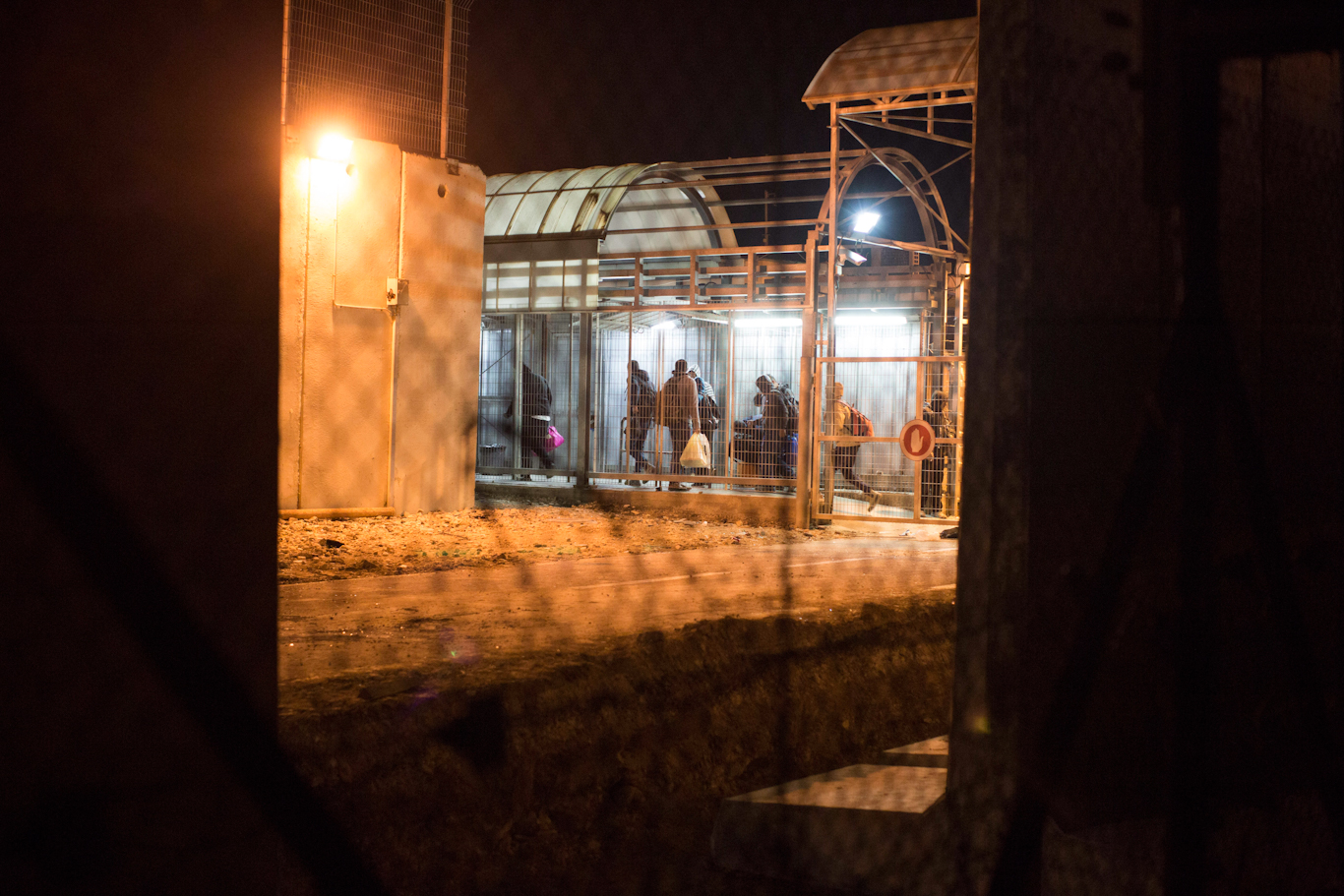
Palestanian workers cross the Eyal checkpoint into Israel under the watchful eye of IDF cameras, January 10, 2021. Keren Manor | Activestills

Every Gazan (including children) is assigned a score of 1-100, based on their perceived proximity to Hamas. A wide range of characteristics will increase an individual’s score, including living or working in the same building or being in a WhatsApp group with a known or suspected Hamas member.

If a person’s number reaches a certain threshold, they are automatically added to a Unit 8200 kill list. This, one IDF commander explained, solved Israel’s perennial targeting “human bottleneck,” allowing them to carry out tens of thousands of strikes into Gaza during the first few weeks of the post-October 7 attack alone.

Unit 8200 is also widely reported to have carried out the Lebanon Pager Attack, exploding thousands of electronic devices at the same time, killing dozens and injuring thousands more. The operation was widely described, even by former CIA director Leon Panetta, as an act of terrorism.

This long history of violence, skulduggery, and spying raises troubling questions about whether a corporation founded and staffed by dozens of individuals from such an organization can be trusted with billions of users’ private and personal data.

Google’s Ties to Israeli Intelligence

Google’s purchase of Wiz deepens its already close ties to Unit 8200. In 2013, the tech giant acquired Waze, an online maps service founded by three Unit 8200 veterans, for $1.3 billion. It has also directly hired dozens of former spooks and spies to fill its ranks; a 2022 MintPress News investigation found at least 99 former Unit 8200 agents working at the Silicon Valley behemoth.

Among these figures is Gavriel Goidel, Head of Strategy and Operations for Google Research. Goidel joined Google in 2022 after a six-year career in military intelligence, during which he rose to become Head of Learning at Unit 8200. There, he led a large team of operatives who sifted through intelligence data to “understand patterns of hostile activists,” according to his own account.

Google is far from an outlier when it comes to hiring former Israeli spies to carry out its operations. Facebook, Microsoft, and Amazon have all hired a significant number of ex-Unit 8200 agents. Even TikTok, supposedly a hotbed of anti-Semitism, employs a considerable number of ex-spooks. Perhaps most surprisingly, a number of top U.S. media outlets, including CNN and Axios, have recruited former Unit 8200 spies and analysts to write and produce America’s news about the Middle East.

Revealed: The Israeli Spies Writing America’s News

Google has invested heavily in Israel, first opening offices there in 2006. Longtime CEO Eric Schmidt is known to be a vocal supporter of the controversial state. In a 2012 meeting with Prime Minister Benjamin Netanyahu, he declared that “the decision to invest in Israel was one of the best that Google has ever made.”

But the Wiz deal is undoubtedly the company’s biggest Israeli investment yet. The all-cash acquisition represents a massive injection of money into Israel’s flailing and war-weary economy, equivalent to 0.6% of the country’s GDP. The money, the Israeli press excitedly reports, will allow the government to continue without enacting major austerity measures, reduce the nation’s deficit, and enable Israel to continue on a wartime footing for longer. As such, it represents a move critics say amounts to a financial intervention on behalf of Israel. Moreover, it also sends a message to the rest of the business world to invest in the country, boosting investor sentiment at a time when it is most needed.

The size of the deal also surprised many. The price is similar to that of the sale of JPMorgan Chase and Wells Fargo in 2008, Visa Europe in 2017, and Twitter in 2022. Yet Wiz is a new and relatively unknown company, raising questions about its valuation.

Ultimately, though, these considerations are secondary to the main issue that such a group will now be charged with providing security for the data of billions of users worldwide. Given Unit 8200’s role in monitoring and targeting the Palestinian population, many will be wondering if, going forward, Google products are at all safe to use.

Feature photo | Illustration by MintPress News

Alan MacLeod is Senior Staff Writer for MintPress News. After completing his PhD in 2017 he published two books: Bad News From Venezuela: Twenty Years of Fake News and Misreporting and Propaganda in the Information Age: Still Manufacturing Consent, as well as a number of academic articles. He has also contributed to FAIR.orgThe GuardianSalonThe GrayzoneJacobin Magazine, and Common Dreams.

Original article by Alan Macleod republished from MPN under a Creative Commons Attribution-NonCommercial-ShareAlike 3.0 International License.
Continue ReadingWiz Acquisition Puts Israeli Intelligence In Charge of Your Google Data

Amnesty Details ‘Shocking’ Allegations of India Targeting Reporters With Pegasus Spyware

Spread the love

Original article by JULIA CONLEY republished from Common Dreams under Creative Commons (CC BY-NC-ND 3.0). 

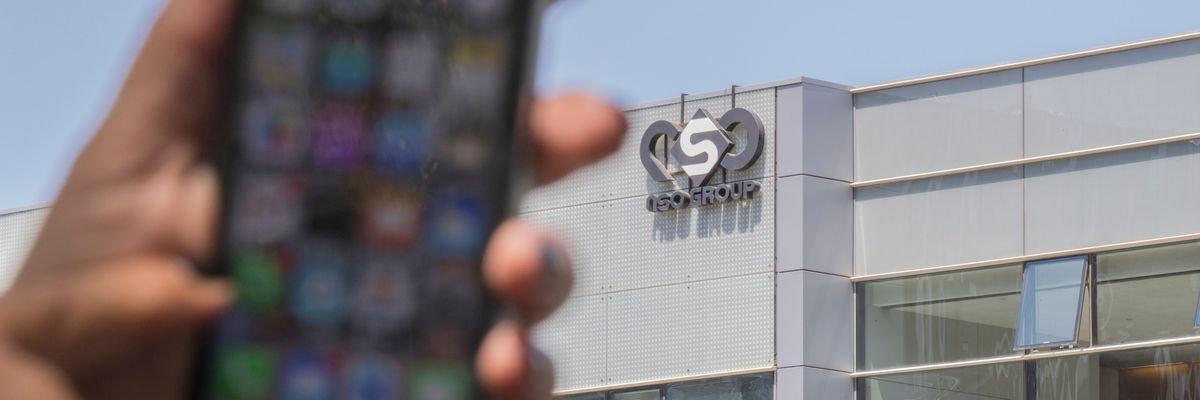
A woman uses an iPhone in front of the building of the NSO Group, developer of the spyware Pegasus, on August 28, 2016, in Herzliya, Israel. (Photo: Jack Guez/AFP via Getty Images)

“Increasingly, journalists in India face the threat of unlawful surveillance simply for doing their jobs,” said one advocate.

Amnesty International on Thursday demanded transparency from the Indian government regarding its contracts with surveillance companies, including the Israeli firm NSO Group, after the rights organization joined The Washington Post in publishing what it called “shocking new details” about the use of spyware to target journalists in India.

Amnesty’s Security Lab revealed that a round of “state-sponsored attacker” notifications that were sent to Apple customers in October by the tech company went to more than 20 Indian journalists including Siddharth Varadarajan, founding editor of The Wire, and Anand Mangnale, South Asia editor at the Organized Crime and Corruption Report Project (OCCRP).

The Security Lab ran a forensic analysis of the two reporters’ devices and found evidence that the NSO Group’s highly invasive Pegasus spyware, which is capable of eavesdropping on phone calls and harvesting data, had been installed on phones owned by Varadarajan and Mangnale.

In Mangnale’s case, the journalist appeared to have received a “zero-click exploit” via iMessage on August 23, allowing the individual or group who sent it to covertly install Pegasus spyware on his phone without requiring Mangnale to take any action, such as clicking a link.

At the time of the attempted attack, said Amnesty, Mangnale was working on a story about alleged stock manipulation by a major Indian multinational firm with ties to Indian Prime Minister Narendra Modi. The journalist told Agence France Presse that his phone was targeted “within hours” of his sending interview questions to the company.

The timing of the attack—and the fact that NSO Group has said it only licenses Pegasus to governments and security agencies—was “a hell of a coincidence,” Mangnale said.

“Targeting journalists solely for doing their work amounts to an unlawful attack on their privacy and violates their right to freedom of expression,” said Donncha Ó Cearbhaill, head of Amnesty’s Security Lab. “All states, including India, have an obligation to protect human rights by protecting people from unlawful surveillance.”

The Indian government was previously accused of targeting journalists, opposition politicians, and activists with Pegasus in 2021, when leaked documents showed the spyware had attacked more than 1,000 phone numbers.

India has fallen 21 spots to 161 out of 180 countries in Reporters Without Borders’ World Press Freedom Index since Modi took office in 2014. In addition to the alleged use of spyware by the government, journalists have been arrested and detained while covering anti-government protests, and reporters have been targeted by coordinated social media campaigns inciting hatred and violence.

Varadarajan was the subject of an earlier report by Amnesty, which documented how he had previously been targeted by Pegasus spyware in 2018.

This past October the same email address used in the Pegasus attack on Mangnale was identified on Varadarajan’s phone, confirming he was targeted again.

Varadarajan toldThe Washington Post that at the time of the most recent covert spyware installation, he had been leading public opposition to the detention of a news publisher in New Delhi.

“Our latest findings show that increasingly, journalists in India face the threat of unlawful surveillance simply for doing their jobs, alongside other tools of repression including imprisonment under draconian laws, smear campaigns, harassment, and intimidation,” said Ó Cearbhaill.

The group called for the Indian Supreme Court to immediately release the findings of a technical committee report on Pegasus, which was completed in 2022 but has still not been made public.

“Despite repeated revelations,” said Ó Cearbhaill, “there has been a shameful lack of accountability about the use of Pegasus spyware in India which only intensifies the sense of impunity over these human rights violations.”

Original article by JULIA CONLEY republished from Common Dreams under Creative Commons (CC BY-NC-ND 3.0). 

Continue ReadingAmnesty Details ‘Shocking’ Allegations of India Targeting Reporters With Pegasus Spyware