Original article by BRETT WILKINS republished from Common Dreams under Creative Commons (CC BY-NC-ND 3.0).
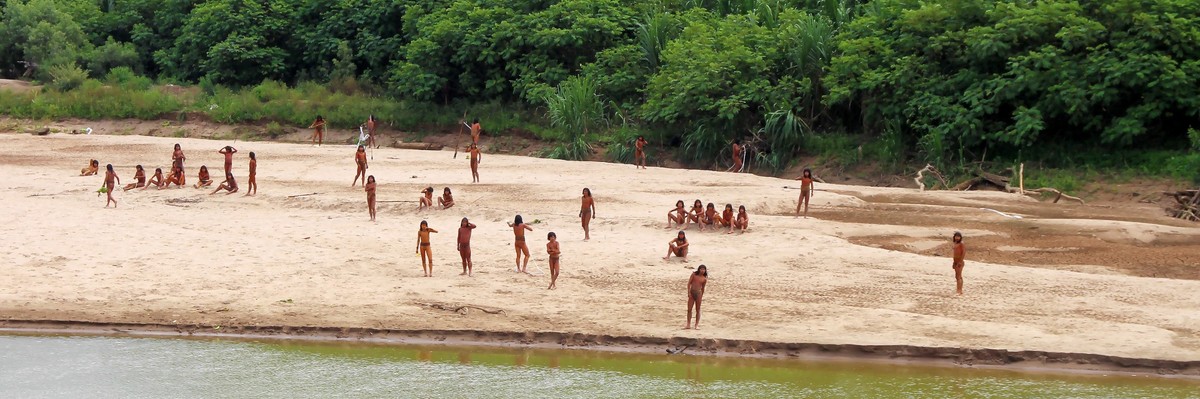
“This is a humanitarian disaster in the making—it’s absolutely vital that the loggers are thrown out, and the Mashco-Piro’s territory is properly protected at last,” said the director of Survival International.
A leading rights group on Tuesday called for loggers to be “thrown out” of a remote part of the Peruvian Amazon following recent sightings of people belonging to what is believed to be the world’s largest uncontacted Indigenous tribe.
London-based Survival International published video and photos of dozens of Mashco-Piro people taken near the village of Monte Salvado in southeastern Peru near the Brazilian border. The group said that in recent days, more than 50 Mashco-Piro have appeared near the village, which is inhabited by the related Yine people. A group of 17 Mashco-Piro were also recently sighted near the neighboring village of Puerto Nuevo.
Several logging companies are operating within just a few miles of where the Mascho-Piro were spotted. One company operating inside Mashco-Piro territory, Canalaes Tahuamanu, has laid more than 120 miles of road there to facilitate timber extraction. The company is certified by the Forest Stewardship Council as a sustainable and ethical operator, even though it is known to be felling trees inside Mashco-Piro territory. Survival International is calling on the FSC to withdraw its certification.
“This is a humanitarian disaster in the making—it’s absolutely vital that the loggers are thrown out, and the Mashco-Piro’s territory is properly protected at last,” Survival International director Caroline Pearce said in a statement Tuesday. “The FSC must cancel its certification of Canales Tahuamanu immediately—failure to do so will make a mockery of the entire certification system.”
Alfredo Vargas Pio, president of the local Indigenous group Native Federation of the Río Madre and its Tributaries, called the new photographs “irrefutable evidence that many Mashco-Piro live in this area, which the government has not only failed to protect, but sold off to logging companies.”
“The logging workers could bring in new diseases which would wipe out the Mashco-Piro, and there’s also a risk of violence on either side,” he added, “so it’s very important that the territorial rights of the Mashco-Piro are recognized and protected in law.”
In 2014, Peruvian authorities evacuated residents from Monte Salvado by boat after around 200 Mashco-Piro armed with bows and arrows raided the village, killing livestock and pets and taking food and tools. In 2022, Mashco-Piro members killed 21-year-old Peruvian logger Gean del Aguila and wounded another man with arrows as they fished on the Tahuamanu River.
In the 1890s most Mashco-Piro were either enslaved or exterminated by private mercenaries hired by self-described Peruvian “Rubber King” Carlos Fitzcarrald—immortalized in the 1982 Werner Herzog film Fitzcarraldo. Surviving Mashco-Piro fled deeper into the Amazon and avoided contact with most outsiders. They fiercely defended their territory from intruders. However, in recent decades, loggers have penetrated and exploited Mascho-Piro lands.
There are believed to be more than 750 Mascho-Piro living in Peru. They sometimes cross the border into Brazil.
“They flee from loggers on the Peruvian side. At this time of the year they appear on the beaches to take tracajá eggs,” Rosa Padilha of the Indigenous Missionary Council in the Brazilian state of Acre told The Guardian, referring to a species of Amazon turtle.
“That’s when we find their footprints on the sand. They leave behind a lot of turtle shells,” Padilha added. “They are a people with no peace, restless, because they are always on the run.”
Around 15 other uncontacted Indigenous tribes with as many as 15,000 members are believed to remain in the Peruvian Amazon. It is illegal to make contact with such peoples for fear they would contract common human illnesses that could be fatal to unexposed populations without immunity.
Original article by BRETT WILKINS republished from Common Dreams under Creative Commons (CC BY-NC-ND 3.0).
- Oil Firms And Loggers ‘Push Indigenous People To Brink Of Extinction’ ›
- As Rivers Run Black In Peru, Indigenous Tribes Left Cleaning Big Oil’s Disaster ›
- Brazilian Indigenous Activists Join Peruvian Comrades Fighting ‘Genocide Bill’ ›
- ‘This Land Is Our Life’: Indigenous Shipibo-Konibo-Xetebo People Defend Forest From Illegal Destruction In Peru ›
- After Years Of Indigenous-Led Campaigning, Court Grants Rights To Peru’s Marañón River ›