Labelling the Palestinian resistance: Political propaganda or legal classification?

Spread the love

This work by Middle East Monitor is licensed under a Creative Commons Attribution-NonCommercial-ShareAlike 4.0 International License.

People, holding flags and banners, gather to demand sanctions against Israel during pro-Palestinian protest and march through the city’s streets in Melbourne, Australia on August 24, 2025. [Recep Sakar – Anadolu Agency]

The dominant narrative in the West portrays the Islamic Resistance Movement – Hamas – as a “terrorist group”, uncritically repeating the rhetoric of Israel and its allies. However, when analysing the issue from the perspective of international law and the history of national liberation movements, it is clear that the “terrorism” label is more a tool of political propaganda than a legal definition.

In light of international law and the United Nations Charter, Hamas should be understood as a Palestinian resistance movement in the face of more than seven decades of Israeli colonisation, ethnic cleansing, and military occupation. This also includes almost two years of uninterrupted confrontation with genocide in the Gaza Strip.

The United Nations (UN) has never declared Hamas a terrorist group. Only a few countries, such as the United States, the European Union, Canada, the United Kingdom, and Australia, have unilaterally adopted this classification. International law, in turn, does not criminalise resistance against occupation.

Since 1967, Israel has maintained its occupation of the Gaza Strip, the West Bank, and East Jerusalem, in flagrant violation of the UN Charter and Security Council resolutions. According to International Humanitarian Law, peoples subjected to foreign occupation have the legitimate right to resist, including by armed means, against the occupying power.

This principle is supported by Article 51 of the UN Charter, as well as Resolutions No. 2649/1970, 2787/1971, 3070/1973, and 3103/1974, which explicitly recognise the inalienable right of peoples to fight against colonial domination, foreign occupation, and apartheid. Furthermore, the Geneva Conventions of 1949 and the Additional Protocols of 1977, along with the practice of the International Criminal Court (ICC), distinguish between armed resistance and terrorism.

Ceasefire intransigence: Palestinian prisoners and Israeli reluctance

Therefore, the existence of an armed struggle against occupation does not constitute terrorism, but rather a legitimate exercise of resistance.

Founded in 1987 during the First Intifada, Hamas is not just an armed group; it is also a political, social, and religious movement deeply rooted in Palestinian society.

Its surprising victory in the 2006 legislative elections, which were recognised as free and democratic by international observers, demonstrates its popular representation. It won 76 of the 132 seats, while its main rival, Yasser Arafat’s Fatah, won 43 seats.

Over the decades, Hamas has administered social institutions, hospitals, schools, and assistance programmes, playing a similar role to liberation movements in Algeria (FLN), Vietnam (Viet Minh), or South Africa (ANC), all of which were also labelled terrorists at some point in history. Today, many of these movements are recognised as legitimate builders of their national states.

The classification of Hamas as “terrorist” serves the clear objectives of Israeli policy: To silence the debate on occupation, apartheid, and genocide, diverting attention from the root cause of the conflict; to justify massive attacks against civilians in Gaza, presented as “the fight against terrorism”; to criminalise all forms of Palestinian resistance, whether armed or peaceful – from NGOs to journalists and students.

Judith Butler, an American philosopher from the University of Berkeley, observes that armed resistance under occupation cannot be reduced to terrorism, as this ignores the structural causes of violence: colonialism, supremacism, and military occupation.

Since 2007, Israel has imposed a land, air, and sea blockade on the Gaza Strip, which the UN classifies as collective punishment – a practice prohibited by international law. Millions of Palestinians live without freedom of movement, drinking water, electricity, and medicines. With each Israeli offensive, thousands of civilians are massacred, homes and hospitals are destroyed, and entire neighbourhoods are razed.

The current scenario of indiscriminate attacks on hospitals, schools, and refugee camps is described by international law experts and UN rapporteurs as ongoing genocide, due to the scale of the destruction and the explicit intention to expel or exterminate the original Palestinian population of Gaza.

“Greater Israel”: A huge challenge to Arab national security

In the face of this reality, Hamas’s armed resistance should be understood not as terrorism, but as the exercise of a people’s right to self-defence under occupation and ethnic cleansing. The Palestinian struggle is, in essence, a struggle for physical and cultural survival in the face of a colonial project to eliminate all forms of life in Palestine.

The framing of Hamas as a terrorist group is a political construct of Israel and its Western allies, without a basis in international law. Palestinian resistance, whether armed or not, is recognised as legitimate by the UN, the BRICS countries, and international treaties whenever it is intended to confront foreign occupation and colonial oppression.

Calling Hamas “terrorist” is an attempt to delegitimise the struggle of a people seeking freedom, justice, and self-determination. The truth is that Israel, as the occupying power, systematically violates international law, practices apartheid, and commits war crimes and crimes against humanity.

Hamas is an integral part of the Palestinian resistance and must be understood as a national liberation movement, not as terrorism. Recognising this fact is a fundamental step towards a fair and honest reading of the conflict and for seeking a solution based on historical truth, justice, and the right of peoples to self-determination.

The views expressed in this article belong to the author and do not necessarily reflect the editorial policy of Middle East Monitor.

Keir Starmer objects to criticism of the IDF. He asks how could anyone object to them starving people to death, forced marches like the Nazis did, bombing Gaza's hospitals and universities,mass-murdering journalists, healthworkers and starving people queuing for food, killing and raping prisoners and murdering children. He calls for people to stop obstructing his genocide for Israel.
Keir Starmer objects to criticism of the IDF. He asks how could anyone object to them starving people to death, forced marches like the Nazis did, bombing Gaza’s hospitals and universities,mass-murdering journalists, healthworkers and starving people queuing for food, killing and raping prisoners and murdering children. He calls for people to stop obstructing his genocide for Israel.
UK Labour Party government ministers Keir Starmer, Angela Rayner and Rachel Reeves explain that they are partners complicit in Israel's Gaza genocide. The UK has provided Israel with arms, military and air force support. They explain that they don't do gas chambers but do do forced marches, starvation, destroy hospitals, mass-murders of journalists and healthcare workers.
UK Labour Party government ministers Keir Starmer, Angela Rayner and Rachel Reeves explain that they are partners complicit in Israel’s Gaza genocide. The UK has provided Israel with arms, military and air force support. They explain that they don’t do gas chambers but do do forced marches, starvation, destroy hospitals, mass-murders of journalists and healthcare workers.
Experiencing issues with this image not appearing. I suspect because it's so critical of Zionist Keir Starmer's support of and complicity in Israel's genocides.
Genocide denier and Current UK Prime Minister Keir Starmer is quoted that he supports Zionism without qualification. He also confirms that UK air force support has been essential in Israel’s mass-murdering genocide. Includes URLs https://www.declassifieduk.org/keir-starmers-100-spy-flights-over-gaza-in-support-of-israel/ and https://youtu.be/O74hZCKKdpA
Continue ReadingLabelling the Palestinian resistance: Political propaganda or legal classification?

Trump 2.0: the rise of an ‘anti-elite’ elite in US politics

Spread the love
Elon Musk urges you to be a Fascist like him, says that you can ignore facts and reality then.

William Genieys, Sciences Po and Mohammad-Saïd Darviche, Université de Montpellier

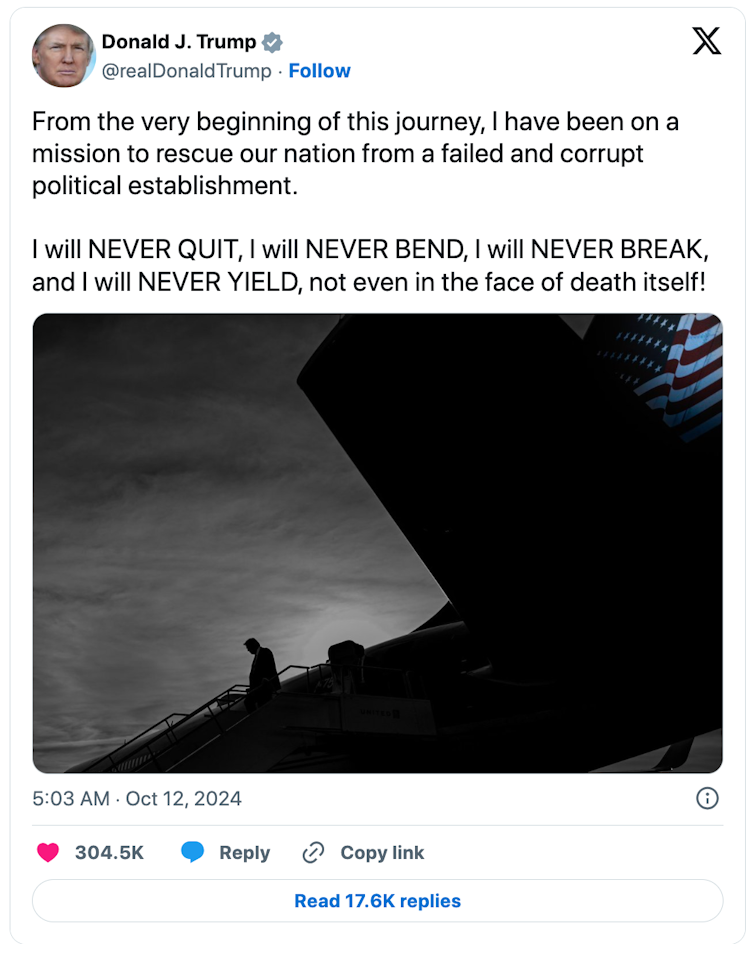
US president Donald Trump is surrounded by a new cohort of politicians and officials. While one of his campaign promises was to overthrow the “corrupt elites” he accuses of flooding the American political arena, his second term in office has elevated elites chosen, above all, for their political loyalty to him.

The media’s focus on Trump’s comments on making Canada the 51st US state and annexing Greenland and billionaire Elon Musk’s support for some far-right parties in Europe has obscured the ambitious programme to transform the federal government that the new political elite intends to implement.

In the wake of Trump’s inauguration on January 20, the Republican elites most loyal to the MAGA (“Make America Great Again”) leader, who staunchly oppose Democratic elites and their policies, are operating amid their party’s control over the executive and legislative branches (at least until the midterm elections in 2026), a conservative-dominated Supreme Court that includes three Trump-appointed justices, and a federal judiciary that shifted right during his first term.

However, the political project of the Trumpist camp consists less of challenging elitism in general than attacking a specific elite: one particular to liberal democracies.

Castigating democratic elitism

Typical anti-elite political propaganda, along the lines of “I speak for you, the people, against the elites who betray and deceive you,” claims that a populist leader would be able to exercise power for and on behalf of the people without the mediation of an elite disconnected from their needs.

Political theorist John Higley sees behind this form of anti-elite discourse an association between so-called “forceful leaders” and “leonine elites” (who take advantage of the former and their political success): a phenomenon that threatens the future of Western democracies.

Since the Second World War, there has been a consensus in US politics on the idea of democratic elitism. According to this principle, elitist mediation is inevitable in mass democracies and must be based on two criteria: respect for the results of elections (which must be free and competitive); and the relative autonomy of political institutions.

The challenge to this consensus has been growing since the 1990s with the increased polarization of American politics. It gained new momentum during and after the 2016 presidential campaign, which was marked by anti-elite rhetoric from both Republicans and Democrats (such as senators Bernie Sanders and Elizabeth Warren). At the heart of some of their diatribes was an aversion to “the Establishment” on the east and west coasts of the United States, where many prestigious financial, political and academic institutions are based, and the conspiracy notion of the “deep state”.

The re-election of Trump, who has never admitted defeat in the 2020 presidential vote, growing political hostility and the direct involvement of tech tycoons in political communication –especially on the Republican side– further reinforce the denial of democratic elitism.

Trump’s populism from above: a revolt of the elites

The idea that democracy could be betrayed by “the revolt of the elites”, put forward by the US historian Christopher Lasch (1932-1994), is not new. For the anthropologist Arjun Appadurai, it is a particular feature of contemporary populism, which comes “from above.” Indeed, if the 20th century was the era of the “revolt of the masses”, the 21st century, according to Appadurai, “is characterized by the ‘revolt of the elites’.” This would explain the rise of populist autocracies (such as those currently led by Viktor Orban in Hungary, Recep Tayyip Erdogan in Turkey and Narendra Modi in India, and formerly led by Jair Bolsonaro in Brazil), but also the election successes of populist leaders in consolidated democracies (including those of Trump in the US, Giorgia Meloni in Italy, and Geert Wilders in the Netherlands, for example).

As Appadurai explains, the success of Trumpian populism, which represents a revolt by ordinary Americans against the elites, casts a veil over the fact that, following Trump’s victory in November, “it is a new elite that has ousted from power the despised Democratic elite that had occupied the White House for nearly four years.”

The aim of this “alter elite” is to replace the “regular” Democrat elites, but also the moderate Republicans, by deeply discrediting their values (such as liberalism and so-called “wokeism”) and their supposedly corrupt political practices. As a result, this populism “from above” carried out by the President’s supporters constitutes an alternative elite configuration, the effects of which on American democratic life could be more significant than those observed during Trump’s first term.

Beyond the idea of a ‘Muskoligarchy’

The idea that we are witnessing the formation of a “Muskoligarchy” –in other words, an economic elite (including tech barons such as Jeff Bezos, Mark Zuckerberg and Marc Andreessen) rallying around the figurehead of Elon Musk, whom Trump asked to lead what the president has called a “Department of Government Efficiency” (DOGE) –is seductive. It perfectly combines the vision of an alliance between a “conspiratorial, coherent, conscious” ruling class and an oligarchy made up of the “ultra-rich”. For the Financial Times columnist Martin Wolf, it is even a sign of the development of “pluto-populism”. (It is also worth noting that former president Joe Biden, in his farewell speech, referred to “an oligarchy… of extreme wealth” and “the potential rise of a tech-industrial complex.”)

However, some observers are cautious about the advent of a “Muskoligarchy.” They point to the sociological eclecticism of the new Trumpian elite, whose facade of unity is held together above all by a political loyalty, for the time being unfailing, to the MAGA leader. The fact remains, however, that the various factions of this new “anti-elite” elite are converging around a common agenda: to rid the federal government of the supposed stranglehold of Democratic “insiders.”

An ‘anti-elite’ elite against the ‘deep state’

In his presidential inauguration speech in 1981, Ronald Reagan said: “Government is not the solution to our problem; government is the problem.” The anti-elitism of the Trump elite is inspired by this diagnosis, and defends a simple political programme: rid democracy of the “deep state.”

Although the idea that the US is “beleaguered” by an “unelected and unaccountable elite” and “insiders” who subvert the general interest has been shown to be unfounded, it is nonetheless predominant in the new Trump Administration.

This conspiracy theory has been taken to the extreme by Kash Patel, the candidate being considered to head the FBI. In his book, Government Gangsters, a veritable manifesto against the federal administration, the former lawyer writes about the need to resort to “purges” in order to bring elite Democrats to justice. He lists around 60 people, including Biden, ex-secretary of state Hillary Clinton and ex-vice president Kamala Harris.

Government Gangsters, Kash Patel’s controversial book. Google Books

The appointment of Russell Vought as head of the Office of Management and Budget at the White House, a person who is known for having sought to obstruct the transition to the Biden Administration in 2021, also highlights the hard turn that the Trump administration is likely to take.

Reshaping the state around political loyalty

To “deconstruct the administrative state”, the “anti-elite” elites are relying on Project 2025, a 900-plus page programme report that the conservative think-tank The Heritage Foundation, which published it, says was produced by “more than 400 scholars and policy experts.” According to former Project 2025 director Paul Dans, “never before has the entire movement… banded together to construct a comprehensive plan” for this purpose. On this basis, the “anti-elite” elite want to impose loyalty to Project 2025 on federal civil servants.

But this idea is not new. At the end of his first term, Trump issued an executive order facilitating the dismissal of statutory federal civil servants occupying “policy-related positions” and considered to be “disloyal”. The decree was rescinded by president Biden, but Trump on his first day back in office signed an executive order that seeks to void Biden’s rescindment. As President, Trump is also able to allocate senior positions within the federal administration to his supporters.

The “anti-elite” elite not only want to reduce the size of the state, as was the case under Reagan’s “neoliberalism”, but to deconstruct and rebuild it in their own image. Their real aim is a more lasting victory: the transformation of democratic elitism into populist elitism.

William Genieys, Directeur de recherche CNRS au CEE, Sciences Po and Mohammad-Saïd Darviche, Maître de conférences, Université de Montpellier

This article is republished from The Conversation under a Creative Commons license. Read the original article.

Continue ReadingTrump 2.0: the rise of an ‘anti-elite’ elite in US politics