Analysis of Major Polls Shows Trump’s War on Iran Is Historically Unpopular

Spread the love

Original article by Brad Reed republished from Common Dreams under Creative Commons (CC BY-NC-ND 3.0).
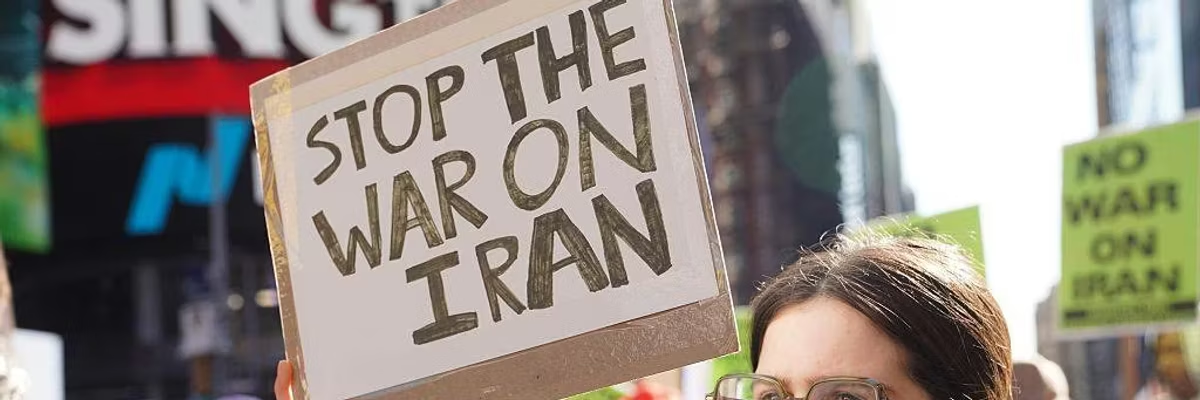
People attend a protest against US-Israeli attacks on Iran in New York on February 28, 2026. (Photo by Zhang Fengguo/Xinhua via Getty Images)

“Not merely negative-number-so-what unpopular, but worst-ever-support-for-war-when-it-started unpopular.”

President Donald Trump’s unprovoked and unconstitutional war against Iran is historically unpopular among US voters.

In an analysis published Friday, polling expert G. Elliott Morris calculated an average of eight high-quality polls conducted over the last week about the war and found just 38% of Americans approve of the military strikes against Iran, while 49% are opposed.

RECOMMENDED…
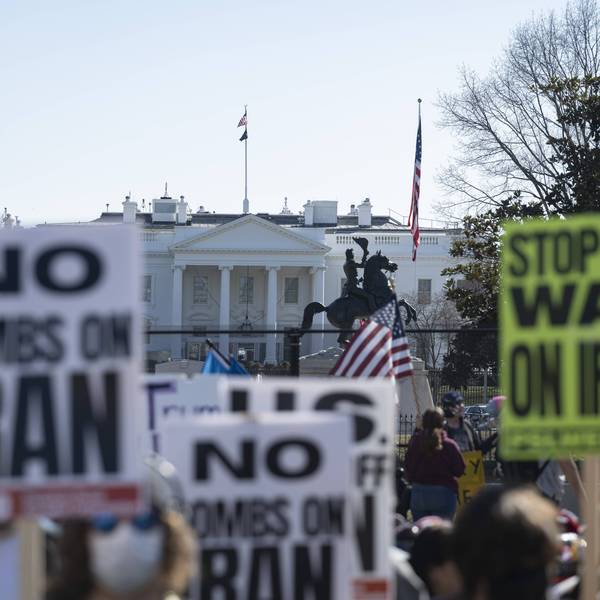
Protesters rally outside White House against US and Israeli strikes on Iran

Only 25% of Americans Support Trump Attack on Iran: Poll

US-POLITICS-CONGRESS-DEMOCRATS

As Trump Marches US Toward Iran War, Critics Ask: Where’s the ‘Pushback’ From Dems and Media?

Morris noted that there is simply no precedent for a US war being this unpopular from the very outset.

“The big takeaway from these numbers is that the new war in Iran is very unpopular,” he wrote. “Not merely negative-number-so-what unpopular, but worst-ever-support-for-war-when-it-started unpopular. With just 38% of Americans in favor, support for bombing Iran is lower than retrospective support for the war in Iraq was in 2014.”

Morris then offered some comparisons to past US military conflicts to show that the lack of support for Trump’s Iran war is simply in uncharted territory.

“No president in modern polling history has launched a major military operation with the public already against him,” he wrote. “After the September 11 attacks, a November 2001 Gallup poll found 90% of Americans approved of military action in Afghanistan, with just 5% opposed. The Gulf War in 1991 hit 79-80% approval. Gallup measured 76% support for the invasion of Iraq in March 2003 (Pew had it at 71%).”

Even comparatively unpopular operations, such as Trump’s strikes against Syria in 2017 or former President Barack Obama’s 2011 military operation in Libya, still had net-positive approvals at the times they occurred.

Morris added that Trump should be concerned about this because historically “wars only get less popular” over time as “casualties mount and costs become clear.”

CBS News polling director Anthony Salvanto on Tuesday also highlighted this phenomenon when analyzing a poll on the Iran war commissioned by his network that showed US voters’ support for the conflict dropped precipitously the longer they believed it would last.

“If you think it’s going to be a long conflict, months, even years… the numbers tilt toward disapproval overall,” he said.

Trump so far has not offered any kind of timeline for his war against Iran, and Politico reported on Wednesday that the US military is preparing for the conflict to last until at least September.

Trump on Friday insisted he would not end the conflict with Iran until its government offered its “unconditional surrender.”

Original article by Brad Reed republished from Common Dreams under Creative Commons (CC BY-NC-ND 3.0).

Orcas discuss Donald Trump and the killer apes' concept of democracy. Front Orca warns that Trump is crashing his country's economy and that everything he does he does for the fantastically wealthy.
Orcas discuss Donald Trump and the killer apes’ concept of democracy. Front Orca warns that Trump is crashing his country’s economy and that everything he does he does for the fantastically wealthy.
Donald Trump warns against following the https://onaquietday.org blog, says that it's easy atm, she only needs to report war crimes supporting Israel's genocidal expansion.
Donald Trump warns against following the https://onaquietday.org blog, says that it’s easy atm, she only needs to report war crimes supporting Israel’s genocidal expansion.
Orcas discuss rotting brain. Front Orca says "Wish someone would lock him up".
Orcas discuss rotting brain. Front Orca says “Wish someone would lock him up”.

Continue ReadingAnalysis of Major Polls Shows Trump’s War on Iran Is Historically Unpopular

Netanyahu Renewed Gaza Slaughter to Save His Own Hide

Spread the love

Original article by James Zogby republished from Common Dreams under Creative Commons (CC BY-NC-ND 3.0).

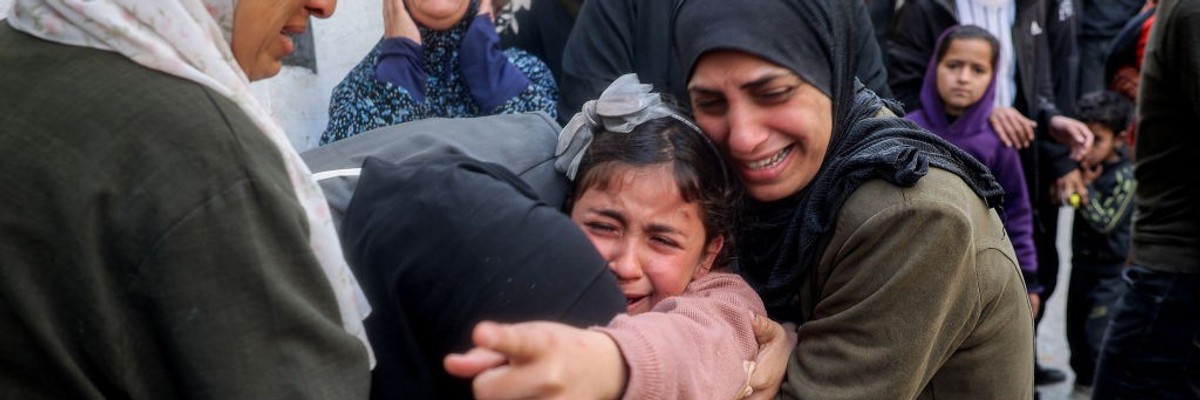
The young sister (C) mourns for her siblings and other members from the Abu al-Rous family who were killed when their house was hit by Israeli bombardment, during the funeral at the Bureij camp for Palestinian refugees in the central Gaza Strip on March 25, 2025. Israel, vowing to destroy Palestinian militant group Hamas, on March 18 resumed intense bombardment of Gaza and redeployed ground troops, shattering a truce that had largely held since January 19. (Photo by EYAD BABA/AFP via Getty Images) Photo by Eyad BABA / AFP

While the Israeli leader claims that his goal is the elimination of Hamas, the evidence is clear that his real intention is to save himself and his government—and in this he has had a willing accomplice.

When the Israeli Knesset passed its 2025 budget this past week, the government of Prime Minister Benjamin Netanyahu breathed a sigh of relief. Had the budget not been approved by March 31, the Knesset would have been automatically disbanded, and new elections would have been called. Polls indicate that Netanyahu and his coalition would have decisively lost.

What saved Netanyahu was his renewed war in Gaza.

The negotiations over a ceasefire in Gaza had resulted in the desertion of one of his coalition partners and the alienation of some members of his own party, putting his government at risk. Once the ceasefire was announced, Netanyahu’s problems grew. His trial on charges of corruption and abuse of his office was once again centerstage as were his Trump-like theatrics in response to the grilling he received from the prosecutors. Also plaguing Netanyahu were reports of his government’s failures emanating from the ongoing investigation into the October 7th Hamas attack.

With his coalition hemorrhaging and his personal position weakening, renewing the war in Gaza provided Netanyahu with a way out. His coalition was restored. His budget was passed. He had a distraction from his trial. His cabinet approved his decision to remove the head of Israel’s domestic intelligence agency who was faulting him for the October 7th attack. And he was in a position to once again advance his legislative efforts to “reform” what he views as the obstacles presented by Israel’s pesky judiciary.

Further compounding Netanyahu’s dilemma were the expectations created once the implementation of the ceasefire agreement began. The world witnessed the powerfully moving scenes of hundreds of thousands of Palestinians trekking northward to return to their demolished homes and communities in the north of Gaza. Compassion grew for Palestinians as did revulsion for the gratuitous devastation wrought by Israel’s bombardments.

There were other factors that weighed heavily on Netanyahu in this period.

Hamas, as expected, overplayed their hand with disgraceful scenes of bravado during each of the hostage releases. Most likely done out of a need to demonstrate control, their behavior was stupid and provocative, especially in the face of the enormity of the suffering endured by their people. One might reasonably ask Hamas’ leadership, “How many times can you foolishly kick the hornets’ nest before you understand the consequences of your actions?”

Gaza’s Palestinians, who our polling establishes have long had unfavorable views toward Hamas, are now demonstrating their anger at both Israel and Hamas. But the last thing Netanyahu wants is an alternative Palestinian leadership in Gaza, as that would threaten his continuation of the conflict and his rule.

The ceasefire agreement of January 19th included three phases, with the second and third phases ultimately leading to an Israeli withdrawal from Gaza and an end to the war. As the negotiations themselves had already cost Netanyahu coalition partners, he promised his allies that he would never allow the process to get to phase two. As a result, early in the implementation of phase one, Netanyahu began seeking an escape, claiming that Hamas was violating the terms of the agreement and pressing unacceptable demands that he sought to add to the first phase.

Then came the Arab peace plan to end the conflict. The plan, which would fulfill phase three of the ceasefire agreement, called for an Israeli withdrawal from Gaza, the positioning of an Arab/international peacekeeping force, the establishment of Palestinian governance linked to the Palestinian Authority, and a plan to reconstruct Gaza. This Arab plan has won broad international support and, if adopted, would have spelled the end of Netanyahu’s reign in Israel.

In the face of all these challenges, Netanyahu felt compelled to break the ceasefire. The renewed campaign has been a ruthless continuation of genocide. For one month now, Israel has withheld entry of all aid and medical personnel from the north of Gaza, implementing what was once termed “the General’s plan” of starving the Palestinians in that area, forcing them to leave. The Israelis have also continued their bombing campaign, taking the lives of hundreds. They have retaken areas of Gaza, promising to annex them to Israel, and are exploring plans to forcibly evict Palestinians from Gaza to both sabotage any effort to allow for Palestinian governance and facilitate Israel’s conquest and annexation of more of Gaza’s land.

While Netanyahu claims that his goal is the elimination of Hamas, the evidence is clear that his real intention is to save himself and his government—and in this he has had a willing accomplice. The Trump administration has supported Israel’s trashing the very ceasefire agreement Trump once boasted as his personal diplomatic victory.

And so here we are, a little over two months after the announced ceasefire and Palestinians are once again victims of slaughter and mass starvation. Instead of being an agreement that would lead to an end of the conflict, the ceasefire, as I feared, turned out to be nothing more than a pause or a cruel ruse that was sacrificed on the altar of Netanyahu’s political survival.

There are no good guys to this story, only Palestinian victims. As tens of thousands of Israelis are demonstrating in opposition to Netanyahu because he is risking the lives of Israeli hostages still held in Gaza, it is time for Arabs to unite in defense of the Palestinian people and their own peace plan to end the genocide.

Original article by James Zogby republished from Common Dreams under Creative Commons (CC BY-NC-ND 3.0).

Experiencing issues with this image not appearing. I suspect because it's so critical of Zionist Keir Starmer's support of and complicity in Israel's genocides.
Genocide denier and Current UK Prime Minister Keir Starmer is quoted that he supports Zionism without qualification. He also confirms that UK air force support has been essential in Israel’s mass-murdering genocide. Includes URLs https://www.declassifieduk.org/keir-starmers-100-spy-flights-over-gaza-in-support-of-israel/ and https://youtu.be/O74hZCKKdpA
UK Foreign Minister David Lammy confirms that UK government and military are active participants in Israel’s genocides and that the F-35 parts that they suspended from supplying to Israel are instead simply diverted via the United States. He says see https://youtu.be/QILgUHrdWRE
Continue ReadingNetanyahu Renewed Gaza Slaughter to Save His Own Hide

Support for separation at four-year high as SNP rebound in polls

Spread the love

https://morningstaronline.co.uk/article/support-for-separation-at-four-year-high-as-snp-rebound-in-polls

People take part in a Believe in Scotland march and rally in Edinburgh, September 2, 2023

SNP is on course to retain power in Holyrood as support for independence hit a four-year high of 54 per cent, according to a new poll.

Despite a year which has seen their former chief executive facing charges related to embezzlement, the loss of a leader, a coalition with the Greens and 38 seats at the general election, research since Wednesday’s draft budget suggests the SNP are on course to win 37 per cent of constituency votes and 32 per cent on the regional lists at the next Holyrood elections in 2026.

Writing in the Sunday Times — which commissioned the Norstat poll — expert Sir John Curtice suggests this would give SNP 59 seats in Holyrood, as Labour plunge to a new low of 20, and Reform win 13.

https://morningstaronline.co.uk/article/support-for-separation-at-four-year-high-as-snp-rebound-in-polls

Continue ReadingSupport for separation at four-year high as SNP rebound in polls

Will abandoning left-wing voters backfire for Keir Starmer?

Spread the love

Original article by Paul Rogers republished from Open Democracy under a Creative Commons Attribution-NonCommercial 4.0 International licence

Labour leader’s reluctance to differ from Tories on policy or Gaza sets stage for progressive independent candidates

Keir Starmer has moved Labour to the right – leaving left-wing voters without a political home  | Belinda Jiao/Getty Images

Almost all of Britain’s pollsters agree: the Labour Party is heading for a massive victory in this year’s general election, while Rishi Sunak’s Tories are set for a historic defeat. But there is another, far less talked about shift underway, which could see a wave of independent left-wing MPs elected.

Most polling firms expect Labour to win a majority of more than a hundred seats. A ‘poll of polls’ by political forecasting website Electoral Calculus suggests the party is on course for a 200+ majority.

These polls could all be wrong, but little seems to shake them. There is some evidence, though, of another trend that is yet to be reflected in the polls: Keir Starmer’s unwillingness to set out any clear policy differences from the Conservatives may be backfiring.

One area likely to cause the Labour leader trouble is his position – or lack thereof – on Israel’s war on Gaza.

Several polls in recent months have indicated that around 70% of people in the UK want an immediate ceasefire, and there are weekly demonstrations in towns and cities across the country in support of Palestinians. Organisers of a march in London last week estimated that up to 400,000 people had gathered to demand an end to the violence.

These protests receive minimal coverage in the mainstream media, bar senior Conservatives labelling the peaceful crowds as ‘hate mobs’. The government maintains strong support for Israel, continuing to sell arms and share intelligence with the country, as well as allowing it to use RAF Akrotiri in Cyprus as a support base – a position Labour has largely agreed with.

This leaves a huge gap in political representation, at least from the biggest two parties, for swathes of people nationwide.

It was in this opening that former Labour MP George Galloway – who was kicked out of the party in the 2000s after objecting to the UK entering the Iraq war – was elected as an independent MP for Rochdale last month, following a campaign that centred the need for a ceasefire in Gaza.

Another gap in political representation has been created by Starmer’s remodelling of the Labour Party, which has been sanitised to ensure it poses little or no threat to the political establishment. The majority of his policies so far appear to be a continuation of the status quo, suggesting little will change if the party wins the forthcoming election.

In contrast, so bold and progressive were the policies of his predecessor, Jeremy Corbyn, that the higher echelons of the Labour Party and the wider political and media establishment were determined to get rid of him from the offset.

A leadership challenge was mounted against him in the summer of 2016, little over a year after he was elected the party’s leader. Corbyn won comfortably – a fact I found unsurprising, having seen first-hand how he could pull a crowd of more than a thousand people to a hurriedly arranged event half a mile from a city centre.

Internal party opposition to Corbyn surged following his re-election, again backed by the mainstream media. When then Tory prime minister Theresa May called an election in 2017, many anticipated she would win a landslide victory that would consign ‘Corbynism’ to the outer margins.

Instead, Corbyn and his Labour manifesto struck a chord with many voters. Labour gains resulted in a hung parliament, to the horror of the political establishment, which worked to eliminate this threat from the left over the following two years.

After Labour lost the 2019 general election, Corbyn resigned and Starmer moved the party rightwards – prompting tens of thousands of its members to desert it as a result. Their votes are now up for grabs, and left-wing independents are hoping to win them.

Take a meeting in London just last weekend, scarcely reported on except by socialist paper The Morning Star. Two hundred of Labour’s former parliamentary candidates, councillors and supporters gathered to develop an alternative to its current stance on Gaza and other issues.

A sense of the mood at the event was best summed up by Tyneside’s independent socialist mayor Jamie Driscoll, who quit Labour after the party decided not to select him to run again for the north-east mayoral election in May.

In a video message played at the meeting, Driscoll said: “In the next election, both parties will have the same manifesto and the same rich donors pulling the strings.”

similar event is planned in Blackburn next month – just one part of a much wider movement that will likely see independent left-wing candidates standing against Labour candidates in many seats in the general election.

This is already being seen in England’s upcoming local council elections, where clusters of non-party, progressive candidates are working together in many parts of the country. In Blackburn, for example, every ward will have an independent left-wing candidate standing, as will all six wards in Dewsbury, West Yorkshire. Early indications suggest similar trends in Merseyside and parts of London.

The accepted political wisdom in the UK is that once a general election is called, voters tend to revert to the usual pattern of voting. But if independent candidates were to pick up substantial numbers of votes in the local elections, even taking some council seats, it could indicate a political shift that means this wisdom will not apply this year.

This may seem unlikely but there is undeniably a political vacuum waiting to be filled – and a sense that something is afoot in British politics that is simply not being recognised.

Original article by Paul Rogers republished from Open Democracy under a Creative Commons Attribution-NonCommercial 4.0 International licence

Status Quo, again and again and again and again
Continue ReadingWill abandoning left-wing voters backfire for Keir Starmer?

These bombshell new polls are among the worst yet for the Tories

Spread the love

https://leftfootforward.org/2023/09/these-bombshell-new-polls-are-among-the-worst-yet-for-the-tories/

UK Prime Minister Rishi Sunak and former Energy Security and Net Zero Secretary Grant Shapps.
Prime Minister Rishi Sunak and former Energy Security and Net Zero Secretary Grant Shapps. Credit: Simon Dawson / 10 Downing Street, CC BY-NC-ND 2.0

This would be an unprecedented wipeout

Tory polling woes continue this week. Three new polls have indicated Rishi Sunak’s party are on track to be obliterated at the next general election.

Polling firm Redfield and Wilton has Labour currently sitting on a healthy 18 point lead over the Tories. The company’s latest poll has Labour on 44%, the Tories on 26%, the Lib Dems on 14%, Reform on 6% and the Greens on 6%.

Polling aggregator Stats for Lefties has projected that if this were repeated in a general election, the Tories would be left with just 109 seats. Labour would have a stonking majority, bagging 426 seats.

That would be bad enough for the Tories. But another poll is even more damning. The latest poll from Ipsos gives Labour an even bigger lead of 20 points – with Labour on 44%, the Tories 24%, the Lib Dems 12%, the Greens 8% and Reform 4%.

Projecting what that might look like at the next general election (thanks to Stats for Lefties again) would see the Tories down to double digits of MPs. Labour would end up on 461 seats, with the Tories way behind on 72.

https://leftfootforward.org/2023/09/these-bombshell-new-polls-are-among-the-worst-yet-for-the-tories/

Continue ReadingThese bombshell new polls are among the worst yet for the Tories