Independent Exclusive: Energy minister Miatta Fahnbulleh confirmed her department has assessed the impact the policy change will have on pensioners living in fuel poverty, but said only that it will be published ‘in due course’
The government has assessed the number of people who will be pushed into fuel poverty by its winter fuel payment cuts, but will not publish the figures until after MPs vote on the measure, The Independent can reveal.
But, asked by Mr McDonnell and The Independent, the Department for Energy Security and Net Zero refused to say when the document would be published, only promising that it would be “in due course”.
Her answer suggests that while the department has carried out the analysis, it will not be published until after MPs have voted on the measure. Mr McDonnell said “it is no way to implement policy” and he is “fearful of the impact on those who will be put at serious risk”.
The left-wing MP told Lewis Goodall on LBC that he will not vote for the changes if there is no adjustment before they are put before Parliament.
Mr McDonnell said: “I will vote against it. We’ve had 14 years of austerity I don’t think my community can cope with it anymore.
“My fear is, as a result of this, there will be more deaths.”
On the policy, Mr McDonnell added: “It’s the wrong route to go down – it will disillusion people. This is not what a Labour government should be doing I’m afraid.
“My fear is there may be other austerity measures coming down the track”.
Take the Labour Government’s decision to means-test winter fuel payments. Over nine million pensioners, including many on just £12,000 a year, will lose help as we head into the cold months. Some will be forced to turn down the heating. Cold homes are linked to higher rates of strokes, heart attacks and respiratory diseases, so this policy could have fatal consequences.
That harm is entirely avoidable. These are not “tough choices” for politicians, but for those forced to choose between heating their homes and eating. Maintaining universal winter fuel payments costs £1.4 billion. Meanwhile, a modest two per cent wealth tax on assets over £10 million could raise £24 billion, more than enough to fund winter fuel payments, scrap the two-child benefit cap and support public sector workers whose wages have stagnated for over a decade.
The false narrative that resources are too limited to support both the elderly and the young pits us against each other. Within a few weeks in office, the new Labour Government has already denied help to all children with more than one sibling, and now to older people too. The Prime Minister talks about growth, but the only thing that is growing so far is avoidable poverty. No child should be born into poverty due to an arbitrary limit on family support, just as no pensioner should freeze because of arbitrary means-testing. There is still time to change course and not go ahead with this.
The government can’t cure the lethal consequences of deprivation by increasing deprivation. Eligibility for the payment will be linked to pension credit, but experts say that this will see 1.6 million pensioners who are below the poverty line lose vital financial support during the coldest months. With a majority of 167, the government will comfortably win Tuesday’s vote on the issue. However, it has lost the argument, largely because ministers seem incapable of making a coherent case for their policy.
The risible claim that there would be a “run on the pound” if there were not spending cuts was dismissed in the City. Ministers then said that they want to increase pension credit uptake – currently 880,000 eligible people do not claim it – but many are put off by the 243 questions that need to be answered in the application form. Sir Keir argues that the losses would be offset by rises in the state pension. But that won’t wash with many pensioners who know such increases were coming anyway and have been less than impressed by Labour discarding its social care commitments.
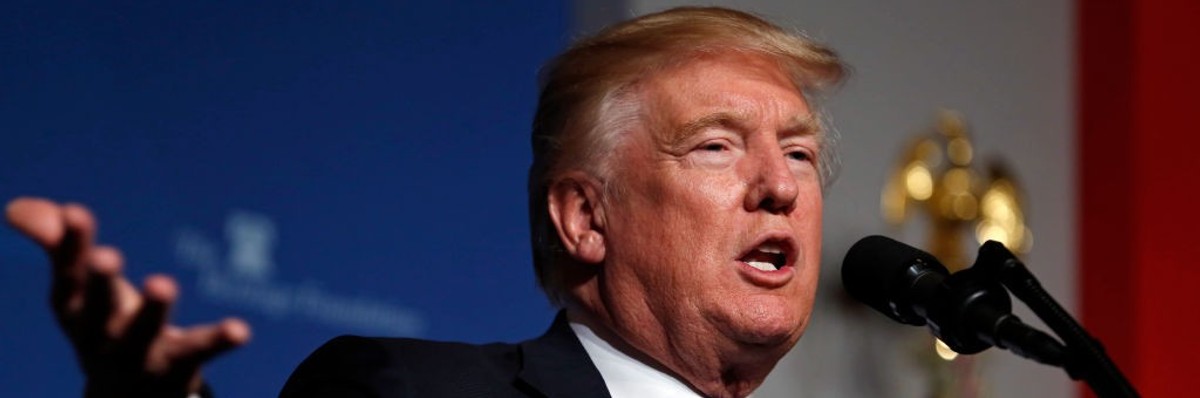
Then-President of the United States Donald Trump speaks at a Heritage Foundation meeting in 2017. (Photo: Martin H. Simon – Pool/Getty Images)
“This analysis lays bare how the extreme, conservative Project 2025 plan is more of the same from conservative leaders—delivering handouts to the wealthy and corporations on the backs of working people.”
The Center for American Progress on Tuesday released an analysis of the tax plans in Project 2025, a right-wing manifesto whose authors have close ties to Republican presidential nominee Donald Trump, showing that conservatives aim to lower taxes on corporations and the rich while raising them on working- and middle-class Americans.
The liberal research and advocacy group, which published the analysis as part of a series of in-depth articles on Project 2025, found that the right-wing plan would raise income taxes for the median family of four by about $3,000, cut taxes by at least $1.5 million for a household earning more than $10 million per year, on average, and cut the corporate tax rate to 18% from 21%, an already historically low rate instituted by Republicans in 2017.
The analysis, authored by Brendan Duke, a senior director of economic policy at CAP, shows that, of households with a married couple and two children, only those earning more than $170,000 per year would see a tax break under the Project 2025 plan.
“This analysis lays bare how the extreme, conservative Project 2025 plan is more of the same from conservative leaders—delivering handouts to the wealthy and corporations on the backs of working people,” Kobie Christian, a spokesperson at Unrig Our Economy, an advocacy group, said in a statement.
Project 2025’s income tax plan would increase taxes on middle class families. Only families making over $170,000 would get a tax cut.
The Project 2025 plan would consolidate seven tax brackets into just two—15% and 30%—on the grounds that it would “simplify” the tax code. However, CAP says that the existing number of tax brackets don’t create any additional complexity and are easily dealt with by tax-filing software. Moreover, 70% of tax filers only deal with the two lowest tax brackets—10% and 12%—”so they effectively are already in a two-bracket system,” Duke wrote.
CAP’s findings about the impact of Project 2025’s tax proposals on median earners are in keeping with those of the Democrats on the U.S. congressional Joint Economic Committee, who released a similar analysis earlier this month.
CAP included projections of the impact that Project 2025 would have on median income earners in each state and in the District of Columbia. Only in D.C., a high-earning area, were median earners projected to pay lower taxes under the right-wing plan; in all 50 states, their taxes went up.
It’s unclear how popular the Project 2025 tax plans would be. Polling from Navigator Research, a progressive polling firm, in February showed that the vast majority of Americans favor increasing taxes on the rich and large corporations.
In addition to the immediate tax plans laid out above, Project 2025 also puts forth a long-term plan to replace all income taxes with a value-added tax—a flat, regressive proposal endorsed by some U.S. House Republicans. In addition to the injustice of such a plan, it may also be impractical. CAP found that it would require a value-added tax—similar to a sales tax—on everything, even essential items such as groceries and healthcare, of at least 45%, if it were to replace lost government revenues, and warned that this would cause inflation.
Project 2025 policy agenda is a 920-page manifesto written by right-wing groups including the Heritage Foundation. The plan has drawn intense media attention in recent months and has proven unpopular with the American public, leading Trump, who was president from 2017 to 2021, to repeatedly try to distance himself from it. However, 140 of his former administration officials helped create the manifesto.
Stephen Moore, a Heritage Foundation fellow and an outside economic adviser to Trump, helped write Project 2025 tax plan, according to Duke. Moore drew scrutiny this week for questioning the need for the child tax credit.