This work by Middle East Monitor is licensed under a Creative Commons Attribution-NonCommercial-ShareAlike 4.0 International License.
Workers from the Gaza Electricity Distribution Company repair the power lines that supply seawater to the desalination plant in Deir al-Balah, Gaza on July 04, 2024 [Ashraf Amra/Anadolu Agency]
Israel has cut off power to two desalination plants in the Deir Al-Balah area of central Gaza, depriving thousands of Palestinians of water, the local municipality has said.
In a statement, the Deir Al-Balah Municipality announced that the South Sea Desalination Plant and the Basra Desalination Plant ceased operations after Israeli occupation forces cut off the electricity supply.
It added that the plants produce about 20,000 cubic meters of desalinated water daily which supply about 70 per cent of the area’s residents with water.
For his part, Director General of Planning, Water and Sanitation in the Gaza Municipality, Maher Ashour Salem, warned that “the amount of water currently available in the Strip is less than 25 per cent of the normal quantities,” explaining that more than 70 per cent of water had been lost due to Israel’s destruction of the water supply lines.
He warned of a looming humanitarian disaster if the Israeli water company cuts off the water supply which makes up 80 per cent of the currently available water.
“The loss of this vital water source will severely affect domestic use, hospitals and shelters, amid almost non-existent alternative water sources as a result of the destruction of more than three-quarters of the water wells in the Gaza Strip,” Salem said.
The Israeli occupation’s decision came a day after Israeli Prime Minister, Benjamin Netanyahu, stopped the entry of humanitarian aid into Gaza, hours after the first phase of the ceasefire with Hamas had ended.
This work by Middle East Monitor is licensed under a Creative Commons Attribution-NonCommercial-ShareAlike 4.0 International License.
Zionist Keir Starmer is quoted “I support Zionism without qualification.” He’s asked whether that means that he supports Zionism under all circumstances, whatever Zionists do.Genocide denier and Current UK Prime Minister Keir Starmer is quoted that he supports Zionism without qualification. He also confirms that UK air force support has been essential in Israel’s mass-murdering genocide. Includes URLs https://www.declassifieduk.org/keir-starmers-100-spy-flights-over-gaza-in-support-of-israel/ and https://youtu.be/O74hZCKKdpAUK Foreign Minister David Lammy confirms that UK government and military are active participants in Israel’s genocides and that the F-35 parts that they suspended from supplying to Israel are instead simply diverted via the United States. He says see https://youtu.be/QILgUHrdWRE
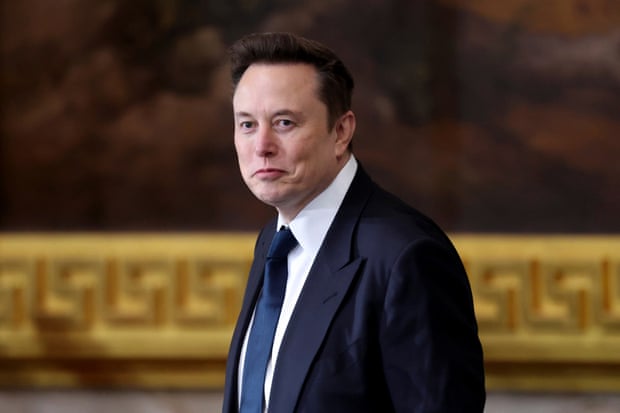
Elon Musk at Trump’s inauguration. The president established a ‘department of government efficiency’ on the same day. Photograph: Kevin Lamarque/AP
Elon Musk has achieved astonishing power in Trump’s administration – and spent the weekend wielding it
Since declaring his support for Donald Trump in July of last year and subsequently spending more than $250m on his re-election effort, Elon Musk has rapidly accumulated political influence and positioned himself at the heart of the new administration. Now as prominent as the president himself, Musk has begun to make use of that power, making decisions that could affect the health of millions of people, gaining access to highly sensitive personal data, and attacking anyone who opposes him. Musk, the world’s richest man and an unelected official, has achieved an astonishing level of power over the federal government.
Over the weekend, workers with Musk’s “department of government efficiency” (Doge) clashed with civil servants over demands for unfettered access to the computer systems of major US government agencies in a breakneck series of confrontations. When the dust settled, several top officials who opposed the takeover had been pushed out, and Musk’s allies had gained control.
Musk, with the backing of Trump, is now working to shut down the US Agency for International Development (USAid) – the world’s largest single supplier of humanitarian aid. He bragged on Sunday about “feeding USAid into the wood chipper”. He has also targeted several other agencies in an aggressive attempt to purge and remake the federal government along ideological lines, while avoiding congressional or judicial oversight.
Many of Musk’s actions have taken place without forewarning or transparency, sowing chaos and confusion among the thousands of people employed at the agencies like USAid that he has gone after. Humanitarian organizations that rely on US funding have halted operations and laid off staff, while government workers have been locked out of their offices. He is operating Doge as an unofficial government department with no congressionally approved mandate while he technically holds the position of “special government employee”, which allows him to sidestep financial disclosures and a public vetting process.
Elon Musk urges you to be a Fascist like him, says that you can ignore facts
and reality then.Climate Science Denier Donald Trump says Burn, Baby, Burn.
Greta Thunberg was detained by police in The Hague along with other climate protesters. Photograph: Peter Dejong/AP
COP29 is coming to an end.
Posted on X by Greta Thunberg. I’ve had difficulies embedding X for a week or two.
As the COP29 climate meeting is reaching its end, it should not come as a surprise that yet another COP is failing. The current draft is a complete disaster. But even if our expectations are close to non-existent, we must never ever find ourselves reacting to these continuous betrayals with anything but rage.
The people in power are yet again about to agree to a death sentence to the countless people whose lives have been or will be ruined by the climate crisis. The current text is full of false solutions and empty promises. The money from the Global North countries needed to pay back their climate debt is still nowhere to be seen.
Those in power are worsening the destabilisation and destruction of our life supporting ecosystems. We are on track to experience the hottest year ever recorded, with the global greenhouse gases reaching an all time high just last year.
The COP processes aren’t just failing us, they are part of a larger system built on injustice and designed to sacrifice current and future generations for the opportunity of a few to keep making unimaginable profits and continue to exploit planet and people.
With every negotiation, with every speech made by a world leader and with every agreement they sign, it becomes clear that it is up to us as a global collective to take the action we so desperately need and show where the leadership truly lies. They are not going to do it for us, as this COP29 yet again proves.
“The idea that rich and poor are equal before government in democratic societies is ludicrous,” writes Polychroniou. “As disparities in wealth and income grow, so do the disparities in political influence.” (Photo: flickr/Creative Commons)
Wealth taxation may sound like a good idea, but can it really address, let alone solve, the problem of inequality?
Economic inequality is the scourge of the 21st century. The rich are getting richer and faster than any other time since the onset of neoliberalism, which calls for “free-market” capitalism, regressive taxation, fiscal austerity and the rejection of the social state. They get richer not only when the economy is on an upswing but even amid crises. Billionaires more than doubled their net worth during the pandemic, according to Bloomberg Billionaires Index.
The latest analysis shows that the richest 1 percent gained $42 trillion in new wealth over the past decade, which amounts to “nearly 34 times more than the entire bottom 50 percent of the world’s population.” In the meantime, the very poor and low-income people across the globe, including the U.S., are actually getting poorer. So much for trickle-down economics which was popularized during the 1980s by the Reagan administration’s vast capital gains and income tax cuts and continues to persist to this day in spite of its major flaws. Cutting taxes on the rich not only increases economic inequality but has no effect on economic growth and unemployment.
There must be something very rotten with an economic system that allows individuals to generate obscene amounts of wealth to the point they can hijack the political system and undermine democracy.
However, inequality should not be examined purely from an economic perspective. Over the years, numerous studies have shown that economic inequality influences public attitudes toward democracy by generating political disillusion and low trust in government and other institutions, like Congress. Inequality also undermines social mobility, contributes to political polarization and fuels authoritarianism.
Finally, inequality contributes to climate change. The richest 1 percent is responsible for more carbon emissions than the poorest 66 percent, according to a 2023 report by Oxfam. Of course, while the world’s wealthiest people make a huge contribution to climate change, they are also able to insulate themselves from the worst impacts of global warming.
In sum, the super-rich can be blamed for many of the most serious ills confronting societies in the twentieth-first century. The only consequential question here is this: what can be done about it then?
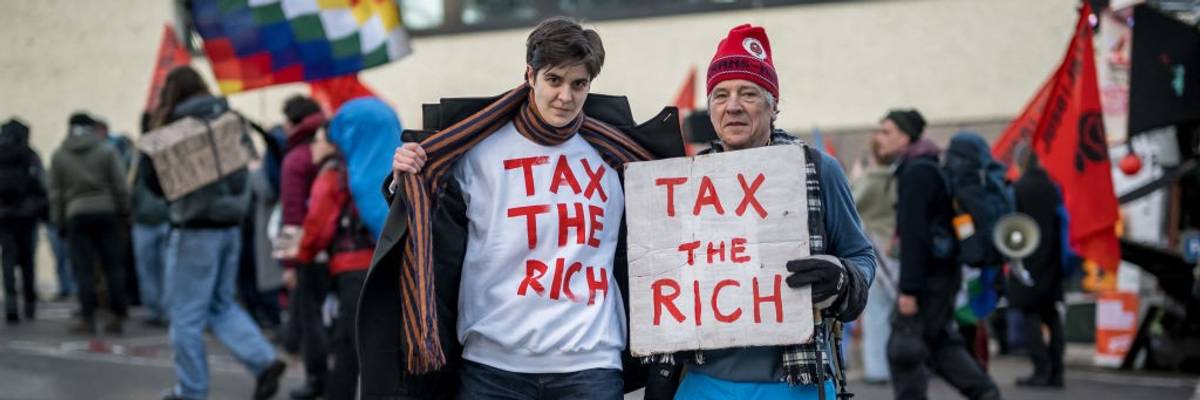
One of the most frequent responses to the problem of rising inequality is a call for the implementation of a wealth tax. Wealth taxation may sound like a good idea, but can it really address, let alone solve, the problem of inequality? The answer is an unqualified “no.” At least for the world’s advanced economies. Indeed, even if it’s possible to discover all the wealth that the very rich people own (much of which is hidden in companies or put in trusts) and then proceed with an accurate asset valuation, this will have very little impact, if any, on the daily lives of people who try to survive on minimum wages. Wealth taxation alone will have no impact on workers without social protection and no bargaining power at companies. It won’t protect workers at the “gig economy” and part-time workers.
To effectively address economic inequality, we must identify the root cause of the problem, and one simple way to do this is by asking a rather simple question: How does one become superrich? Where does this immense wealth come from? Because as the renowned progressive economist James K. Boyce recently put it “nobody ‘earns’ a billion dollars.
There must be something very rotten with an economic system that allows individuals to generate obscene amounts of wealth to the point they can hijack the political system and undermine democracy. Democracy cannot exist when we have wealth concentrated in the hands of a few. The idea that rich and poor are equal before government in democratic societies is ludicrous. As disparities in wealth and income grow, so do the disparities in political influence.
Take corporations, for example, which exert enormous influence, thanks primarily to campaign donations and lobbying Their actions, which range from opposing labor laws and policies that benefit workers to restricting unionization, exacerbate inequalities at all levels of society and across the globe. Moreover, the surge in billionaire wealth and the surge in “corporate power and monopoly power” form a powerful connection. The very rich are not simply beneficiaries of the existing economic order. They are in control of the working arrangements of the global economic system. Yet despite the enormous power that corporations have on people’s lives and the communities in which they operate, there are very few policies and mechanisms at national or international level to curtail that power.
Of course, we know that billionaires and big corporations pay very little in taxes, but we need much more than wealth and corporate taxation. We need ways to curb the power of big corporations and their drive to maximize shareholder value at the expense of everything else. We should also set a cap on extreme wealth. There is no social value for having billionaires. We should abolish the superrich, perhaps an easier task, politically speaking, than finding ways to tax them. Democratic societies could hold a referendum on whether we should abolish extreme wealth.
In addition, we could create economic arrangements that provide a minimum income to ensure that everyone’s basic needs are met. This can be done either through universal basic income or guaranteed income programs.
Last, but not least, we can challenge the rule of capital by advancing democratic forms of economic governance and economic planning. Participatory economics is one such alternative that would change the economy as we know it since it entails social ownership of production and self-managed workplaces. Worker cooperatives are established is various parts of Europe, particularly in Italy and Spain. The Mondragon Corporation in the Basque region of Spain is owned by its workers and represents the biggest and most successful case of worker cooperatives. Of course, for economic transformation to occur, breaking down hierarchical structures and putting workers in charge of business activities is not enough. What needs to happen is that the values of worker cooperatives spread across the economy and that power is wrested away from the capitalist class.In today’s world, we can tackle economic inequality only by shifting the conversation to its root causes and then coming up with blends of policies that work together to put an end to the driving forces behind inequality. Spending all political capital on something like a wealth tax will only help to prolong the life of an immensely cruel and dangerous economic system. An easier and far more effective way to end plutocracy is through the power of democracy via a binding referendum that calls on citizens to decide whether or not we should abolish altogether extreme wealth.
Corporate lobbyists have successfully pushed Keir Starmer’s party to ditch its progressive policies
Keir Starmer sucking up to the rich and powerful at World Economic Forum, Davos.
Over the summer, Keir Starmer’s Labour Party for the first time articulated a clear vision for government: everything will continue to be awful. Nothing will get better. Hope is for fools. And, most importantly, no one with wealth or power need worry themselves that any of either will be taken from them.
Because despite two-thirds of voters wanting the government to increase wealth taxes, shadow chancellor Rachel Reeves last month emphasised that she won’t. And although 63% of Brits think taxes on the rich are too low, Starmer has made clear that he doesn’t want to raise income tax for top earners, saying his driving principle is, rather, to lower taxes. Only 5% think the rich pay too much tax.
Meanwhile, Labour’s £28bn-a-year pledge to invest in a Green New Deal – a plan to boost the transition to a zero-carbon economy – has been cancelled by Reeves, who stressed a need for ‘fiscal discipline’. The policy has wide support among voters, particularly in key marginals in England’s North and Midlands.
A certain portion of the press – both Conservative hacks and Blairite shills – see all this as genius: if Labour steals the Tories’ story, how can Rishi Sunak attack? And in a way, though not the way they mean, they may be right.
Wealth and political power are enormously concentrated in Britain. Since 1945, Labour has only ever got into government when it’s made very clear that it doesn’t intend to challenge the ruling elite.
As we saw with Jeremy Corbyn, our oligarch-controlled media, the City and even army generals won’t allow any suggestion that the party plans to govern in line with the egalitarian desires of the overwhelming majority of voters.
In the battle of a general election, the cultural grip of the UK’s establishment is strong enough to override voters’ policy preferences. Actually doing the things voters want – taxing the rich, renationalising key services and tackling the climate crisis – would mean taking on institutions powerful enough to take you down. Or, at least, that’s what many Labour strategists have effectively concluded, even if that’s not how they would express it.
Of course, you can argue against that. Maybe establishment institutions are losing their grip. Perhaps the Tories would still lose the next election if Starmer stuck to his promise to run on the left.
On the other hand, it’s possible that the Labour leader being such an obvious liar – getting himself elected by his party on one set of promises and then immediately breaking them – will allow the Tories to successfully take him down. But more likely, it will make his first term as prime minister very difficult, and leave a festering anger that the right will exploit.
Cock-ups and corruption
Over the past few weeks, I’ve revealed a series of scandals about Labour.
Most of these stories boil down to at least one of the various C-words that shape so much of our politics: cock-up, conspiracy, co-option, coercion, collusion, corruption, capture, cooperation and class interest. Each is, in its own way, revealing.
In the first story, I showed that the Barnes and Richmond Labour Club had given the central party an illegal donation of just under £600,000. This seems to have been an example of the first C – a cock-up.
The money came from a local Labour club selling a building that had once been used as a social club for members. The club’s treasurer had given the cash to his local party through the national party in order to comply with regulations. But the national party seems to have failed to deliver it: within five minutes of going through their donor list, I could see that they’d broken the rules.
One local Labour club messing up isn’t a big deal. The fact that the central party cared so little about obeying transparency laws that one of its biggest donors in recent years inadvertently broke them, is. For all of Starmer’s emphasis on competence, the party he leads seems not to have invested enough in training its staff in the laws governing political finance.
It’s much harder to see Google as the bad guy when you’ve sung along to Elton John with its team, while tipsy on its tab
When we broke the second story, about Starmer’s freebies, and the third, about Jonathan Reynolds’ trip to Glasto with Google, there was a pretty ferocious reaction online. The word people kept coming back to was ‘corruption’. But I’m sure that, in his mind, Starmer doesn’t think there is any transaction going on; he’s not accepting gifts from the gambling industry in exchange for future laxity with gambling laws. They are just inviting him, he presumably thinks, because they enjoy the glamour of having the likely next prime minister on their arm.
And, the labour leader’s internal monologue might argue, it’s perfectly appropriate for him to hear from and experience the wares of various British industries. In any case, if a politician was selling elements of public policy, they could do a lot better than a four-course meal with fizz in a special box at the races.
A better word for what is going on is ‘co-option’.
Co-option
The social theorist Ralph Miliband – dad of Ed and David – documented how the same thing was done to the very first Labour MPs, a century ago. While some of the establishment was horrified by the arrival of these cloth-capped working-class men in the hallowed halls of the Palace of Westminster, its cleverer figures knew just what to do. They took them out for dinner at their smart London clubs. They introduced them to their wives, and to fine wines. They inducted them into the ruling class.
The consequence was that the first Labour administrations in the 1920s governed very much within the rules set by the establishment they had been socialised into, including pushing through massive public spending cuts after the Wall Street Crash, rather than devaluing the pound. What we’re seeing now is the same process of co-option in post-Corbyn Labour. Only now, it’s not so much co-option into the old ruling class – though we get a whiff of that in Starmer’s days out at the races – but into the glitz of big business: tickets to the Brit Awards, the best seats in the nation’s swankiest football stadiums, the luxury end of Glastonbury.
Part of the message these businesses are trying to convey to Labour folk will be expressed verbally, over sips of champagne or between the amuse bouche and the appetiser. But part of it comes in the setting itself: it’s much harder to see Google as the bad guy when you’ve sung along to Elton John with its team, while tipsy on its tab. It’s much easier to go soft on elites once you feel part of them, to see things from the perspective of a multi-millionaire if you’re watching the football from the premium suite than if you’re cheering from the stands with the fans.
You see a similar phenomenon with sponsored events at Labour Party conference, as revealed by my colleague Ruby recently. Often, these are luxurious affairs – I can still remember the delicious beef and truffle canapés I got from a firm pushing freeports a few years back.
Businesses with policy agendas invest time and money in buying nice things for politicians and their staff because it works – not in the simple transactional way that a word like ‘corruption’ implies. But in subtler, softer ways. If it didn’t, they wouldn’t do it.
Co-operation
Cooperation is important, too. While members of the cabinet have special advisers funded through the civil service, their shadows don’t get equivalent staffing support – and the resources aren’t distributed equally. Some members of the shadow cabinet have just one adviser, funded by the Labour Party, others have whole teams, paid for by major donors.
It’s generally those associated with the right of the Labour Party who seem able to attract the funding of the handful of hedge funders and millionaires who chip in to such things. As a result, they get the researchers and spinners who make them look more competent, allowing them to deliver more, to grow their profiles, to succeed.
In 2018, the party took £700,000 in donations. So far this year, it’s already taken £12m
Peter Kyle, for example, who has recently been appointed shadow secretary of state for science, and who is associated with the right of the party, has been given £50,000 by wealthy financiers over the past year. Jonathan Ashworth, who was shadow secretary of state for work and pensions and who is seen as being on the soft left of the party, got no such donations, and was demoted to paymaster general in the recent reshuffle.
Other recipients of large amounts of private cash include shadow chancellor Rachel Reeves, shadow health secretary Wes Streeting, and shadow home secretary Yvette Cooper – all of whom are associated with the right of the party. Shadow cabinet members who come from the ‘soft left’ don’t get anything like the same support.
There is no suggestion of impropriety here. Kyle and pals genuinely believe in policies that are good for their banker backers, while Ashworth et al are less keen. But the result is that the one on the side of the super-rich gets to have a super-sized staff team, and the political muscle which comes with it.
This phenomenon is not limited to shadow cabinet members. The Labour Party has changed its policy over the past few months, and has subsequently been richly rewarded with a surge in large donations.
Since becoming leader in 2020, Starmer’s Labour has struggled for money. Membership – and the revenue it provides – has dropped by 170,000 in the past three years, while trade union contributions have fallen by more than a million since 2018.
But the party’s latest accounts, which came out this week, show that the shortfall has now been more than bridged by large donations from rich people and companies. In 2018, the party took £700,000 in donations above the £7,500 reporting threshold (or £1,500 for local parties and the like). So far this year, it’s already taken £12m.
The policies that Labour has ditched in recent months may have been overwhelmingly popular among voters. But they weren’t, it seems, with its wealthy potential donors.
Collusion
It’s not surprising that lots of businesses want to shape Labour policy. Polls show that the party will likely form the next government, and corporations want to make sure it won’t get in the way of their plans to extract as much profit as they can.
In one of its newsletters this week, Politico quotes Alice Perry, associate director at H/Advisors Cicero and a former chair of Labour’s ruling National Executive Committee, as saying that demand for insider advice on how to lobby Starmer’s team has rocketed since last year. According to the website: “You can’t move in SW1 without meeting one of the new bespoke ‘Labour units’ being set up by lobbying shops or their latest ex-Labour hire.”
The revolving door goes the other way, too. As I revealed earlier this week, at least ten current staffers for shadow cabinet ministers previously worked as corporate lobbyists.
But the revolving door between lobbying agencies and the top of politics is old news. And at least a revolving door means you are either in or out at any given moment. Starmer and his colleagues, however, seem to have found a new way to blur the lines: taking on staff who are still employed as corporate lobbyists – seconded from their usual work to the Labour Party. Much of the shadow cabinet is, in other words, directly collaborating with the lobbying firms trying to sell access to them.
Commercial lobbying exists to help those with money get extra influence over governments. The inevitable corollary is that ordinary citizens will get, relatively, less say. As such, its point is to distort democratic processes, to bend them to the will of capital.
In the dying days of the last Labour government, a string of former cabinet ministers were caught offering themselves for hire as lobbyists. The ensuing scandal contributed to a sense that the party’s time in office was coming to a somewhat sordid end, and coincided with a dip in the polls. But that was after 13 years in power.
If the party is willing to so openly collude with corporate lobbyists when it ought to be fresh faced and ready for office, then voters will hear its message loud and clear: don’t expect anything to get better.