In 1979, Fidel called it “genocide”: Cuba’s legacy of solidarity with Palestine

Spread the love

Original article by Pablo Meriguet republished from peoples dispatch under a Creative Commons Attribution-ShareAlike 4.0 (CC BY-SA) license.
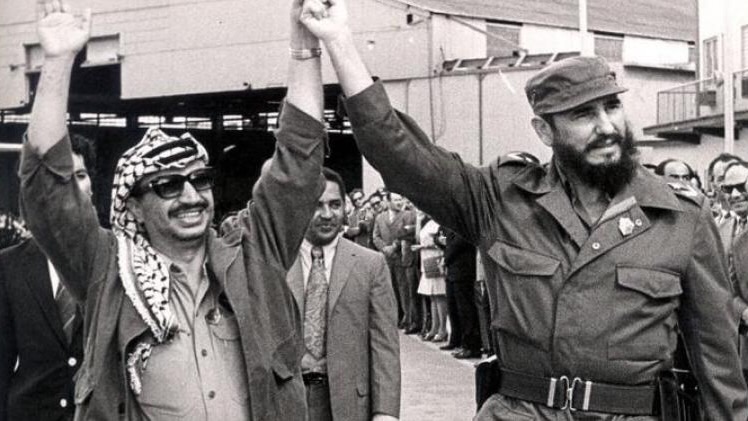
Palestinian leader Yasser Arafat and Cuban President Fidel Castro. Photo: Cuba Sí

On the 99th anniversary of Fidel Castro’s birth, we remember the revolutionary government’s support for Palestine, especially its condemnation of the genocide of the Palestinian people.

In a famous speech, Fidel Castro, the supreme leader of the Cuban Revolution, stated that medical, civil, and military support for the Angolan people was provided without expectation of any material reward. He pointed out that this way of thinking exposes an imperialist ideology, according to which one country supports another, always expecting to benefit materially in some way. “Revolutionaries expect nothing, which means that revolutionaries must devote themselves totally to a cause, to their ideas, to their noble goals, without expecting anything in return.”

This was the same principle that Fidel applied in supporting the Palestinian people’s struggle almost from the beginning of the revolutionary process he led since 1959. It is no coincidence that one of the most renowned Palestinian leaders, Yasser Arafat, visited the Caribbean Island eight times, on the personal invitation of Castro.

On October 12, 1979, at the United Nations Assembly, Fidel denounced before the world Israel’s process of territorial expansion, supported by the United States, at the expense of Palestinian territory. “The basis for a just peace in the region begins with Israel’s total and unconditional withdrawal from all occupied Arab territories and for the Palestinian people, the return of all their occupied territories and the restoration of their inalienable national rights, including the right of return to their homeland, self-determination, and the establishment of an independent state in Palestine, following General Assembly Resolution 3236,” Fidel said.

Castro acknowledged that this expansion was achieved through the killing of Palestinians, thus becoming one of the first world leaders to speak of “genocide” against the Palestinian people: “We repudiate with all our strength the ruthless persecution and genocide that Nazism unleashed against the Jewish people in its time. But I can think of nothing more similar in our contemporary history than the eviction, persecution, and genocide that imperialism and Zionism are carrying out today against the Palestinian people. Stripped of their lands, expelled from their homeland, scattered throughout the world, persecuted and murdered, the heroic Palestinians are an impressive example of self-sacrifice and patriotism, and they are the living symbol of the greatest crime of our time.”

Fidel also recognized that there are geopolitical interests that do not want peace to be established in the Middle East: “Can anyone be surprised that the Conference (of the Non-Aligned Movement) was forced, for reasons that do not stem from any political prejudice but from an objective analysis of the facts, to point out that US policy plays a fundamental role in preventing the establishment of a just and comprehensive peace in the region, by aligning itself with Israel, supporting it, and working to obtain partial solutions favorable to Zionist objectives and guaranteeing the fruits of Israeli aggression at the expense of the Arab people of Palestine and the entire Arab nation?”

“More than just rhetorical support, it was tangible support”

As historians point out, Fidel’s support for Palestine was not purely rhetorical, but also diplomatic. In 1974, Arafat arrived in Cuba and was received with the honors of a head of state, even though Palestine was not yet “officially” recognized as a state. Fidel’s message was clear: Palestine should be recognized by the international community as a state, and Arafat as its leader. In addition, Arafat was awarded the Playa Girón National Order, Cuba’s highest recognition for citizens “who have excelled in the struggle against imperialism, colonialism, and neo-colonialism, or who have done great deeds for peace and progress of mankind”.

The relationship between Cuban revolutionaries and the Palestine Liberation Organization (PLO) dates to the beginning of the Cuban Revolution. In 1959, Raúl Castro and Ernesto “Che” Guevara traveled to the Gaza Strip, disobeying the doctrine of hemispheric alignment whereby all Latin American countries, except for Cuba, supported Israel.

Thus, in 1964, thanks to Che Guevara’s tremendous efforts, Cuba recognized the PLO as soon as it was founded, becoming one of the first countries to do so. But its support went beyond official documents, according to Mansour Tahboub, former acting director of the Arafat Foundation: “Cuba has always been a strong supporter of Palestinians in all realms: political, military, vocational training. The Cubans trained Palestinian cadres, and Fidel himself was a staunch advocate of the Palestinian quest for freedom and independence.”

The truth is that one of the core principles of Castro’s administration was to support anti-imperialist and anti-colonialist struggles, wherever they took place. In a 1977 interview with French Weekly, Fidel stated: “The Palestinian movements have shown their ability to resist imperialist … aggression … [The Palestinian cause] will prevail sooner or later despite the betrayal by Arab reactionaries, imperialist maneuvers and Israeli aggression.”

That is why Cuba, along with Nicaragua, were the only two Latin American countries to condemn Israel’s actions after the Six-Day War. In 1973, Cuba severed diplomatic relations with Israel following the Non-Aligned Movement meeting in Algeria.

According to Abdel Majeed Sweilim, professor of political science at Al Quds University, the PLO also benefited from the relationship between Cubans and Palestinians, thanks to the political training of Palestinians on Cuban soil.

Today, despite the economic blockade imposed by the United States, which causes a perpetual economic crisis on the Caribbean Island, the Cuban government has reserved funding in the form of academic scholarships so that each year, 150 Palestinians can study medicine, engineering, and other professions at Cuban universities.

In his final years, Fidel continued to support the Palestinian cause. Thus, after resigning from his political posts, Castro signed an international manifesto in support of Palestine in 2014, which demanded Israel’s withdrawal from the Gaza Strip, the West Bank, and East Jerusalem, as well as respect for the resolutions passed by the United Nations regarding the conflict.

Arafat’s recognition of Cuban support

These and other measures have led countless Palestinians to see the revolutionary government of Cuba as an unwavering ally. Arafat himself acknowledged this when he stated: “I consider, Your Excellency President Fidel Castro, this demonstration of firmness and unwavering friendship that has taken place in Havana, as a strong and effective message from a beloved world leader who enjoys great international prestige among all the peoples and countries of the world, to mobilize them quickly to put an end to the suffering of the Palestinian people as a result of the Israeli occupation of their homeland, and the intensification of military, economic, and financial actions and blockades against our cities, villages, towns, farms, and water wells, and the closure of international border crossings by land, air, and water.”

In addition, the historic leader of the PLO said: “Every Palestinian today holds in their heart and conscience this glorious image of Your Excellency with the Palestinian hatta on your shoulders, which is irrefutable evidence of the justice of our cause and the magnitude of the injustice committed by the Israeli aggressors against our people. Have full confidence, Your Excellency President Castro, so beloved by our people and by all peoples, that our people, as resilient as the Palestinian mountains, take from your position and example, which makes us proud, more courage and determination to continue the struggle, the resistance, and the Intifada to remove the Israeli occupiers from our country, Palestine.”

In this way, Cuba continues to unreservedly support the demands for sovereignty, self-determination, and peace made by the Palestinian people in the face of the previous and most recent attacks by the Israeli government on their territory. This support, since 1959, is not given with the expectation of anything in return, but because of the anti-imperialist and anti-colonialist principles that guide the Cuban Revolution and that Fidel helped to establish as principles of the Cuban state itself.

Original article by Pablo Meriguet republished from peoples dispatch under a Creative Commons Attribution-ShareAlike 4.0 (CC BY-SA) license.

Experiencing issues with this image not appearing. I suspect because it's so critical of Zionist Keir Starmer's support of and complicity in Israel's genocides.
Genocide denier and Current UK Prime Minister Keir Starmer is quoted that he supports Zionism without qualification. He also confirms that UK air force support has been essential in Israel’s mass-murdering genocide. Includes URLs https://www.declassifieduk.org/keir-starmers-100-spy-flights-over-gaza-in-support-of-israel/ and https://youtu.be/O74hZCKKdpA
Keir Starmer objects to criticism of the IDF. He asks how could anyone object to them starving people to death, forced marches like the Nazis did, bombing Gaza's hospitals and universities,mass-murdering journalists, healthworkers and starving people queuing for food, killing and raping prisoners and murdering children. He calls for people to stop obstructing his genocide for Israel.
Keir Starmer objects to criticism of the IDF. He asks how could anyone object to them starving people to death, forced marches like the Nazis did, bombing Gaza’s hospitals and universities,mass-murdering journalists, healthworkers and starving people queuing for food, killing and raping prisoners and murdering children. He calls for people to stop obstructing his genocide for Israel.
Continue ReadingIn 1979, Fidel called it “genocide”: Cuba’s legacy of solidarity with Palestine

Fidel Castro: a life of revolution

Spread the love

Original article by Pablo Meriguet republished from peoples dispatch under a Creative Commons Attribution-ShareAlike 4.0 (CC BY-SA) license.
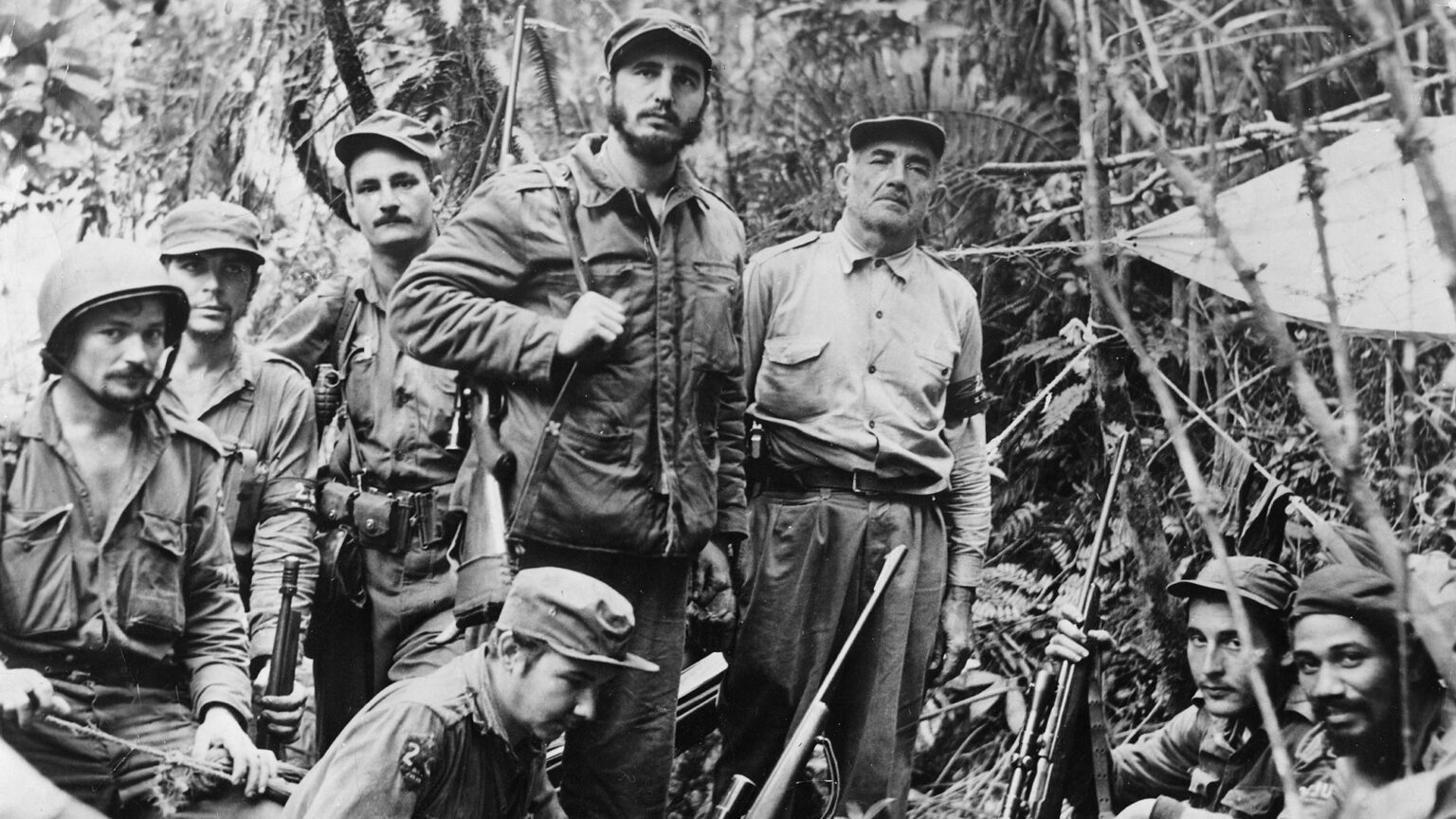
Fidel Castro in the Sierra Maestra with Guillermo García, Ernesto “Che” Guevara, Universo Sánchez, Raúl Castro, Crescentio Pérez, Jorge Sotus, and Juan Almeida. Photo: Wikimedia Commons

August 13 marks the anniversary of the birth of Marxist and communist revolutionary Fidel Castro, one of the most influential political leaders of the 20th century. Read our series of articles about the political life of the revolutionary leader.

Fidel Castro was born in Biran, in the east of the island of Cuba, in 1926, and died in Havana on November 25, 2016. His historical figure however, transcends the time in which he lived. Even when historians study the period in the region before the Cuban Revolution, they always keep in mind that, during the 1950s, on a Caribbean island, social, economic, and political changes would take place that would transform the entire history of the continent.

In this case, Fidel’s name cannot be detached from a process that shook the foundations of the entire Latin American and Caribbean society. Although the “Comandante” himself disavowed the simplification of revolutionary and historical processes to a few names, it seems that human memory prefers to engrave in its memory certain individuals rather than economic forces, cultural disputes, or political ideas. At least this has been the case with Fidel, whose figure is tied to the destiny of a country, just as Bolívar is tied to Venezuela, Juarez to Mexico, and Martí to Cuba.

The young student

Fidel studied at a Jesuit school, and perhaps because of this he always maintained an unyielding intellectual discipline, as well as an almost stoic confidence in the unity of any political group that has clear general objectives. At university, he studied law and social sciences. There he began to read several books on politics while presiding over the Federation of University Students (FEU), a space which he was active in during the struggle against the government of Ramón Grau San Martín, and in which he began to denounce the bloody dictatorship of the infamous Rafael Trujillo in the Dominican Republic.

As president of the FEU, he traveled to Colombia to attend the Inter-American Student Conference and meet personally with Jorge Eliecer Gaitan, the Colombian politician, whose assassination, a few hours before his meeting with the young Fidel, would set off a historical process in Colombian society that began with the famous “Bogotazo”.

Once he finished his university studies, he tried to enter national politics by running for the House of Representatives in 1952, but the disastrous coup d’état of Fulgencio Batista overthrew the government of Carlos Prío Socarrás and prohibited future elections. Fidel tried to denounce Batista before the courts for violating the constitution, but the denunciation was denied. Faced with this adversity, the young Fidel understood that elections and legal denunciations were not an adequate way to engage in political struggle at that time in Cuba.

The beginning of the revolutionary struggle

That is how several young revolutionaries decided to follow the path of armed struggle. On July 26, 1953, they attacked two military bases (the “Moncada” in Santiago de Cuba and the “Carlos Manuel de Céspedes” in Bayamo) which stored thousands of weapons and were located in areas where the people were mostly opposed to the Batista dictatorship. They had hoped that the attack would provoke sympathy among the population and the young military who doubted the dictatorship. But all plans, including the escape plans, failed. More than 80 young revolutionaries were tortured and killed by the repressive forces.

Fidel quickly understood that not every military failure necessarily implies a political failure. In the trial against him, he gave a famous and brilliant self-defense in which he defended two fundamental theses. In the first place, he said that the intellectual author of the attack was named José Martí, implying that the Cuban independence hero, who had died more than 50 years ago, inspired the sovereign ideals of the young revolutionaries. This implied that the revolutionary struggle in Cuba had not ended with Independence from Spain, but continued, thus establishing a political thesis to be followed by the various revolutionary movements in Latin America and the Caribbean during the sixties and seventies of the 20th century: the struggle for independence has not ended because there is still imperialist subjugation. Secondly, he concluded that, although they had been defeated and imprisoned, they were right to act in that way, and that historical time would know how to judge better what at that time seemed a risky adventure of a few young people: “History will absolve me,” Castro said before the judge.

He was imprisoned for almost two years on the Isla de Pinos before being acquitted and banished from Cuba on May 15, 1955. Batista thus hoped to get rid of an uncomfortable political prisoner, although in reality, by doing so, he sentenced himself (in the not-too-distant future) to be defeated militarily and to die in exile in the Spain of fellow dictator Francisco Franco.

After prison, Fidel Castro traveled to the United States and Mexico. In Mexico, he trained (under an ex-combatant of the Spanish Civil War named Alberto Bayo) and organized an expedition of fighters, among them Ernesto “Che” Guevara. The emerging political-military group was called the “26th of July Movement”, in honor of the attack on the military bases. The purpose was clear: to defeat the Batista dictatorship and create a more equitable country. Several months earlier Fidel said in the Palm Garden Hotel in New York City that “In the year 1956 we will be free or we will be martyrs. This struggle began for us on March 10, has lasted almost four years and will end on the last day of the dictatorship or on our last day.”

The Cuban Revolution

Aboard the now revered yacht Granma, a group of 82 expedition members left the coast of Veracruz for Cuba on November 25, 1956. They arrived in Cuba on December 2. Fidel imitated Martí’s military strategy, which consisted of disembarking in the eastern part of the country and approaching the capital from the extreme east of Cuba, passing through the Sierra Maestra, a slight mountain range on the island.

At first, it seemed that the new revolutionary struggle would fail…again. Batista’s army had discovered Castro’s plans and attacked the revolutionary troops with all its might. In Santiago de Cuba, the dictatorship managed to suppress the urban uprising commanded by Frank País, also a member of the Movement 26 of July, in support of the landing of the Granma (which, however, was several days late in arriving). They also quickly discovered the place of arrival of Castro and the rest of the combatants, attacking the guerrillas by air and sea.

After several combats, dispersions, persecutions, and regroupings, only 17 of the 82 original expedition members survived. Despite the obvious adversity, Fidel exclaimed upon meeting with the few survivors: “Now we will win the war!”, which shows a position of historical certainty that Che Guevara would explain years later: “Fidel was certain that, if we left Mexico, we would reach Cuba. If we arrived in Cuba, we would disembark. If we disembarked, we would fight. And if we fight, we will win.

During the coming months, hundreds of new fighters joined Castro’s troops, which were eventually divided into five columns commanded by him, his brother Raul, Camilo Cienfuegos, Che Guevara, and Juan Almeida. However, Batista’s army had more than 70,000 soldiers, so the Movement 26 of July launched a guerrilla war in various parts of the country. Batista launched a military offensive called “Operation Summer”, in which he sent 17 battalions to destroy the Rebel Army, but they were surprised with a series of victories by the revolutionary forces.

Fidel’s popularity began to increase. The Revolutionary Directory, another anti-Batista armed group, attacked the Presidential Palace in Havana to assassinate Batista but were defeated. Despite this, Batista’s invincible image began to be demystified. In addition, the dictatorship increased extrajudicial assassinations and torture against political opponents (the most famous case is the death of Frank País), which eroded the government’s public image. On September 5, the Cienfuegos naval base revolted along with several members of the Movement 26 of July. The government responded to the uprising with a bombing in which more than 400 people died. The majority of the Cuban people repudiated the cruelty with which Batista’s troops acted. The government’s repression only made the revolutionaries more popular.

In addition, after several interviews with international media, Fidel and his followers began to gain support outside Cuba, while denouncing the horrendous crimes of the Batista dictatorship.

During several months of armed struggle, Fidel proved to be the only leader capable of uniting the different factions opposing the dictatorship. The most important political movements recognized that he was the only figure capable of commanding the overthrow of Batista. In addition, Fidel proved to be a very astute military strategist, withdrawing his troops in difficult moments and counter attacking fearlessly when he found the slightest opportunity to gain territory. In this way, he managed to conquer most of the East and Center of the country by the end of 1958. Guevara and his troops managed to take the city of Santa Clara, the last strategic defense of Havana.

Despite the attempt of several military men to carry out an orderly withdrawal of Batista and his troops, Fidel ordered a final attack against the forces of the dictatorship. In this way, Castro sought to curtail the installation of a puppet government and assure the establishment of a truly revolutionary government. “Revolution yes, military coup no!” was Fidel’s phrase repeated by radio throughout the Caribbean island. Batista managed to flee Cuba with the support of US Ambassador Earl T. Smith.

Despite the apparent impossibility of the geopolitical situation, the Cuban Revolution triumphed on January 1, 1959 just to the south of the United States.

Fidel was right: victory was possible in Cuba despite all possible disadvantages. It was a matter of finding the right strategy. The Cuban Revolution inspired dozens of political groups to fight to seize power throughout Latin America and across the Global South, often with Cuban support. Thus began a new era in the history of the Caribbean island, which will never forget the name of Fidel Castro.

Original article by Pablo Meriguet republished from peoples dispatch under a Creative Commons Attribution-ShareAlike 4.0 (CC BY-SA) license.

Continue ReadingFidel Castro: a life of revolution