[Guardian] Exclusive: Chloë Deakin tells how she wrote to Dulwich college master to argue against Farage’s nomination as prefectSun 28 Dec 2025 06.00 GMTShare
It was 1981 and Nigel Farage was turning 17. He was already a figure of some controversy, as would become a lifelong habit, among the younger pupils and staff at Dulwich college in south-east London.
“I remember it was either in a particular English lesson or a particular form period that his name came up,” said Chloë Deakin, then a young English teacher, of a discussion with a class of 11- and 12-year-olds. “There was something about bullying, and he was being referred to, quite specifically, as a bully. And I thought: ‘Who is this boy?’”
Deakin conferred with colleagues in the staff room who corroborated accounts of harassment of fellow pupils and of Farage’s apparent fascination with the far right, including claims that he had been “goose-stepping” on combined cadet force marches.
“But initially I had heard it from boys,” she said. “I was shocked to hear that this Dulwich boy was apparently getting away with this kind of behaviour, at cadet camp etc, and I thought: ‘This is seriously out of order. It’s horrible.’”
Despite the chatter in the playground and staffroom, Farage was put on a draft list of prefects by the headteacher, David Emms, and his deputy, Terry Walsh. There was a meeting where strong views were aired, though Emms and Walsh were of the opinion that Farage was naughty, rather than being a malevolent racist.
“So when I heard that Farage’s name was on the finalised prefect list, I was appalled and that was why I wrote independently to Emms, because I felt strongly about it – I still do,” Deakin recalled.
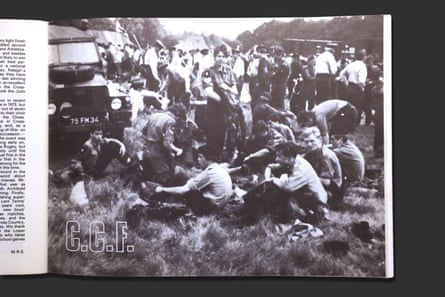
A Dulwich college magazine, the Alleynian, shows members of the combined cadet force including a boy believed to be Nigel Farage seated on the ground (centre, reaching towards his feet). Photograph: Martin Godwin/The Guardian
Deakin’s letter of June 1981, first revealed by the Channel 4 journalist Michael Crick in a report in 2013, is uncompromising. She has never spoken before of this episode with the letter – written after Farage’s 17th birthday – emerging only as a result of her having given a copy of it to a senior teacher at the time, as was the practice at the school.
She wrote: “You will recall that at the recent and lengthy meeting about the selection of prefects, the remark by a colleague that Farage was a ‘fascist but that was no reason why he would not make a good prefect’ invoked considerable reaction from members of the [staff] common room.
“Another colleague, who teaches the boy, described his publicly professed racist and neo-fascist views, and he cited a particular incident in which Farage was so offensive to a boy in his set that he had to be removed from his lesson …
Climate science denier Nigel Farage explains that it’s simple to blame asylum-seekers or Muslims for everything.Keir Starmer refuses to be outcnuted by Nigel Farage’s chasing the racist bigot vote.Nigel Farage explains the politics of Reform UK: Racism, Fake anti-establishmentism, Deregulation, Corporatism, Climate Change Denial, Mysogyny and Transphobia.
Nigel Farage’s party was recognised for “widespread embrace of climate change denialism and antivaccine misinformation”
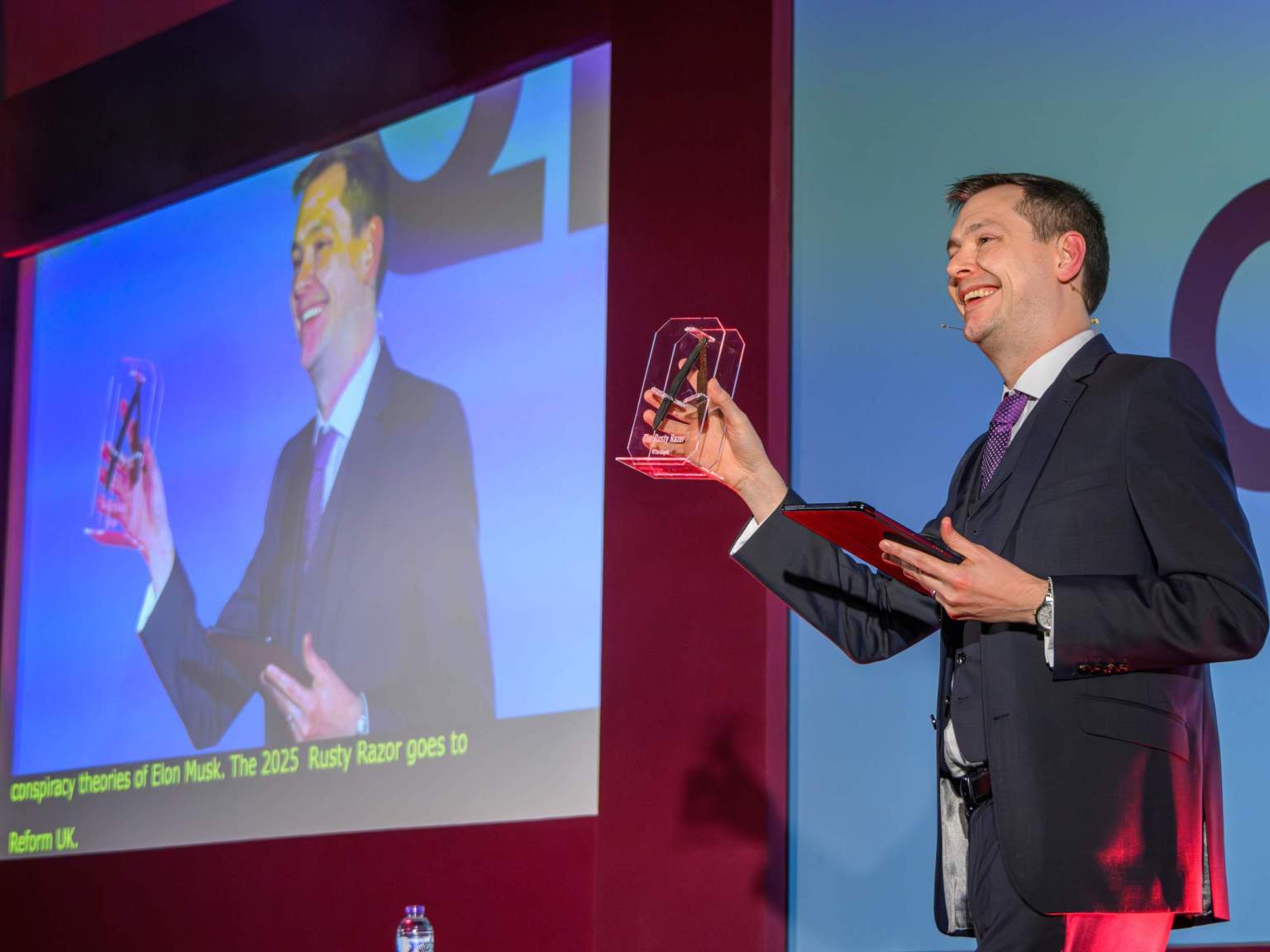
Skeptic magazine editor Michael Marshall presents the Rusty Razor Award to an absent Reform party. Photo: Dave Hughes. / The Skeptic
Reform UK has received an award for being the organisation that engaged in the “most prolific promotion of pseudoscience” during 2025.
Each year the UK’s long-running publication for analysis of pseudoscience, conspiracy theory and claims of the paranormal, The Skeptic magazine, names their pseudoscientist of the year, and awards them the Rusty Razor prize.
The Rusty Razor this year went to Reform UK in recognition of “their widespread embrace of climate change denialism and antivaccine misinformation.”
The award was announced in front of an audience of around 700 people at the QED science and skepticism conference in Manchester on Saturday night.
In the Rusty Razor Award category, Nigel Farage’s party was recognised for ‘promoting pseudoscientific claims’.
…
Michael Marshall, Editor of The Sceptic, said: “Whilst the political positions Reform UK put forward are outside of the scope and remit of The Skeptic and our awards, their positions on science are not.
“On current polling, Reform UK is the party with the most support in the country, yet they have shown that they have no problem with spreading pseudoscientific misinformation that aligns with the interests of their donors, no interest in vetting their members and candidates for holding dangerously misguided views about science and health, and no issue with fostering and indulging all manner of conspiracy theories if they think there’s a vote in it.”
Marshall branded Reform “a threat to science and reason, and deserving of being singled out as winners of our 2025 Rusty Razor award.”
Nigel Farage reminds you that he’s the man that brought you Brexit and asks what could possibly go wrong.Nigel Farage urges you to ignore facts and reality and be a climate science denier like him and his Deputy Richard Tice. He says that Reform UK has received £Millions and £Millions from the fossil fuel industry to promote climate denial and destroy the planet.Nigel Farage explains the politics of Reform UK: Racism, Fake anti-establishmentism, Deregulation, Corporatism, Climate Change Denial, Mysogyny and Transphobia.
Zack Polanski, Zarah Sultana and Jeremy Corbyn offer hope for the British left | Ben Montgomery/Stringer / Leon Neal/Staff / Kristian Buus/Contributor / Getty Images / Composition by James Battershill
In choosing big business over ordinary people, the PM has sacrificed the heart of the Labour Party. So what next?
Labour’s political position is increasingly the reverse of the ‘for the many, not the few’ policy pursued under former leader Jeremy Corbyn. The party has embraced corporate capture and the main features of neoliberalism, albeit with incredibly poor timing, as the neoliberal economic model drives runaway wealth that increases dissent across much of the world.
It is no coincidence that, at the same time, when it should be coasting along on a huge parliamentary majority won less than 18 months ago, Labour has been plunged into political disarray and seen its lead disappear in the polls.
By cosying up to big business and failing to offer anything to substantially improve the lives of ordinary people up and down the country, Keir Starmer’s New-New Labour has seen a collapse in its general support and, more significantly, its membership.
The Labour Party has lost 300,000 of the 550,000 members it had in the Corbyn era. While it has been able to recoup the financial support offered by these ordinary members from a few big donors, it has in the process lost the heart of the party.
Many issues demonstrate this, but a few stand out. The government’s repeated refusal (now rumoured to be U-turned on at next month’s Budget) to lift the two-child benefit cap. Its flagship welfare bill (already U-turned on), which would have cut Universal Credit and Personal Independence Payments for millions of vulnerable people. The decision, announced in February of this year, to cut the foreign aid programme to increase military spending.
And then came perhaps the biggest problem of all for Starmer’s Labour: Gaza, where the UK government’s continuing support for Israel as it engages in genocide still beggars belief for many. There have been 32 mass demonstrations in London in the past two years, the most recent being one of the largest protests ever held in the UK. That level of political activity will continue, given Israeli prime minister Binyamin Netanyahu seems determined to avoid a peaceful outcome, and Starmer is unlikely to stand up to him or, by extension, the US.
Widespread dismay and depression on the backbenches may ebb and flow, but at this point, it feels like even a change of leadership may not be enough for a real change in fortune.
The government’s current predicament is the main reason why Westminster politics is so uncertain. Looking at the UK-wide parties, the far-right Reform UK is leading polls with vote shares that vary but are typically over 30%, having soaked up plenty of support as a substantial protest vote. If that persists through to the next general election in 2029, it will likely put Nigel Farage into Downing Street.
Labour’s support, meanwhile, is hovering at around 20%, the Tories more like 15% and the Liberal Democrats rather less.
And until three months ago, the Greens were still weak in polling terms – despite having made some progress since last year’s election – and millions on the left were still disenfranchised, having been disillusioned with Starmer’s Labour leadership.
Two things have changed; the first being Zack Polanski winning the Green Party leadership at the start of September. He has brought a more radical and left-wing perspective to the party, which has led to a jump in the polls and an 80% increase in new members. The Greens announced this week that its membership now stands at 126,000 – more than either the Conservatives or the Lib Dems.
The second change is in the fortunes of the new Your Party group, fronted by Corbyn and former Labour MP Zarah Sultana. While the party’s initial request for expressions of interest received a massive 800,000 responses – at which point it appeared likely to provide a serious challenge to Starmer’s Labour – it ran into internal disagreements six weeks ago that knocked it right back and led to a period of utter dismay and anger among supporters.
Those feelings have eased somewhat over the past two weeks, as Your Party has published draft versions of its constitution, standing orders and an organisational strategy, all of which are to be discussed and developed before being decided at a large national conference in Liverpool at the end of November. The documents, including a draft political statement, are open to all and will no doubt be subject to intense debate and plenty of disagreement, but they do appear to be a genuine attempt at accountability that is a very long way from the opacity of the Labour Party.
A typical meeting of supporters, of which there are hundreds around the country, still sees some of the anger of a few weeks ago, but now also more determination to see things through. If the new party can recapture the mood of three months ago – and particularly if it and the Greens are willing to work with one another – then there may be some hope for the disenfranchised left.
One of the most interesting aspects of these rapid political changes is the potential for the three figureheads of these two parties to have a substantial impact.
Zarah Sultana, with an often combative style, appeals particularly to younger and frustrated audiences, while Zack Polanski’s normal and measured approach is persistently disarming for Reform’s far-right politicians. Then there is Jeremy Corbyn, who is already a national figure known for a long-term commitment to a progressive agenda and a remarkable personal following.
These are very early days in a time of rapid political change. Reform is still on the up, but compared with just three months ago, there is now a lot more reason for hope on the left.
Keir Starmer explains that he feels no shame or guilt benefitting personally from gifts from the rich and powerful while insisting on policies of severe austerity causing suffering and death.Keir Starmer says that the Labour Party under his leadership all feel a small part of Scunthorpe.Keir Starmer objects to criticism of the IDF. He asks how could anyone object to them starving people to death, forced marches like the Nazis did, bombing Gaza’s hospitals and universities, mass-murdering journalists, healthworkers and starving people queuing for food, killing and raping prisoners and murdering children. He calls for people to stop obstructing his genocide for Israel.
Chancellor Rachel Reeves and the rest of the Labour cabinet have been captured by corporate interests | Joe Giddens – WPA Pool/Getty Images
The party is steamrolling ahead with deregulation that will benefit big businesses at the expense of consumers. Why?
It’s no secret that Keir Starmer, Rachel Reeves, and the rest of the Labour cabinet have been captured by corporate interests.
Health secretary Wes Streeting has received at least £372,000 in donations from sources with links to private healthcare since 2015, equivalent to around £10,000 per month. The international lobbying and PR firm FGS Global, which is owned by the private equity firm that pulled out of buying Thames Water in June, sent a member of staff to work in Reeves’ office during the election campaign. And the party has received over £1m in donations from firms tied to the gambling industry in the past two years.
Labour’s links to big business and wealthy donors are concerning in themselves, but we now have direct evidence that they are being used to influence policy.
As openDemocracy reported this week, the party has defanged the Competition and Markets Authority, the regulator responsible for enforcing competition law, to appease business interests – at the expense of consumers.
The government’s deregulatory efforts began back in January, when it ousted Marcus Bokkerink as the CMA’s chair and replaced him with Doug Gurr, Amazon’s former UK boss. Appointing a former executive of one of the world’s most powerful monopolies as the head of a competition authority is so on the nose it defies satire; unions referred to the move as a “slap in the face”.
If this wasn’t enough, the business secretary, Jonathan Reynolds, instructed Gurr to deliver “pro-business decisions” in the role. The message from Labour is clear: we will not stand in the way of anti-competitive behaviour, regardless of the impact on people and planet.
Then, in May, the government issued a new “strategic steer to the CMA”, ordering the watchdog to prioritise “growth and investment” – a barely veiled instruction to wave through mergers and acquisitions that consolidate corporate power.
And just this week, the Financial Times reported that the chancellor plans to pursue a “blitz on bureaucracy” at the CMA by changing the way it reviews anti-competition investigations, which would likely make it easier for ministers to nudge outcomes in favour of big business. The move may come from Reeves, but its intellectual and political architect is reportedly Varun Chandra, one of Starmer’s most powerful advisers.
Chandra is a former managing partner at Hakluyt, the shadowy corporate intelligence firm founded by ex-MI6 officers, which counts among its clients many of the world’s biggest corporations and private equity funds. He retains a multimillion-pound stake in the company and deep relationships across the City and Silicon Valley. In government, he has pushed for a “pro-growth” deregulatory agenda.
This is how corporate capture works in the Labour Party today. There is a revolving door between corporate boardrooms and the highest offices of state. Ministers fall over themselves in their desperate attempts to gain the approval of the City and the Confederation of British Industry, an influential business lobby group. The party has demonstrated it is willing to take donations and gifts from almost anyone, and that it will happily return the favour by amending legislation or cutting regulation.
Ulterior motives
This corporate capture is, in part, a structural problem.
The state is not some neutral tool that political parties can pick up and use as they wish when they enter power. As Marxist theorist Nicos Poulantzas argued back in the 1970s, it is a social relation: a set of institutions that crystallise the balance of class power in society. In capitalist societies, capital is both better resourced and more organised than labour, and this imbalance of power is reflected within state institutions.
When a party severs its links with the working-class organisations that once anchored it in social struggle – from trade unions, to protest movements, to community organisers – it doesn’t float above class conflict; instead, it must fill the gap left by the mass base by deepening its links to capital. This reorganisation of the relationship between party and base is exactly what’s happened to Starmer’s Labour. Absent a mass movement capable of holding politicians to account, his government takes its cues from the boardroom rather than workers and communities.
But there’s also a more cynical dynamic at play, too. Everyone knows this government’s days are numbered, including Starmer himself. Nigel Farage’s Reform UK has cannibalised the Conservative Party and is now tearing ahead in the polls. Labour was probably hoping to rely on haranguing its disgruntled left-wing voters over the need to stop the rise of Reform, but with Starmer increasingly echoing Farage’s talking points, the Greens now seem like a more natural home for those people.
In short, Labour is toast – and it knows it. Ministers and advisers are already looking beyond government to the well-paid, cushy corporate positions they all want to take up when they leave office.
For the Tories who lost their seats at the last election, this transition was pretty easy thanks to the long-standing links between their party and big business and finance. Labour politicians have had to work harder to cultivate strong relationships with the private sector. In this context, the push for ‘pro-business’ policies isn’t just ideological – it’s personal.
Keir Starmer explains that he feels no shame or guilt benefitting personally from gifts from the rich and powerful while insisting on policies of severe austerity causing suffering and death.Keir Starmer says that the Labour Party under his leadership all feel a small part of Scunthorpe.
Plaid Cymru celebrates by-election results. Source: Rhun ap Iorwerth/X
Plaid Cymru’s by-election win in Wales shows that space still exists for progressive politics despite Nigel Farage’s claims.
Welsh party Plaid Cymru, an advocate for independence from the United Kingdom, delivered a major blow to both the Labour Party and Reform UK in a by-election for the devolved parliament, the Senedd. Plaid candidate Lindsay Whittle won 47% of the vote in Caerphilly, leaving Reform behind at 36% and Labour at just 11% – an astonishing 35-point drop compared to the previous election. The result marks Labour’s first loss of the seat in more than a century.
“This result shows that Plaid is no longer just an alternative, we are now the real choice for Wales, the only party able to stop billionaire-backed Reform,” party leader Rhun ap Iorwerth said after the result was announced. Ahead of the election, Reform had invested substantial resources into the campaign, with Nigel Farage apparently confident a win in Wales would prove his claim that the far right has become the only true alternative to Britain’s two establishment parties.
In reality, while the by-election confirmed that both Labour and the Conservatives remain in crisis after years of backing austerity, it actually showed that the far right can still be stopped by more progressive alternatives. “In every corner of Britain, people are calling out for an alternative to the misery faced by millions and candidates who will stand up against the hate and division sold by Reform and the shameful parroting of Farage’s rhetoric by Keir Starmer and his weakling Labour government,” the Peace and Justice Project wrote on social media.
Since the 2024 general election, Prime Minister Starmer’s shift to the right on everything from austerity to migration and Palestine solidarity has alienated much of Labour’s base and beyond. Many polls now predict the party could be shattered in upcoming elections. Although Reform UK has so far benefited the most from the widespread frustration and anger, positioning itself as the main alternative, progressive political forces have also gained significant ground.
The early announcement of a new left party by independent MPs Jeremy Corbyn and Zarah Sultana drew more than 600,000 expressions of support, while the Green Party has seen thousands of new members join in recent months. Following the election of a new leadership team headed by Zack Polanski, the Greens announced their membership had doubled to 140,000. Both the groups have rejected Reform’s hate-driven narrative and scapegoating of migrants, while also condemning Labour for failing to address people’s real concerns since taking office.
“This Senedd by-election result shows that people are sick of the Westminster establishment and its persistent scapegoating of marginalized communities instead of effectively dealing with the issues we all face,” the Peace and Justice Project stated. While Reform’s failed bid in Caerphilly suggests that not everyone has accepted the idea that the far right is the only alternative to business as usual in British politics, progressives still face the enormous challenge of mobilizing on a larger scale ahead of future elections – including the 2026 run for the Senedd – to counter far-right narratives and build a vision of hope for working-class communities across Britain.
Nigel Farage explains the politics of Reform UK: Racism, Fake anti-establishmentism, Deregulation, Corporatism, Climate Change Denial, Mysogyny and Transphobia.Keir Starmer justifies why he has to travel abroad so muchUK Conservative Party leader Kemi ‘not a genocide’ Badenoch explains her reality that the Earth is flat, the Moon is made of cheese and that she was born from
Unicorn horn dust