Continuing ‘Ethnic Cleansing’ Campaign, Israel Blows Past US Deadline for Gaza Aid

Spread the love

Original article by Julia Conley republished from Common Dreams under Creative Commons (CC BY-NC-ND 3.0). 

One advocate urged action “to prevent further loss of innocent life, the deepening of an extraordinary humanitarian crisis, and the continued erosion of U.S. credibility as an upholder of international humanitarian law.”

As the deadline set by the Biden administration last month for Israel to step up aid deliveries to Gaza passed on Tuesday, human rights groups demanded that the U.S. stick to its commitment to holding the Israeli government accountable for what one advocate called “a campaign of ethnic cleansing.”

But the White House’s refusal over the last 13 months to follow U.S. and international law provoked doubt that it would do so.

U.S. Secretary of State Antony Blinken and Defense Secretary Lloyd Austin wrote a letter to Israeli Prime Minister Benjamin Netanyahu’s government on October 13, giving Israel 30 days to allow at least 350 humanitarian aid trucks per day into Gaza, open a fifth crossing into the enclave, and ensure access to northern Gaza for aid groups, among other specific steps outlined in the letter.

Noncompliance would violate National Security Memorandum 20, which President Joe Biden issued in February to demand credible assurances from Israel that it was acting according to international law, and Section 620I of the Foreign Assistance Act, which prohibits the U.S. from providing military aid to countries that are blocking U.S. humanitarian aid.

Advocates have said for months that Israel and the U.S. have been violating both statutes, as mounting evidence has shown U.S. weapons have been used in Israeli attacks on civilians and United Nations experts have warned Gaza has descended into famine.

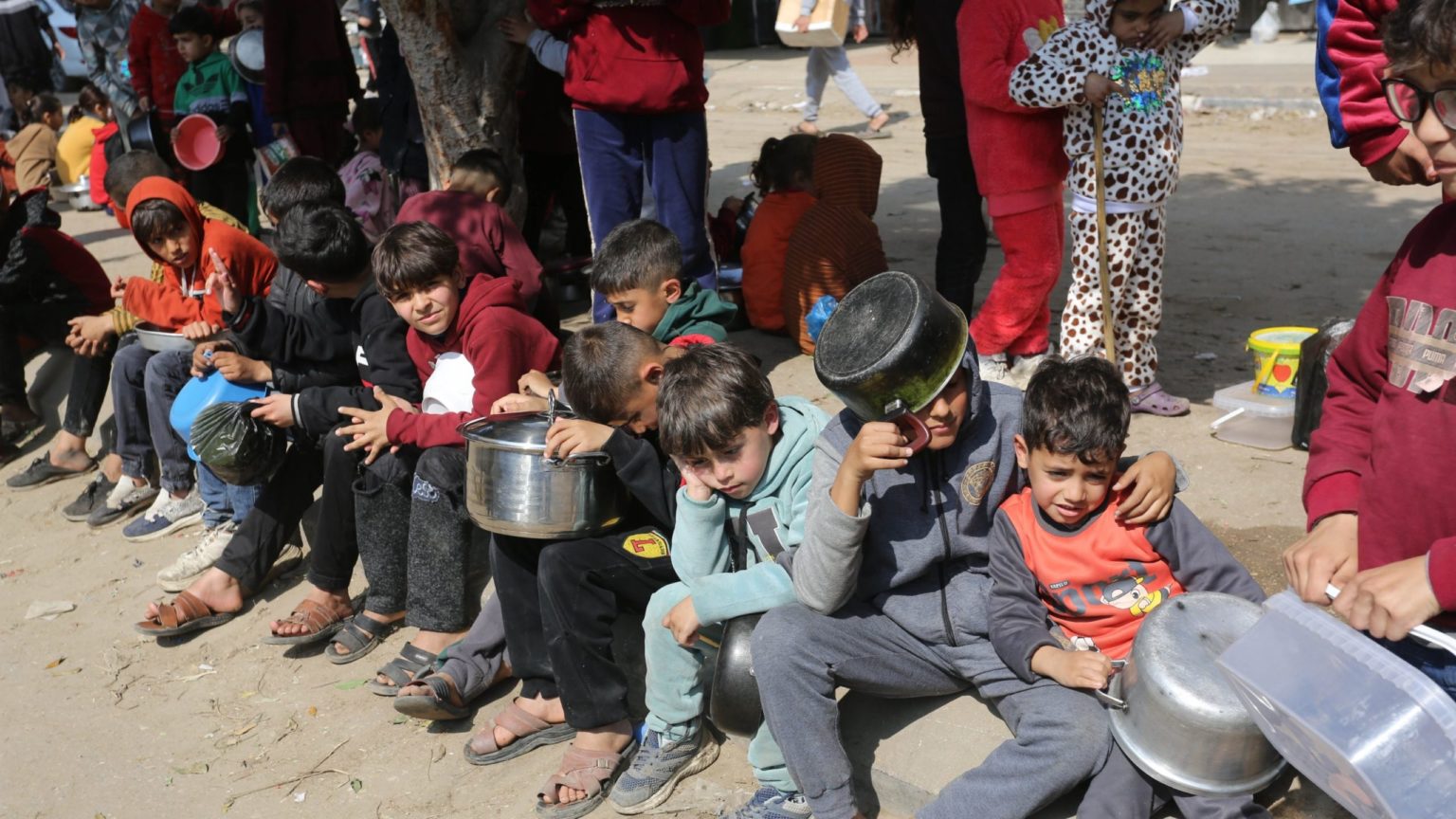
Louise Wateridge, a senior emergency officer for the U.N. Relief and Works Agency for Palestine Refugees in the Near East (UNRWA), said Tuesday that the Biden administration’s warning 30 days ago did not improve conditions in Gaza, with aid entering the enclave “at its lowest level in months.”

“Thousands and thousands of people have been killed senselessly. They have been killed because there is lack of aid, because the bombs have continued, and because we have not been able to even reach them under the rubble,” Wateridge said at a press briefing in Geneva. “The average for October was 37 trucks a day into the entire Gaza Strip… That is for 2.2 million people… Children are dying. People are dying every day.”

With the number of daily deliveries since October 13 far below the level stipulated by the Biden administration, Wateridge emphasized that “anything that happens now is already too late.”

As the deadline passed, Israel appeared eager to put new humanitarian aid efforts on display, with the Coordinator of Government Activities in the Territories (COGAT) posting on social media an image of a convoy delivering what it said were “hundreds of food and water packages to the Jabaliya and Beit Hanoun areas in 6n Gaza.”

The military also arranged a photo call on Monday where journalists “were invited to film around eight aid truc ks passing into Gaza,” reported Jon Donnison at the BBC. “They were laden with sacks of flour, rice, and toilet paper, among other things.”

“So, aid is getting into Gaza,” wrote Donnison. “But nowhere near enough.”

Before Israel began its bombardment of Gaza in October 2023, about 500 aid trucks entered the enclave each day.

A spokesperson for COGAT told the BBC Tuesday that “most aspects [of Blinken’s demands] have been met and those which have not are being discussed.”

https://twitter.com/comrade_sweezy/status/1856249133385879648?ref_src=twsrc%5Etfw%7Ctwcamp%5Etweetembed%7Ctwterm%5E1856249133385879648%7Ctwgr%5Ed80e230c97c6ebc1ead0d60158b1e3cfe99ae4bd%7Ctwcon%5Es1_c10&ref_url=https%3A%2F%2Fwww.commondreams.org%2Fnews%2Fisrael-aid-deadline

Sorry, this content could not be embedded.

X

U.N. officials said this week that aid workers have been unable to deliver relief even after the Israel Defense Forces gave approval for deliveries in northern Gaza, which has been cut of from virtually all aid for more than a month. Israeli troops on the ground have restricted aid despite the IDF’s approval.

In southern Gaza, hundreds of trucks containing aid have been sitting on the enclave’s side of the border with Egypt because U.N. workers cannot reach them due to “lawlessness, theft, and Israeli military restrictions,” according to The Associated Press.

As the deadline passed Tuesday, a coalition of human rights groups including Oxfam, Refugees International, and Save the Children released a scorecard assessing Israel’s progress in complying with the conditions set by Blinken and Austin on October 13.

They found “outright failure” by Israel to meet 15 out of 19 measures of compliance, and said the IDF has only partially complied with the remaining four.

Israel has failed to allow 350 aid trucks into Gaza over the last month, said the groups, and has not ended the isolation of northern Gaza or allowed the International Committee of the Red Cross (ICRC) access to Palestinians detained by Israel, among other requirements set last month.

“The U.S. government once again laid out basic measures for how the government of Israel must follow international law and allow for aid delivery in Gaza,” said Oxfam America president and CEO Abby Maxman. “Since then, we have seen Israeli forces accelerate their efforts to bombard, depopulate, deprive, and erase the Palestinian population of the North Gaza governorate. We are witnessing a campaign of ethnic cleansing.”

“Oxfam and partner organizations are unable to provide any support to the remaining civilians in the North Gaza governorate, where people are dying every day,” added Maxman. “jAccess to the rest of Gaza is also severely restricted, with civilians facing starvation and relentless violence. The U.S. must finally make this overdue call to suspend deadly arms sales to Israel or be complicit in the horrific atrocities unfolding before our eyes.”

Michelle Nunn, president and CEO of CARE, said that with the letter sent to Netanyahu’s government last month, the U.S. “created a critical opportunity to respond to the facts on the ground, and to insist upon accountability to our own laws.”

“It is imperative to act now to prevent further loss of innocent life, the deepening of an extraordinary humanitarian crisis, and the continued erosion of U.S. credibility as an upholder of international humanitarian law,” said Nunn.

The analysis, added Refugees International president Jeremy Konyndyk, “demonstrates that the Israeli government is violating its obligations under U.S. and international law to facilitate humanitarian relief for suffering Palestinians in Gaza.”

“With experts again projecting imminent famine in north Gaza, there is no time to lose,” he added. “The United States must impose immediate restrictions on security cooperation with Israel as required under Section 620I of the Foreign Assistance Act.”

Original article by Julia Conley republished from Common Dreams under Creative Commons (CC BY-NC-ND 3.0).
Continue ReadingContinuing ‘Ethnic Cleansing’ Campaign, Israel Blows Past US Deadline for Gaza Aid

Israel’s blocking of aid to Gaza is a weapon in its brutal war against Palestinians

Spread the love

Original article by Abdul Rahman and Ana Vračar republished from peoples dispatch under a Creative Commons Attribution-ShareAlike 4.0 (CC BY-SA) license.

Photo: UNRWA

Israel’s deliberate blocking of humanitarian aid to Gaza has emerged as key weapon against the people of the territory. More than 20 Palestinians have reportedly been killed due to starvation in the last few weeks and numbers are expected to explode in the coming days.

Though Israel denies it has any such policy, almost all UN agencies working to provide aid on the ground in Gaza, as well as several other groups, have termed the deliberate blocking of aid as the most important reason for an imminent famine in the besieged Palestinian territory. 

Research conducted by organizations such as Refugees International show that, “Israeli conduct has consistently impeded aid operations within Gaza, blocked legitimate relief operations, and resisted implementing measures that would genuinely enhance the flow of humanitarian aid in Gaza.”

By denying adequate aid to Gaza, Israel has been in violation of the interim order passed by the International Court of Justice (ICJ) on January 26 while hearing the genocide petition filed by South Africa. The ICJ had asked Israel to facilitate “urgently needed basic services and humanitarian assistance to address the adverse conditions of life.”

In its submission to the court in February, Israel claimed it had complied with the ruling. However, UN data shows that the actual number of trucks with aid reaching Gaza decreased by half in February in comparison to the previous month. International organizations still describe experiences where the Israeli Occupying Forces (IOF) block their entry into Gaza, especially North Gaza, after being made to wait for hours on end.

According to Philippe Lazzarini, Commissioner General of UNRWA, in February, on an average just 98 trucks entered Gaza in comparison to around 200 trucks a day in January. Before October 7, Israel used to allow around 500 trucks a day to the besieged territory for a population of over 2.3 million.

Israel’s denial of adequate aid to Gaza also violates the UN Security Council resolution adopted in December which talks about greater access to humanitarian aid to Palestinians in Gaza. 

The US, which was the primary mover of the UN security council resolution, recently airdropped aid to Gaza. While delivering his State of the Union address on March 7, President Joe Biden also talked about opening a temporary port in Gaza to deliver faster aid. Both the moves confirm the claims that there is not enough aid reaching Gaza at the moment, despite Israeli claims.

However, the US act is widely seen as a face-saving exercise given the Biden administration’s reluctance to press Israel for a permanent ceasefire in Gaza and its supply of arms and ammunition which is used by Israel to bomb Palestinians.

The Biden administration has failed to make Israel comply with its own National Security Memorandum (NSM 20) as well. It requires that countries seeking security aid from the US make arrangements for adequate humanitarian assistance.

Medea Benjamin of CODEPINK highlighted on her page on X that Biden says “Israel must allow more aid into Gaza and protect civilians. But it doesn’t. And Biden keeps sending them more weapons.”

Meanwhile “after five months of war, Palestinians are struggling to find adequate food, water, shelter and basic medicine. Famine level hunger is already widespread and worsening” in Gaza, Refugees International’s report says. The lack of adequate food has significant health implications for children in Gaza who have been the primary victims of Israel’s war since October 7.

Israel weaponized starvation against Palestinians

Israel has killed over ten thousand children in its bombings and ground offensives in Gaza since October 7. In addition to that, the health effects of Israel’s blockade on aid delivery are worsening by the day.

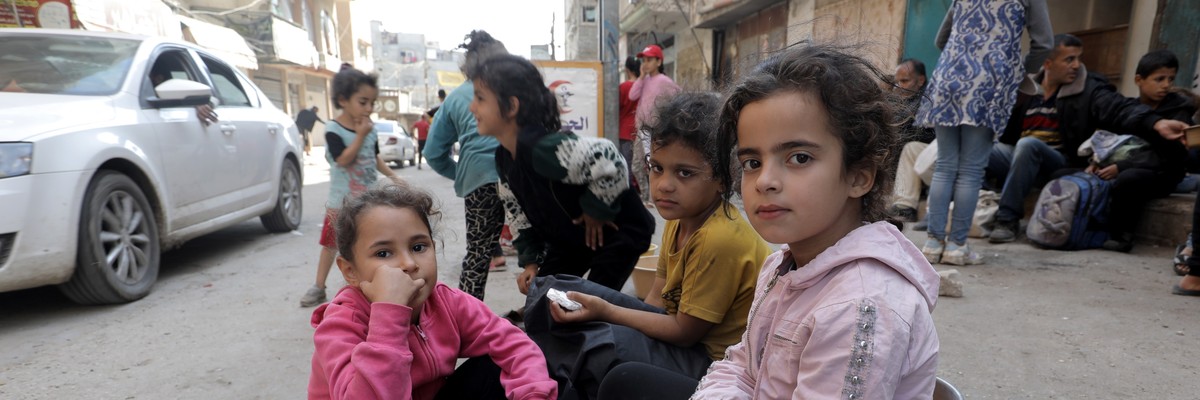
According to the World Health Organization (WHO), 1 in 6 children under 2 years of age in Gaza are acutely malnourished. The combination of food shortages, lack of clean water, and inadequate healthcare provision is having devastating effects, particularly on young children and mothers.

Many women are facing extreme difficulties in initiating and continuing breastfeeding due to their own nutritional status and stress. “People are hungry, exhausted, and traumatized,” said Adele Khodr, Regional Director of UNICEF’s Middle East and North Africa office.

The food shortage in the north is so severe that health workers report 95% of female patients are suffering from anemia. “There have been many operations performed, such as cesarean sections, to remove fetuses, [which] died of malnutrition among women,” Mohammed Salha, director of Al-Awda Hospital, told ActionAid.

Pediatricians at Kamal Adwan Hospital have reported not having the resources to treat more than half the children admitted to the hospital for malnutrition, as there is no food or medical supplement the staff can give them. “The most we can do for them is give them a saline solution or sugar solution,” physician Imad Dardonah told UN teams visiting the institution.

Israeli obstacles to aid delivery also mean that there is not enough infant formula or diapers. On the rare occasions when these essential supplies are found, their cost puts them out of reach for most of the population in Gaza.

A box of diapers in northern Gaza now costs around ILS 200 (USD 55), while monthly income before October 7, 2023, was reported around ILS 1,200 (USD 343)— not even enough to cover a newborn’s monthly supply during her first month of life, let alone food on top of that.

Restrictions are also being applied to the number of international medical teams allowed into Gaza and to field hospitals, which would allow for a partial expansion of much-needed health service capacities.

The siege is causing a devastating paradox: at the same time, there are too few health workers to respond to the needs of the population and those who have been working in Gaza’s healthcare system since October; and there are too many health workers in comparison to the operational surgery capacities—the only remaining functional operation rooms are located at the European Hospital in southern Gaza, according to surgeon Ghassan Abu Sittah.

Some countries have attempted to circumvent Israel’s aid blockade by airdropping supplies, but the amounts reaching the population in Gaza this way are nowhere near sufficient. To adequately stock hospitals and health centers, several international agencies have warned, it is paramount to ensure unimpeded passage for truck convoys carrying a wide range of supplies, not just a specific type of food or sanitary bandages.

When it comes to aid delivery, the UN humanitarian coordinator for the occupied Palestinian territories, James McGoldrick, said, “There is no alternative to food trucks, to road transports.”

Original article by Abdul Rahman and Ana Vračar republished from peoples dispatch under a Creative Commons Attribution-ShareAlike 4.0 (CC BY-SA) license.

Continue ReadingIsrael’s blocking of aid to Gaza is a weapon in its brutal war against Palestinians