For the Cuban people, surrender is not an option

Spread the love

Original article by Manolo De Los Santos republished from peoples dispatch under a Creative Commons Attribution-ShareAlike 4.0 (CC BY-SA) license.

Thousands marched on January 26, 2026 in Havana, Cuba, to honor José Martí’s legacy. Photo: Progressive International

Claims by officials in Washington that “Cuba’s collapse is imminent” usually coincide with a tightening of the blockade. Yet, once again, Cubans have reaffirmed their commitment to the revolution and their creative resistance in the face of the latest US attacks.

The halls of power in Washington are echoing with a familiar, predatory chorus. Once again, the White House, various think-tank experts, and US politicians are predicting the “imminent collapse” of Cuba. This is a tune the world has heard for over sixty years, usually sung at its highest volume whenever the United States decides to tighten the economic noose around the island’s neck. However, in 2026, the rhetoric has shifted from sanctions to an overt campaign of total strangulation. Under a new executive order signed in late January, the second Trump administration has escalated the decades-long blockade into a proactive fuel blockade.

Cuban President Miguel Díaz-Canel laid bare the intended consequences in a press conference on February 5, 2026: “Not allowing a single drop of fuel to enter our country will affect transportation, food production, tourism, children’s education, and the healthcare system.” The objective is clear: to induce systemic failure, sow popular discontent, and create conditions for political destabilization. The White House rhetoric confirms this intent. Press Secretary Karoline Leavitt’s statement on the same day, that “the Cuban government is on its last leg and its country is about to collapse,” is not an analysis but public signaling, a psychological operation meant to reinforce the narrative of inevitable doom and pressure Cuban leadership into unilateral concessions.

This policy is not merely a “sanction” in the traditional sense; it is a calculated attempt to suffocate a nation by blocking every drop of fuel from reaching its shores. The administration has authorized aggressive tariffs and sanctions on any foreign country or company that dares to trade oil with the island, effectively treating Cuban territorial waters as a zone of exclusion. Since December, multiple oil tankers headed to Cuba have been seized by US naval forces in the Caribbean or forced to return to their ports of origin under threat of asset forfeiture. In direct response to this intensifying siege, Cuba has announced sweeping fuel rationing measures designed to protect essential services. The plan prioritizes fuel for healthcare, water, food production, education, public transportation, and defense, while strictly limiting sales to private drivers. To secure vital foreign currency, the tourism sector and key export industries, such as cigar production, will continue operating. Schools will maintain full in-person primary education, with hybrid systems implemented for higher levels. The leadership of the Cuban Revolution has affirmed that Cuba “will not collapse.”

To the planners in the White House, Cuba is a 67-year-old problem to be solved with starvation and darkness. But to the Cuban people, the current crisis is a continuation of a long-standing refusal to trade their sovereignty for Washington’s demands of submission.

The ghost of the “Special Period” 

To understand why the Cuban people have not descended into the chaos Washington predicted, one must look to the historical precedent of the “Special Period in Time of Peace.” Following the collapse of the Soviet Union in 1991, Cuba experienced an economic shock that would have toppled almost any other modern state. Overnight, the island lost 85% of its international trade and nearly all of its subsidized fuel imports. The resulting statistics were staggering: the Gross Domestic Product plummeted by 35%, and the daily caloric intake of the average citizen dropped from over 3,000 calories to roughly 1,800. During this era, the lights went out across the island for more than 16 hours a day, and the bicycle became the primary mode of transportation as the public transit system collapsed.

At the same time, Washington escalated its assault through the Torricelli Act (1992) and the Helms-Burton Law (1996), each tightening the noose around Cuba’s economy. However, instead of fracturing under the weight of this tightened blockade, Cubans developed “Option Zero”, a survival plan designed to keep hospitals running and children fed without any fuel, and the Cuban social fabric tightened. The government prioritized the distribution of remaining resources to the most vulnerable, ensuring that infant mortality rates remained lower than those in many parts of the United States despite the scarcity. This period proved that when a population is politically conscious of the external forces causing their suffering, they become extraordinarily resilient. The “Special Period” was not just a time of hunger; it was a period of forced innovation that gave rise to the world’s first national experiment in organic urban farming and mass-scale energy conservation.

The return of the energy crisis

The crisis of 2026 is, in many ways, a sequel to the 1990s, but with higher stakes and more advanced technological targets. The roots of the current energy shortage can be traced back to the first Trump administration’s decision in 2019 to target Cuban oil imports as a means of punishing the island for its solidarity with Venezuela. By designating Cuba as a “State Sponsor of Terrorism” and activating Title III of the Helms-Burton Act, the US successfully scared off international shipping lines and insurance companies. This was followed by a focused campaign against the PDVSA (Venezuela’s state oil company) and the shipping firms involved in the trade agreement between countries in the region known as ALBA-TCP.

By 2025, the impact on Cuba’s energy grid was catastrophic. The island’s thermal power plants, most of which were built with aging Soviet technology, were never designed to burn the heavy, sulfur-rich crude that Cuba produces domestically without constant maintenance and expensive imported additives. The lack of foreign exchange, caused by the tightening of the blockade, meant that spare parts were non-existent. By the time the 2026 fuel blockade began, the national grid was already operating at 25% below its required capacity. President Miguel Díaz-Canel has been transparent with the public, noting that without fuel, everything from the morning school bus to the refrigeration systems for the nation’s advanced biotech medicines is under constant threat, a reality that has now precipitated the stringent new rationing regime.

The threat of intervention: from Caracas to Havana

The current US stance toward Cuba cannot be viewed in isolation from its recent military interventions in the Middle East and Latin America. The “regime change” efforts in Cuba are being modeled after the maximum pressure campaigns used against Iran and the military incursions seen in Venezuela on January 3, 2026. The threat of a US military attack is no longer a rhetorical flourish used by Havana to drum up nationalism; it is a documented strategic option discussed in Washington.

The logic behind such an intervention is twofold. First, there is the ideological drive to eliminate the “contagion” of a country that questions the Monroe Doctrine and US domination in the region. Cuba’s existence serves as a reminder that sovereignty is possible even in the shadow of a superpower. Second, and more pragmatically, the US is motivated by a thirst for strategic minerals. Cuba sits on some of the world’s largest reserves of nickel and cobalt, essential components of lithium-ion batteries that power the global transition to electric vehicles and advanced weaponry. In a world where the US is scrambling to compete with China for control of the mineral and energy supply chain, a sovereign Cuba that controls its own mines is seen as an obstacle to American hegemony. If the US can force a collapse, these minerals would no longer belong to the Cuban people; they would be auctioned off to US corporations as it was before 1959.

The new resistance: extraordinary efforts in renewable energy

However, the Cuban response to this renewed strangulation is not a white flag of surrender. Recognizing that fossil fuel dependence is a vulnerability the US will always exploit, Cuba has, in recent years, launched an extraordinary national effort to transform its energy matrix. Building on this momentum, the country completed 49 new solar parks in 2025 alone. This massive undertaking added approximately 1,000 megawatts of power to the national grid, marking a 7% increase in total grid capacity and accounting for a remarkable 38% of the nation’s energy generation. By the end of March 2026, with support from China, the island is on track to add over 150 MW of renewable power to its grid through the rapid deployment of solar parks.

The strategy is clear: if the empire can shut off the oil, Cuba will harvest the sun. “The way the US energy blockade has been implemented reinforces our commitment to the renewable energy strategy,” President Miguel Díaz-Canel declared. The government has committed to a plan to generate 24% of the country’s electricity from renewable sources by 2030, with a long-term goal of achieving total energy independence. This involves not just large-scale solar farms, but the decentralization of the grid through the installation of thousands of small-scale solar panels on homes and state buildings. This “energy sovereignty” movement is the 21st-century equivalent of the 1990s urban gardens. It is a way of overcoming the US blockade by removing the very commodity, oil, that Washington uses as a leash.

The narrative of Cuba’s “imminent collapse” has been written a thousand times by people who do not understand the depth of the island’s historical memory. The 2026 fuel blockade is a brutal crime against a civilian population, designed to create the very chaos that the US media then reports on as “proof” of government failure. It is the arsonist blaming the house for being flammable. The newly imposed fuel rationing is not a sign of surrender, but a tactical maneuver of national defense, a structured effort to outlast the assault while safeguarding the pillars of Cuban society that precisely make it an alternative to the US model.

Yet, Cuba’s message to the world remains consistent. They are willing to talk and trade, but not to be owned or become a neo-colony of the United States. The story of Cuba is not one of a failed state, but of a people who have decided that the most potent fuel for their future isn’t oil, it’s the will to remain independent. As the sun rises over the new solar arrays in the Cuban countryside, it serves as a silent, glowing testament to a nation that refuses to disappear.

Manolo De Los Santos is Executive Director of The People’s Forum and a researcher at Tricontinental: Institute for Social Research. His writing appears regularly in Monthly Review, Peoples Dispatch, CounterPunch, La Jornada, and other progressive media. He coedited, most recently, Viviremos: Venezuela vs. Hybrid War (LeftWord, 2020), Comrade of the Revolution: Selected Speeches of Fidel Castro (LeftWord, 2021), and Our Own Path to Socialism: Selected Speeches of Hugo Chávez (LeftWord, 2023).

Original article by Manolo De Los Santos republished from peoples dispatch under a Creative Commons Attribution-ShareAlike 4.0 (CC BY-SA) license.

Donald Fuhrump says that Amerikkka doesn't bother with crimes or charges anymore, not being 100% Amerikkkan and opposing his real estate intentions is enough.
Donald Fuhrump says that Amerikkka doesn’t bother with crimes or charges anymore, not being 100% Amerikkkan and opposing his real estate intentions is enough.
Elon Musk urges you to be a Fascist like him, says that you can ignore facts and reality then.

Continue ReadingFor the Cuban people, surrender is not an option

Oil and Gas Trade Group Blasts Reform’s Anti-Renewables Agenda

Spread the love

Original article by Adam Barnett republished from DeSmog.

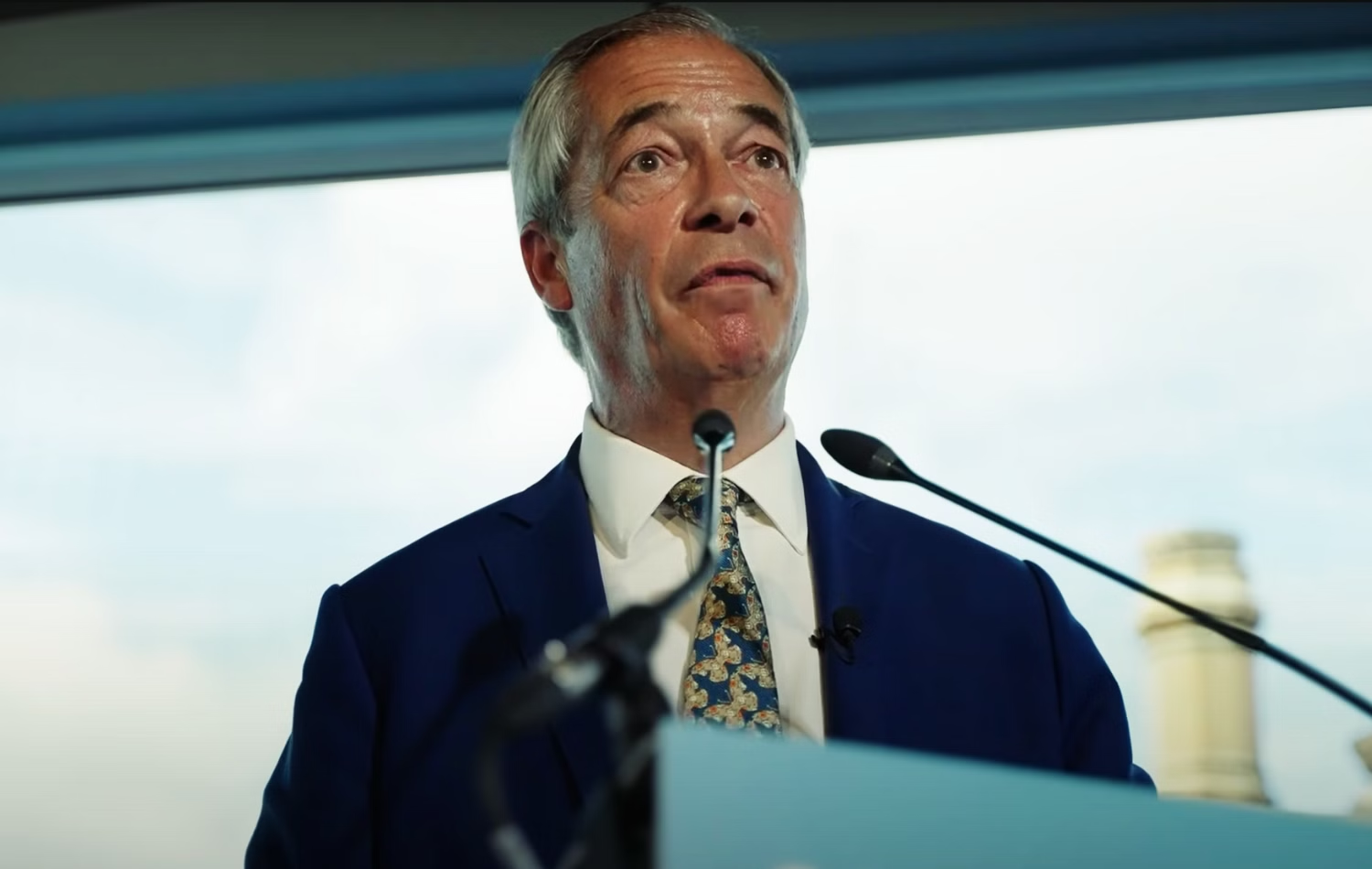
Reform UK leader Nigel Farage speaking in Aberdeen. Credit: Reform UK / YouTube

Nigel Farage’s party was told by Offshore Energies UK to rethink its plan to thwart clean energy.

LIVERPOOL – The UK’s largest oil and gas trade body has criticised Reform UK’s plans to “turn off the tap” on renewable energy.

Nigel Farage’s party has tried to present itself as the oil and gas industry’s closest ally, vowing to “drill, baby, drill” in the North Sea and scrap the windfall tax on excess profits, while meeting with oil executives, and courting donations from the sector.

However, on a panel at the Labour Party’s annual conference in Liverpool on Monday (29 September), a spokesperson for Offshore Energies UK (OEUK) criticised Reform’s plans to end state support for clean energy.

Natalie Coupar, communications and marketing director at OEUK – members of which include fossil fuel giants BP, Shell, ExxonMobil, TotalEnergies, and Equinor – said the group is “apolitical” but gives “hard truths to all parties”.

She said: “One of the things we’ve been saying to Reform very much is, you know, if you’re going to turn on the taps for oil and gas, there’s almost really no point if you’re just going to turn off the taps to renewables.

“That doesn’t help. We need to keep both those streams open.”

According to the Confederation of British Industry (CBI), the UK’s net zero economy grew by 10 percent in 2024, employing almost a million people in full-time jobs.

Coupar also said it was essential to “hold the consensus on tackling climate change and growing our energy future”.

A panel at 2025 Labour Party conference sponsored by Offshore Energies UK (OEUK). Credit: DeSmog

Reform’s Oil Campaign

Reform has vowed to stop all government subsidies for renewable energy, and has pledged to block solar and onshore wind farms in the local authorities it controls.

In May, the party’s deputy leader Richard Tice said: “Whether it’s planning blockages, whether it’s judicial reviews, whether it’s lawsuits, whether it’s health and safety notices, we will use every available legal measure to an extreme way in order to frustrate these people.”

Tice – who has said “there’s no evidence that man-made CO2 is going to change the climate” – met with senior oil executives in May and promised to approve new drilling licences “on day one” of a Reform government.

Last month, he pledged to overturn the UK’s ban on fracking for shale gas, which he calls “treasure beneath our feet”, and told the industry to “get ready”.

In April, Reform party treasurer and a billionaire property developer Nick Candy said he was trying to secure donations from oil and gas executives, claiming to have raised £100,000 from one, though this has yet to appear on Reform’s donations register.

As DeSmog has reported, 92 percent of Reform’s funding between the 2019 and 2024 general elections came from climate science deniers or those with highly polluting interests – a total of £2.3 million.

Since his election as an MP last year, Farage has spoken at a string of events in the U.S. organised by radical groups backing U.S. President Donald Trump’s pro-fossil fuel agenda. Last December, Farage launched the UK-EU branch of the Heartland Institute, a U.S. climate denial think tank.

Speaking at the Alliance for Responsible Citizenship conference in London in February, Farage claimed it was “absolutely nuts” for CO2 to be considered to a pollutant. However, he added: “I’m not a scientist. I can’t tell you whether CO2 is leading to warming or not, but there are so many other massive factors.”

Climate scientists at the UN’s Intergovernmental Panel on Climate Change (IPCC), the world’s leading climate science body, have stressed that “it is a statement of fact, we cannot be any more certain; it is unequivocal and indisputable that humans are warming the planet”.

Original article by Adam Barnett republished from DeSmog.

Nigel Farage urges you to ignore facts and reality and be a climate science denier like him and his Deputy Richard Tice. He says that Reform UK has received £Millions and £Millions from the fossil fuel industry to promote climate denial and destroy the planet.
Elon Musk urges you to be a Fascist like him, says that you can ignore facts and reality then.
Nigel Farage reminds you that he's the man that brought you Brexit and asks what could possibly go wrong.
Nigel Farage reminds you that he’s the man that brought you Brexit and asks what could possibly go wrong.

Continue ReadingOil and Gas Trade Group Blasts Reform’s Anti-Renewables Agenda

Tony Blair opposes phasing out fossil fuels. These academics disagree

Spread the love

Jack Marley, The Conversation

Rapidly phasing out fossil fuels and limiting energy consumption to tackle climate change is “a strategy doomed to fail” according to former UK prime minister Tony Blair.

In the foreword of a new report, Blair urges governments to rethink their approach to reaching net zero emissions.

Instead of policies that are seen by people as involving “financial sacrifices”, he says world leaders should deploy carbon capture and storage, including technological and nature-based approaches, to meet the rising demand for fossil fuels.

But speak to many academic experts on climate change and they will tell a very different story: that there is no strategy for addressing climate change that does not involve ending, or at least massively reducing, fossil fuel combustion.


This roundup of The Conversation’s climate coverage comes from our award-winning weekly climate action newsletter. Every Wednesday, The Conversation’s environment editor writes Imagine, a short email that goes a little deeper into just one climate issue. Join the 45,000+ readers who’ve subscribed.


A fossil fuel phase-out is ‘essential’

“There is a wealth of scientific evidence demonstrating that a fossil fuel phase-out will be essential for reining in the greenhouse gas emissions driving climate change,” says Steve Pye, an associate professor of energy at UCL.

“I know because I have published some of it.”

Ed Hawkins, a climate scientist at the University of Reading, agrees.

“Rapidly reducing our reliance on fossil fuels, and not issuing new licenses to extract oil and gas, is the most effective way of minimising future climate-related disruptions,” he says.

“The sooner those with the power to shape our future recognise this, the better.”

Fossil fuels are responsible for 90% of the carbon dioxide heating the climate. The amount burned annually is still rising, and so is the rate at which the world is getting hotter. Scientists now fear we are approaching irreversible tipping points in the climate system, hence their support for an urgent replacement of fossil fuels with renewable energy.

Blair is confident that an emergency response on this scale can be avoided by absorbing CO₂ immediately after burning fossil fuels, from the smokestacks where the greenhouse gas is concentrated.

Not all of the emissions responsible for climate change would be prevented. UCL earth system scientist Mark Maslin says that natural gas, which would linger as an energy source thanks to carbon capture, still leaks from pipelines and storage vessels upstream of power plants.

Commercial applications of the technology also have a poor track record. Just two large-scale coal-fired power plants are operating with CCS worldwide – one in the US and one in Canada.

“Both have experienced consistent underperformance, recurring technical issues and ballooning costs,” Maslin says.

A valve and an oil derrick at dusk.
CCS is no alternative to turning off the fossil fuel taps. Pan Demin/Shutterstock

Blair might baulk at what he perceives to be the expense of ditching fossil fuels. But economic modelling led by Oxford University’s Andrea Bacilieri suggests his concern is misplaced. A rapid phase-out of fossil fuels could save US$30 trillion (US$1 trillion a year) by 2050 she concludes, compared with allowing power plants and factories to keep burning them with CCS.

Developing CCS will be necessary to help manage an orderly transition from fossil fuels according to Myles Allen, a professor of geosystem science at Oxford University. But it is not a substitute for undergoing that transition, he says.

“Above all, we need to make sure the availability of CCS does not encourage yet more CO₂ production.”

Keeping the public on board

Is Blair right to fret about a public backlash to lower energy use? Academics suggest multiple reasons to think otherwise if the alternative is prolonging the use of fossil fuels.

Replacing a gas boiler with a heat pump that runs on electricity, for example, can lower a household’s energy consumption without a deliberate effort. That’s because renewable appliances convert power to heat more efficiently (how much depends on how well insulated the home is).

In fact, it’s dependence on fossil fuel that is preventing many households from making this switch. The high wholesale price of gas determines the cost of electricity for UK consumers.

And surveys repeatedly show that support for net zero policies is broad and deep in the UK – including those that would involve lifestyle changes say Lorraine Whitmarsh (University of Bath), Caroline Verfuerth and Steve Westlake (both Cardiff University), who research public behaviour and climate change.

“Crucially, the public wants and needs the government to show clear and consistent leadership on climate change,” they say.

Meanwhile, what can corrode public acceptance of sacrifices is the high-consuming behaviour of a minority (think pop stars in rockets, as Westlake recently argued). And, arguably, the statements of powerful people like Blair.

New research even suggests the politics that Blair and many others like him favour might also play a role here. Felix Schulz (Lund University) and Christian Bretter (The University of Queensland) are social scientists who study how ideology affects personal views on climate policy.

They identified respondents in six countries (the UK, US, Germany, Brazil, South Africa and China) who shared Blair’s neoliberal worldview, which the pair define as a belief that individuals are primarily responsible for their own fortune, and need to take care of themselves – as well as an abiding faith in the free market.

“We observed a strong link between a neoliberal worldview and lack of support for the climate policies in our study,” they say.

Schulz and Bretter urge us to consider how someone’s ideology ultimately shapes their understanding of the problem and its solutions as well.

Jack Marley, Environment + Energy Editor, The Conversation

This article is republished from The Conversation under a Creative Commons license. Read the original article.

Continue ReadingTony Blair opposes phasing out fossil fuels. These academics disagree

Starmer’s latest con job

Spread the love

https://morningstaronline.co.uk/article/starmer’s-latest-con-job

SELF-DECEPTION: A 245-tonne steel dome is lifted onto Hinkley Point C’s first reactor building, at Bridgwater, Somerset on December 15 2023 – note the slogan on the banner

The government’s nuclear power expansion plan is a hollow betrayal of working people that panders to wealthy corporations and will rip off consumers, writes LINDA PENTZ GUNTER

The restriction on building new reactors on existing nuclear sites is to be lifted so they could be built anywhere and everywhere and people who “hadn’t thought there’s going to be anything nuclear near me” will simply “get used to the idea of it,” Starmer said.

The whole thing is of course a massive con that would, if such a plan ever materialised, dramatically raise electricity rates, further fleece taxpayers, impede real progress on climate by diverting money away from already available renewable energy solutions, and put countless communities in danger.

And of course, what will become of the radioactive waste these “small” reactors would still produce? A recent Stanford study found that small modular reactors will actually generate more radioactive waste than conventional nuclear power plants.

Unions should not be fooled. Promising jobs that will likely never materialise and would be better created immediately in industries such as renewable energy that are here now and have a long-term future, isn’t a boon to working people, it’s yet another betrayal.

Further, nuclear power, as the industry has itself demonstrated over and over, is the slowest and most expensive energy choice among the so-called low-carbon options.

No nuclear reactor, small or otherwise, will ever be built in time, affordably or in enough quantities to address the climate crisis that is already upon us.


https://morningstaronline.co.uk/article/starmer’s-latest-con-job

Keir Starmer warns against following the https://onaquietday.org blog.

Continue ReadingStarmer’s latest con job

26 Climate-Fueled Extreme Weather Events Killed at Least 3,700 People in 2024: Report

Spread the love

Original article by Jake Johnson republished from Common Dreams under Creative Commons (CC BY-NC-ND 3.0).

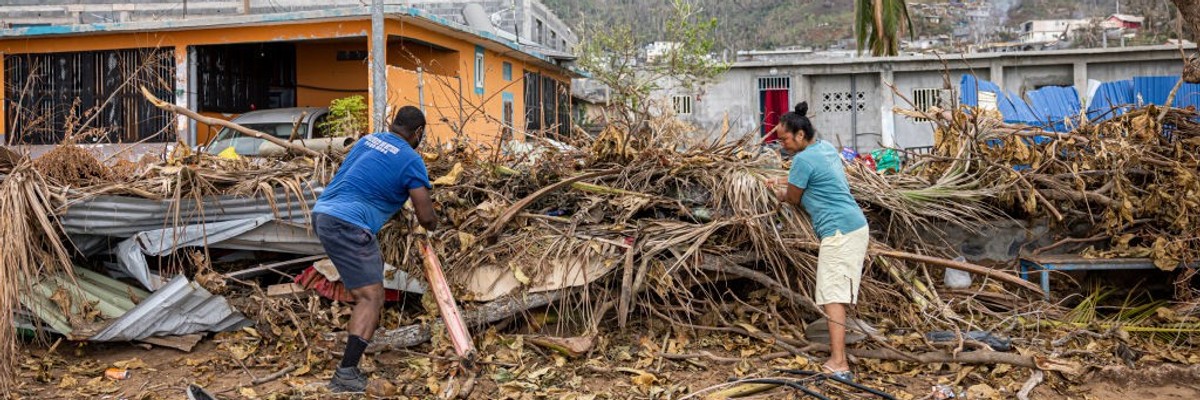
Residents collect garbage and debris to burn in the town of Acoua after Cyclone Chido wreaked havoc on the French island territory of Mayotte on December 25, 2024. (Photo: Patrick Meinhardt/AFP via Getty Images)

“This exceptional year of extreme weather shows how dangerous life has already become… and highlights the urgency of moving away from planet-heating fossil fuels as quickly as possible.”

Just over two dozen climate-fueled extreme weather events killed at least 3,700 people worldwide and displaced millions in 2024, according to a report published Friday as the hottest year on record drew to a close.

The new analysis from World Weather Attribution (WWA) and Climate Central states that extreme weather “reached dangerous new heights in 2024” as “record-breaking temperatures fueled unrelenting heatwaves, drought, wildfire, storms, and floods that killed thousands of people and forced millions from their homes.”

“This exceptional year of extreme weather shows how dangerous life has already become with 1.3°C of human-induced warming, and highlights the urgency of moving away from planet-heating fossil fuels as quickly as possible,” said the two organizations, which examined 26 destructive weather events that occurred in 2024—a fraction of the hundreds that took place globally this year.

Those 26 events—from Hurricane Helene in the United States to the typhoon that hammered the Philippines, China, and Taiwan— caused close to 4,000 deaths, according to WWA and Climate Central.

“It’s likely the total number of people killed in extreme weather events intensified by climate change this year is in the tens, or hundreds of thousands,” the analysis states.

“Extremes will continue to worsen with every fraction of a degree of fossil fuel warming.”

Around the world, the fossil fuel-driven climate emergency added, on average, 41 additional days of dangerous heat this year, Climate Central found.

“The countries that experienced the highest number of dangerous heat days are overwhelmingly small island and developing states, who are highly vulnerable and considered to be on the frontlines of climate change,” the analysis says.

WWA and Climate Central said their findings should spur global action to shift away from fossil fuel, the burning of which is “the primary reason extreme weather is becoming more severe,” they said.

“Extremes will continue to worsen with every fraction of a degree of fossil fuel warming,” WWA and Climate Central added. “A rapid move to renewable energy will help make the world a safer, healthier, wealthier, and more stable place.”

Original article by Jake Johnson republished from Common Dreams under Creative Commons (CC BY-NC-ND 3.0).

Continue Reading26 Climate-Fueled Extreme Weather Events Killed at Least 3,700 People in 2024: Report