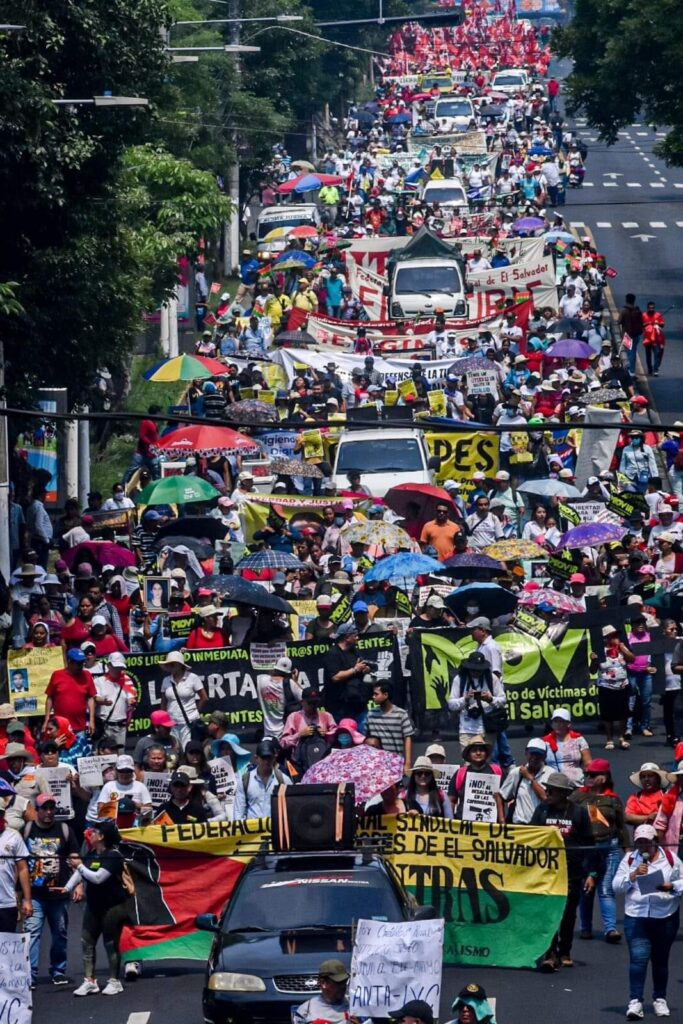
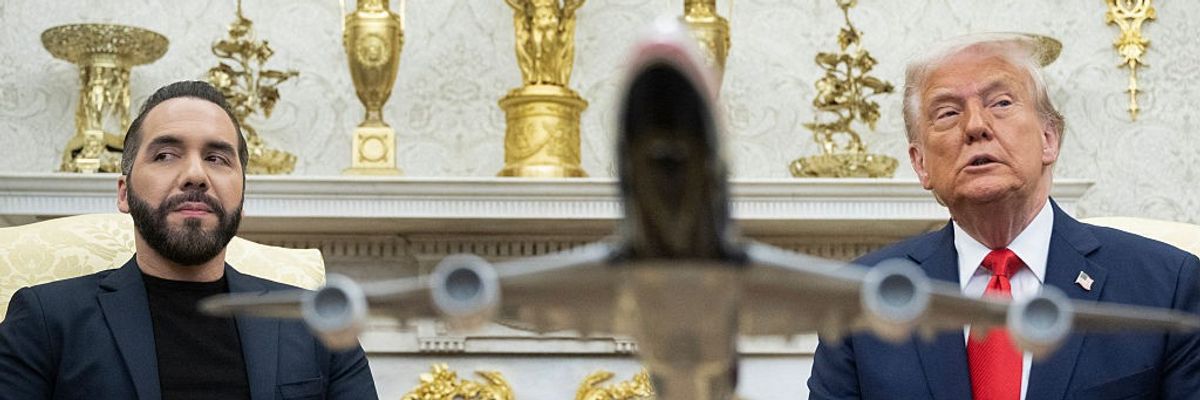
Nayib Bukele: The Dark Side of the “World’s Coolest Dictator”

Spread the love

Original article by Alan Macleod republished from MPN under a Creative Commons Attribution-NonCommercial-ShareAlike 3.0 International License.

The Trump administration’s deal to send large numbers of people to prisons in El Salvador has thrust its president, Nayib Bukele, into the international spotlight. Bukele has been praised, especially in conservative media, as a dynamic and popular leader who has saved his country from the grips of gang violence. But beneath this polished image, he has cemented his rule based on assigning himself autocratic powers, jailing and persecuting his political opponents, and overseeing the creation and expansion of the world’s first prison state. MintPress News explores the dark side of the man who calls himself “the world’s coolest dictator.”

Cruelty is the Point

The hundreds of migrant detainees the U.S. sent to Central America should be kept in Salvadoran jails “for the rest of their lives,” according to Homeland Security Secretary Kristi Noem in an April interview.  This is despite the fact that a Bloomberg investigation found that around 90% of those deported have no criminal records or charges against them.

Noem’s words reflect an administration eager to find a partner willing to help them outsource America’s prison-industrial complex. In February, Salvadoran President Nayib Bukele offered to use El Salvador’s sprawling and rapidly growing network of jails to receive thousands of “dangerous American criminals” for a fraction of the cost of detaining them in the United States. “No country has ever made an offer of friendship such as this,” said a delighted Secretary of State Marco Rubio, a strong Bukele supporter.

The migrants have been sent to the Terrorism Confinement Center (Centro de Confinamiento del Terrorismo, or CECOT), a $115 million facility widely criticized by human rights groups that opened its doors in October 2023. The 23-hectare site is situated in a rural area of the country, around 70 km (45 miles) from the capital, San Salvador, and is set to house 40,000 people, making it, by quite some margin, the largest prison in world history.

Conditions inside the jail have been widely condemned. Those incarcerated are packed into cells of up to 100 people. Sleeping on metal or concrete bunks, inmates must defecate in front of their cellmates. A 2024 report from the Inter-American Commission on Human Rights found an average of just 0.6 square meters (6.45 square feet) per inmate. Lights are kept on 24 hours a day.
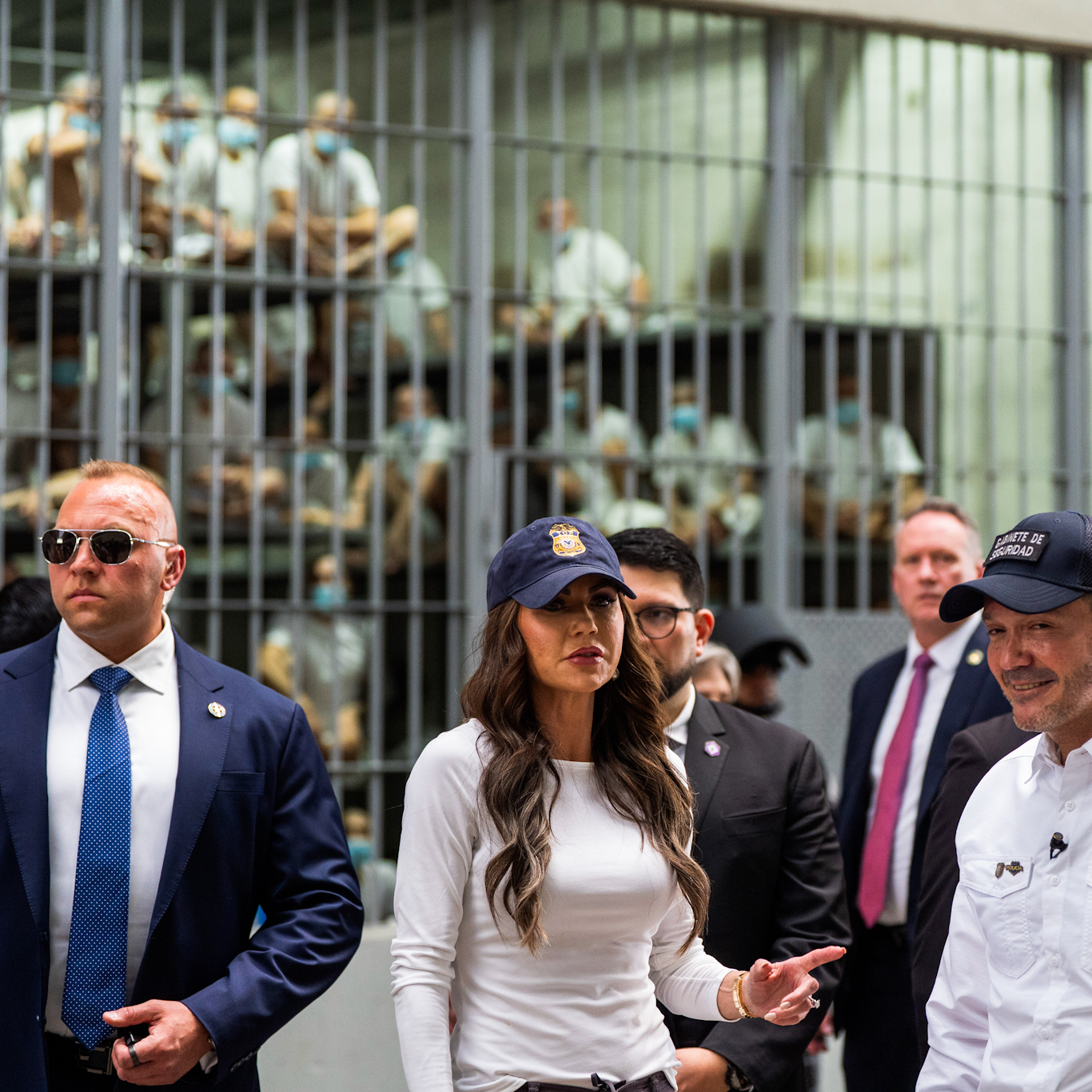
Kristi Noem and Héctor Villatoro tour El Salvador’s Terrorist Confinement Center, March 2025
Kristi Noem tours El Salvador’s mega-prison with Minister Héctor Villatoro, March 26, 2025. Alex Brandon | AP

The food is as sparse as the personal space. Detainees are fed just 450 grams of the same meal every day, consisting of beans, pasta and tortillas, along with coffee or another drink. Provided no utensils, they must eat with their hands only.

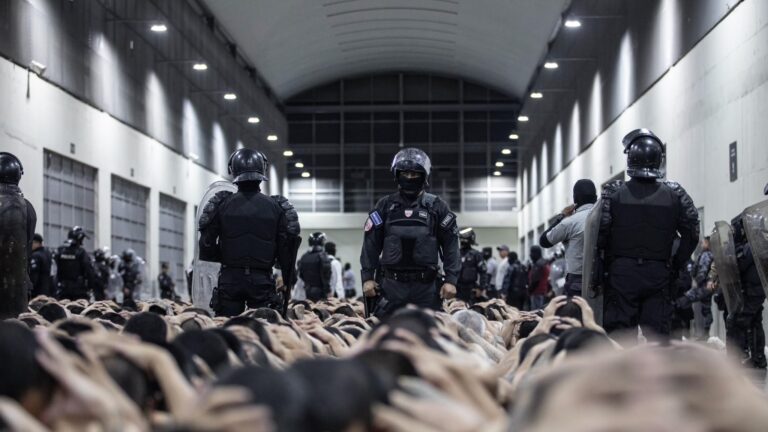
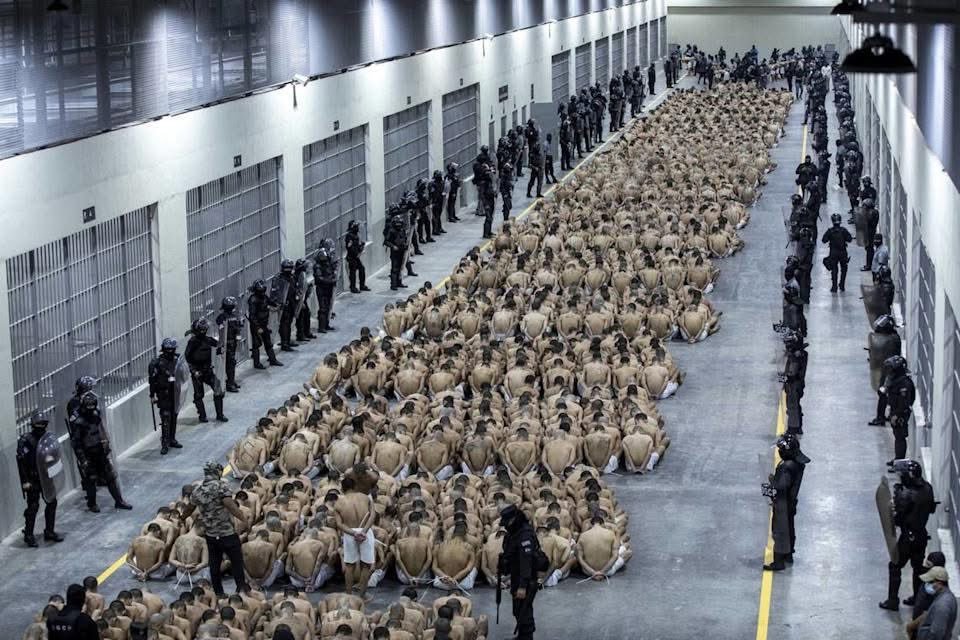
CECOT offers no outside recreation space, and those inside are allowed only 30 minutes per day out of their cells. Upon arrival, prisoners have their heads shaved, and are often forced to sit close together in formations resembling the conditions on trans-Atlantic slave ships. They are not allowed any contact with their friends, family, or lawyers. Often, the first news a family receives of the whereabouts of their disappeared relative is a note explaining that they have died in prison. The Bukele administration has made clear that they intend to make sure those inside CECOT’s walls “will never leave.”

The Trump administration had shown little concern for the reported condition at CECOT. In March, Noem herself traveled to the complex to pose in front of dozens of incarcerated people, warning others that they could be next. The Trump administration has justified its move as legal under an obscure law from 1798, and claimed that those deported were members of Tren de Aragua, a Venezuelan criminal group.

Prison Nation

Yet the conditions at CECOT are actually considerably better than at many other Salvadoran jails, as it is one of the few facilities not (yet) overflowing with inmates. In 2022, under the rubric of fighting gang violence, Bukele declared a state of exception, suspending civil liberties and overseeing the arrest and imprisonment of 85,000 people. The prison population has tripled in just a few years, to the point where around 2% of the country’s adult population is behind bars—equivalent to roughly seven million Americans.

“El Salvador, under the dictatorship of Nayib Bukele, has overtaken the U.S. as the global leader in incarcerating its own people,” Wanda Bertram, a spokesperson for the Prison Policy Initiative, told MintPress News. Today, the country imprisons more than twice as many people per capita as the next highest nation. “As horrific as El Salvador’s mass incarceration program is, we shouldn’t overlook that it had a clear role model in the United States,” she added, pointing out that nearly half of all U.S. adults have an immediate family member who has been incarcerated.

Few of those caught up in Bukele’s massive dragnet have had due process. Unable to prove their guilt or connections to MS-13 or other gangs, prosecutors continue to extend their pretrial detentions. Torture is widespread. “It’s a system that by design is mistreating and torturing people,” said Ana Piquer, Amnesty International’s Americas Director. Hundreds have died in custody.

Since he declared the state of exception, Bukele’s forces have arrested at least 3,000 children. Far from releasing them, in February, the president signed a bill into law transferring child detainees into adult prisons.

The U.S. government is intimately aware of the nature of Bukele’s rule. A 2023 State Department report detailed widespread abuses, including:

[U]nlawful or arbitrary killings; enforced disappearance; torture or cruel, inhuman, or degrading treatment or punishment by security forces; harsh and life-threatening prison conditions; arbitrary arrest or detention; [and] serious problems with the independence of the judiciary.”

It also noted that, even before the massive surge in prisoner numbers, conditions inside Bukele’s jails were “harsh and life-threatening,” and recounted how prison guards beat victims to death and used electric stun guns on the prison’s wet floors to deliver shocks to prisoners en masse.

Osiris Luna, the director of El Salvador’s prison system, had been sanctioned by the U.S. government for his role in “gross human rights abuses.”

Despite the long list of documented abuses, the Trump administration has chosen El Salvador as the location to dump migrants and has promised that this is the beginning of a long partnership between the two nations.

“Salvadoran prisons are the product of the U.S. justice department, Drug Enforcement Agency, and other officials’ work in Latin America over the course of the decades. The United States has aided and abetted the construction of these gulags of the Americas. And so, in a lot of ways, Bukele is a monster made in the U.S.,” Roberto Lovato, a Salvadoran-American writer and professor at the University of Nevada, Las Vegas, told MintPress News.
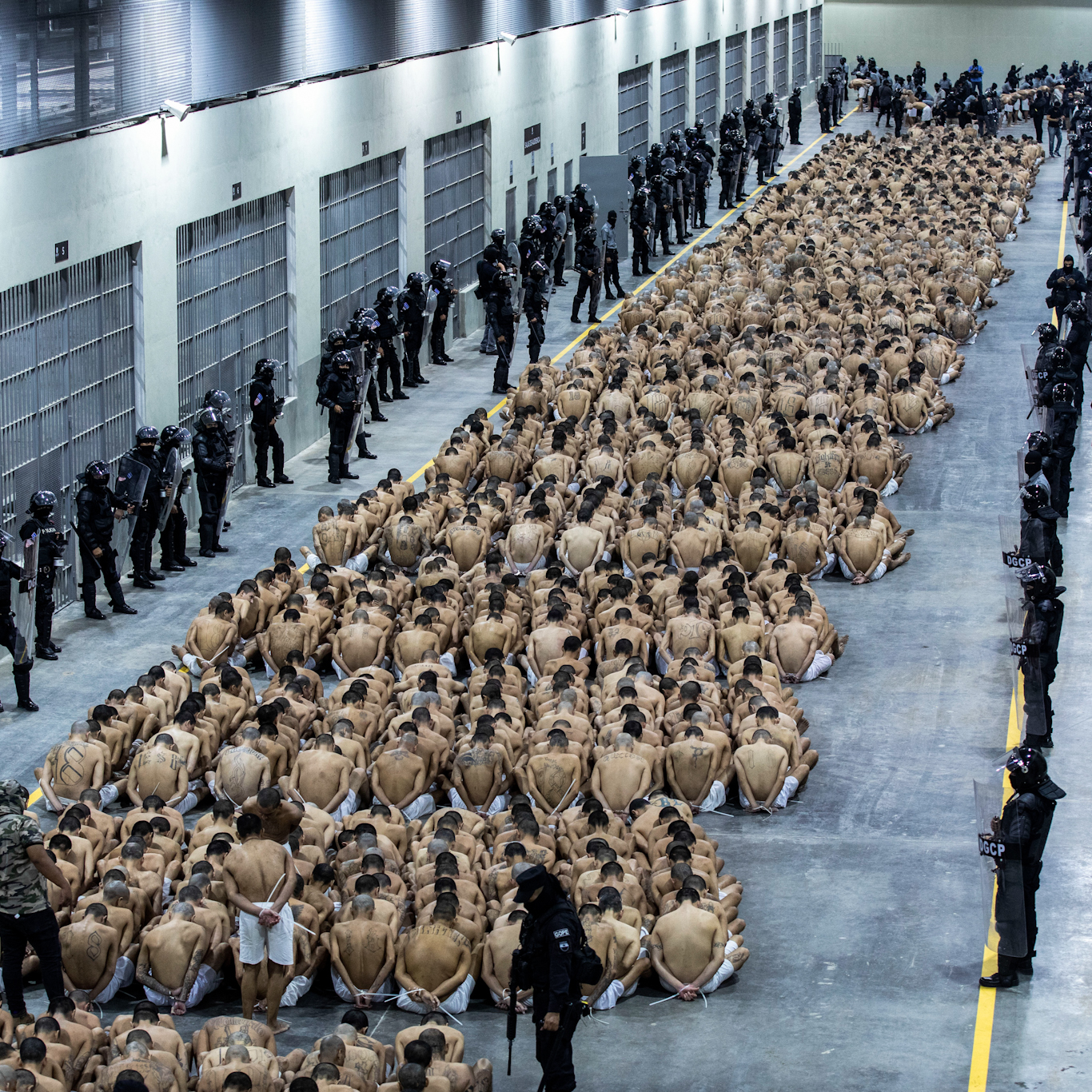
Inmates seated in El Salvador's mega-prison, March 2023
Accused gang members sit on the floor of El Salvador’s Terrorism Confinement Center, March 15, 2023. Via AP

“The combination of importing U.S. prison and gang culture with U.S. government-funded digital technology applied to politics is how we get Bukele now,” he added. Lovato’s 2020 memoir, “Unforgetting: A Memoir of Family, Migration, Gangs, and Revolution in the Americas,” explores the relationship of violence between the U.S. and El Salvador.

President Bukele has justified the crackdown as a necessary response to the country’s overwhelming organized crime problem, with groups such as MS-13 and Barrio 18 terrorizing the nation. His uncompromising approach has produced results: El Salvador’s official murder rate has fallen dramatically, and many say the country’s streets are safe again. His policies have certainly gained him significant public backing and praise in the West.

“Nayib Bukele’s iron fist has transformed El Salvador,” wrote Time magazine, noting he is “arguably the most popular head of state in the world.” He also has a fan in billionaire turned government official Elon Musk, who met with him in September, describing him as an “amazing leader.” Bukele’s achievements, including the drop in homicides, Musk later stated that such policies, “need to happen and will happen in America.”

One major issue with this narrative, however, is that as soon as the state of exception was declared, the government began radically undercounting homicides by changing the way deaths were recorded. As Foreign Policy noted, unidentified bodies, or those discovered in mass graves, were no longer classified as homicides, nor were prison homicides, or individuals killed by Bukele’s police or security forces, a number known to total in the hundreds.

Persecuting Opponents

El Salvador’s youngest president has used these same security forces to attack those who oppose him, such as union leaders and human rights campaigners.

In January, the spokesperson for the Human Rights and Community Defense Union, along with 20 local leaders fighting the eviction of hundreds of families from their land, were arrested and absorbed into the country’s sprawling prison network. Public union leaders who organized a protest against the government’s failure to pay its workers were also jailed. Likewise, officials and activists from the country’s main left-wing political party, the FMLN (in power between 2009 and 2019), are prime targets.

Journalists unwilling to toe the official line have faced scrutiny and persecution. A 2022 report from Citizen Lab and Amnesty International found Pegasus spyware on the devices of dozens of Salvadoran reporters and civil society leaders.

Outlets critical of Bukele have been subjected to costly audits and other legal measures to financially cripple them. In 2023, El Faro, one of the nation’s leading outlets, moved its operations to neighboring Costa Rica, citing ongoing threats against its staff. “The dismantling of democracy, the lack of checks and balances on the exercise of power of a small group of people, the attacks against press freedom, and the shuttering of all transparency and accountability mechanisms gravely threaten Salvadorans’ right to be informed,” its editorial board lamented.

Another potential check on Bukele’s power is the judiciary, and the president has taken steps to dismantle it, replacing older judges with loyalists and packing the courts. In 2021, in what was widely described as a “self-coup,” he swiftly removed the Attorney General and five judges from the Supreme Court.

With few impediments to his power, Bukele could then concentrate on implementing his agenda of economic shock therapy, which largely consisted of firing tens of thousands of public workers and reducing taxes on the rich and the international business community.

More than 22,000 public sector employees have been laid off in a country of only 6.3 million people. Most of them have not received their legally mandated compensation, and some of those who protested have been arrested.

Bukele has been careful to enrich his backers in El Salvador’s business community. Indeed, he has gone so far as to announce his intent to charge municipal governments who do not lower business taxes with “extortion”—a crime usually associated with organized criminal groups. In a country supposedly fighting an all-out war against gangs, the consequences of being labeled as such could be severe.

Another of Bukele’s projects is to try to turn El Salvador into a tech hub, building data centers and science parks across the country. To much international fanfare, in 2021, he made Bitcoin legal tender, although it failed to gather significant domestic traction. He has also used social media to carefully craft his image as a maverick risk-taker. Lovato was unimpressed by Bukele’s branding, telling MintPress:

El Salvador is a digital dictatorship. It is innovating fascism for the digital age. The country has always been a laboratory for U.S. repression tactics. Both Democrat and Republican administrations would study and experiment with everything from death squads, torture, surveillance technology, and now imprisonment in El Salvador, and then they would bring it back to the U.S.”

Made in the USA

Internationally, Bukele has aligned himself with the Trump administration and the global right-wing movement. This has included Israel.

Despite being a member of El Salvador’s large Palestinian diaspora, Bukele has made pains to associate himself with Tel Aviv. In 2019, he traveled to Jerusalem to meet with local officials and to be photographed at the Western Wall. And in the wake of the October 7 attack, he described Hamas as “savage beasts” and said that the “best thing that could happen to the Palestinian people is for Hamas to completely disappear.”

The conditions that led to El Salvador’s poverty and Bukele’s rise were intimately shaped by the United States. Throughout the late twentieth century, successive administrations provided the cash, weapons, and training for far-right death squads to rampage throughout Central America, in an attempt to suppress the then-armed FMLN guerrillas.

Trade policies, crafted in Washington, locked El Salvador into a dependent relationship with the U.S., turning the country into a source of cheap labor, where American corporations could outsource poorly-paid jobs, like those in textiles. Predictably, millions of Salvadorans attempted to escape this fate. Two and a half million have moved to the United States. Around half of those living there now are undocumented, meaning that they could be swept up by the very system Bukele is enabling Trump to roll out. Remittances continue to sustain the economy. Furthermore, the insatiable appetite for drugs in the U.S. has left deep scars on the Central American nation, as rival cartels vie for supremacy and control over the lucrative drug trade.

Rather than stop the harm that is triggering it in the first place, Washington’s solution to the predictable migrant wave is to militarize the border, using many of the tactics honed by the same death squads it funded in the 1980s.

Perhaps most ominously, the Trump administration is looking to drastically expand the outsourcing of the carceral state to El Salvador, including sending American citizens to the country.

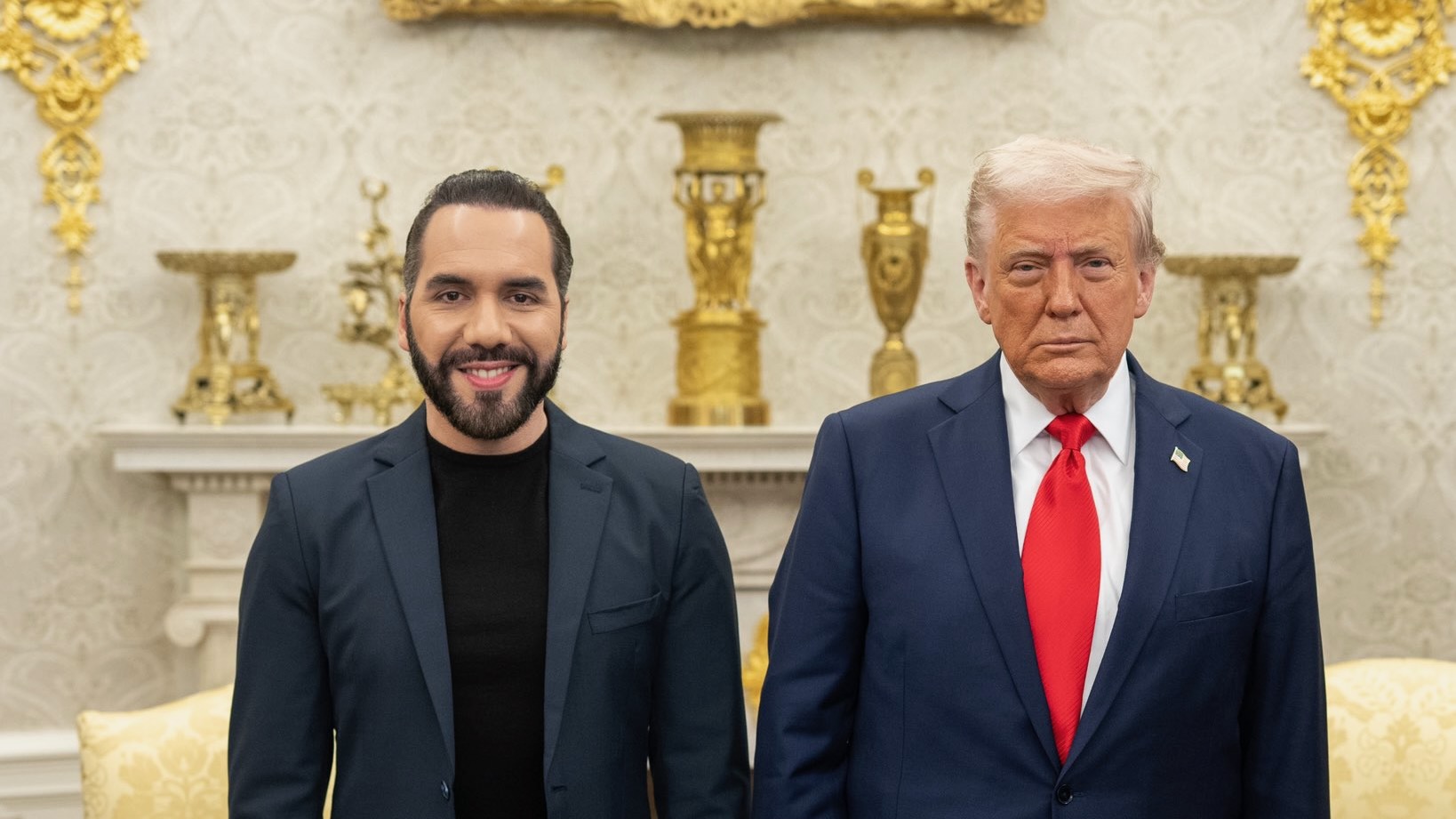
In a meeting between the two presidents in the Oval Office in April, Trump stated that “Home-growns are next. The home-growns. You have got to build about five more places. It [CECOT] is not big enough.” Bukele appeared delighted by the proposal. “Yeah, we’ve got space,” he replied.

This development has shocked onlookers. “The U.S. system of mass incarceration is already draconian, oppressive, and racist. Sending U.S. citizens to El Salvador would be an extremely dark turn for an already misguided system,” Bertram told MintPress.

“El Salvador serves the U.S. as a laboratory of repression,” Lovato said:

Just as the U.S. provided El Salvador with schools of oppression, like the School of the Americas. And now we see what I call the Salvadorization of the United States. The wealth gap between rich and poor has reached Latin American proportions, and even surpassed them. The dismantling of the welfare state, coup attempts, mass imprisonment, counterinsurgency theory and practice, the militarization of the police. The U.S. is becoming a Latin American country in many ways, and therefore, it is having to learn repression techniques from places like El Salvador.”

It is, therefore, crucial for those wishing to understand American politics to study the Salvadoran model. “If you want to look to the future of the U.S., you can look at the history of El Salvador, and you can see some of the things that are coming our way now. And we should be signaling red alert,” Lovato said.

Feature photo | Illustration by MintPress News

Alan MacLeod is Senior Staff Writer for MintPress News. He completed his PhD in 2017 and has since authored two acclaimed books: Bad News From Venezuela: Twenty Years of Fake News and Misreporting and Propaganda in the Information Age: Still Manufacturing Consent, as well as a number of academic articles. He has also contributed to FAIR.orgThe GuardianSalonThe GrayzoneJacobin Magazine, and Common Dreams.

Follow Alan on Twitter for more of his work and commentary: @AlanRMacLeod.

Original article by Alan Macleod republished from MPN under a Creative Commons Attribution-NonCommercial-ShareAlike 3.0 International License.

Neo-Fascist Climate Science Denier Donald Trump says Burn, Baby, Burn.
Elon Musk urges you to be a Fascist like him, says that you can ignore facts and reality then.
Continue ReadingNayib Bukele: The Dark Side of the “World’s Coolest Dictator”

Trump White House Mocks Abrego Garcia—and Provides ‘More Evidence of Contempt’ of Court

Spread the love

Original article by Julia Conley republished from Common Dreams under Creative Commons (CC BY-NC-ND 3.0). 

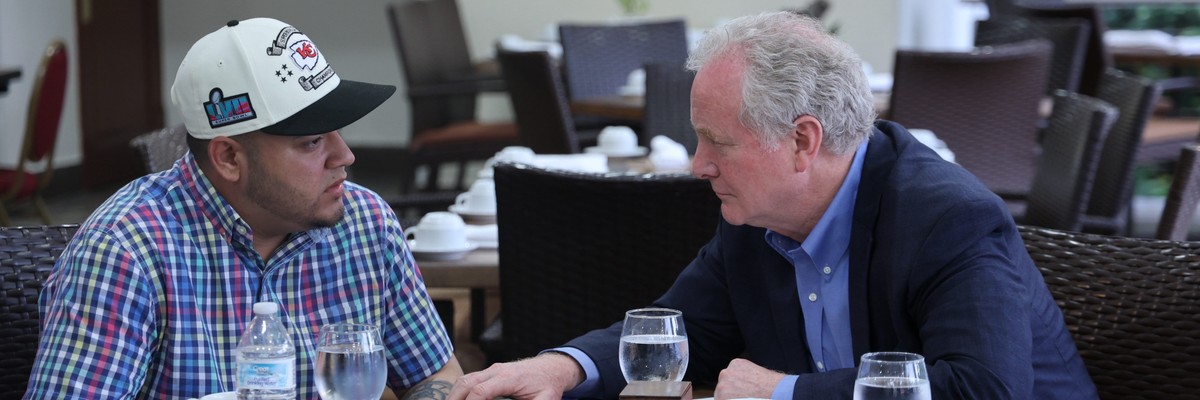
U.S. Sen. Chris Van Hollen (D-Md.) meets with Kilmar Armando Abrego Garcia (L) at an undisclosed location on April 17, 2025 in San Salvador, El Salvador. 
(Photo: Sen. Chris Van Hollen’s Office via Getty Images)

“Whoever thought this was cute at the time may be less giddy when this becomes evidence of intent to disobey a court order,” said one legal expert of a social media post from the White House.

The White House’s public response on Friday to an image of Kilmar Abrego Garcia, a Maryland father who the Trump administration sent to a notorious prison in El Salvador last month, was to mock the migrant and the U.S. senator who successfully urged Salvadoran President Nayim Bukele to allow a visit with him—and critics said officials may come to regret that decision.

“I suspect this is going to show up in a variety of court pleadings,” said former U.S. Attorney Joyce White Vance, who is now a law professor. “Whoever thought this was cute at the time may be less giddy when this becomes evidence of intent to disobey a court order.”

White Vance was among those who responded to a social media post from the White House’s official account on the platform X, in which it displayed the New York Times cover story featuring an image of Abrego Garcia and Sen. Chris Van Hollen (D-Md.) at their meeting on Thursday.

The story headline read, “Senator Meets With Wrongly Deported Maryland Man in El Salvador”—but the White House crossed out the word “wrongly,” replaced “Maryland Man” with “MS-13 Illegal Alien,” and scrawled, “who’s never coming back” on the article about the father and sheet metal worker.

The digital graffiti was shared with the White House’s 1.6 million followers even though, as software engineer and writer Lakshya Jain said, “the White House admitted in court that they deported the wrong guy.”

Journalist David Leavitt added that the White House had given a federal court “more evidence of contempt,” two days after Chief Judge James Boasberg of the U.S. District Court in Washington, D.C. warned that there was “probable cause… to find the government in criminal contempt”—punishable by fines or prison time.

Boasberg ordered the administration last month to turn around two planes that were carrying migrants to El Salvador to be imprisoned at Bukele’s Terrorism Confinement Center (CECOT) under a $6 million deal. The White House disobeyed the order.

The administration has also flouted the U.S. Supreme Court’s unanimous ruling last week that found the White House must facilitate Abrego Garcia’s return to the United States. Officials have admitted he was sent to El Salvador due to an “administrative error.” Although officials including Vice President JD Vance have called him a “convicted” gang member and Bukele repeatedly called him a “terrorist” in the White House earlier this week, Abrego Garcia has not been convicted of any crimes. He was also protected by a 2019 court order which found he had a credible fear of persecution if he were deported to El Salvador.

Washington Post senior political reporter Aaron Blake said that by saying Abrego Garcia is “never coming back,” the White House was “basically taunting” the Supreme Court.

Attorney Aaron Regunberg added that White House officials were “explicitly declaring they will violate a unanimous Supreme Court order,” and reminded Senate Minority Leader Chuck Schumer (D-N.Y.) of his earlier remarks that such defiance from President Donald Trump would trigger “extraordinary action.”

“So… where the fuck are you?” asked Regunberg Schumer.

At a press conference following his return to the U.S., flanked by Abrego Garcia’s wife, Van Hollen—who was widely praised this week for taking concrete action to advocate for his constituent—on Friday accused the Trump administration of “lying about this case from the beginning.”

“They’ve been trying to change the subject from the beginning,” said Van Hollen. “As I’ve said, and the courts have said—from the Supreme Court to the 4th Circuit, to the District Court—what this is about is adhering to the Constitution, to the right of due process. And that’s why we say: ‘Bring Kilmar home,’ so he can be afforded his rights under the Constitution. That’s what this is about.”

Original article by Julia Conley republished from Common Dreams under Creative Commons (CC BY-NC-ND 3.0). 

Elon Musk urges you to be a Fascist like him, says that you can ignore facts and reality then.
Image of the original Fascists Mussolini and Hitler
Neo-Fascist Climate Science Denier Donald Trump says Burn, Baby, Burn.

Continue ReadingTrump White House Mocks Abrego Garcia—and Provides ‘More Evidence of Contempt’ of Court

CECOT: Bukele’s mega prison where “the only way out is in a coffin”

Spread the love

Original article by Devin B. Martinez republished from peoples dispatch under a Creative Commons Attribution-ShareAlike 4.0 (CC BY-SA) license.

CECOT prison in El Salvador. Photo: Nayib Bukele/X

The alliance between Trump’s expanding deportation campaign and Salvadoran President Bukele’s carceral authoritarianism has major implications for human rights and the future of democracy.

In February 2023, the Salvadoran government released drone footage of thousands of shirtless men with shaved heads, shackled and crouched in tight formation, being herded into a newly built prison called the Center for the Confinement of Terrorism – CECOT. 

The high-tech mega-prison was constructed at breakneck speed under the rule of President Nayib Bukele as he declared victory in the so-called “war on gangs” in the country. 

Known as the largest prison in the world, CECOT can hold up to 40,000 people. However, plans to expand the mega-prison to double its current capacity (80,000) are already underway, with the US expected to “send enough to fill it,” as reported by the Wall Street Journal

From state of emergency to state of exception

The year before CECOT’s inauguration, President Nayib Bukele declared a “state of emergency,” suspending constitutional rights like due process, legal defense, and freedom of assembly, and allowing measures like mass arrests, and indefinite pretrial detention. 

“CECOT is nothing more than an extermination prison for the poor,” says Marisel Ramírez, a member of the Popular Resistance and Rebellion Bloc, a coalition of Salvadoran trade unions, civil society groups, and political organizations. “The regime invests in mega-prisons instead of health, education, or structural reforms.”

Today, El Salvador’s detention rate has outpaced that of the United States – the former world leader in incarceration by far. 1 in every 57 Salvadorans is now incarcerated, triple the rate of the US. 

In March 2025, various human rights organizations in El Salvador, such as Human Rights Institute of the Central American University (IDHUCA); Foundation for the Study and Application of the Law (FESPAD); Passionist Social Service, among others, produced a report compiling documented cases of mistreatment, torture, and the inhumane conditions of detainees over the three years of the “state of exception.” Their findings include:

  • 85,000+ people have been detained by the state during this period
  • 6,889 cases of human rights violations have been filed by human rights organizations
  • 52% of detainees are 19–30 year-old men
  • 265–375 deaths in state custody have been verified by different data agencies

Their report demands the repeal of the “state of exception,” reparations for the families and victims of human rights violations, and independent investigations of all human rights abuses.

Welcome to CECOT

Many of CECOT’s prisoners are denied due process. Visitation is prohibited. Communication with family, friends, and even lawyers is prohibited. Inmates are also completely stripped of privacy. Cells are packed with up to 80 people for 23.5 hours a day. They share metal bunks and an open toilet, under constant surveillance by prison guards. There is no form of education or recreation offered at the facility. Letters and reading material are prohibited. And there are no reports of any inmates being released. CBS News reported El Salvador’s justice minister saying, “the only way out is in a coffin.”

In fact, Google Earth images and videos have recently circulated social media showing a CECOT courtyard that appears to be stained with blood. 

CECOT has become a symbol of a global trend towards militarization, mass incarceration, and political repression under the guise of “domestic security.” As Trump’s offshore detention of migrants in CECOT shines an international spotlight on Bukele’s policies, urgent questions are arising:

  1. How far will the US go in utilizing Bukele’s repressive infrastructure for its own agenda?
  2. How did a self-described “dictator” rise to power in El Salvador?
  3. How are communities in El Salvador responding?
CECOT. Photo: CECOT/X

The US – Bukele alliance

While CECOT was built for domestic repression and incarceration, it is now a site of international collaboration between extreme-right-wing governments. Bukele’s prison has been openly endorsed – and now directly funded – by the US government. 

On March 15, in an unprecedented move, the Trump administration deported roughly 250 Venezuelan migrants to CECOT prison in El Salvador, ignoring a federal judge’s order to halt the deportations. Invoking the Alien Enemies Act (AEA) of 1798 against Venezuelan nationals accused of being part of the gang Tren de Aragua, Trump attempted to pave a “legal” pathway for his policy of mass deportations. Yet a report from CBS News claims that the majority of those deported have no criminal record in the US, and human rights and advocacy groups have rejected any legal basis for Trump’s use of the AEA. 

One of the deportees, a Maryland resident and union worker named Kilmar Abrego Garcia, has become a central figure in the broader legal and political crisis surrounding Trump and Bukele’s authoritarian alliance. 

The case of Kilmar Abrego Garcia

Kilmar was born in El Salvador and holds protected status in the US, where he has lived for over 14 years. The Trump administration admitted he was deported in error and the Supreme Court has ordered the US government to facilitate his return. Nevertheless, Trump has defied the order, and Bukele refuses to release Abrego. Recently, Trump has accused Abrego of being part of the Salvadoran gang, MS-13, without evidence or due process.

Since the day CECOT was inaugurated, the government has used social media to promote positive ideas about the prison and Bukele’s iron-grip approach. Far-right politicians and YouTube influencers are regularly welcomed to tour CECOT, posing in front of groups of detainees for their online audiences. However, Maryland Senator Chris Van Hollen was denied entry to the facility on April 16, when he traveled to El Salvador to advocate for Kilmar’s release.

In the late hours of April 17, the senator was finally able to meet with Abrego off-site from the prison. Kilmar’s wife credited the growing movement for justice for this small win in a statement released by the advocacy group CASA

“Now I know that my husband is alive…Thank you to everyone, including Senator Van Hollen, my CASA family, all our Union’s, faith leaders and community for continuing this fight for my family to be reunited.”

In a press conference held on April 18 in Dulles International Airport, the Maryland Senator told reporters that the Maryland father is not being held at CECOT but is still being illegally detained in a different Salvadoran prison. “The reason they relented is pretty clear — they were feeling the pressure,” said the senator.

The USD 6 million deal behind CECOT

The use of El Salvador’s prison system to detain migrants with no clear end in sight has faced heavy criticism, especially in the wake of the mistaken deportation and detention of Abrego Garcia.

During his visit to El Salvador, US Senator Van Hollen raised this same question to Vice President Félix Ulloa regarding Abrego Garcia, who said that the Trump administration is paying El Salvador to keep migrants like him at CECOT.

The Trump administration has reportedly agreed to pay El Salvador USD 6 million to house hundreds of migrants deported from the US for up to a year. In Van Hollen’s press conference on April 18, he told reporters that the deal between Trump and Bukele may be for as much as USD 15 million.

Salvadoran President Nayib Bukele and US President Donald Trump at the White House on April 14. Photo: White House/X

“Homegrowns are next”

However, migrants are not the only ones being targeted for deportation to CECOT. During Bukele’s White House visit on April 14, Trump was recorded saying he wants to send US citizens to CECOT too. The “homegrown criminals” are next. “You’ve got to build about five more places,” he said. To which Bukele responded, “we’ve got space.” 

Legal experts and human rights organizations have asserted that the offshore detention of US citizens is illegal, but Trump confirmed “We are looking into it, and we want to do it.”

The US – Bukele alliance represents a convergence in the growing international authoritarian trend. But this alliance didn’t emerge overnight. It is the result of a deliberate political project that Bukele has been advancing for years. But to understand how the country got to this point, we have to look back at how Bukele transformed El Salvador into, as he calls it, a dictatorship. 

The world’s “coolest dictator”

For years, El Salvador faced one of the highest homicide rates in the world, driven by the extortion practices of gangs, like MS-13 and Barrio 18. Communities were often caught in the crossfire, with widespread insecurity and little trust in state institutions to protect them. Bukele rose to power promising an end to the violence, using harsh anti-gang rhetoric and militarization to gain popular support amid a climate of fear and frustration. 

However, according to organizers with the Popular Resistance and Rebellion Bloc, Bukele’s security policy is based on a pact with the gangs – not a war on them. They explain that while the president claims there are 80,000 gang members and terrorists in prison, the National Civil Police only reports the seizure of 4,000 weapons, 20,000 cell phones, and USD 4 million. There have been no arrests of top gang leaders, nor have those who have committed crimes in the US been extradited to that country. 

Movement leaders describe Bukele’s rise as one of clear authoritarianism – cloaked in anti-gang rhetoric, backed by the US, and enforced through mass repression. He enjoys popular support “because people perceive improved security, and he has imposed the idea that traditional parties were corrupt and waged a war that led to tragedies.”

Activists also assert that eliminating the left in the country as a political option has been a deliberate goal of Bukele’s “business clan.” They say Bukele has specifically targeted the FMLN, a former guerilla group that led the armed struggle against US-backed dictatorship in the 1980s, and later helped secure key democratic reforms through the Peace Accords

“The FMLN is a victim of a smear campaign by the regime…whose influence in the state and society has significantly diminished. After governing for 10 years, the FMLN has no presence in the Legislative Assembly and no longer governs any mayoralties,” reads a statement by the Bloc.

Here is a brief timeline of the Bukele’s rise to power from the perspective of movements on the ground:

2019 – Bukele elected president

  • Breaking with the two dominant parties (ARENA and FMLN), he formed the party Nuevas Ideas, and presented himself as a young, social media savvy reformist. 

2020 – Bukele storms Legislative Assembly with military

  • Flanked by heavily armed soldiers and police, Bukele enters the Legislative Assembly to pressure lawmakers to approve a USD 109 million loan, in order to further militarize his police and soldiers for the “war on gangs.”
  • International human rights groups condemn the action, while activists draw connections to El Salvador’s history of military dictatorships.

2021 – Removes Constitutional Court judges, adopts Bitcoin

  • Replacing judges in the Constitutional Court with loyalists, and removing the Attorney General, Bukele gains unchecked control over all three branches of government.
  • El Salvador becomes the only country in the world to adopt Bitcoin as a legal tender, despite mass protests.
  • Bukele’s new court rules that presidential reelection is now legal, ignoring a constitutional ban. Bukele announces his intent to run for reelection in 2024. 
  • The US government applies some pressure on Bukele to maintain legal appearances.
  • Critics argue that a major part of Bukele’s propaganda is the idea that he’s “changing the country,” using symbolic gestures, minor public projects, and some changes to the state like reducing the number of provincial and municipal governments. 

2022 – “State of emergency” declared

  • Following a spike in homicides, Bukele declares a “state of emergency,” suspending constitutional rights, and launching a so-called “war on gangs.”
  • Mass arrests without warrants begin. Many are detained without evidence or due process. Organizers call the state of emergency a “mechanism of social containment.” They report popular leaders being targeted, generating fear and limiting popular protests.

2023 – CECOT prison unveiled

  • The 40,000 person-capacity mega-prison is inaugurated with a propaganda blitz displaying prisoners in dehumanizing ways.
  • Bitcoin investment loses over 50% of its value, costing El Salvador hundreds of millions.
  • The Bukele family, which owns 12 large companies, monopolizes public procurement and appropriates state resources. The public procurement law is practically repealed, limiting public access to details about government spending and contracts.

2024 – Bukele wins reelection

  • Despite a constitutional ban on reelection, Bukele runs for president and wins. He is backed by his courts and military, amid a climate of fear and mass imprisonment justified by “domestic security” rhetoric.
  • The US government supports his illegal reelection.
  • Political opposition in government has been practically eliminated. 55/60 representatives are from Bukele’s party, NI. 43/44 mayoralities are controlled by NI and its allies. The majority of the population rejects the FMLN and even the traditional, non-governing right parties. 
  • Bukele reverses a landmark ban on metal mining, sparking a nationwide protest movement.

Today, Bukele’s “state of exception” continues indefinitely. Reports of torture, disappearances, and political arrests grow. People’s movements for the freedom of political prisoners, and against the “state of exception” continue to build, the most important of these is the Popular Resistance and Rebellion Bloc. 

Meanwhile, the Salvadoran President is promoting himself worldwide as a model far-right leader and enjoying a lucrative alliance with the US government. 

Salvadoran resistance

Dozens of organizations march on May 1, 2024. Photo: Bloque de Resistencia y Rebeldía Popular

The Popular Resistance and Rebellion Bloc is an organization of 35 social organizations from various sectors of society: students, women, peasants, unions, professionals, and more. 

Marisel Ramírez, a member and organizer with the Bloc, told Peoples Dispatch: “These organizations came together in January 2021 to denounce the major setbacks we have suffered since the Bukele business clan took office, and to demand an end to the government’s repressive policies.”

Explaining the Bloc’s strategies and tactics, Marisel said that “the organizations that belong to the bloc act according to their own demands, highlighting the serious human rights violations committed under the state of emergency.”

She outlined several fronts of their struggle:

1. Movement of Victims of the State of Emergency (MOVIR)

  • Families of the detainees mobilize their communities and protest the arbitrary arrests, demanding justice and freedom for their loved ones.

2. Salvadoran Student Force

  • Students are consistently fighting back against the arrests of university students under the state of exception.

3. Feminist Resistance 

  • Women are organizing and mobilizing around the economic, emotional, and familial impacts of the arbitrary arrests of innocent people, as well as the abuse of power by the military and police.
  • These forces, Marisel said, “demand ‘sexual favors’ in exchange for ‘benefits’ – not taking people away, expediting judicial processes, and access to personal hygiene products.”

4. The Confederation of Salvadoran Agrarian Reform Federations (CONFRAS)

  • Mobilizes peasants and farm workers and denounces the shortage of agricultural labor caused by the high migration triggered by the state of exception.

Despite Bukele’s iron-grip approach and mass incarceration campaign, resistance in El Salvador is growing – led by families of the detained and disappeared, student organizers, feminist collectives, and peasant unions who refuse to be silenced. Their struggle aims to demonstrate that CECOT is not just a prison – it is a weapon of political power aimed at the poor and fueled by international complicity. 

What’s becoming increasingly clear is that the US is seeking to expand its deportation machine and outsource incarceration and repression to third countries like El Salvador. As these transnational policies develop, urgent questions remain: How far will Trump go in bulldozing any legal barriers to utilizing this repressive model? Will US citizens begin facing deportation and detention in CECOT? How will the people in the US respond to this deepening authoritarian alliance?

Original article by Devin B. Martinez republished from peoples dispatch under a Creative Commons Attribution-ShareAlike 4.0 (CC BY-SA) license.

Neo-Fascist Climate Science Denier Donald Trump says Burn, Baby, Burn.
Elon Musk urges you to be a Fascist like him, says that you can ignore facts and reality then.
Image of the original Fascists Mussolini and Hitler

Continue ReadingCECOT: Bukele’s mega prison where “the only way out is in a coffin”

Sanders Says World Just Witnessed New ‘Step Forward in Trump’s Move Toward Authoritarianism’

Spread the love

Original article by Jake Johnson republished from Common Dreams under Creative Commons (CC BY-NC-ND 3.0).

U.S. President Donald Trump participates in a bilateral meeting with Salvadoran President Nayib Bukele in the Oval Office of the White House on April 14, 2025. (Photo: Brendan Smialowski/AFP via Getty Images)

Sen. Bernie Sanders said that a Maryland resident whom the Trump administration wrongly deported “must not be allowed to rot in an El Salvadorian jail based on lies and defiance of our Constitution.”

U.S. Sen. Bernie Sanders warned late Monday that President Donald Trump’s open refusal to comply with court orders requiring him to bring home a Maryland resident his administration wrongly deported represents “just another step forward” in his “move toward authoritarianism.”

“Just a few weeks ago, the Trump administration admitted that the deportation of Kilmar Abrego Garcia, a father of three who has been in the country more than decade, was an ‘administrative error,'” Sanders (I-Vt.) said in a statement following the U.S. president’s chummy meeting with far-right Salvadoran President Nayib Bukele at the White House.

“The U.S. Supreme Court—in a 9-0 decision backed by every Trump-appointed justice—ruled that the administration must bring Abrego Garcia back to the United States,” Sanders continued. “Now, in open defiance of the Supreme Court and without any evidence, the White House claims that Abrego Garcia is a ‘terrorist,’ who was ‘sent to the right place.’ This is a blatant LIE.”

During Monday’s meeting, Bukele showed a willingness to help Trump evade domestic court mandates, echoing the U.S. administration’s false narrative that Abrego Garcia is a “terrorist” and declining to release him from a notorious El Salvador mega-prison—insisting, like his American counterpart, that he lacks the power to do so.

The Trump administration proceeded to quote Bukele’s claim that he cannot “smuggle a terrorist into the United States” in a court filing.

Silky Shah, executive director of Detention Watch Network, said the Trump-Bukele meeting “should alarm everyone.”

“Trump is taking monumental yet calculated steps to expand the scope of who can be subjected to arrest, incarceration, and deportation, and normalize the abduction and removal of people to another country without due process,” said Shah. “The Trump and Bukele partnership to outsource incarceration to El Salvador is setting a dangerous precedent of total disdain for basic human rights—not only for migrants, but for everyone in the United States, including residents and citizens, and especially Black and brown people who are disproportionately targeted by the U.S.’s unjust criminal legal system.”

During Bukele’s visit to the White House, livestream audio captured Trump telling El Salvador’s president that “he needs to build about five more places” and that “homegrown” U.S. prisoners “are next.”

Working Families Party national director Maurice Mitchell said Monday that Trump’s remarks were “some of the most chilling words uttered in the Oval Office.”

“He’s pulling straight from the authoritarian playbook—and isn’t hiding it,” said Mitchell. “We condemn his comments in the strongest possible terms and demand the immediate release of wrongly imprisoned Maryland resident Kilmar Abrego Garcia.”

Original article by Jake Johnson republished from Common Dreams under Creative Commons (CC BY-NC-ND 3.0).

Neo-Fascist Climate Science Denier Donald Trump says Burn, Baby, Burn.
Elon Musk urges you to be a Fascist like him, says that you can ignore facts and reality then.
Image of the original Fascists Mussolini and Hitler

Continue ReadingSanders Says World Just Witnessed New ‘Step Forward in Trump’s Move Toward Authoritarianism’

As White House Doubles Down, Judge Launches Inquiry of Refusal to Return Kilmar Abrego Garcia

Spread the love

Original article by Jessica Corbett republished from Common Dreams under Creative Commons (CC BY-NC-ND 3.0). 

Jennifer Vasquez Sura, a U.S. citizen and the wife of Kilmar Abrego Garcia, who was mistakenly deported to El Salvador, speaks to the media before she enters federal court on April 15, 2025 in Greenbelt, Maryland. (Photo: Tasos Katopodis/Getty Images)

“There will be no tolerance for gamesmanship or grandstanding,” the judge said. “Cancel vacations, cancel other appointments… I expect all hands on deck.”

As White House Press Secretary Karoline Leavitt on Tuesday had a “full-blown meltdown” after a reporter asked about the Maryland man wrongly deported to a prison in his native El Salvador, U.S. District Judge Paula Xinis launched an inquiry into the Trump administration’s refusal to seek the return of Kilmar Abrego Garcia to the United States.

The Trump administration has previously admitted in court that Abrego Garcia was mistakenly sent to the notorious Terrorism Confinement Center (CECOT)—despite an immigration judge’s 2019 order barring his deportation to El Salvador—due to an administrative error. Xinis ordered the administration to facilitate his release, a decision unanimously affirmed last week by the U.S. Supreme Court.

However, Abrego Garcia remained imprisoned as the U.S. Department of Justice (DOJ) argued in a Sunday filing that Xinis has “no authority” to compel the administration to bring him home, and as President Donald Trump on Monday welcomed Salvadoran President Nayib Bukele to the White House. Their meeting was followed by a Tuesday court hearing.

According to NBC News: “Attorneys for Abrego Garcia had asked that the administration be found in contempt of court over its inaction. The judge said she wants to review the evidence the administration submits, which is expected to include sworn depositions, before ruling on the matter.”

During the hearing, Drew Ensign of the DOJ told Xinis—who was appointed to the District of Maryland by former President Barack Obama—that if Abrego Garcia “appears at a port of entry or U.S. Embassy we will facilitate his return.”

Meanwhile, the judge called out the administration, saying: “What the record shows is that nothing has been done. Nothing. I asked for reports from individuals with direct knowledge, and I’ve gotten very little information of any value.”

“We’re going to move. There will be no tolerance for gamesmanship or grandstanding,” Xinis continued. “There are no business hours while we do this… Cancel vacations, cancel other appointments. I’m usually pretty good about things like that in my court, but not this time. So, I expect all hands on deck.”

NEW: Judge Xinis authorizes up to 15 interrogatories, 15 document requests, depositions from all govt declarants (Cerna, Katz, Kozak, and Mazzara) and up to two others to assess what the govt has done to "facilitate" Kilmar Abrego Garcia's release storage.courtlistener.com/recap/gov.us…

Joshua J. Friedman (@joshuajfriedman.com) 2025-04-15T22:36:55.397Z

At the White House on Tuesday, a reporter asked Leavitt who is responsible for Abrego Garcia and where he is going to end up. The press secretary responded by sharing unfounded allegations that he is a “terrorist” and member of the gang MS-13, and said that “deporting him back to El Salvador was always going to be the end result.”

Leavitt also used Bukele’s framing from the Oval Office event, when he suggested that returning the Maryland resident would mean smuggling a terrorist into the country. In addition to Abrego Garcia, the Trump administration has sent 238 Venezuelan migrants to CECOT, and the president on Monday expressed interest in sending “homegrown” American prisoners there.

“This is what mass deportation looks like,” Vanessa Cárdenas, executive director of the advocacy group America’s Voice, said in a Tuesday statement. “The concept of stripping citizenship from U.S. citizens and sending them to El Salvador prisons without due process is the stuff of nightmares and undemocratic regimes, yet here we are.”

“It’s hard to overstate what the stakes are for our democracy and core American principles given what we’re seeing and what the administration is now floating as the next steps in their larger deportation agenda,” Cárdenas added. “And it’s time Americans of all political perspectives stand up and speak out in opposition.”

Some Democrats in Congress have blasted the Trump administration’s anti-immigrant agenda and are part of the battle to bring Abrego Garcia home—including U.S. Sen. Chris Van Hollen of Maryland, who is aiming to travel to El Salvador if the deported man is not swiftly returned to his state. Multiple Democratic members of the House of Representatives have signaled that they plan to join the trip.

Original article by Jessica Corbett republished from Common Dreams under Creative Commons (CC BY-NC-ND 3.0). 

Power-mad orange gasbag Donald Trump says Burn, Baby, Burn.
Power-mad Neo-Fascist orange gasbag Donald Trump says Burn, Baby, Burn.
Elon Musk urges you to be a Fascist like him, says that you can ignore facts and reality then.
Continue ReadingAs White House Doubles Down, Judge Launches Inquiry of Refusal to Return Kilmar Abrego Garcia