Children and paramedics were among at least 80 civilians killed in the incident, Declassified can reveal.
Royal Air Force (RAF) refuelling planes supported US strikes on Yemen that the Pentagon assessed “more likely than not” resulted in 281 civilian casualties, it has emerged.
Britain’s involvement in the operation “may make them complicit in war crimes,” Human Rights Watch told Declassified.
…
Last year saw President Trump directly target the Houthis in Operation Rough Rider, which aimed to stop the group blockading Israeli-linked shipping in the Red Sea.
Britain – then led by Keir Starmer – provided aerial refuelling support during the two-month-long bombing campaign, with RAF Voyager tankers flying at least 25 missions from Akrotiri airbase in Cyprus.
…
It determined that 153 civilians were “likely” killed and a further 243 civilians injured in three particular air strikes during Operation Rough Rider, two of which Britain can be linked to.
The acknowledgement included one of the worst strikes for civilian harm ever recorded in Yemen, which experts say raises serious questions about Britain’s potential involvement.
Keir Starmer explains that UK is actively supporting Israel’s genocidal expansion and repeats his previous quotation that he supports Zionism “without qualification”. Keir Starmer said “I said it loud and clear – and meant it – that I support Zionism without qualification.” here: https://www.jewishnews.co.uk/keir-starmer-interview-i-will-work-to-eradicate-antisemitism-from-day-one/. New UK Prime Minister Andy Burnham is pursuing the same policy of active support of and denial of genocide by Israel.Donald Trump sings and dances, says that it’s fun to kill everyone … unless he gets distracted or falls asleep.Orcas discuss rotting brain, front Orca says Sundown Syndrome is a dead givaway and he wishes someone would Lock Him Up
This work by Middle East Monitor is licensed under a Creative Commons Attribution-NonCommercial-ShareAlike 4.0 International License.
The Israeli and German flags are shown in front of the German parliament building in Berlin. [Photo via Getty Images]
A German court ruled that comparing Israel to the Nazi regime is not a criminal offense, the legal website beck online reported, Anadolu reports.
In the case, in several Instagram posts, a user had compared the actions of the state of Israel to the methods of the Nazi regime—and in doing so used the Nazi swastika and the Nazi party flag.
Citing her right to freedom of speech, a higher regional court in the southwestern city of Zweibruckem has acquitted her of any wrongdoing, according to the report published earlier this week.
According to the court, the criminal offense of using symbols of unconstitutional organizations is not fulfilled if someone uses the symbols to sharp criticize the state of Israel’s methods and thereby clearly distances herself from or condemns Nazi-era injustices.
The user in question posted a table in her story comparing the actions of the Nazis with Israel’s actions in the Middle East conflict. Above it was a split image showing the flag of Israel on one side and the flag of the Nazi party—with a partially visible swastika—on the other.
Another post showed a wall with a Star of David, in the center of which was a Nazi swastika. Soldiers were firing from the wall into the walled-off area, with blood flowing out from beneath the walls. The user also included the hashtags #freepalestine and #gazaunderattack.
A lower court in the city of Ludwigshafen had sentenced the woman to a fine of €2,400 ($2,768) for using symbols of unconstitutional organizations. On appeal, the Zweibrucken court overturned the decision. It cautioned against interpreting the criminal offense too broadly in light of freedom of expression.
UK Prime Minister Andy Burnham admits to blatently lying and engaging in deception to become leader of the UK Labour Party and Prime Minister.Keir Starmer objects to criticism of the IDF. He asks how could anyone object to them starving people to death, forced marches like the Nazis did, bombing Gaza’s hospitals and universities, mass-murdering journalists, healthworkers and starving people queuing for food, killing and raping prisoners and murdering children. He calls for people to stop obstructing his genocide for Israel. New Labour UK Prime Minister Andy Burnham continues Labour party policy of active support and complicity in Israel’s genocide.
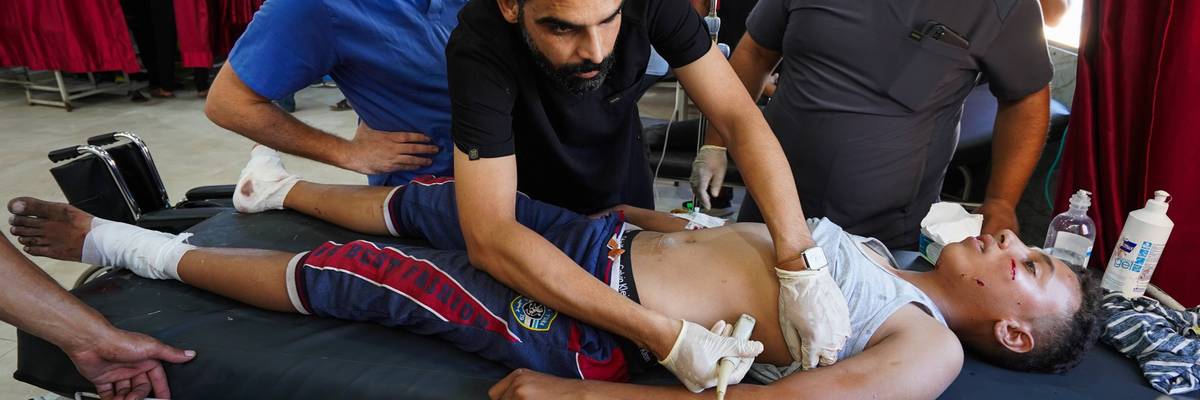
A Palestinian boy receives treatment after the Israeli forces attacked the Nuseirat refugee camp in the central Gaza Strip on July 28, 2026. (Photo by Adem Bilal/Anadolu via Getty Images)
“A ceasefire should ensure that hostilities are paused, weapons are silenced, and that people are safe from strikes across the strip.”
Nearly 10 months into a “ceasefire” in the Gaza Strip, as Israel on Tuesday killed at least one Palestinian man with an airstrike on the Nuseirat refugee camp, Doctors Without Borders declared that “the wounds of war are not only unhealed—they are still being inflicted.”
“This is not a ceasefire,” said the medical charity, also known as Médecins Sans Frontières (MSF), in a statement. “It is a continuation of the genocide, calibrated to be violent enough to keep Palestinians suffering every day, yet silent enough to avoid stirring international outrage.”
Israeli forces have killed more than 73,300 Palestinians in Gaza and wounded over 174,009 since the Hamas-led October 7, 2023 attack on Israel—with global experts warning the true toll is likely far higher. Local authorities have documented at least 1,200 deaths and 3,900 injuries since the ceasefire was agreed to over nine months ago.
Nearly all of Gaza’s roughly 2 million survivors have been forcibly displaced, starved, or sickened. MSF said that “the destruction of homes has not stopped with the announcement of the ceasefire. Sudden and arbitrary orders for people to flee their homes and shelters continue to be used as a tool of psychological warfare by Israeli forces.”
Rajaa Jendiya, who was widowed in the “flour massacres,” is living in a tent at a school-turned-displacement camp with her children. She told Middle East Eye that she often takes them to the hospital because of illnesses.
“Inside and around the school, you often see sewage water overflowing, while rubbish accumulates, attracting flies and insects,” Jendiya said. “These conditions become even worse with the heat, and many times my children have developed skin diseases.”
“Our medical team keeps saying, ‘it’s not a ceasefire at all. It’s not even close to being a ceasefire’. We need to advocate… for a true ceasefire in Gaza.”
🔊 Dr Randa Masoud, our medical coordinator in Gaza, describes the current levels of violence and the impact on people… pic.twitter.com/TdLTWdipHZ
Accessing healthcare has also become difficult in the coastal strip, as Israel has killed and detained Palestinian medical providers, and bombed civilian infrastructure such as hospitals, including in the months since the ceasefire deal was reached.
As MSF detailed Tuesday:
On July 16, an Israeli strike near an MSF clinic in Al-Mawasi sent four injured people to our teams. The following day, two apartment buildings housing our staff in Gaza City were struck without warning, trapping families inside as explosions shattered windows. In one building, rubble and bodies crashed into the lower-floor apartment of an MSF staff member.
The same day, MSF teams in Deir al-Balah, central Gaza, treated 12 people—seven of whom were children—who were injured after Israeli forces struck a funeral in Al-Nuseirat. In total, this strike killed eight people and injured 20. Among those killed was the 21-year-old son of an MSF staff member. Our colleague got the news while working in another emergency room.
“These were not isolated incidents,” the organization stressed, “but merely a snapshot of 48 hours in Gaza.”
Israel has also limited the flow of food and medicine into the war-torn territory. Calling out the country for using humanitarian assistance “as an instrument of oppression,” MSF emphasized that “the Israeli state has an obligation under international law to ensure Palestinians in Gaza have access to aid, regardless of political negotiations, military agreements, or conduct of hostilities.”
Since October, when the Israel Defense Forces controlled about half of Gaza, the “yellow line” indicating IDF occupation has kept shifting, to push Palestinians into “an ever-shrinking area,” MSF explained. “Today, almost 2 million Palestinians are confined to approximately 30% of the strip.”
Since the Gaza 'ceasefire' took effect on October 10, 2025, Israeli attacks have killed at least 1,207 Palestinians and injured 3,914 others.
Israel has violated the agreement at least 3,795 times.
After speaking with residents in Deir al-Balah, Khan Younis, Rafah, and Gaza City’s Zeitoun, Tuffah, and Shejaia neighborhoods, Reuters reported Tuesday that “Israeli forces have advanced the yellow block markers during the past 10 days, triggering new waves of displacement in areas already devastated by months of conflict.”
While loading bags and mattresses onto a truck in Zeitoun, Assem Dawla told the news agency: “The whole war is displacement, displacement. You can’t stay anywhere without [Israel] telling you, ‘Get out of here, we want to come in.’”
Staying near the yellow line comes with risks. MSF said that “just this week, one mother told our teams that her 14-year-old son, who has Down syndrome, was shot five times by Israeli snipers near the yellow line while he was playing near his home.”
“A ceasefire should ensure that hostilities are paused, weapons are silenced, and that people are safe from strikes across the strip,” the group asserted. “Using it as a weapon of war and reinforcing the confinement to a fraction of Gaza cannot be justified.”
Donald Trump sings and dances, says that it’s fun to kill everyone … unless he gets distracted or falls asleep.Keir Starmer explains that UK is actively supporting Israel’s genocidal expansion and repeats his previous quotation that he supports Zionism “without qualification”. Keir Starmer said “I said it loud and clear – and meant it – that I support Zionism without qualification.” here: https://www.jewishnews.co.uk/keir-starmer-interview-i-will-work-to-eradicate-antisemitism-from-day-one/. New UK Prime Minister Andy Burnham is pursuing the same policy of active support of and denial of genocide by Israel.
This work by Middle East Monitor is licensed under a Creative Commons Attribution-NonCommercial-ShareAlike 4.0 International License.
People stage a pro-Palestinian demonstration and call on Labour Party leader Andy Burnham, who is preparing to take office as prime minister, to impose comprehensive sanctions on Israel, in London, United Kingdom on July 18, 2026. [Raşid Necati Aslım – Anadolu Agency
Britain’s new government has rejected calls from 80 MPs and peers to recognise Israel’s genocide in Gaza, impose a full arms embargo and introduce comprehensive sanctions against the occupation state.
The decision has intensified criticism of Prime Minister Andy Burnham and Foreign Secretary Ed Miliband, whose first statements in office raised expectations of a break with the policies of former Prime Minister Keir Starmer but have so far produced little substantive change.
In a cross-party letter led by Labour MP Kim Johnson, members of the House of Commons and House of Lords urged Burnham to recognise the findings of the UN Independent International Commission of Inquiry, which concluded that Israel had committed genocide against Palestinians in Gaza.
I'm one of 80 MPs & Peers calling on the PM to:
– Recognise the UN’s findings on genocide & implement the ICJ ruling in full – Impose sanctions including a full arms embargo – Ban trade that supports Israel’s illegal settlements
The parliamentarians called on the government to “fundamentally change its position” by supporting Palestinian rights and taking steps to prevent further Israeli violations of international law.
They also urged ministers to implement the International Court of Justice’s ruling on Israel’s illegal occupation, impose comprehensive sanctions, introduce a complete arms embargo and prohibit trade in goods and services linked to illegal Israeli settlements in the Occupied Palestinian Territory.
However, the Foreign, Commonwealth and Development Office declined to endorse any of the demands.
The rejection follows criticism of Miliband’s first statement as foreign secretary, in which he referred explicitly to “Russia’s illegal war in Ukraine” but described Israel’s assault on Gaza only as “conflict in the Middle East”.
British governments and senior ministers have repeatedly made legal and political judgements about Russia’s conduct without waiting for a final international court ruling. The UK described Russia’s invasion as illegal from its outset and accused Russian forces of committing war crimes.
In June 2026, the Commission reported that Israeli authorities and forces continued to commit genocide and other atrocity crimes, including through the deliberate targeting of Palestinian children.
The UN findings are part of a much broader body of expert assessments.
Amnesty International concluded in December 2024 that Israel had committed and was continuing to commit genocide against Palestinians in Gaza. Israeli human rights organisation B’Tselem reached the same conclusion in its July 2025 report, Our Genocide. The International Association of Genocide Scholars later declared that Israel’s policies and actions met the legal definition of genocide under the Genocide Convention.
Despite these findings, the British government has maintained that only a court can make a genocide determination.
During a House of Lords debate following the UN Commission’s September 2025 report, ministers insisted that the government would not describe Israel’s actions as genocide until a competent national or international court had ruled on the issue.
Burnham had sought to distance himself from Starmer’s record before entering Downing Street. He acknowledged that Labour “got it wrong” in its initial response to Gaza and admitted that Britain had been too slow to call for a ceasefire.
However, he stopped short of recognising genocide, arguing that the matter should be left to international courts. Green Party deputy leader Mothin Ali accused Burnham of hiding behind the courts when discussing Israel while showing no similar hesitation in condemning Russia.
Ali warned that the duty under the Genocide Convention is to prevent genocide rather than wait until the destruction has been completed and formally adjudicated. Recognising the evidence, he argued, would also raise questions about Britain’s arms exports, surveillance cooperation and wider support for Israel.
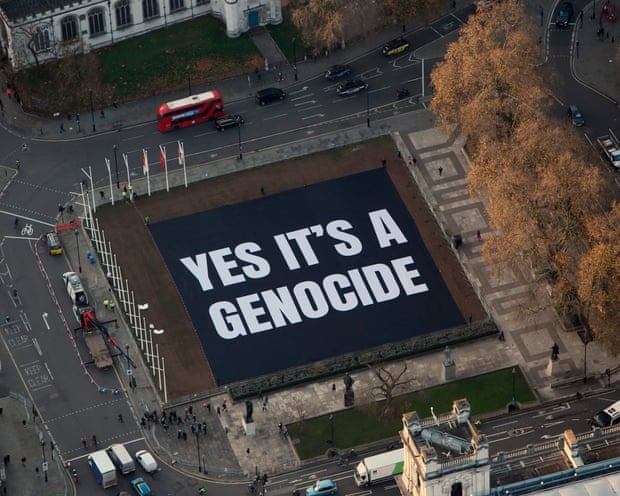
Waste firm Veolia pays £27k after ‘Yes It’s A Genocide’ banner taken by Greater London Authority was destroyed
The banner was unflurled in Parliament Square in London in December 2024. Photograph: Haroon Siddique/Jiri Rezac/Led by Donkeys
The campaign group Led By Donkeys has received £27,000 in compensation after a giant banner it displayed in Parliament Square saying “Yes It’s A Genocide” was seized by Greater London Authority officials and destroyed.
Representatives of the GLA arrived on the scene in central London and confiscated the 40-metre by 40-metre banner after it was unfurled on 4 December 2024, just over a year after Israel began its assault on Gaza after the 7 October 2023 attacks by Hamas.
…
Ben Stewart, a co-founder of Led By Donkeys, said: “The Parliament Square banner was in collaboration with one of the world’s leading genocide scholars, but still the authorities threw process out the window and simply seized and destroyed our property. Pursuing compensation was never about the money, it was about defending space to protest Israel’s war crimes.
“Palestine protests are treated differently in Britain to all other forms of activism. Direct action is regarded as terrorism and words on a placard are rendered illegal. Over the years we’ve delivered banners, put up billboards and done guerilla projections across the country, but the only time our equipment has been seized and destroyed was when it related to Palestine.”
The banner was videoed from the air and a film created that was posted on social media featuring a voiceover from the renowned Israeli scholar Prof Amos Goldberg, a historian of the Holocaust, who said: “This is exactly what a genocide looks like.”
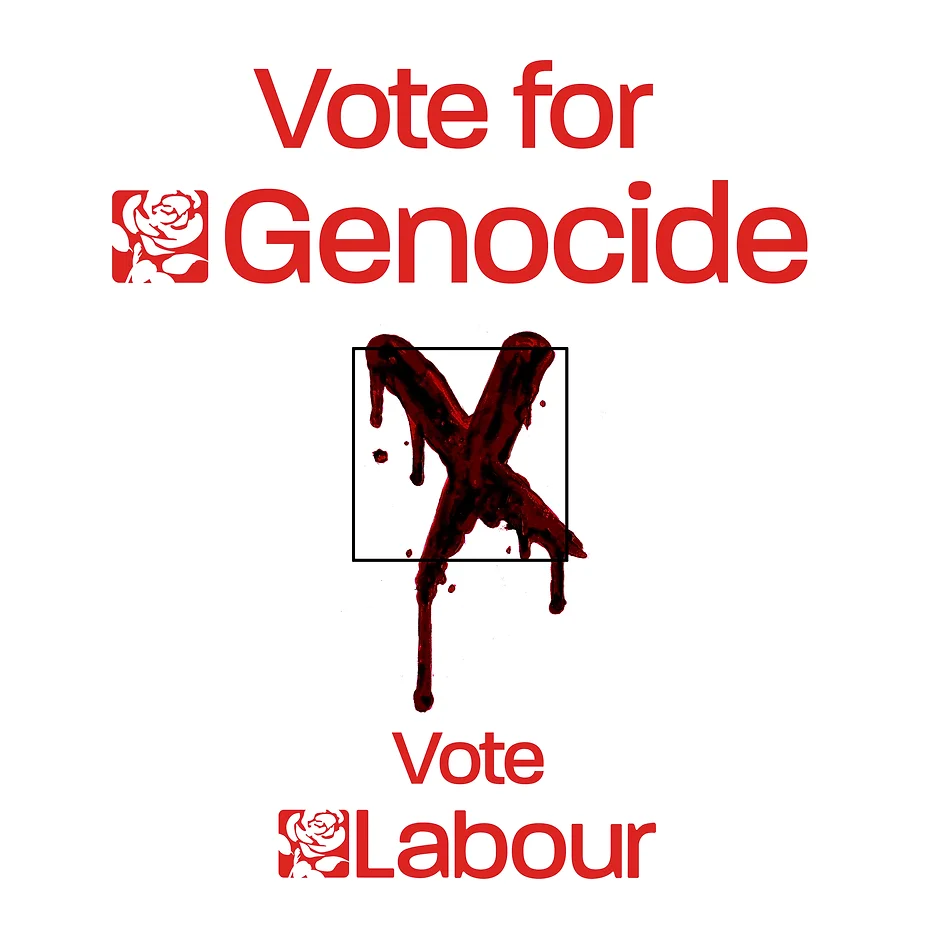
Vote Labour for Genocide.Keir Starmer objects to criticism of the IDF. He asks how could anyone object to them starving people to death, forced marches like the Nazis did, bombing Gaza’s hospitals and universities, mass-murdering journalists, healthworkers and starving people queuing for food, killing and raping prisoners and murdering children. He calls for people to stop obstructing his genocide for Israel.Donald Trump sings and dances, says that it’s fun to kill everyone … unless he gets distracted or falls asleep.