There isn’t enough ‘sustainable’ aviation fuel to make a dent in our emissions – and there won’t be for years

Spread the love
Most of this fuel is currently made from used cooking oil. Scharfsinn / shutterstock

Ben Purvis, University of Sheffield

The UK chancellor, Rachel Reeves, has described so-called sustainable aviation fuel (SAF) as a “game changer”. As she announced government support for a series of airport expansions, she said that the fuel “can reduce carbon emissions from flying by 70%”.

This number is misleading. Optimistic estimates do suggest that fully replacing fossil jet fuel with its sustainable alternative could lead to total savings of around 70%. But it will be hard to produce enough SAF to make a difference on that sort of scale. Even if the UK meets its ambitious targets, an annual saving of 7% by 2030 is more plausible.

SAF is synthetic liquid fuel derived from something other than fossil fuels. These inputs have to be processed into a liquid that can be burned safely while also storing a lot of energy for its weight, since minimising weight is crucial. This is why long-haul electric battery-powered planes are unlikely to take off any time soon.

The UK classifies three major pathways for creating sustainable aviation fuel. It can be derived from oils or fats, including used cooking oil or tallow. It can come from other sorts of material, such as municipal solid waste, agricultural residues, or sewage. Or it can be made from hydrogen and captured carbon using renewable electricity.

SAF can also be produced from bioenergy crops, and products such as palm oil. However the UK won’t certify it as sustainable, due to concerns about land use and impacts on wildlife.

Emissions that would have occurred anyway

Burning SAF actually emits a similar amount of CO₂ to fossil jet fuel. Instead, most savings come from how we account for the waste and renewable energy that is used to produce it.

landfill
Waste emits greenhouse gases anyway, sustainable fuel supporters argue. So why not have those emissions do something useful, like power a plane? Jenya Smyk/shutterstock

SAF fundamentally relies on assumptions that if waste or energy crops were not used to make this fuel, they would be incinerated, would degrade, or would in some way release their embodied carbon anyway. In the case of fuel derived from renewable energy and captured carbon, it assumes that carbon came from the atmosphere in the first place. This allows these emissions to be deducted from the total impact of SAF, leading to lower emissions than conventional aviation fuel.

Is sustainable aviation fuel even sustainable?

Estimates of how much greenhouse gas SAF could cut vary greatly due to the many different ways it can be produced, and the complexities of accounting for emissions across the entire life cycle from waste, to fuel production, to plane engine. A 2023 review by the Royal Society illustrates this nicely. It found SAF could at best produce effectively negative emissions (a 111% reduction), while at worst it could be more carbon intensive than fossil kerosene jet fuel (a 69% increase).

While policy incentives are likely to encourage increased production, there remain serious concerns that will need to be addressed before SAF can become a serious competitor for conventional jet fuel. There are hard limits to the amount of used cooking oil available for instance, and the use of other feedstocks is still in its infancy.

Meanwhile any renewable energy used to make the fuel will have to compete with growing demand from electric vehicles, AI data centres and more. And there are big worries the industry simply won’t be profitable enough to attract initial capital investment, let alone take on its well-established rival.

UK SAF production

Coming into effect in January, the UK’s SAF mandate sets legal obligations for aviation fuel suppliers in the UK to progressively increase proportions of sustainable fuel, from 2% of total jet fuel in 2025 to 10% in 2030, and 22% in 2040.

This is one of a growing number of commitments globally, including RefuelEU, and the US SAF grand challenge, which seek to increase demand and encourage more investment in production.

As of 2023, 97% of the UK’s supply is derived from used cooking oil, with the rest from food waste. Only 8% of this cooking oil is sourced from the UK, with most being imported from China and Malaysia. The UK also comprises 16% of the global SAF market, despite representing only 1% of total passengers.

Currently, the only commercial producer of SAF in the UK is the Phillips 66 Humber Refinery which processes used cooking oil. The previous government allocated £135 million of funding to nine projects, aiming to have five plants under construction by 2025. Despite several projects selecting sites, at the time of writing none appear to be under construction.

In an industry with razor-thin profit margins, SAF remains considerably more expensive than conventional aviation fuel. With potential producers filing for bankruptcy and companies including Shell pulling out due to profitability concerns, the market is looking rocky.

A 7% saving is more plausible

Let us assume that Rachel Reeves’ 70% saving is deliverable if fossil jet fuel was fully replaced with SAF. That’s optimistic in itself, but not beyond the realms of possibility.

Getting hold of that much sustainable fuel is less plausible, however – the total demand for jet fuel in the UK is more than ten times the current global production of SAF. But let’s assume that the rocky global market can deliver the UK’s ambitious demand of 10% SAF use by 2030.

Reeves’ figure then becomes an optimistic value of 7% savings across the UK industry. If we then correct for anticipated growth of passenger numbers, assuming plans for airport expansion, those savings are likely to vanish.

While SAF has a role to play in decarbonisation, growth sits in clear opposition to its impacts and potential. If the UK has any hope of meeting its climate targets, it should instead be seeking alternatives to flying where possible.


Don’t have time to read about climate change as much as you’d like?
Get a weekly roundup in your inbox instead. Every Wednesday, The Conversation’s environment editor writes Imagine, a short email that goes a little deeper into just one climate issue. Join the 40,000+ readers who’ve subscribed so far.


Ben Purvis, Research Associate, Sustainability Assessment, University of Sheffield

This article is republished from The Conversation under a Creative Commons license. Read the original article.
Continue ReadingThere isn’t enough ‘sustainable’ aviation fuel to make a dent in our emissions – and there won’t be for years

‘Sustainable’ aviation fuel and other myths about green airport expansion debunked

Spread the love
Taking off: emissions from the aviation sector. WildSnap/Shutterstock

Jack Marley, The Conversation

Environmentalists and locals have resisted a third runway at London’s Heathrow, Europe’s busiest airport, for more than two decades. Today, their efforts took a major setback.

The UK government has announced it will give the green light to airport expansion. This is not guaranteed to increase growth in the national economy as Chancellor Rachel Reeves hopes. More flights and more emissions are certain, however, at a time when experts are practically screaming at governments to rein them in.


This roundup of The Conversation’s climate coverage comes from our award-winning weekly climate action newsletter. Every Wednesday, The Conversation’s environment editor writes Imagine, a short email that goes a little deeper into just one climate issue. Join the 40,000+ readers who’ve subscribed.


“No airport expansions should proceed” without a UK-wide plan to annually assess and control the sector’s climate impact said the government’s watchdog, the Climate Change Committee, in 2023. Aeroplanes are 8% of UK emissions and 2% of the world’s, but they also release gases that seed heat-trapping clouds in the upper atmosphere, which triples air travel’s greenhouse effect.

While the government’s own advisers have effectively ruled out new runways for the sake of net zero, airport and airline bosses play a different tune. So what does the sector propose to manage its own pollution?

Not enough cooking oil to save us

Aviation is a notoriously difficult sector to decarbonise says Richard Sulley, a senior research fellow in sustainability policy at the University of Sheffield: “If electric or hydrogen-powered planes are possible, it won’t be for many years yet.”

To justify air travel emissions ballooning in the meantime, the aviation sector has promised a mix of “supply-side” measures, like replacing kerosene with so-called “sustainable aviation fuel” (SAF), which Reeves described as “a game changer”, and making planes lighter and more fuel-efficient.

Efficiency, in this context, is a slippery path to decarbonisation. When a high-emitting activity is reformed so that it consumes less energy, the efficiency savings are generally eclipsed by the increasing demand it drives.

“Indeed, the sector’s own plans for growth will outstrip efforts to decarbonise through synthetic fuel, delivering a neutral effect at best,” Sulley says.

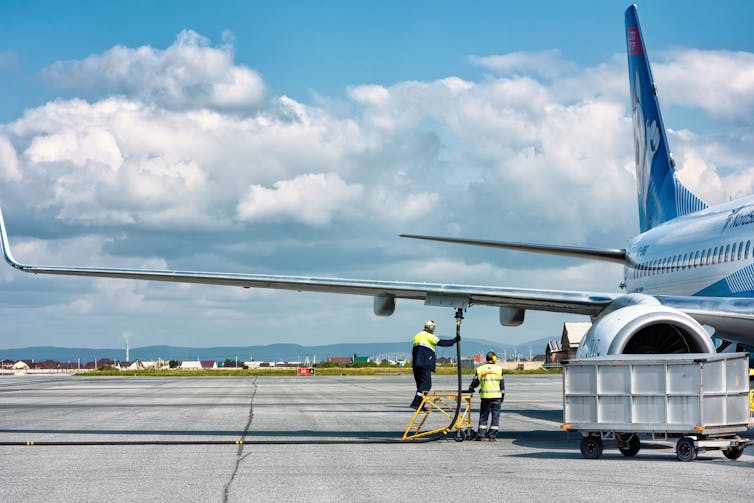
Technicians refuel an aeroplane on the runway.
Fuel consumption is the biggest emissions source in aviation. Sergey Ginak/Shutterstock

“Demand-side” measures like fewer flights, taxes on frequent flying and domestic flight bans (see France) could cut emissions, he notes, but are seldom mentioned.

The UK has set a target for airline fuel to be 10% SAF by 2030. So far we’re at 1.2% – and Sulley reports that the industry has not said how it will scale up in time.

Even if airlines start taking their commitment to SAF seriously very soon, it’s a dubious solution to aviation’s climate impact according to political economists Gareth Dale (Brunel University) and Josh Moos (Leeds Beckett University).

Earlier SAF test flights burned coconut oil – 3 million coconuts to power a journey from London to Amsterdam, as Dale and Moos calculate it. At that rate, they argue Heathrow would exhaust the world’s entire crop in a few weeks (there are 18,000 commercial airports worldwide).

Modern SAF is blended with waste products from farms and kitchens. But the pair argue that the market for used cooking oil is “notoriously unregulated”. SAF may in fact be relabelled palm oil from plantations that are erasing orangutan habitat in the tropics. Again, Dale and Moos argue there is not enough used cooking oil to meet existing, let alone future, demand.

Transport for the rich, by the rich

At least the hype around SAF addresses the main problem, albeit misleadingly. Policy experts David Howarth (University of Essex) and Steven Griggs (De Montfort University) marvel at how often “carbon-neutral airports” in aviation sustainability strategies simply mean terminals powered by renewable energy.

“A terminal’s heating or lighting is, of course, largely irrelevant when its core business is as emissions-intensive as flying,” says Sulley.

Unfortunately for Rachel Reeves, a 2023 report by the New Economics Foundation found that any economic benefits of airport expansion will be largely confined to the airports themselves. Meanwhile, a wealthy subset of UK society can be expected to capture the biggest share of any new flight capacity. Each year, around half of British residents do not fly at all, Sulley points out.

At the stratospheric heights of that subset are the private jet passengers who are served by “more or less dedicated airports” that are more obscure to the general public, says Raymond Woessner, a geographer at Sorbonne Université. A study published in November found that emissions from these flights rose by 46% between 2019 and 2023. The lead author described wealthy passengers using jets “like taxis”.

“Discretion and anonymity” is what one airport nestled in the Oxfordshire countryside promises for “routine celebrity, head of state and royal visits”. Without state direction or regulation, it is these people who are setting the agenda for air travel.

Woessner notes that the world’s richest man, Elon Musk, successfully lobbied to derail a high-speed rail project in California in 2013. Instead of an option that has shown its ability to cut flight demand, the US will be offered intercontinental rocket travel.

Musk’s company SpaceX says that rockets could ferry passengers between New York and Shanghai in under an hour. Rockets would burn “vastly more fuel per trip than conventional aircraft”, says aerospace engineer Angadh Nanjangud of Queen Mary University of London, but this might “drive critical research into carbon-neutral” methane-based rocket fuel.

It would not be the first time an industry seeking to grow has used an as yet fantastical fuel to justify more carbon in Earth’s atmosphere.

“There is the potential to create a good life for all within planetary boundaries,” say Dale and Moos.

“But getting there requires clipping the wings of the aviation industry.”

Jack Marley, Environment + Energy Editor, The Conversation

This article is republished from The Conversation under a Creative Commons license. Read the original article.

Orcas comment on killer apes destroying the planet by continuing to burn fossil fuels.
Continue Reading‘Sustainable’ aviation fuel and other myths about green airport expansion debunked

COP28: oil pushers scrape the barrel as critical climate talks begin in Dubai

Spread the love
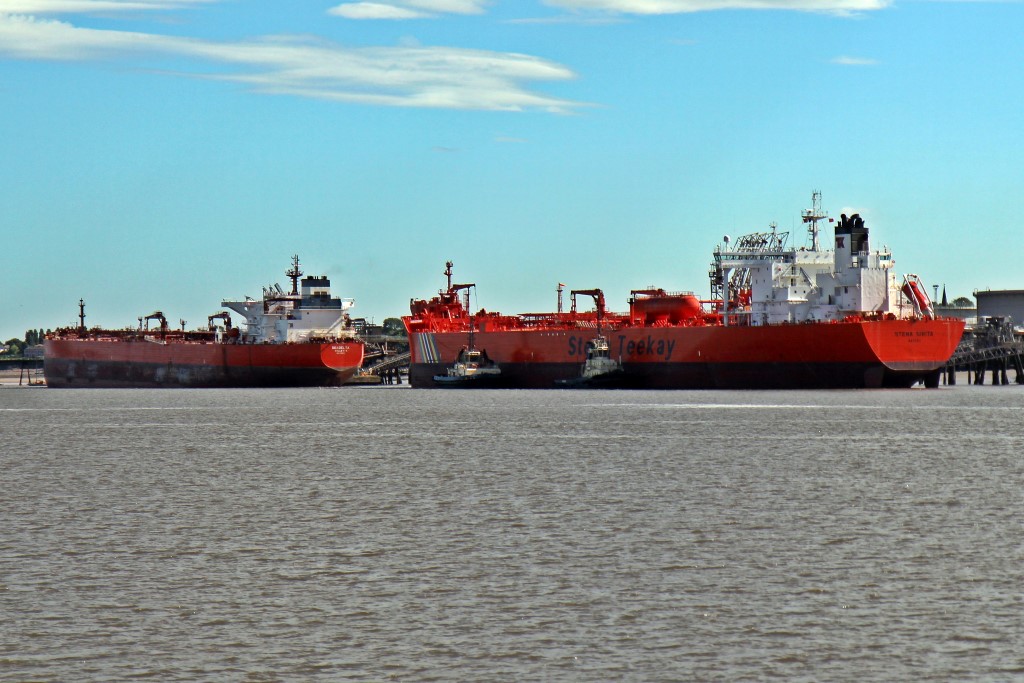
El Pollock / Oil tankers, Tranmere Oil Terminal / CC BY-SA 2.0

Jack Marley, The Conversation

Days before the latest climate summit is due to begin in Dubai, the first flight powered entirely by “sustainable aviation fuel” landed safely in New York.

The twin engines of this Boeing 787 Dreamliner ran on farm waste and used cooking oil, an alternative to the kerosene that is usually dug up, refined and burned to satisfy the wanderlust of a relatively wealthy minority of Earth’s people.

Sadly, the entire event was a stunt, say political economists Gareth Dale (Brunel University London) and Josh Moos (Leeds Beckett University). They point out that the market for cooking oil is poorly regulated, and so “sustainable fuels” can come from palm oil plantations which have devastated orangutan habitat in the tropics.

The result is “a smoke-and-mirrors exercise” designed to give the illusion of a world leaving fossil fuels behind, they say. With climate disasters mounting and greenhouse gas emissions at an all-time high, the same could be said for the UN negotiations themselves.


Imagine weekly climate newsletter

This roundup of The Conversation’s coverage of COP28 comes from our weekly climate action newsletter. Every Wednesday, The Conversation’s environment editor writes Imagine, a short email that goes a little deeper into just one climate issue. Join the 30,000+ readers who’ve subscribed.


First, let’s check in on the climate.

“Eight years ago, the world agreed to an ambitious target in the Paris Agreement: hold warming to 1.5°C to limit further dangerous levels of climate change,” says Brendan Mackey, an environmental scientist at Griffith University.

“Since then, greenhouse gas emissions have kept increasing … In 2023, the world is at 1.2°C of warming over pre-industrial levels. Heatwaves of increasing intensity and duration are arriving around the world. We now have less than 10 years before we reach 1.5°C of warming.”

COP28 in the United Arab Emirates (UAE) will proceed under the shadow of the UN’s global stocktake. This assessed whether humanity was on course to cut emissions in line with the Paris agreement’s targets by 2030.

The results are in: if all national pledges are fulfilled (not guaranteed), global warming will peak between 2.1-2.8°C this century. Blowing past 2°C, the upper temperature target of the Paris agreement, makes triggering feedback loops (like the release of potent greenhouse gas methane from Arctic permafrost) and catastrophic sea-level rise more likely.

For a chance to avoid climate breakdown and limit warming to 1.5°C, the world needs to prevent greenhouse gases equivalent to 22.9 gigatonnes of carbon dioxide (CO₂) from reaching the atmosphere over the next six years. This is roughly how much the top five polluters (China, US, India, Russia and Japan) emit in a year.

Tasked with leading negotiations to secure this outcome is Sultan Al Jaber, chief executive of Adnoc, the UAE’s state-owned oil company. Al Jaber and the UAE hosts were recently embarrassed by leaked documents showing they intended to pitch oil and gas deals to international delegates at the summit.

“The UK invited ridicule by expanding its North Sea oil fields less than two years after urging the world to raise its climate ambitions as summit host. The UAE seems destined for a similar fate – before its talks have even begun,” say Emilie Rutledge and Aiora Zabala, economists at the Open University.

On the agenda at COP28 is a proposed target for tripling renewable energy capacity and doubling the efficiency of existing sources by 2030. Delegates from countries within the High Ambition Coalition demand a written agreement to halt the burning of coal, oil and gas which accounts for roughly 90% of all CO₂ emissions.

Rutledge and Zabala argue that the UAE is an apt case study for the inertia which seems to prevent countries from meeting these aims. The Persian Gulf state subsidises rampant energy use among its public with oil and gas sales that total 80% of government revenues.

Little wonder the UAE would rather talk about the potential for technology to mop up its emissions.

“Adnoc, along with the wider oil and gas industry, has invested in carbon sequestration and making hydrogen fuel from the byproducts of oil extraction. According to the Intergovernmental Panel on Climate Change (IPCC), such measures, even if fully implemented, will only have a small impact on greenhouse gas emissions,” Rutledge and Zabala say.

Where’s the money?

Another test of the UN negotiations will concern the money needed to help developing countries phase out fossil fuels, adapt to a hostile climate and overcome the damage wrought by greenhouse gases overwhelmingly produced by developed countries.

According to the UN, 80% of climate change can be attributed to G20 countries, a group consisting of the world’s major economies.

“For decades, nations have wrestled over the fraught question of who should pay for loss and damage resulting from climate change,” says Mackey.

“Now we’re close to finalising arrangements for the new Loss and Damage Fund. This will be [a] major issue for negotiators at COP28.”

Lisa Vanhala, a professor of political science at UCL, has followed the wrangling over a fund to compensate poor nations for climate change since one was agreed in principle in 2013. Ten years later, questions remain over who will pay into it, who will be able to draw from it and who will control it.

The last of those three questions was at least partially answered in early November. The World Bank, headquartered in Washington D.C., will administer the fund for an interim period. This would give rich donor countries like the US disproportionate influence over loss and damage funding, Vanhala says, and is a far cry from the partnership model small-island developing states had urged.

The World Bank traditionally offers loans instead of grants. Developing countries have consistently argued this funding should not increase a recipient’s debt burden, Vanhala says. And a board member for another fund hosted by the World Bank has reported that the admin fees it charges are rising and absorbing a larger share of its aid.

“This could mean that, for every US$100 billion offered to countries and communities reeling from disaster, the World Bank will keep $US1.5 billion. This will be hard for an institution still funding the climate-wrecking oil and gas industry to justify,” Vanhala adds.

Aside from loss and damage, rich countries failed to keep a promise to raise US$100 billion of climate change mitigation and adaptation funding by 2020. This money would help the most vulnerable nations build sturdier storm defences and solar farms, for instance, and will be the subject of heated debate at COP28.

US and EU negotiators have argued that China, the world’s second largest economy and its current biggest emitter, should be obliged to contribute to such funding – despite sitting with other developing countries in the UN talks.

But a new analysis by Sarah Colenbrander, director at the Overseas Development Institute and guest lecturer in climate economics at the University of Oxford, tells a different story. By following the substantial climate aid China already provides via other channels, such as multilateral development banks, Colenbrander argues that the real laggard and obstacle to a financial settlement is the US.

“The fastest way to restore trust in the international climate regime would be for the US to step up with its fair share of climate finance,” she says.

“Only once the developed countries have fulfilled their longstanding promise does a conversation about new climate finance contributors become politically possible.”The Conversation

Jack Marley, Environment + Energy Editor, The Conversation

This article is republished from The Conversation under a Creative Commons license. Read the original article.
Continue ReadingCOP28: oil pushers scrape the barrel as critical climate talks begin in Dubai

Why the world’s first flight powered entirely by sustainable aviation fuel is a green mirage

Spread the love
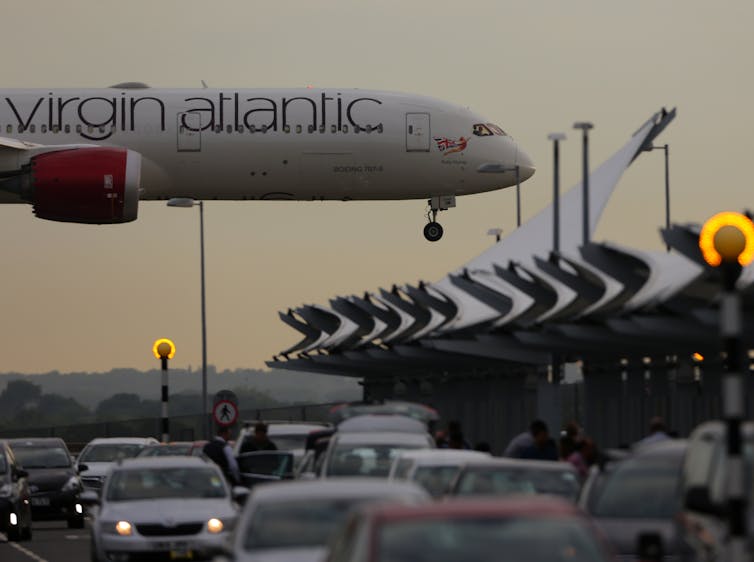
A Boeing 787 Dreamliner landing at Heathrow international airport in London.
Fasttailwind/Shutterstock

Gareth Dale, Brunel University London and Josh Moos, Leeds Beckett University

A Boeing 787 Dreamliner is set to take off from Heathrow on November 28 and head for JFK airport in New York, powered by so-called sustainable aviation fuel (SAF). According to its operator, Virgin Atlantic, the world’s “first 100% SAF flight” will mark “a historic moment in aviation’s roadmap to decarbonisation”.

It is proof of concept, we are led to believe, of the dawn of “guilt-free” flying. Unfortunately, we have been here before, and the results last time were anything but green.

Based on our research into how wealth and power shape the environment, we argue that continued growth of the aviation sector, as with the economy in general, is incompatible with preventing runaway climate change. The technology currently being developed by the aviation industry has zero chance of changing that. And the fuels being used in Virgin’s latest experiment are not significantly more sustainable than those in its previous attempt.

Virgin’s sustainability initiative dates back to the 2000s, when British business magnate Richard Branson was at the helm. In 2008, to some fanfare, a Virgin aircraft flew from London to Amsterdam using a fuel derived in part from palm oil and coconuts. Technically, the mission was a success, but the sustainability claims were laughable.

To have fuelled that short hop with 100% coconut oil would have consumed 3 million coconuts. The entire global crop would supply Heathrow for only a few weeks — and it is one of 18,000 commercial airports worldwide. Following this stunt, Virgin gave up on coconut oil.

Virgin’s latest flight is simply a repeat of 2008. It’s a smoke-and-mirrors exercise to convince governments that SAF will enable aviation to continue its relentless growth on a sustainable basis – and in this, it is succeeding.

Even waste products aren’t sustainable

Virgin’s defence rests on the claim that its new SAF no longer comes exclusively from crops. It is blended with waste products. One of the main suppliers for Virgin’s transatlantic flight is Virent, an organisation based in Wisconsin. Virent makes SAF from conventional sugars such as corn, mixed with wood, agricultural waste and used cooking oil.

As with coconuts, any crop grown for fuel competes with foodstuffs and pushes the agricultural frontier further into forests and peatlands, with large releases of carbon.

But what of the waste products? Surely reusing cooking oils offers a sustainable solution? Unfortunately, in a notoriously unregulated market, it seems not.

Another of Virgin’s suppliers, Neste, collects cooking oils from sources worldwide, including McDonald’s restaurants in the Netherlands and food processing plants in California, Oregon and Washington. The US Department of Agriculture alleges that some trade in SAF feedstocks – including from Indonesia to Neste’s refinery in Singapore – may be “fraudulent”.

Neste has denied the claim. But, even if its used cooking oil is entirely legitimate, there is still an allegation that palm oil from plantations responsible for tropical deforestation is being marketed as used cooking oil.

Virgin Atlantic maintains that the SAF it uses is made entirely from used cooking oil. However, if the aviation industry bets big on used cooking oil, it is feared it will turbocharge tropical logging and the extermination of the orangutan and countless other endangered species.

Orangutan in the rainforest on Borneo island with trees and palms behind.
More tropical logging would threaten the orangutan and countless other endangered species.
Michail_Vorobyev/Shutterstock

The real kicker is that even if all used cooking oils were traceable and sustainably sourced, they are not scalable. The US collects around 600,000 tonnes of used cooking oil each year. If every last drop were diverted to SAFs, it would meet at most 1% of America’s current aviation demand.

Capturing the White House

The problems of scalability, the competition of agricultural inputs with foodstuffs, forests and wildlife, and the carbon emissions that result from land use change are just three of the shortcomings that ensure SAFs will not be the magic bullet that the aviation industry would have us believe. Despite this, SAF fever has won over the White House.

The Inflation Reduction Act set targets for SAF production at 3 billion gallons by 2030 and 35 billion by 2050. These targets are fantasies. But, to the extent that they are approached, they will only add to the pressure on food prices and wildlife.

That SAF is being touted so zealously attests to the shortage of alternative technologies. Battery-powered planes are viable but only as short-haul “flying taxis” that compete with ground transport. The other panacea, hydrogen, confronts colossal technological and infrastructural barriers, problems of scalability, competing uses, and environmental concerns.

Tinkering with aircraft technology, such as engine size or wing shape has also faced diminishing returns. Efficiency improvements lag far behind the sector’s growth, which is why aviation emissions are still soaring.

Where do we go from here?

Ahead of the 2008 coconut-fuelled flight, Virgin’s chief executive Steve Ridgway explained its logic. He said the aviation industry needs “to be seen to be doing something”. Fifteen years on and the playbook remains the same.

The Virgin Atlantic SAF flight promises to rescue the airline from the threat of climate change, allowing them and their passengers to “keep calm and carry on”. In buying into this fantasy, governments give themselves an excuse to avoid taking climate breakdown seriously – an emergency that requires radical action if the planet is to remain habitable for humans.

There is the potential to create a good life for all within planetary boundaries. But getting there requires clipping the wings of the aviation industry.

This would begin, for short-haul, with ground-based alternatives. Within the US, many flights could be swiftly replaced by coach travel, and over a quarter of flights between EU destinations could be replaced by high-speed rail. For long-haul, the first step is demand management, which will expedite the use of virtual conferencing, marine transportation and other alternatives.

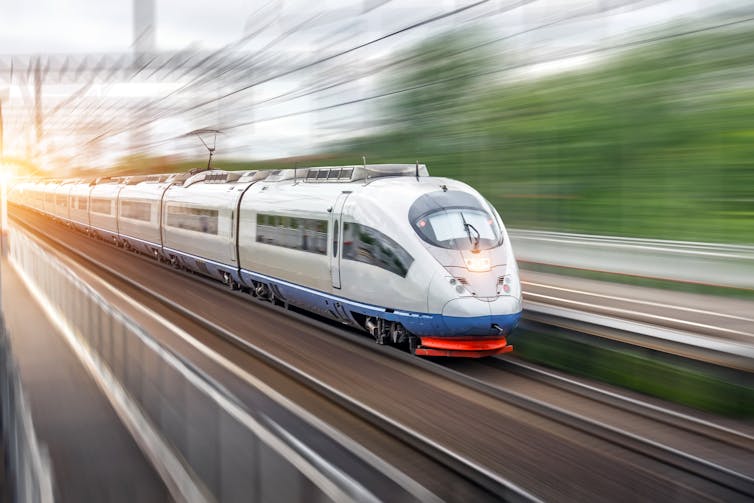
Modern high-speed train driving past a station in a city.
Many flights could be replaced by high-speed rail.
aappp/Shutterstock

Developing alternatives would be practical, efficient and create jobs. And now is a good time to begin. Americans have been “falling out of love with flying” in recent years, in part due to large numbers of flight cancellations following bad weather, which is only likely to increase with climate breakdown.

As the weather chaos worsens, the aviation industry will find it harder to shrug off its responsibility through PR stunts and greenwashed gimmickry.

In response to this article, a Virgin Atlantic spokesperson said that the organisation is committed to achieving net zero by 2050, and has set interim targets, including 10% SAF by 2030. It sees SAF as a mid-term solution for decarbonising aviation, and that Flight100 aims to demonstrate the safe use of 100% SAF within existing infrastructure. Virgin Atlantic referred to a Sustainable Aviation report, which indicates that there is sufficient feedstock to meet the government’s 2030 target without environmental impact or competition with crop production.


Imagine weekly climate newsletter

Don’t have time to read about climate change as much as you’d like?

Get a weekly roundup in your inbox instead. Every Wednesday, The Conversation’s environment editor writes Imagine, a short email that goes a little deeper into just one climate issue. Join the 20,000+ readers who’ve subscribed so far.The Conversation


Gareth Dale, Reader in Political Economy, Brunel University London and Josh Moos, Lecturer in Economics and Politics, Leeds Beckett University

This article is republished from The Conversation under a Creative Commons license. Read the original article.

Continue ReadingWhy the world’s first flight powered entirely by sustainable aviation fuel is a green mirage

COP26: CLIMATE ACTIVISTS TO TARGET 10 UK AIRPORTS THIS WEEKEND TO PROTEST EXPANSION

Spread the love

https://www.independent.co.uk/travel/news-and-advice/cop26-airport-expansion-protests-uk-b1950499.html

Climate activists will target 10 UK airports this weekend to protest proposed expansion.

Campaigners are planning to protest at Bristol, Doncaster-Sheffield, Gatwick, Glasgow, Leeds-Bradford, London-City, Luton, Liverpool, Manchester and Southampton airports from 11am on Saturday.

[Hypocritical P]oliticians have consistently refused to endorse any reduction in flights, or any restraint on further aviation growth.

Speaking ahead of a UN climate conference earlier this year, MP Rachel Maclean – the minister in charge of government policy on the future of transport and decarbonisation – said flying was one of the things that “make life worth living” and that the government would not place any restrictions on the aviation industry.

Airlines are increasingly committing to becoming “greener” by using technology such as Sustainable Aviation Fuels (SAF) – however, these will account for 10 per cent of aviation fuel, at most, by 2030, and SAFs emit at least as much CO2 inflight as conventional kerosene.

Continue ReadingCOP26: CLIMATE ACTIVISTS TO TARGET 10 UK AIRPORTS THIS WEEKEND TO PROTEST EXPANSION