The Israeli army reinforces its ground forces as military mobility continues in Golan Heights, Israel on December 9, 2024 [Mostafa Alkharouf – Anadolu Agency]
Israel has seized more Syrian territory close to the occupied Golan Heights following the collapse of the Assad regime, citing potential threats Tel Aviv may face from the former rebels.
On Sunday, Syrian rebels conquered the capital, Damascus, concluding a rapid new offensive which saw the Syrian opposition capture numerous towns and major cities from Bashar Al-Assad’s regime, effectively ending almost 14 years of civil war and over five decades of the Assad dynasty’s rule.
Amid mixed messages and reactions from much of the international community, Israel’s Prime Minister, Benjamin Netanyahu, stated in a video that the collapse of the Assad regime and “the tyranny in Damascus” was a “historic day in the Middle East” which “offers great opportunity”, but claimed that it is also “fraught with significant dangers”.
Emphasising that the 1974 disengagement agreement with Syria over Israel’s occupation of the Golan Heights had “collapsed” due to the rebel takeover of the country, Netanyahu announced the Israeli military’s entering of the buffer zone and seizure of “commanding positions nearby”, calling the move a “temporary defensive position until a suitable arrangement is found”.
Warning that Tel Aviv “will not allow any hostile force to establish itself on our border”, Netanyahu claimed that “if we can establish neighbourly relations and peaceful relations with the new forces emerging in Syria, that’s our desire. But if we do not, we will do whatever it takes to defend the State of Israel and the border of Israel.”
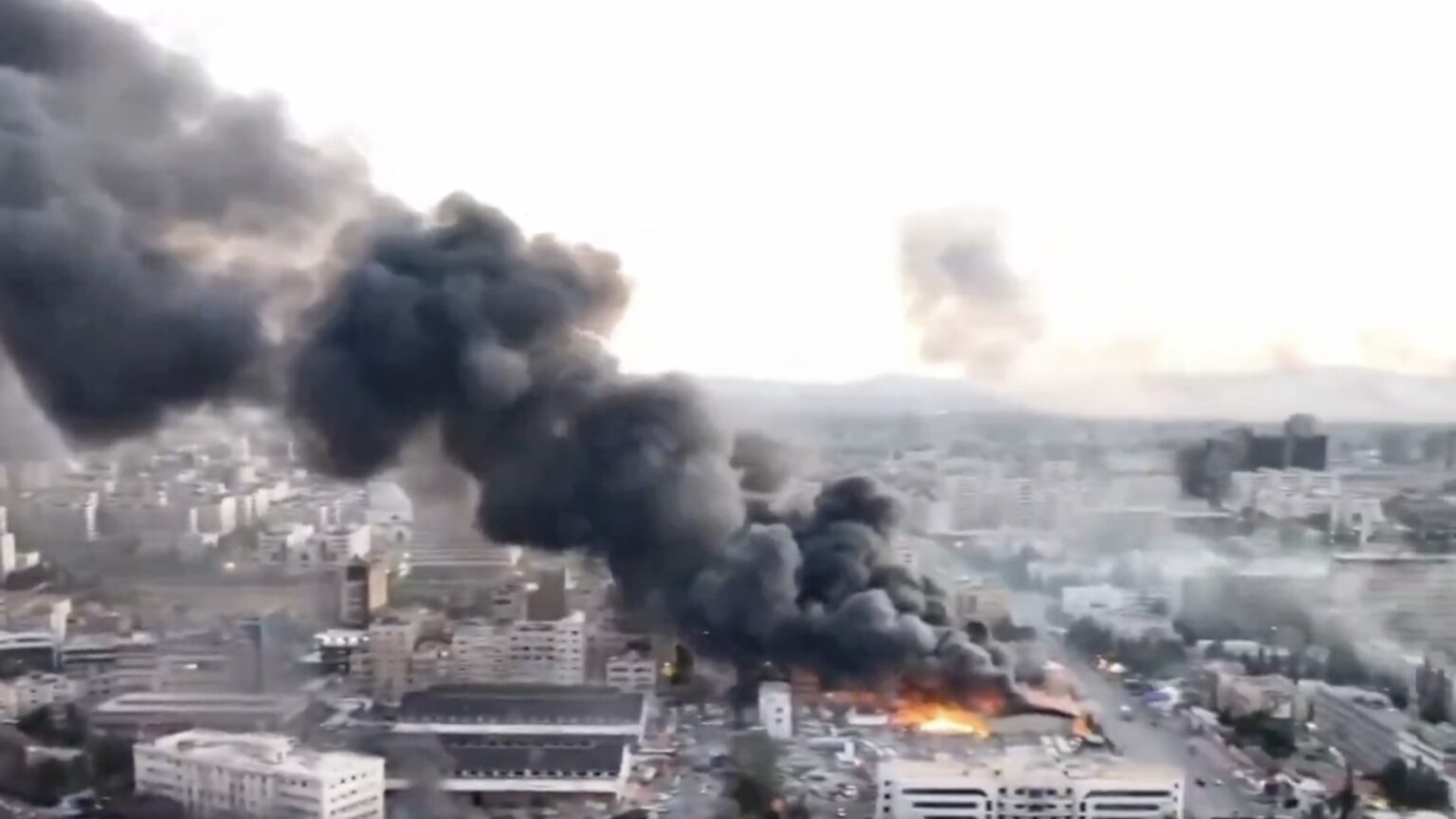
Israel carried out multiple airstrikes against the Syrian capital of Damascus on Sunday, December 8, after the fall of President Bashar al-Assad. Photo: Screenshot
The resignation and fleeing of Bashar al-Assad inaugurates a new chapter in the region that has been facing constant US and Israeli aggression for decades.
As Israeli forces advanced into the Golan buffer zone and initiated airstrikes on targets in the Syrian capital of Damascus, Israeli Prime Minister Benjamin Netanyahu declared in a video published on X that the collapse of Assad’s government on Sunday, December 8, “is a direct result of our forceful action against Hezbollah and Iran, Assad’s main supporters.” Meanwhile, images circulated across social media of members of the armed opposition groups led by Hay’at Tahrir al-Sham (HTS) taking control over Damascus, invading the Iranian embassy in the capital and tearing down posters of late Hezbollah leader Sayyed Hassan Nasrallah and Iranian General Qassem Soleimani.
The dramatic events took place after groups led by HTS launched a surprise offensive on November 27, against Syrian government forces in the Aleppo governorate. HTS is led by Abu Mohammad al-Julani, the former leader of Al-Qaeda’s Syrian branch Al-Nusra front which rebranded as HTS. In the following 12 days, the groups, some of which are backed by the United States, Turkey, and covertly Israel, quickly advanced and gained control of key Syrian cities with little resistance until reaching the capital Damascus on December 8.
The fall of Assad’s government has sent a shock wave across the region and the world. The Syrian government had been engaged in a protracted civil war since 2011, which eventually saw armed opposition groups, including ISIS and Al-Qaeda affiliates, take control over large swathes of territory. The United States officially intervened in the conflict in 2014, carrying out extensive airstrikes as well as territorial deployment alongside Kurdish forces in the north, which continues to this day. Syria’s allies including Russia, Iran, and Lebanese resistance group Hezbollah, played a central role in the military campaign to regain control over the majority of Syrian territory and defeat the Islamic State and other terrorist groups. Importantly, the coalition of armed opposition groups retained control over the Idlib governorate, from where they evidently regrouped to launch their latest offensive.
Analysts, and even Netanyahu himself, have pointed out that the timing of this offensive was no coincidence. The HTS-led offensive began on the same day that a ceasefire deal was reached between a significantly-weakened Hezbollah and Israel. The critical support Syria received in its fight against opposition groups in the last decade, was significantly reduced as its partners and allies have been engaged in their own arduous wars and conflicts.
Lebanese American journalist Rania Khalek wrote on December 5, “There is a feeling that all the forces against Syria – Turkey, the US, Israel, etc – have joined forces to attack the resistance axis at one of its weakest moments, taking advantage of the last year plus of genocide in Gaza, destruction in Lebanon and Russia being bogged down in Ukraine. All this while US sanctions and bad governance hollowed out what was left of the Syrian state and its remaining institutions. Everyone fears even darker days ahead.”
Additionally, with Israel’s advance on the Golan buffer zone, many now fear that it will seek to advance its annexation goals for the Golan Heights.
In a 2018 article written by Nour Samaha for The Intercept, she warned that, taking advantage of the war, Israel at the time was “expanding its influence and control deeper into opposition-held southern Syria.” Samaha argued that this advance through NGOs and backing opposition groups was partially in response to Israel’s anxiety about “increasing Iranian influence in Syria and Hezbollah’s presence close to its northern border”, but also ultimately part of its “aim of cementing Israel’s hold on the Golan Heights.” She reported at the time that there was an increase in Israeli settlement activity within the Occupied Golan Heights.
Israeli forces stated the deployment to the buffer zone was “to ensure the safety of the communities of the Golan Heights and the citizens of Israel. We emphasize that the IDF is not interfering with the internal events in Syria.”
Meanwhile, Israel continues to carry out airstrikes on Syria’s capital targeting strategic sites such as ammunition and weapons depots and the Mezzeh airbase, reportedly to prevent the sites from falling into the hands of the new government.
Iran, the foremost ally of the Assad government, responded to the developments in Syria during a cabinet session on Sunday, December 8. Iranian President Masoud Pezeshkian stated, “We stress the importance of preserving Syria’s unity and sovereignty, with its people deciding the country’s future and political system. We emphasize the importance of dialogue among all segments of Syrian society to reach an understanding, and we hope for an end to military confrontations.” The head of state added that Iran condemns Israel’s “violation of Syrian territory and calls on all parties and countries in the region to be vigilant against its aims.”
The country also condemned the incursion into its embassy in Damascus.
US President Joe Biden speaking in a press conference held at the White House, praised the government takeover by HTS as a “fundamental act of justice” but also that “the fall of the Assad regime in Syria is also a moment of risk and uncertainty.”
In 2017, the US had declared that it considers HTS a “designated terrorist org”. The US Embassy in Syria posted an image of HTS leader al-Julani, who himself had been declared a global terrorist as early as 2013, and stated “we remain committed to bringing leading AQS figures in HTS to justice”, offering a USD 10 million reward for his capture.
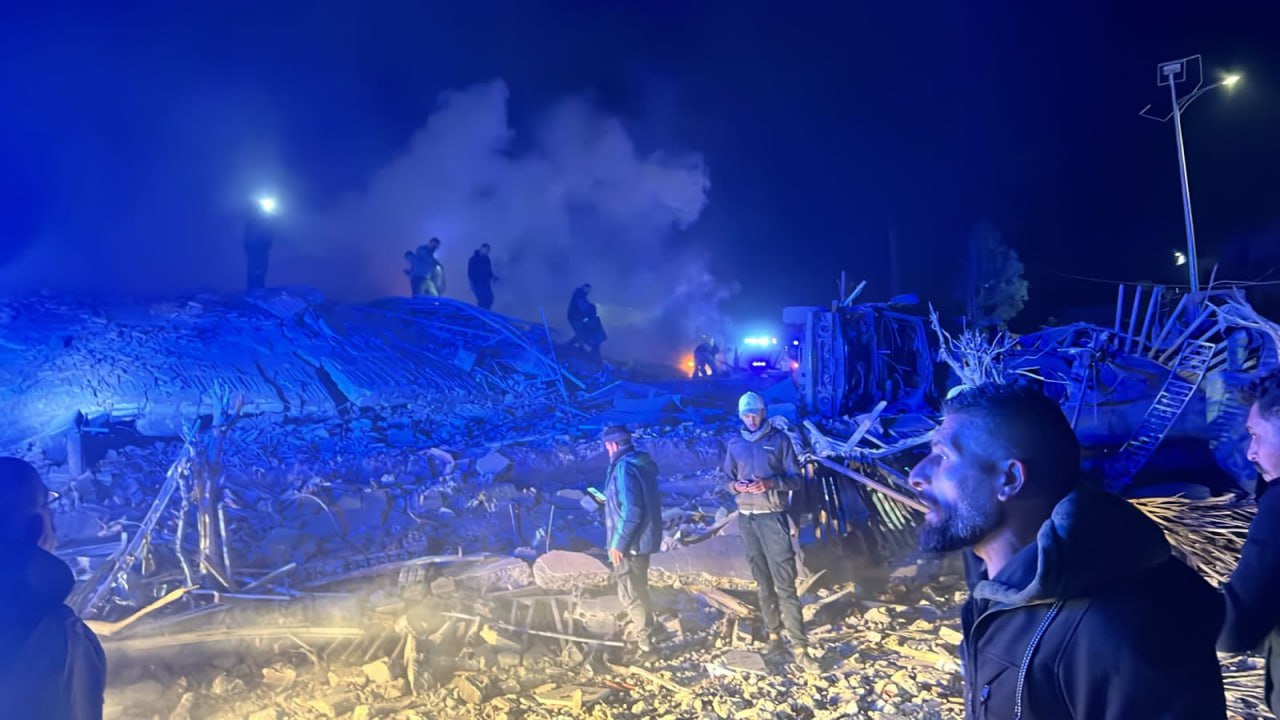
Aftermath of airstrike in Balbek. Photo: Al Akhbar
November marked an increase in Israeli airstrikes on different parts of Syria, foreshadowing a serious escalation in a third front in the region in addition to Gaza and Lebanon.
Israeli warplanes intensified their deadly attacks on different parts of the Syrian capital Damascus, and the Southern Suburb (Dahiyeh) in the Lebanese capital Beirut on Thursday, November 14.
The aerial attacks on Damascus targeted residential buildings in both Mazzeh and Qudsaya areas, leaving at least 15 people killed and 16 others injured, in addition to causing significant material damage to a number of buildings, according to a source in the Syrian military.
Thursday’s airstrikes on Damascus were preceded by a series of airstrikes that targeted different parts of Syria within the last couple of weeks. On Wednesday, November 13, Israeli fighter jets struck bridges on the Orontes River and roads in Al-Qusayr area in Homs countryside, near the Syrian Lebanese borders. The airstrikes inflicted great damage on the bridges and roads, which consequently became out of service, as per a report published by the Syrian Arab News Agency SANA.
On Sunday, November 10, Israeli warplanes targeted a residential building in the Sayyidah Zaynab area of Damascus, killing seven civilians including women and children. Previous airstrikes were launched by Israeli fighter jets on November 4, targeting a number of sites south of Damascus, resulting in material damages.
Syria’s Foreign and Expatriates Ministry condemned the Israeli attacks in a statement issued on Thursday. “The Israeli entity’s continuation of its attacks on Syria today comes only two days after the joint Arab-Islamic summit in Riyadh issued a broad condemnation of its brutal and escalating aggression on Syrian territory, and its warning of the danger of this escalation that is ravaging the region and its regional and international repercussions,” the Ministry stated.
“Syria affirms that the usurping entity’s continued disregard for international laws and regulations, and its indifference to all international demands to stop its aggression and violations, comes as a result of the Security Council’s failure to take a firm and real stance to deter it from its crimes, which also included attacks on international peacekeeping forces in Lebanon,” the Ministry added.
Meanwhile, Israel carried out at least four rounds of air raids on different targets across Beirut’s Southern Suburb (Dahiyeh), including Al-Amrousiyeh area near Beirut’s International Airport. Moreover, the Israeli aggression continued to target different areas of South Lebanon and Beqaa. The attacks across Lebanon on Thursday left at least 11 people killed and several others wounded, according to media reports.
The escalation of Israeli aggression and its expansion on different fronts has been increasing despite the mounting regional and international calls for a ceasefire and de-escalation, which indicates Israel’s total disregard of international law and its obligations. Israel insists on committing blatant violations of territorial integrity of sovereign states, due to the impunity it enjoys, and being given the greenlight by the United States.
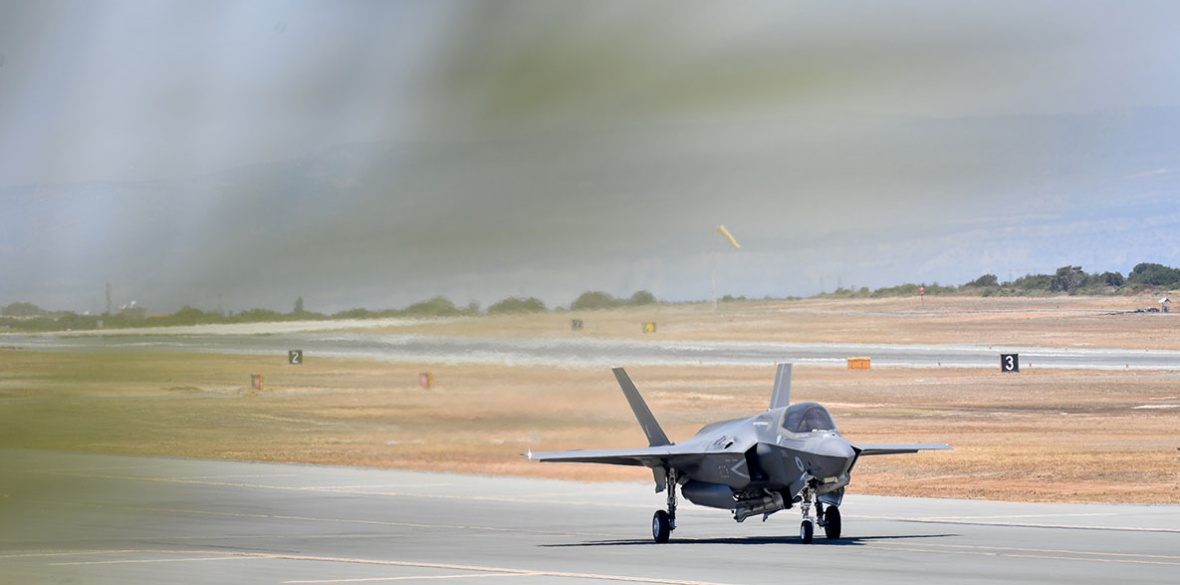
An F-35 arriving back at RAF Akrotiri in Cyprus, June 24, 2019
LABOUR remains complicit in Israel’s war crimes despite imposing a partial arms suspension, a briefing from the Campaign Against Arms Trade (CAAT) has revealed.
The government suspended 30 export licences to Israel out of about 350 last month.
But the briefing by CAAT highlights that crucial elements have been excluded, including components for F-35 combat aircraft.
F-35 components are exempt if not sent directly to Israel, despite evidence that they have been used in violations of International Humanitarian Law (IHL).
On the same day the suspension was announced, Danish NGO Danwatch revealed that an F-35 was used to drop bombs in an attack on a “safe zone” on Al-Mawasi in Khan Younis, killing 90 people.
CAAT warns this attack likely violated IHL.
Britain makes 15 per cent of all F-35s, with CAAT estimating the value of British components in the 39 planes delivered to Israel since 2016 at about £360 million — almost three times the value of other aircraft-related licences to Israel in the same period.
The F-35 is the largest and most important part of Britain’s arms trade with Israel and exports are made through an open licence, often excluded from media reporting as its financial value isn’t attached.
Freedom of information requests by CAAT revealed that the use of the Open General Export Licence for F-35 spare parts to Israel nearly tripled in 2023.
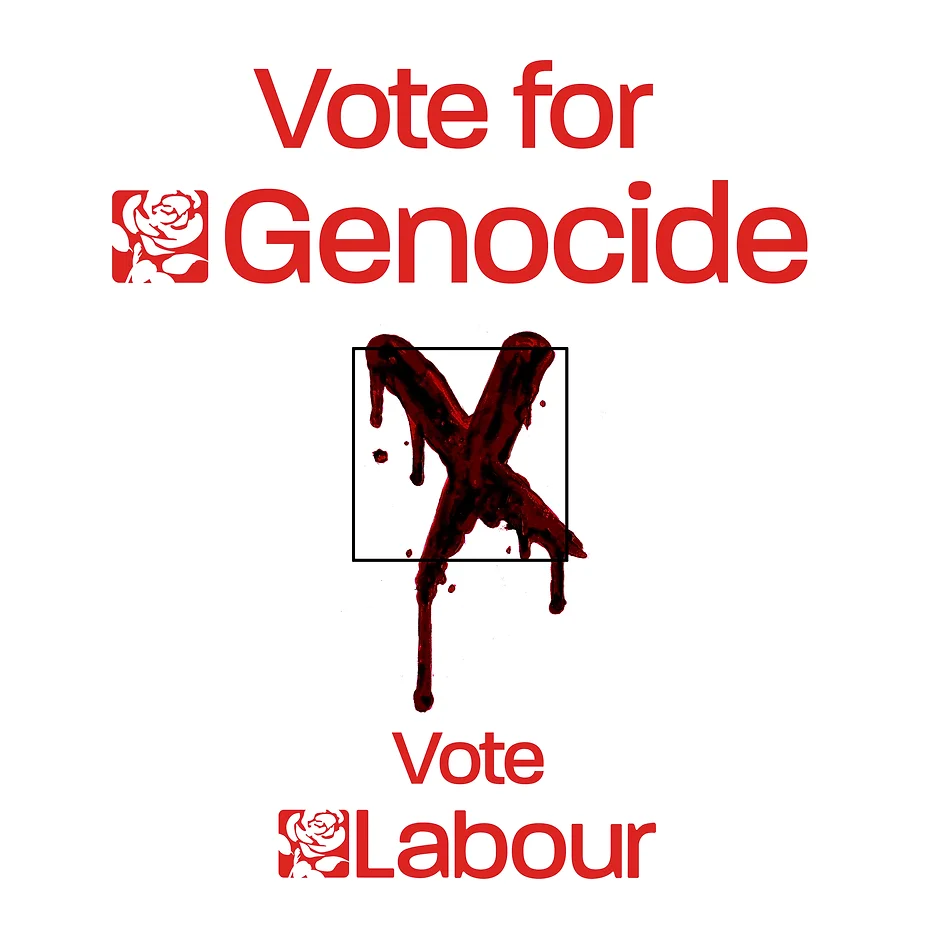
Zionist Keir Starmer is quoted “I support Zionism without qualification.” He’s asked whether that means that he supports Zionism under all circumstances, whatever Zionists do.UK Foreign Secretary David Lammy says that UK is suspeding 30 of 350 arms licences to Israel. He also confirms the UK government’s support for Israel’s Gaza genocide.Vote For Genocide Vote Labour.