Mark Zuckerberg (C), CEO of Meta, attends the inauguration ceremony where Donald Trump was sworn in as the 47th U.S. President in the U.S. Capitol Rotunda in Washington, D.C., on January 20, 2025. (Photo: Shawn Thew / POOL / AFP)
“Rather than learning from its reckless contributions to mass violence in countries including Myanmar and Ethiopia, Meta is instead stripping away important protections that were aimed at preventing any recurrence of such harms.”
An expert on technology and human rights and a survivor of the Rohingya genocide warned Monday that new policies adopted by social-media giant Meta, which owns Facebook and Instagram, could incite genocidal violence in the future.
On January 7, Meta CEO Mark Zuckerberg announced changes to Meta policies that were widely interpreted as a bid to gain approval from the incoming Trump administration. These included the replacement of fact-checkers with a community notes system, relocating content moderators from California to Texas, and lifting bans on the criticisms of certain groups such as immigrants, women, and transgender individuals.
Zuckerberg touted the changes as an anti-censorship campaign, saying the company was trying to “get back to our roots around free expression” and arguing that “the recent elections also feel like a cultural tipping point toward, once again, prioritizing speech.”
“With Zuckerberg and other tech CEOs lining up (literally, in the case of the recent inauguration) behind the new administration’s wide-ranging attacks on human rights, Meta shareholders need to step up and hold the company’s leadership to account to prevent Meta from yet again becoming a conduit for mass violence, or even genocide.”
However, Pat de Brún, head of Big Tech Accountability at Amnesty International, and Maung Sawyeddollah, the founder and executive director of the Rohingya Students’ Network who himself fled violence from the Myanmar military in 2017, said the change in policies would make it even more likely that Facebook or Instagram posts would inflame violence against marginalized communities around the world. While Zuckerberg’s announcement initially only applied to the U.S., the company has suggested it could make similar changes internationally as well.
“Rather than learning from its reckless contributions to mass violence in countries including Myanmar and Ethiopia, Meta is instead stripping away important protections that were aimed at preventing any recurrence of such harms,” de Brún and Sawyeddollah wrote on the Amnesty International website. “In enacting these changes, Meta has effectively declared an open season for hate and harassment targeting its most vulnerable and at-risk people, including trans people, migrants, and refugees.”
Past research has shown that Facebook’s algorithms can promote hateful, false, or racially provocative content in an attempt to increase the amount of time users spend on the site and therefore the company’s profits, sometimes with devastating consequences.
One example is what happened to the Rohingya, as de Brún and Sawyeddollah explained:
We have seen the horrific consequences of Meta’s recklessness before. In 2017, Myanmar security forces undertook a brutal campaign of ethnic cleansing against Rohingya Muslims. A United Nations Independent Fact-Finding Commission concluded in 2018 that Myanmar had committed genocide. In the years leading up to these attacks, Facebook had become an echo chamber of virulent anti-Rohingya hatred. The mass dissemination of dehumanizing anti-Rohingya content poured fuel on the fire of long-standing discrimination and helped to create an enabling environment for mass violence. In the absence of appropriate safeguards, Facebook’s toxic algorithms intensified a storm of hatred against the Rohingya, which contributed to these atrocities. According to a report by the United Nations, Facebook was instrumental in the radicalization of local populations and the incitement of violence against the Rohingya.
In late January, Sawyeddollah—with the support of Amnesty International, the Open Society Justice Initiative, and Victim Advocates International—filed a whistleblower’s complaint against Meta with the Securities and Exchange Commission (SEC) concerning Facebook’s role in the Rohingya genocide.
The complaint argued that the company, then registered as Facebook, had known or at least “recklessly disregarded” since 2013 that its algorithm was encouraging the spread of anti-Rohingya hate speech and that its content moderation policies were not sufficient to address the issue. Despite this, it misrepresented the situation to both the SEC and investors in multiple filings.
Now, Sawyeddollah and de Brún are concerned that history could repeat itself unless shareholders and lawmakers take action to counter the power of the tech companies.
“With Zuckerberg and other tech CEOs lining up (literally, in the case of the recent inauguration) behind the new administration’s wide-ranging attacks on human rights, Meta shareholders need to step up and hold the company’s leadership to account to prevent Meta from yet again becoming a conduit for mass violence, or even genocide,” they wrote. “Similarly, legislators and lawmakers in the U.S. must ensure that the SEC retains its neutrality, properly investigate legitimate complaints—such as the one we recently filed, and ensure those who abuse human rights face justice.”
The human rights experts aren’t the only ones concerned about Meta’s new direction. Even employees are sounding the alarm.
“I really think this is a precursor for genocide,” one former employee told Platformer when the new policies were first announced. “We’ve seen it happen. Real people’s lives are actually going to be endangered. I’m just devastated.”
Climate Science Denier Donald Trump says Burn, Baby, Burn.Elon Musk urges you to be a Fascist like him, says that you can ignore facts and reality then.
The ability of governments to implement climate policies effectively is the “most important” factor in the feasibility of limiting global warming to 1.5C, a new study says.
The future warming pathways used by the Intergovernmental Panel on Climate Change (IPCC) suggest that holding warming to 1.5C is unlikely, but still possible, when considering the technological feasibility and project-level economic costs of reaching net-zero emissions.
However, the new study, published in Nature Climate Change, warns that adding in political and institutional constraints on mitigation make limiting warming to 1.5C even more challenging.
They find that the most ambitious climate mitigation trajectories give the world a 50% chance of limiting peak global warming to below 1.6C above pre-industrial temperatures. However, adding ”feasibility constraints” – particularly those involving the effectiveness of governments – reduces this likelihood to 5-45%.
The study shows that, thanks to advances such as solar, wind or electric vehicles, “the technological feasibility of climate-neutrality is no longer the most crucial issue”, according to an author on the study.
Instead, he says, “it is much more about how fast climate policy ambition can be ramped up by governments”.
Emissions scenarios
In 2015, almost every country in the world signed the Paris Agreement – with the aim to limit global warming to “well below” 2C above pre-industrial levels, with a preference for keeping warming below 1.5C.
Since then, most countries have set net-zero targets and many are making progress towards achieving them. However, as the planet continues to warm, some scientists are questioning whether it is still possible to limit warming to 1.5C, the new study says.
The IPCC’s special report on 1.5C, published in 2018, included a cross chapter box on the “feasibility” of this temperature limit. The report says there are six components of feasibility that could inhibit the world’s ability to limit warming to 1.5C, as shown in the image below.
The six components of feasibility that could inhibit the world’s ability to limit warming to 1.5C, according to the IPCC”s special report on 1.5C. Source: IPCC SR1.5, cross chapter box 3.
The IPCC’s working group three report from its sixth assessment cycle explores thousands of different future warming scenarios. These scenarios are mainly generated by integrated assessment models (IAMs) that examine the energy technologies, energy use choices, land-use changes and societal trends that cause – or prevent – greenhouse gas emissions.
Fewer than 100 of these scenarios result in warming of below 1.5C with limited or no overshoot, defined as more than a 50% chance of seeing a peak temperature below 1.6C. These are known as the “C1 scenarios”. However, these scenarios do not consider all of the feasibility constraints outlined by the IPCC.
(Furthermore, these scenarios – which run from 2019 – assume that rapid decarbonisation began almost immediately. However, in reality, emissions have continued to rise since 2020, eating into the remaining “carbon budget” for warming to be limited to 1.5C more quickly than the models assume.)
The new study investigates five constraints. The first two – geophysical and technological – focus on the constraints presented by technologies, such as the growth of carbon capture and storage, nuclear power and solar generation, and the Earth’s total geological carbon storage capacity.
For sociocultural constraints, the study explores behavioural changes that can accelerate decarbonisation, such as reduced energy demand. The authors refer to these as “enablers”. And the “economic constraint” focuses on carbon prices.
However, the authors say the “key innovation” of their study is the inclusion of “institutional constraints”, which measure a government’s ability to “effectively implement climate mitigation policies”.
Policy constraints
All countries have different “institutional capabilities” to enforce policies. Some countries are able to quickly and successfully implement policies, such as taxation changes or environmental regulation. Other countries – which are often less wealthy – have lower levels of governance, making it harder to implement these measures.
The indicator is based on the speed and success with which they have achieved their past “environmental goals” – for example, reductions in the sulphur emissions of power plants – he explains. Countries that were successful in achieving these targets in the past are given higher governance scores.
She tells Carbon Brief that the indicator is originally from the Worldwide Governance Indicators published by the World Bank. (See more on the indicators in the guest post Andrijevic and her co-authors wrote for Carbon Brief.)
The graph below, taken from the new study, shows how governance is expected to improve over the 21st century for countries with a population of more than 25 million in 2020, according to this indicator. Each colour indicates a different world region. The grey lines indicate a “pessimistic” scenario in which governance remains frozen at 2020 levels.
Expected increases in governance over the 21st century. Only countries with a population of more than 25 million in 2020 are shown. Each colour indicates a different world region. Source: Bertram et al (2024).
The authors use global average carbon prices as a “proxy” for the overall strength of a country’s climate policy, assuming that countries with higher levels of governance will implement higher carbon prices.
They develop a range of scenarios. In their optimistic scenario, carbon prices vary, but this does not explicitly constrain emissions reductions. In the “default” scenario, both carbon prices and emissions reductions are constrained.
In the pessimistic scenario, governance indicator values are “frozen” at their 2020 levels, meaning that governments’ ability to implement new climate mitigation policies does not improve over the 21st century.
Bertram tells Carbon Brief that the measure is “not perfect”, but says that it gives a good approximation of “how fast decarbonisation can happen in different countries”.
Is 1.5C ‘feasible’?
The authors used existing literature to quantify how much each of the five constraints might affect the world’s ability to limit global warming. They then produced a set of different “feasibility scenarios” and assessed their future CO2 emissions using eight IAMs.
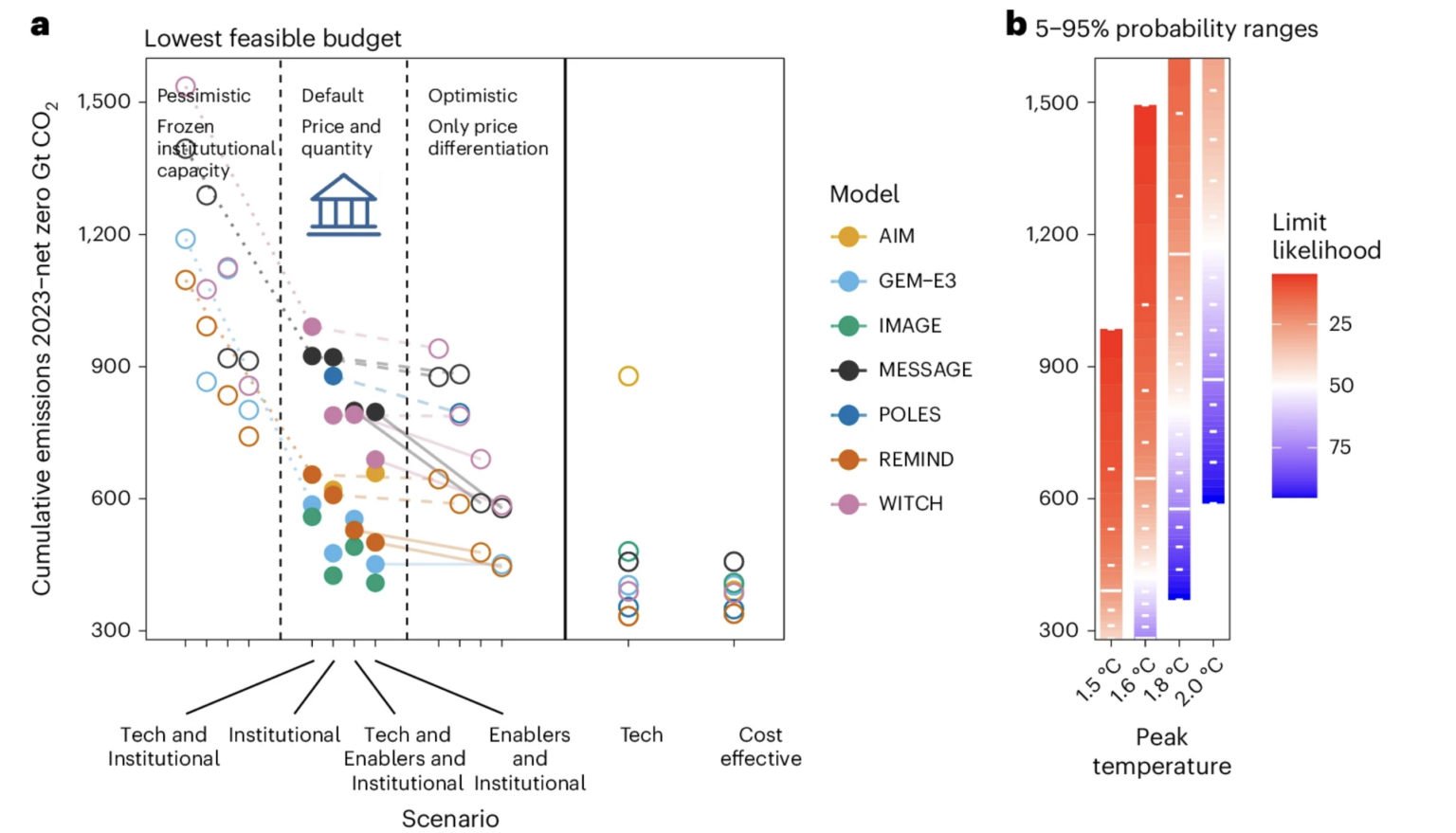
The plot below shows the minimum total global CO2 emissions that could be produced between 2023 and the date that net-zero CO2 is reached for these scenarios. In the panel “a”, on the left, each dot indicates a model result.
The column on the far left is a “pessimistic” institutional feasibility scenario, in which governance indicators do not improve beyond 2020 levels. Cumulative global CO2 emissions before net-zero here are the highest of any scenario explored.
The next column is the “default” assumption of carbon prices and emissions-reduction quantities, under four different combinations of constraints.
From left to right within this column, the combinations cover technological and institutional constraints, only institutional constraints, technological and institutional constraints with enablers and then institutional constraints with enablers.
The enablers include measures such as reduced energy demand in high income countries and increased electrification. This helps to “create more flexibility on the supply side and thus further improve the feasibility of implementation”, according to the paper.
The final column shows “optimistic” scenarios, divided between a scenario with technological constraints (left) and a “cost-effective” scenario, as used in the IPCC (right).
Panel “b” shows the likelihood, based on the 14 feasibility scenarios in panel a, of staying below 1.5C, 1.6C, 1.8C and 2.0C peak temperatures. Each bar indicates a different peak temperature. Red indicates a high likelihood of meeting the temperature target, given the level of emissions, and purple indicates a low likelihood.
Minimum achievable carbon budget from 2023 until net-zero CO2, across 14 different feasibility scenarios. Source: Bertram et al (2024).
In scenarios without any institutional constraints, nearly all models are able to produce scenarios which line up with the IPCC’s C1 scenarios, which have more than a 50% chance of seeing a peak temperature below 1.6C.
However, adding institutional constraints reduces this likelihood to 5-45%.
(A peak temperature of 1.6C would not necessarily breach the long-term goal of the Paris agreement, as long as temperatures were brought back down below the 1.5C threshold by the end of the century. However, there are risks associated with overshoot – such as crossing tipping points – and it relies more heavily on large-scale implementation of negative emissions technologies.)
Under the “pessimistic” institutional constraints, the ability of countries to cut emissions is “sharply curtailed”, the authors say, resulting in only a 30-50% chance of limiting warming even to 2C above pre-industrial levels.
The study shows that “technological constraints are not a crucial impediment to a fast transition to net-zero anymore,” Bertran tells Carbon Brief.
“Thanks to the latest advances in low-carbon technology deployment, such as solar, wind or electric vehicles, the technological feasibility of climate-neutrality is no longer the most crucial issue,” Prof Gunnar Luderer – a study author and lead of the energy systems group at the PIK – added in a press release.
Instead, he said, “it is much more about how fast climate policy ambition can be ramped up by governments”.
Future warming
The findings of this study have implications for meeting the Paris Agreement 1.5C limit. “Our study does not imply that the 1.5C target needs to be abandoned,” the study says. However, it adds:
“The world needs to be prepared for the possibility of an overshoot of the 1.5C limit by at least one and probably multiple tenths of a degree even under the highest possible ambition.”
“The 1.5C target was always something that, while theoretically possible, was very unlikely given the real-world technical, institutional, economic and political setting that determines climate policy,” says Prof Frances Moore from the department of environmental science and policy at UC Davis, who was not involved in the study.
However, she tells Carbon Brief, the finding that humanity could still limit warming to 2C is “a signal of the progress countries have made in committing to climate action”.
However, he says the results “need to be interpreted very cautiously”. For example, he notes that the study only considers CO2 emissions and not other greenhouse gases, such as methane.
In addition, he notes that “institutional capacities affect climate action in a myriad of different ways that are not easily representable in the modelling world”. As a result, the study authors had to “settle” on an approach that “may only be partly representative of ‘real world’ dynamics and is very sensitive to modelling assumptions”.
Moore says this is a “valuable initial study”, but makes a similar point, noting that the “implementation of institutional constraints and demand-side effects is somewhat arbitrary and ad-hoc”, such as using carbon prices as a governance indicator.
Dr William Lamb is a researcher at the Mercator Research Institute and was also not involved in the study. He tells Carbon Brief that the study results are “sobering” and says that “we need to start focusing research, policy and advocacy on the underlying institutions and politics that shape climate action”.
He adds that there are other aspects of feasibility that could be considered:
“We know that incumbent fossil fuel interests are politically powerful in many countries and are able to obstruct the implementation of climate policies, or even reverse those that are already in place. In other words, some governments may be capable, but do not want to implement ambitious climate action.”