Original article by Andrew Wasley republished from TBIJ under a Creative Commons Attribution-NonCommercial-NoDerivs 3.0 Unported License.
The river Wye.
The case will argue the meat giant knew of the potential environmental consequences of industrial-scale chicken farming
The US meat and grain giant Cargill must compensate those affected by pollution in the River Wye or face court proceedings, lawyers preparing to sue the company have warned.
Legal papers served to the company by the law firm Leigh Day say hundreds of people have suffered loss and damage because of pollution linked to growing industrial chicken farming in the region. The firm also demands that Cargill cleans up the river.
Leigh Day’s letter to the company, seen by the Bureau of Investigative Journalism (TBIJ), also accuses two of Cargill’s UK entities – Avara Foods and Freemans of Newent – of jointly polluting the river with phosphorus. The companies have two months to respond to the allegations.
Natural England downgraded the river’s health rating last year, citing higher phosphorus levels and increased eutrophication – a phenomenon where a build-up of nutrients prompts some plants to grow excessively, depleting oxygen levels.
“Chicken manure is high in phosphorus, having a concentration four to five times higher than other forms of manure,” Leigh Day’s letter states.
Pollution of the Wye has become a national issue as the number of chicken farms nearby has grown. Today, Avara Foods is responsible for more than four fifths of the 20 million birds reared in the region, according to Leigh Day.
Until recently, waste from the farms was frequently spread on nearby land as a fertiliser, where it would run into adjacent waterways, including the Wye and its tributaries.
In the legal papers, Leigh Day accuses Cargill, Avara and Freemans of being responsible for “substantial water quality degradation and widespread algal blooms”, as well as “species decline [and] a loss of income from tourism, water sports, fishing, hospitality and other local businesses”.
Local house prices have also been affected, the letter notes, along with the quality of life for residents living next to industrial-scale farms.
Initially, Leigh Day only named Avara as a defendant, but in May it announced that Cargill would also face action. Avara is a joint venture between Cargill and Faccenda Foods – a major UK poultry processor. There are more than 100 intensive poultry farms in the Wye Valley over which Avara, and thus Cargill, “has significant legal and factual control”, Leigh Day claims.
Avara has previously said it is “confident that there is no case to defend” and that Leigh Day’s civil claim is “a year-old, opportunistic attempt to profit from a serious environmental issue”.
“It has no merit and is not supported by evidence or expert opinion,” the company said in March. “It ignores the long-standing use of phosphate-rich fertiliser by arable farms as well as the clear scientific data showing the issue of excess phosphorus considerably pre-dates the growth of poultry farms in the Wye catchment.”
The letter also notes that Avara supplies 4 million chickens to the UK retail, hospitality and food service sectors, and is a supermarket poultry supplier.
The case will argue that Cargill, which is headquartered in Minnesota but operates around the world, must share responsibility for the pollution of the Wye and related waterways.
Cargill knew of the potential consequences of industrial-scale chicken farming because of similar legal challenges in the US, Leigh Day argues. There, waste from poultry farms from a number of companies – including Cargill – was found to have contributed to historic river pollution in Oklahoma.
Leigh Day’s letter adds that Cargill’s importing of phosphorus-rich soy, which is then used to make poultry feed, has also contributed to the problem. TBIJ previously uncovered how Cargill soy from Brazil is shipped to Liverpool, where it is processed for use in animal feed at farms that supply Avara.
Leigh Day partner Oliver Holland told TBIJ: “We hope that Avara and Cargill will take this opportunity to engage constructively with the substance of the claim and work with us to avoid court proceedings being issued. However, if they do not, our clients will be issuing court proceedings and looking to proceed with this claim through the high court.”
Original article by Andrew Wasley republished from TBIJ under a Creative Commons Attribution-NonCommercial-NoDerivs 3.0 Unported License.
Original article by Ed Siddons republished from TBIJ under a Creative Commons Attribution-NonCommercial-NoDerivs 3.0 Unported License.
The number of civil tax avoidance leads looked into by HMRC’s Fraud Investigation Service has fallen by almost half in five years, while the number of civil cases it has formally opened has decreased by more than a quarter.
These figures, obtained by the Bureau of Investigative Journalism (TBIJ) under Freedom of Information laws, raise questions about the tax authority’s performance since the start of the pandemic.
The findings follow revelations by TBIJ and the Observer in September that prosecutions following HMRC investigations plummeted by two thirds in five years. TBIJ then revealed in January that HMRC has not charged a single company under a landmark 2017 law to clamp down on corporate tax evasion.
The new figures suggest that the tax authority’s civil enforcement has also declined alongside its use of criminal powers.
Margaret Hodge MP called on HMRC to “finally crack down on egregious tax avoidance and collect the revenues we desperately need”.
In the tax year of 2018/19, HMRC’s Fraud Investigation Service opened 37,273 “risks”, a term used to describe a preliminary inquiry into suspected error or false declaration. In 2022/23, that figure fell to just 21,338 – a 43% decline in five years.
The number of civil cases that were formally opened fell by 28% in the same period, from 17,424 to 12,585.
“The new revelations that HMRC is failing to make up for [declining numbers of criminal prosecutions] by undertaking more civil investigations is just disgraceful,” said Hodge. “These consecutive failures mean tax dodgers and their enablers can continue getting away scot-free.”
Stephen Daly, senior lecturer in corporate law at King’s College London, said: “[The number of] investigations has fallen off a cliff, and that can’t be good … If you don’t enforce the rules, then you create a culture in which people don’t have to worry about their tax returns later being checked.”
Civil inquiries and investigations declined sharply in 2020, when the Covid-19 pandemic interrupted HMRC’s enforcement activity. But despite a significant rise last year, the number of cases remains well below pre-pandemic levels. “If, in fact, this isn’t explained by Covid, then it’s unacceptable,” said Daly.
A HMRC spokesperson told TBIJ that figures relating to its Fraud Investigation Service “do not take account of our overall compliance activity”, including 300,000 interventions opened in 2022/23. They said the authority has recouped £136bn from compliance interventions since 2018/19.
Easy targets?
As well as the general decline in civil cases opened by HMRC’s fraud unit, the number opened by its team for investigating offshore, corporate and wealthy taxpayers has fallen especially steeply, by 56% in five years.
“Even when [HMRC is] opening civil cases, they appear to be going after the easier, lower value targets,” said Fiona Fernie, a partner at tax advisory firm Blick Rothenberg.
Last year, HMRC reached one of its highest ever tax settlements when former F1 mogul Bernie Ecclestone paid £650m after pleading guilty to tax fraud – but that success was “the exception, not the rule”, said Fernie.
Part of the problem is that the UK has an increasingly complex tax code, which makes enforcement action difficult, she said. “The staff are under considerable pressure, we get an increasingly complicated system every year, [and] it’s very difficult to get anybody to keep up with it.”
Robert Palmer, executive director of Tax Justice UK, said another issue was lack of resources. “We know HMRC is underfunded and resources have been diverted for work on Covid and Brexit,” he said.
HMRC estimates that it collects 95% of all the tax owed in the UK, a proportion it says has remained stable in recent years. However, it estimates that the remaining 5% still accounts for about £36bn.
“Parliamentary research shows that when the government invests in HMRC, the return on investment is significant. Until the department is properly funded, vast sums of money owed, often by the richest people and companies, will go unrecovered,” said Palmer.
The Public Accounts Committee last year found that for every £1 spent on compliance, HMRC recovers £18 in additional tax revenue. “The government is missing the opportunity to recover billions in lost revenue by not resourcing compliance,” it said.
Original article by Ed Siddons republished from TBIJ under a Creative Commons Attribution-NonCommercial-NoDerivs 3.0 Unported License.
Lead image: Her Majesty’s Revenue and Customs building, London. Credit: Ian Bottle/Alamy Stock Photo
Original article by Ed Siddons republished from TBIJ under a Creative Commons Attribution-NonCommercial-NoDerivs 3.0 Unported License.
HMRC has not charged a single company under landmark legislation passed six years ago to crack down on corporate tax evasion.
Critics say the data, released after Freedom of Information requests by the Bureau of Investigative Journalism and TaxWatch, suggests that HMRC is undermining its own deterrents against corporate tax evasion by failing to use its criminal enforcement powers.
Margaret Hodge MP called the findings appalling and said the lack of enforcement had rendered the law “a paper tiger.”
The Criminal Finances Act 2017 introduced new powers to charge companies and partnerships operating in the UK that failed to stop their employees or associates from facilitating tax evasion, regardless of where in the world the tax was evaded.
One part of the new law, known as the Corporate Criminal Offences clause, drastically lowered the bar for prosecuting businesses that enabled tax evasion. It introduced “strict liability”, meaning that a company cannot plead ignorance of the wrongdoing to evade a criminal charge, and prosecutors do not have to prove intent in order to secure a conviction.
It also threatened unlimited fines in the case of established wrongdoing. Companies can avoid punishment if they have reasonable procedures in place to prevent the facilitation of tax evasion.
The law both made criminal prosecutions easier to pursue and strengthened the penalties. But critics say the refusal to charge a single company has cast serious doubts on the landmark legislation.
TBIJ, TaxWatch and The Observer previously revealed that the number of concluded prosecutions after HMRC investigations had fallen by more than two-thirds in five years, with only 11 wealthy taxpayers prosecuted in 2022.‘A deterrent that you never use is no deterrent’
“The lack of any Corporate Criminal Offence prosecutions is, I think, quite serious,” said Dan Neidle, founder of Tax Policy Associates and formerly head of tax at Clifford Chance. “A deterrent that you never use is no deterrent.”
Criminal penalties were the only reliable way to change behaviour, while the overreliance on civil penalties and fines often failed to curb serious wrongdoing, Neidle said. “If you disarm yourself and don’t use the criminal tools that you have available, then you are missing the trick.”
A spokesperson for HMRC said: “Corporate criminal offences were introduced to encourage organisations to put preventative measures in place to stop tax evasion. Our efforts have helped drive a corporate culture shift towards anti-tax evasion awareness, which has led to new procedures across business sectors.”
HMRC told TBIJ it has 11 live investigations and is looking into a further 24 possible cases. It has also reviewed and rejected an additional 94.
Hodge said: “We are in the midst of a cost-of-living crisis, and tax evasion is costing our economy billions each year. So it is appalling that HMRC has failed to prosecute a single enabler of tax evasion.
“We know that there continues to be a whole industry that supports those who don’t want to pay their fair share of tax. We cannot drive cultural change in that industry if its members are under the impression that this offence is just a paper tiger.”
HMRC prioritises the recouping of money lost to tax avoidance and evasion through civil settlements rather than prosecutions, according to Robert Palmer, the director of Tax Justice UK. He cited the risk and cost of prosecuting powerful opponents with deep pockets.
“HMRC is routinely outgunned by the private sector,” he said. “It’s a real problem, because the minute you go against someone who’s rich, they can lawyer up and drag things out. HMRC are outmatched … particularly when it comes to the professional enablers and facilitators.”
Other legislation with similar “failure to prevent” clauses has resulted in charges and convictions. The UK Bribery Act 2010 made it a crime to fail to prevent bribery and has led to high-profile prosecutions, including the oil and gas company Petrofac in 2021.
The realistic threat of criminal prosecutions means “the Bribery Act continues to be taken very, very seriously,” said Neidle, “whereas the Criminal Finances Act is dropping off the radar.”
Susan Hawley, director of Spotlight on Corruption, said: “Legislation only has a deterrent effect for so long without any meaningful enforcement.
“The government urgently needs to get to the bottom of whether this lack of prosecutions is related to failures of political will or resourcing issues at HMRC, or deeper problems with the wording of the offence.”
Original article by Ed Siddons republished from TBIJ under a Creative Commons Attribution-NonCommercial-NoDerivs 3.0 Unported License.
HSBC made a secretive multimillion-dollar loan to an energy company that is bulldozing a village in western Germany to expand a huge coal mine, just three months after the bank pledged to stop funding coal.
HSBC, which claims it is “helping to lead the transition to a more sustainable world”, approved the $340m deal with energy giant RWE after internal discussions in which senior figures at the bank recommended that its involvement should not be publicised.
Violent clashes broke out at the site of the mine on Wednesday as riot police tried to drag away protesters to make way for the bulldozers under the glare of the world’s media. Hundreds of environmental activists have set up camp in Lützerath, the last of several villages to be sacrificed for the 35 km2 Garzweiler mine, which is owned by RWE, one of Europe’s largest energy companies.
According to data from Refinitiv, RWE borrowed a total of $5.4bn in loans arranged by a group of 25 banks including HSBC, Barclays and Santander. All three have committed to aligning their financing and investments with net zero by 2050.
At COP27 last year the UN secretary general, António Guterres, said that it was reprehensible to use “bogus net-zero pledges” to cover up “messy” fossil fuel expansion. “It is rank deception,” he added. “This toxic cover-up could push our world over the climate cliff. The sham must end.”
HSBC told the Bureau: “Details of this [deal] and all its participating banks are in the public domain, as is normal. We have processes to ensure our financing aligns with our policies, which include an expectation on clients to produce and implement credible transition plans.”
Barclays declined to comment on the RWE loan but said it is phasing out financing of thermal coal mining and coal-fired power generation. Santander declined to comment.
Image: Mike Langridge 2008
‘We don’t want our name associated with it’
At the end of 2021, HSBC committed to withdraw financing from clients that are expanding the production of thermal coal and phase out funding for coal-fired power and thermal coal mining.
Bankers asked internally whether lending money to RWE would comply with this policy and raised concerns about RWE’s plans to demolish several villages. The Garzweiler mine produces 25m tonnes of lignite – the dirtiest form of coal – every year.
After several meetings, the sustainability and reputational risk department approved the deal but said that RWE should not publicise HSBC’s involvement.
An HSBC banker, who asked to remain anonymous, said of the deal: “We’re saying, ‘We don’t want our name to be associated with it, but here are the funds and please don’t tell anyone that we gave you the funds.’ I acknowledge that this approach is questionable.”
The deal was initially structured as a sustainability-linked loan, meaning its terms include a commitment from RWE that it will hit certain climate targets by 2025. But the penalty it would face for failing to do so is a tiny increase in the interest it pays on the loan. This would come to $86,700 a year for a company whose most recent annual revenues were $26bn.
Sustainability-linked loans are meant to encourage polluters to transition to more environmentally friendly operations, but companies that raise funds through the loans do not face any restrictions on how that money is used.
The HSBC banker said: “There is no guarantee that the [RWE loan] won’t be used to help pay a supplier, or pay salaries of contractors involved in the coal mine project.”
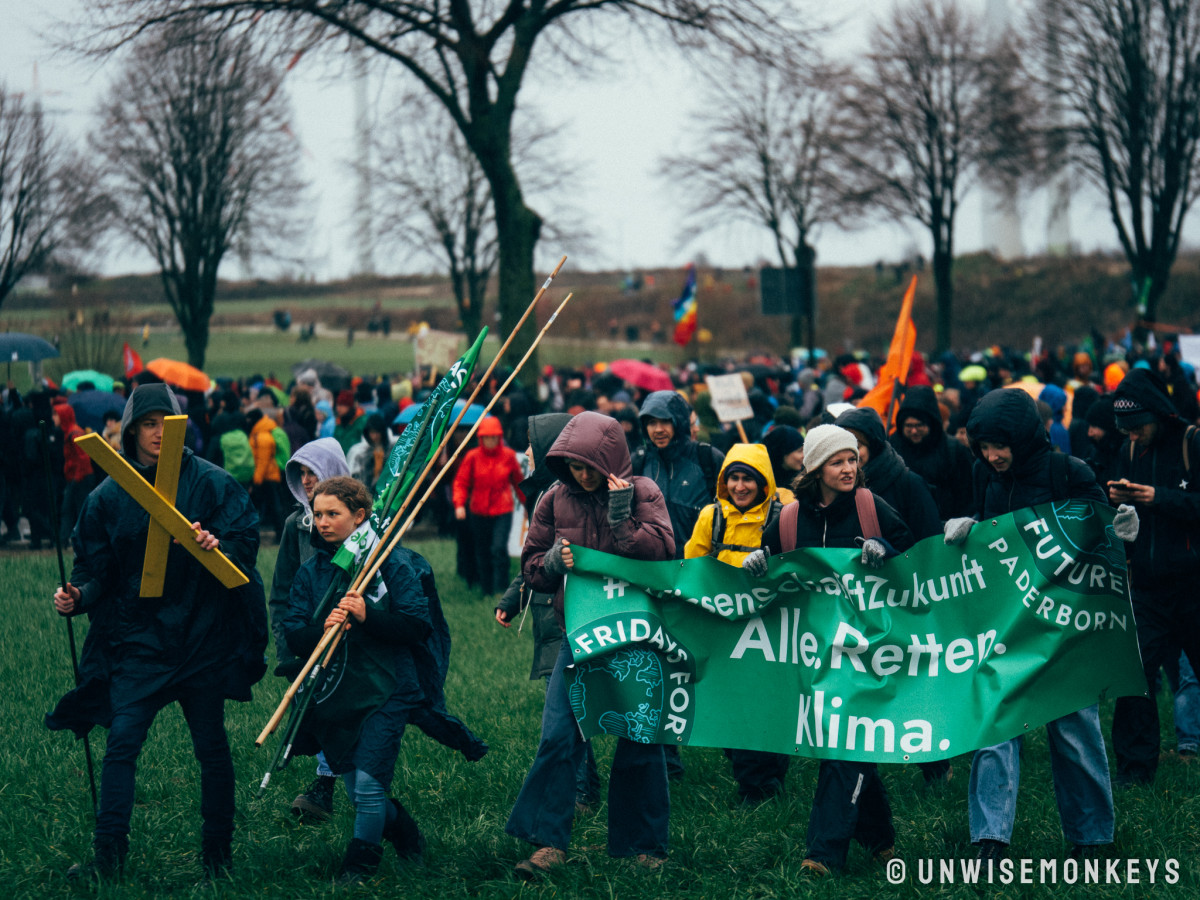
Protesters near Lützerath in January 2023. Photo: Lützi lebt/Unwisemonkeys CC BY-NC 2.0.
A condemned village
The vast Garzweiler open-cast mine has already swallowed 13 villages, according to Friends of the Earth Germany. Thousands of residents have been resettled and churches, schools and village halls have all been bulldozed to satisfy the voracious demand for energy in a heavily industrialised area.
Local residents and environmental activists across Germany have campaigned to protect another six neighbouring villages that were slated for demolition and appear to have had some success. RWE recently said that it would stop using coal in 2030 and so would drop its plans to raze five of the villages.
That just leaves Lützerath, where police are battling to evict hundreds of activists who have been living in abandoned buildings and makeshift treehouses for the past two and a half years. They have built a skate hall, farmed their own food and run workshops on climate justice.
Eckardt Heukamp was Lützerath’s last remaining resident until he moved out last year. “You saw how the church was torn down and dug up, how the villages have vanished,” he told the Times. “At some point you just say to yourself that it can’t keep going on like this, being subjugated and driven into a corner all the time.”
The showdown between the authorities and occupying activists escalated on Wednesday as riot police armed with batons moved in to evacuate the area, hauling out protesters and making arrests as fires burned in the streets of the village.
Just a few hundred metres away, one of the world’s largest land vehicles continues to carve away at the earth, bringing the edge of the mine ever closer to Lützerath.
Meaningless targets
In order to secure the loan, RWE committed to reducing its carbon emissions per unit of power generated, across all its energy sources. This means that, as long as it adds enough wind and solar power into the mix, the company could in fact increase its emissions from coal – and its planet-warming emissions overall.
It also committed to increasing the proportion of energy it generates from renewables and the amount it is investing in sustainable energy.
The penalty if RWE fails to meet all three targets is an increase in the interest it pays on the loan of less than 0.03 percentage points.
“It’s almost meaningless,” said Tariq Fancy, BlackRock’s former chief investment officer for sustainable investing. “Because the only thing that really changes behaviour in financial markets is when you change incentives. And you can’t change incentives with something so miniscule.”
Critics say RWE – which is Europe’s largest emitter of CO2 – could single-handedly stop Germany meeting its climate targets. Catharina Rieve of the German Institute for Economic Research said this will be the case if the company follows through with its plan to burn 280m tonnes of coal from the Garzweiler mine before 2030.
RWE told the Bureau it disputed this projection because the EU’s emissions trading system means that “if one company emits less, other companies elsewhere can emit more”.
The company added: “In the current energy crisis, ensuring security of supply is vital. At the same time, protecting the climate remains one of the key challenges of our time. RWE supports both. The company invests billions of euros into accelerating the energy transition.”
The HSBC banker said it was questionable to view a company as transitioning to net zero while it was expanding coal extraction, and that the bank’s attempts to challenge polluters on their transition plans was minimal.
HSBC decided the loan should not be classified as “sustainability-linked” internally, even though environmental targets remained part of the agreement. The bankers agreed it should not count towards HSBC’s target to contribute up to $1tn in sustainable finance by 2030 because of RWE’s plan to expand the Garzweiler mine and demolish several villages.
Barclays and Santander declined to comment on whether they are counting their parts of the RWE loan package towards their internal sustainable finance targets.
HSBC told the Bureau: “We have been clear we will finance energy companies who are taking an active role in transitioning to a net zero energy future, and we remain committed to this goal amid the double challenge of tackling climate change and an acute energy crisis in Europe.”
RWE is not the only company expanding fossil fuel production that has borrowed money under the guise of sustainable finance. Refinitiv data shows that Chrysaor – now part of the UK North Sea’s biggest producer of fossil fuels – raised $4.5bn with a sustainability-linked loan arranged by HSBC, Barclays, Lloyds, Natwest and a number of other banks.
One of the biggest oil producers in the US, Occidental Petroleum, raised $4bn, and the world’s biggest oil services provider Schlumberger raised $912m, also with sustainability-linked loans arranged by HSBC and other banks.
Tony Burdon, chief executive at Make My Money Matter, which campaigns for greener investments, said: “HSBC took an important first step in ceasing direct finance towards fossil fuel expansion projects. But as this report so clearly shows, they haven’t gone far enough.
“By continuing to provide sizeable corporate loans to companies involved in fossil fuel expansion such as RWE, HSBC is not just damaging the environment and displacing communities, they’re undermining their own climate targets.”
Lead image: Riot police stand in front of burning barricades as activists stage a protest in Lützerath. Credit: Bernd Lauter / Getty
Reporter: Josephine Moulds Environment editor: Robert Soutar Impact producer: Grace Murray Global editor: James Ball Editor: Meirion Jones Production editors: Alex Hess and Frankie Goodway Fact checker: Andrew Wasley
This reporting is funded by The Sunrise Project. None of our funders have any influence over the Bureau’s editorial decisions or output.