10 reasons why US president-elect Donald Trump can’t derail global climate action

Spread the love
Ahn Young-joon/AP

Wesley Morgan, UNSW Sydney and Ben Newell, UNSW Sydney

If you care about saving Earth from catastrophe, you might be feeling a little down about the re-election of Donald Trump as United States president. Undeniably, his return to the White House is a real setback for climate action.

Trump is a climate change denier who has promised to increase fossil fuel production and withdraw the US from the Paris climate deal, among other worrying pledges.

But beyond Trump and his circle, there remains deep concern about climate change, especially among younger people. Support for climate policy remains high in the US and around the world. And studies based on data from 60,000 people in more than 60 countries suggest individuals’ concern about climate change is widely underestimated.

So now is a good time to remember that efforts to tackle the climate crisis – both in Australia and globally – are much bigger than one man. Here are ten reasons to remain hopeful.

Beyond Trump and his circle, there remains deep concern about climate change around the world. HAYOUNG JEON/EPA

1. The global clean energy transition can’t be halted

The global shift to clean energy is accelerating, and Trump can’t stop it. Investment in clean energy has overtaken fossil fuels, and will be nearly double investment in coal, oil and gas in 2024. This is a historic mega-trend and will continue with or without American leadership.

2. Clean energy momentum is likely to continue in the US

Much of the Biden-era spending on clean energy industries went to Republican states and Congressional districts. New factories for batteries and electric vehicles will still go ahead under the Trump administration. After all, entrepreneur Elon Musk – who is expected to join the Trump administration – makes electric vehicles.

Some of Trump’s financial backers are receiving subsidies for clean energy manufacturing and 18 Republican Congress members have gone on record to oppose cuts to clean energy tax credits.

The clean energy shift will continue in the US. Piictured: a solar panel array floats on a water storage pond in New Jersey. Seth Wenig/AP

3. The US still wants to beat China

There is bipartisan concern in Washington about the US losing a technological edge to Beijing. China currently dominates global production of electric vehicles, batteries, wind turbines and solar panels. So internal pressure in the US to counter China’s manufacturing might will continue.

4. The federal government is not everything in the US

When Trump was last in power, he withdrew the US from some climate commitments, such as the Paris Agreement. But many state and local governments powered ahead with climate policy, and that will happen this time around, too. For example, California – the world’s fifth largest economy – plans to eliminate its greenhouse gas footprint by 2045. Even Texas, a Republican heartland, is leading a shift toward wind and solar power.

5. The US climate movement will be more energised than ever

During Trump’s first presidency, the US climate movement developed policy proposals for a “Green New Deal”. Many of these proposals were later implemented by the Biden administration. Initial reactions to Trump’s re-election suggest we can expect similar policy advocacy this time around.
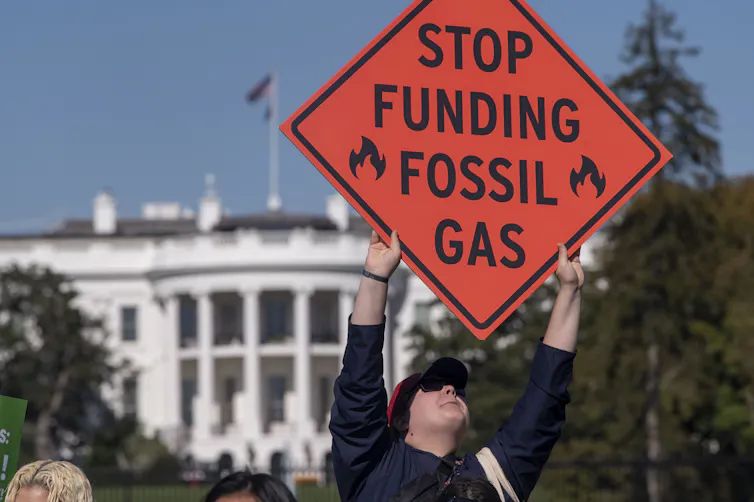
Efforts to tackle the climate crisis are much bigger than one man in the White House. Kevin Wolf/AP

6. Global climate cooperation is bigger than Trump

If Trump makes good on his promise to leave the Paris Agreement (again), he will only be leaving the room where the world’s future is being shaped. The US has walked away from global climate agreements before – for example, refusing to join the Kyoto Protocol in 2001. But other nations rallied for global action, and will do so again.

7. The rules-based global order will remain

When a nation walks away from rules that have been agreed after decades of negotiation, responsible countries must work together to bolster global cooperation. This applies to trade and security – and climate is no different.

As our Foreign Minister Penny Wong recently explained, Australia, as a middle power on the world stage, wants:

a world where disputes are resolved by engagement, negotiation and by reference to rules [and] norms […] We don’t want a world in which disputes are resolved by power alone.

8. Australian diplomacy matters

Australia is seeking to co-host the United Nations climate talks with Pacific island countries in 2026, and is emerging as the favourite. Hosting the conference, known as COP31, would be a chance for Australia to help broker a new era of international climate action, even if the US opts out under Trump.

Hosting the talks would also help cement Australia’s place in the Pacific and assist our Pacific neighbours to deal with the climate threat.

Co-hosting COP31 would help assist our Pacific neighbours to deal with the climate threat. Mick Tsikas/AAP

9. Australia’s clean energy shift is accelerating

About 40% of Australia’s main national electricity grid is powered by renewables and this is set to rise to 80% by 2030. Some states are surging ahead – for example, South Australia is aiming for 100% renewables by 2027.

Australians love clean energy at home, too. One in three households have rooftop solar installed, making us a world-leader in the technology’s uptake. Trump’s occupation of the Oval Office cannot stop this momentum.

10. Trump cannot change the science of climate change

The science is clear – burning coal, oil and gas fuels climate change and increases the risk of disasters that are harming communities right now. In Australia, we need look no further than the Black Summer bushfires in 2019-20 and unprecedented Lismore floods in 2022.

And the damage is happening across the globe. In October, twin hurricanes in the US – made stronger by the warming ocean – left a damage bill of more than US$100 billion. And hundreds of people died when a year’s worth of rain fell in one day in Spain last month.

The devastating floods in Spain remind us that climate change has arrived. ANA ESCOBAR/EPA

On gloomy days – like, say, the election of a climate denier to the White House – it might feel humanity won’t rise to Earth’s biggest existential challenge. But there are many reasons for hope. The vast majority of us support policies to tackle climate change, and in many cases, the momentum is virtually unstoppable.

Wesley Morgan, Research Associate, Institute for Climate Risk and Response, UNSW Sydney and Ben Newell, Professor of Cognitive Psychology and Director of the UNSW Institute for Climate Risk and Response, UNSW Sydney

This article is republished from The Conversation under a Creative Commons license. Read the original article.


Continue Reading10 reasons why US president-elect Donald Trump can’t derail global climate action

Pacific Islands Summit Highlights Disproportionate Climate Impacts

Spread the love

Original article by Brett Wilkins republished from Common Dreams under a CC licence.

Leaders of Pacific island nations gather in Nuku’alofa, Tonga on August 26, 2024 for the 53rd Pacific Islands Forum Leaders Meeting (PIFLM53).
 (Photo: Pacific Islands Climate Action Network/X)

U.N. Secretary-General António Guterres stressed that “the region urgently needs substantial finance, capacities, and technology to speed up the transition and to invest in adaptation and resilience.”

As more than 1,500 delegates from over 40 nations gathered in Tonga for the 53rd Pacific Islands Forum Leaders Meeting, climate defenders on Monday urged the world’s biggest polluters to do much more to phase out the fossil fuels that are driving a planetary emergency disproportionately affecting low-lying island countries, which are among the world’s lowest greenhouse gas emitters.

“Tonga’s vision for the 53rd Pacific Islands Forum Leaders Meeting (PIFLM53) is for the Pacific to move beyond policy deliberation to implementation—to achieve transformation by building better now,” summit organizers said in a statement affirming the event’s mission to “develop collective responses to regional issues and deliver on their vision for a resilient Pacific region of peace, harmony, security, social inclusion, and prosperity.”

“We may be small island countries but we are a force to be reckoned with.”

Addressing attendees at the summit’s opening ceremony in the Tongan capital of Nuku’alofa, Pacific Islands Forum (PIF) Secretary-General Baron Waqa of Nauru called for regional unity to tackle common challenges.

“We may be small island countries but we are a force to be reckoned with,” he said. “We are at the center of geostrategic interest, we are at the forefront of a battle against climate change and its impacts.”

Speaking at Monday’s opening session, United Nations Secretary-General António Guterres lamented that “humanity is treating the sea like a sewer. Plastic pollution is choking sea life. Greenhouse gases are causing ocean heating, acidification, and a dramatic and accelerating rise in sea levels.”

Guterres—who warned in Samoa last week that low-lying island nations face the threat of climate “annihilation”—said that “Pacific islands are showing the way to protect our climate, our planet, and our ocean: By declaring a climate emergency and pushing for action, and with your declarations on sea-level rise, and aspirations for a just transition to a fossil fuel-free Pacific. But, the region urgently needs substantial finance, capacities, and technology to speed up the transition and to invest in adaptation and resilience.”

“The young people of the Pacific have taken the climate crisis all the way to the International Court of Justice,” Guterres added. “You have also rightly recognized that this is a security crisis—and taken steps to manage those risks together.”

Mahoney Mori, who chairs the Pacific Youth Council and is the PIFLM53 youth representative from the Federated States of Micronesia, called out the international community’s failure to adequately fund climate mitigation initiatives like the loss and damage fund—which developing nations say will require an annual investment of at least $400 billion, or nearly 10 times the amount pledged at last year’s United Nations Climate Change Conference in Dubai.

“Despite the commendable pledges from the United Nations and world leaders such as the Paris agreement, the existing global finance mechanisms still hindered community-based and youth organizations from accessing critical support,” Mori said. “The Pacific’s grassroots organizations struggle to meet global standards amidst this crisis and time is running out.”

As leaders met for PIFLM53 amid torrential rains, a 6.9-magnitude earthquake rocked Tonga’s main island of Tongatapu. While there was no damage reported and no tsunami warning issued, summit attendees said the temblor underscored vulnerabilities faced by low-lying island nations.

Leaders and activists from Pacific island nations took aim at regional giant Australia—which has been perennially ranked as one of the world’s worst climate-wreckers in U.N.-backed Sustainable Development reports—for insufficient climate action.

“We recognize Australia’s desire to present itself as a climate leader and co-host the COP alongside the Pacific,” Pacific Islands Climate Action Network regional director Rufino Varea said in a statement, referring to Australia’s bid to help lead the 2026 United Nations Climate Change Conference, or COP31.

“However, true leadership must not merely be aspirational; it must be actionable,” Varea continued. “To date, Australia has expanded gas production instead of aligning its practices with the urgent needs of the Pacific. This does not reflect the leadership we need.”

“If Australia is to demonstrate genuine commitment, it must align its domestic and international climate policies with our goals and advocate earnestly for a fossil fuel-free Pacific,” he stressed. “It must also commit to ambitious climate actions, ensure effective climate finance is delivered to Pacific island countries, and contribute substantially to the loss and damage fund.”

“If these steps are not taken, we risk witnessing a COP that concedes failure—declaring that critical targets were missed, and that Pacific communities continue to be exploited as mere labor resources for the enrichment of others,” Varea added.

Original article by Brett Wilkins republished from Common Dreams under a CC licence.

Continue ReadingPacific Islands Summit Highlights Disproportionate Climate Impacts

Trump vs. Harris: what each presidency would mean for the green transition

Spread the love

https://www.energymonitor.ai/features/trump-vs-harris-what-each-presidency-would-mean-for-the-green-transition/

Trump and Harris’s environmental policies chart starkly different climate futures for the US and the world. Credit (from left): Stephen Maturen/Getty Images and Allison Joyce/AFP via Getty Images

The presidential candidates for the world’s largest fossil fuel producer have starkly different climate policies.

All eyes are on the US elections in November this year, with the decision of the 160+ million voters in the country to play a major role in determining the world’s trajectory towards a net-zero future.

According to the United Nations Environment Programme (UNEP), even with current pledges for emissions reduction, the planet is hurtling towards a rise of up to 2.9°C above pre-industrial levels by the end of the century. This would be catastrophic, and, one report indicates that the crisis could cost $178trn in global economic loss by 2070.

Projected 2030 emissions must fall by an additional 28-42% to limit warming to 2°C, per UNEP estimates. This means that global decisions on decarbonisation in this decade will have ramifications for this century of humanity.

Trump dismisses ‘green new scam’

Under a Trump administration, net-zero goals are expected to be in severe jeopardy.

During his former presidency, Trump not only reversed more than 100 Obama-era environmental protections but also pulled the US out of the landmark 2016 Paris Agreement, through which countries are working together to keep global emissions below the threshold of a 2°C rise.

During his campaign for re-election, Trump has dismissed rising environmental regulations as a “green new scam” and made no secret of his intentions to support the fossil fuel industry yet again.

Speaking to a Fox News journalist at a town hall event in Iowa, he shared plans to expand oil drilling on “day one” and also promised to “drill, baby, drill” in his presidential nomination speech on 18 July.

Moreover, at an April dinner at Trump’s Mar-a-Lago resort, he was reported to have asked oil industry executives to donate $1bn to aid his presidential campaign, citing benefits for them on avoided taxation and regulation as he plans to reverse environmental rules.

The projections are dire. According to analysis by Carbon Brief, a climate policy and science website, Trump’s likely policies would add four billion tonnes of greenhouse gas emissions to the atmosphere, which would cause global climate damages worth more than $900bn, as per the latest US government evaluations.

Harris hailed a ‘climate champion’

Harris, on the other hand, has a long history of enforcing climate action and is widely expected to carry on the legacy of the IRA.  

She was an early co-sponsor for the Green New Deal, a comprehensive proposal for systemic decarbonisation in the US, including creating a 100% renewable energy grid and millions of green jobs.

Most notably, ahead of her brief presidential election campaign back in 2019, Harris unveiled a $10trn plan to reduce US greenhouse gas emissions to zero by 2045, including policies such as working to eliminate fossil fuel subsidies.

She also pledged to tax polluting industries and said she would establish an independent Office of Climate and Environmental Justice Accountability that would represent and support frontline communities, and monitor government compliance.

“Success in the presidential election in November would likely lead to Harris continuing to build on this existing climate legislation and defend against Republican criticism,” says Gregory.

https://www.energymonitor.ai/features/trump-vs-harris-what-each-presidency-would-mean-for-the-green-transition/

Continue ReadingTrump vs. Harris: what each presidency would mean for the green transition

BP Condemned Over ‘Mammoth Profits’ as Fossil Fuels Wreak Havoc on the Planet

Spread the love
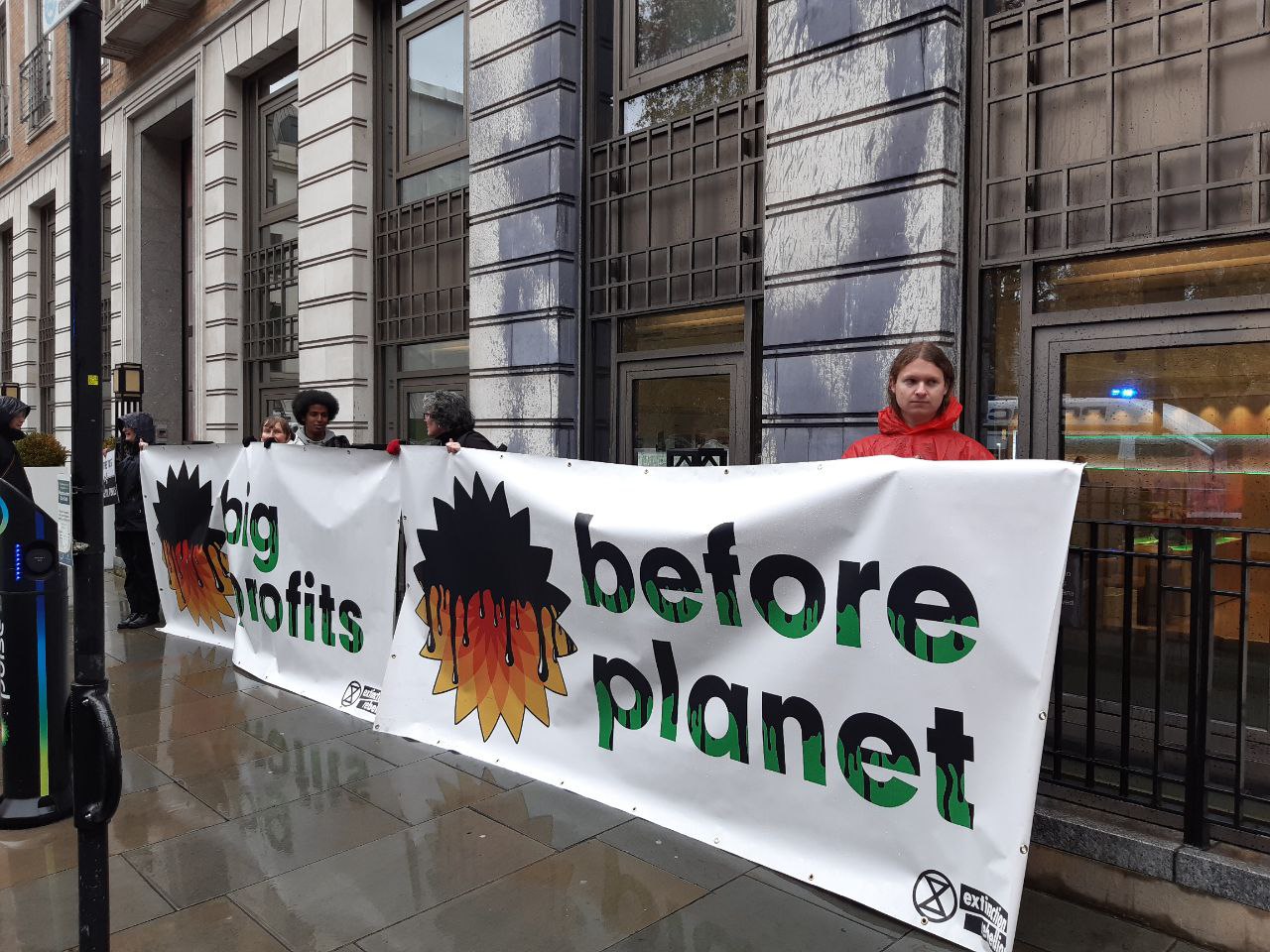
Extinction Rebellion protests at BP
Extinction Rebellion protests at BP London. Banner reads big profits before planet

“The world can no longer afford fossil fuel companies putting short-term profits above people and planet.”

The London-based oil giant BP announced Tuesday that it hauled in $2.8 billion in profit during the second quarter of the year as the world faced the consequences of the fossil fuel industry’s business model in the form of record-shattering heat, devastating wildfires, and other weather extremes.

The company’s second-quarter profit surpassed analysts’ expectations and brought its total profit for the first half of 2024 to $5.5 billion. BP on Tuesday also announced a 10% dividend increase, an expansion of its stock buyback program, and a green light for a new drilling platform in the Gulf of Mexico, even as international scientists say any new fossil fuel production is incompatible with critical warming targets set out by the Paris climate accord.

BP said that once completed, the new floating platform would have the capacity to produce 80,000 barrels of crude oil daily.

Chiara Liguori, Oxfam Great Britain’s senior climate justice policy adviser, said in a statement that “the world can no longer afford fossil fuel companies putting short-term profits above people and planet.”

“It is inexcusable that BP, one of the world’s most polluting and profitable fossil fuel companies, continues to rake in billions of pounds while low-income countries are in urgent need of funds to tackle the devastating impacts of the climate crisis despite doing the least to cause it,” said Liguori. “The costs of inaction are already here with deadly heat waves, wildfires, flooding, and drought, but it is people living in poverty who are left paying the highest price.”

BP’s profit report came weeks after the company, now under the leadership of CEO Murray Auchincloss, announced it would pause new offshore wind projects and put fresh “emphasis on oil and gas amid investor discontent over its energy transition strategy,” as Reuters reported last month. The move came over a year after the company rolled back its plan to curtail oil and gas production.

Extreme weather driven by the burning of fossil fuels, meanwhile, continued to wreak havoc across the globe.

“As global temperatures spiked to their highest levels in recorded history [last Monday], ambulances were screaming through the streets of Tokyo, carrying scores of people who had collapsed amid an unrelenting heat wave,” wrote The Washington Post‘s Sarah Kaplan over the weekend. “A monster typhoon was emerging from the scorching waters of the Pacific Ocean, which were several degrees warmer than normal. Thousands of vacationers fled the idyllic mountain town of Jasper, Canada ahead of a fast-moving wall of wildfire flames.”

“By the end of the week—which saw the four hottest days ever observed by scientists—dozens had been killed in the raging floodwaters and massive mudslides triggered by Typhoon Gaemi,” Kaplan continued. “Half of Jasper was reduced to ash. And about 3.6 billion people around the planet had endured temperatures that would have been exceedingly rare in a world without burning fossil fuels and other human activities, according to an analysis by scientists at the group Climate Central.”

Izzie McIntosh, a climate campaigner at the United Kingdom-based advocacy group Global Justice Now, said Tuesday that BP’s “mammoth profits” come “at the expense of our climate, communities, and the Global South facing the most brutal impacts of a climate crisis they did not cause.”

“Labour has made some promising signals about a move toward green energy—it now needs to throw its weight behind tackling the rampant profiteering of oil and gas companies,” McIntosh said of the newly elected U.K. government. “It can do this by introducing a windfall tax and other measures to fund the U.K.’s contribution to a globally just fossil fuel phaseout that works for workers and communities in the U.K. and around the world.”

Original article by JAKE JOHNSON republished from Common Dreams under Creative Commons (CC BY-NC-ND 3.0). 

Original article by JAKE JOHNSON republished from Common Dreams under Creative Commons (CC BY-NC-ND 3.0). 

‘Twisted’: BP And Shell CEOs See Pay Double As Workers Struggle To Heat Homes ›

Continue ReadingBP Condemned Over ‘Mammoth Profits’ as Fossil Fuels Wreak Havoc on the Planet

Report Details Big Oil Lobby’s Relentless Opposition to a Green Transition

Spread the love

Original article by JESSICA CORBETT republished from Common Dreams under Creative Commons (CC BY-NC-ND 3.0). 

An oil refinery is shown at dusk in Thailand.  (Photo: credit: Suriyapong Thongsawang/Getty Images)

Climate campaigners said the “brilliant and disturbing” publication “shows the crucial need for increased awareness of the delaying tactics of fossil fuel companies.”

Echoing years of academiccongressional, and journalistic research, a U.K.-based think tank on Thursday released a report detailing how top fossil fuel industry trade groups have “used a playbook of narratives and arguments to systematically oppose, weaken, and delay the transition to renewables and electric vehicles (EVs) since at least 1967.”

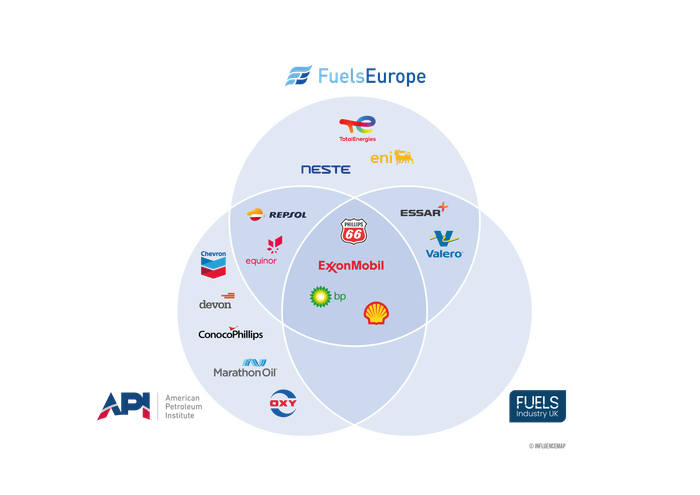
The new InfluenceMap analysis focuses on the American Petroleum Institute (API), FuelsEurope, and Fuels Industry U.K.—whose spokespeople responded to the report by insisting to SustainableViews that the oil and gas industry is playing an “essential” role in the transition and it is necessary to harness “vast energy resources, from oil and natural gas to renewables.”

Meanwhile, InfluenceMap’s report calls out the organizations for their use of three narratives over the past five decades that “has likely contributed to delaying the energy transition and continues to pose a serious threat to policy progress on climate change.”

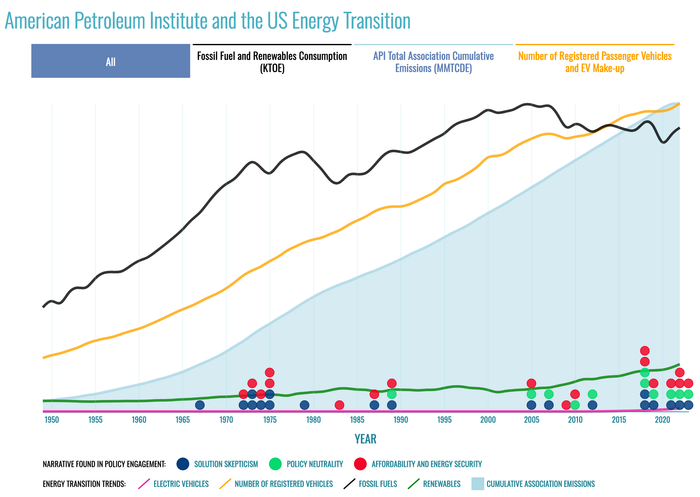
“Between 1950 and 2022, the members of these associations have a combined contribution of approximately 350 billion tons of greenhouse gas emissions, accounting for approximately 18% of the world’s total cumulative CO2 emissions from fossil fuels and industry,” the report notes.

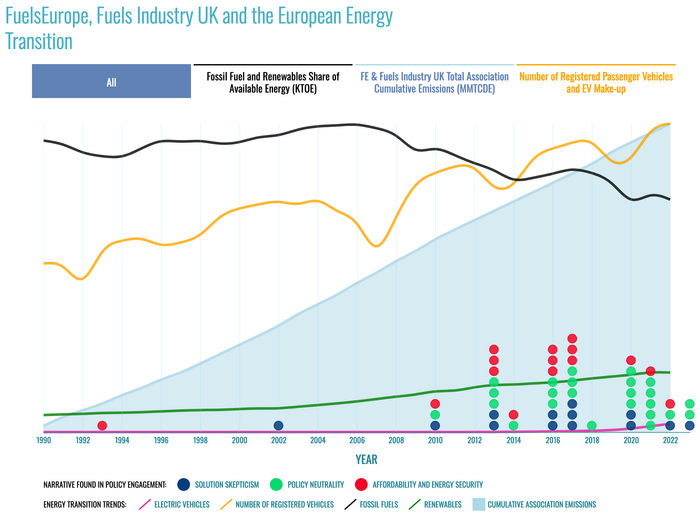
InfluenceMap traced the narratives “across 51 separate instances of the associations’ advocacy against fossil fuel alternatives between 1967 and 2023,” the publication explains. “These narratives include ‘Solution Skepticism,’ which has been in use for 56 years, ‘Policy Neutrality’ for 34 years, and ‘Affordability and Energy Security’ for 51 years.”

The group defined the narratives as follows:

  • Solution Skepticism: downplays the impact and viability of alternative energy.
  • Policy Neutrality: promotes consumer choice, market solutions, and minimal government intervention.
  • Affordability and Energy Security: paints fossil fuel alternatives as a risk to cost-effective and secure energy.

“Despite advancements in understanding the threats posed by the climate crisis, these narratives persist as of 2023,” the report says. It also emphasizes that the narratives contradict science-based policy recommendations from the United Nations’ Intergovernmental Panel on Climate Change (IPCC) and the International Energy Association (IEA).

Some examples identified by InfluenceMap include API comments on the Clean Air Act and amendments in 1967, 1970, and 1989 as well as the association’s remarks on the Inflation Reduction Act of 2022 and pollution standards for heavy-duty vehicles last year. The publication also points to FuelsEurope’s 2021 comments on European Union Performance Standards and the group’s participation in a 2022 letter about the Energy Performance of Buildings Directive.

InfluenceMap produced graphics to display its findings, including one that shows key members of each association as of March. Members of all three include BP, ExxonMobil, Shell, and Phillips 66.

“Some of the world’s largest oil and gas companies are still paying a high premium to participate in industry associations that may no longer represent them on climate policy,” the report states, pointing to how associations’ actions contrast with public positions taken by some major fossil fuel corporations. “Meanwhile, Shell, Chevron, and Exxon have disclosed that they pay between $5 million and $12.5 million per year to hold a membership with the API.”

The think tank also made a pair of graphics showing how the trade associations’ documented use of the three narratives aligns with fossil fuel and renewables consumption, association members’ cumulative emissions, and the number of EVs compared with the total number of registered passenger vehicles since the 1950s.

“This report shows that even faced with mounting scientific evidence over decades, the oil and gas industry have pushed ahead with a damaging messaging strategy they developed as early as the 1960s,” said Tessa Khan, founder and executive director of Uplift, which supports a rapid and fair transition away from fossil fuel production in the U.K.

“It shows the crucial need for increased awareness of the delaying tactics of fossil fuel companies from policymakers if they are to successfully drive the energy transition forward at the pace we need,” Khan added.

Calling the report “brilliant and disturbing,” the U.K.-based Fossil Free Parliament said that “this is exactly why we need to remove the industry’s seat at the table in Westminster.”

In the United States, Democratic federal lawmakers recently concluded a probe into BP, Chevron, ExxonMobil, Shell, API, and the U.S. Chamber of Commerce for decades of spreading climate disinformation, after which they urged the U.S. Department of Justice to investigate all six.

Original article by JESSICA CORBETT republished from Common Dreams under Creative Commons (CC BY-NC-ND 3.0). 

Continue ReadingReport Details Big Oil Lobby’s Relentless Opposition to a Green Transition