‘Reporting Isn’t Treason’: Trump Rant at Journalists Sparks Alarm

Spread the love

Article by Brad Reed republished form Common Dreams under Creative Commons (CC BY-NC-ND 3.0). 

President Donald Trump briefs reporters after he concluded his trip to Beijing aboard Air Force One on May 15, 2026 as he returns to the United States.
 (Photo by Alex Wong/Getty Images)

“No American should be comfortable with the president of the United States accusing a reporter of treason for critical reporting.”

President Donald Trump on Friday sparked alarm among press freedom advocates when he accused New York Times reported David Sanger of committing “treason” for portraying his illegal war with Iran in a negative light.

Speaking with journalists aboard Air Force One on his flight home from China, Trump was asked by Sanger about his failure to accomplish political changes in Iran that he swore to achieve when he launched the war without congressional authorization in late February.

RECOMMENDED…

Pete Hegseth

Trump Cries ‘Virtual Treason’ as US News Outlets Detail Iran War Intel Assessments

Acting US Attorney General Todd Blanche and FBI Director Kash Patel

‘Effort to Stifle and Intimidate’: Trump DOJ Subpoenas News Outlets Over Iran War Coverage

“I had a total military victory,” Trump replied. “But the fake news, guys like you, write incorrectly. You’re a fake guy, and guys like you write incorrectly. We had a total military victory. We knocked out their entire navy, we knocked out their entire air force, we knocked out all their anti-aircraft weaponry.”

Despite this purported “total victory,” however, Iran still controls the Strait of Hormuz and has prevented commercial vessels from traveling through it for the last two months.

After attacking the Times’ reporting about the Iran War, the president pivoted to impugning Sanger’s patriotism.

“I actually think it’s sort of treasonous what you write,” the president said. “You and The New York Times, and CNN, I would say, are the worst… You should be ashamed of yourself. I actually think it’s treason.”

The Times on Tuesday reported that the Trump administration’s “public portrayal of a shattered Iranian military is sharply at odds with what US intelligence agencies are telling policymakers behind closed doors, according to classified assessments from early this month that show Iran has regained access to most of its missile sites, launchers, and underground facilities.”

Hours after the president’s tirade against Sanger—which echoed Trump’s previous remarks about media coverage of the war—New York Times spokesperson Charlie Stadtlander released a statement defending its reporting on the Iran war.

“Reporting isn’t treason,” Stadtlander said. “It’s foundational to a free press and the work that America’s founders wrote the First Amendment to protect. That includes making clear when the claims of government officials and the reality of their actions don’t line up… We will continue this important, constitutionally protected work.”

Trump’s treason accusation also drew a rebuke from Will Creeley, legal director of the Foundation for Individual Rights and Expression, who said that “no American should be comfortable with the president of the United States accusing a reporter of treason for critical reporting.”

New York Times columnist Nicholas Kristof argued that Trump’s attack on Sanger was really a sign of weakness given the failures of his military campaign against Iran.

“President Trump unloading on David Sander reflects a combination of anxiety, insecurity, and desperation about the Iran War,” Kristof wrote. “David is the dean of national security reporters: experienced, meticulous, and fair. Blaming the messenger underscores that the reality itself is pretty bad.”

Kristof’s sentiment was echoed by former ABC News journalist Terry Moran, who wrote that he can’t “understand how anyone can see Trump here and not see weakness.”

Former Republican Illinois Congressman Joe Walsh said Trump’s interaction with Sanger exposed him as “the biggest fucking crybaby in all of human history.”

Article by Brad Reed republished form Common Dreams under Creative Commons (CC BY-NC-ND 3.0). 

Continue Reading‘Reporting Isn’t Treason’: Trump Rant at Journalists Sparks Alarm

Guy Fawkes’ punishment was one of the most severe in English history – here’s what happens when a body is hung, drawn and quartered

Spread the love
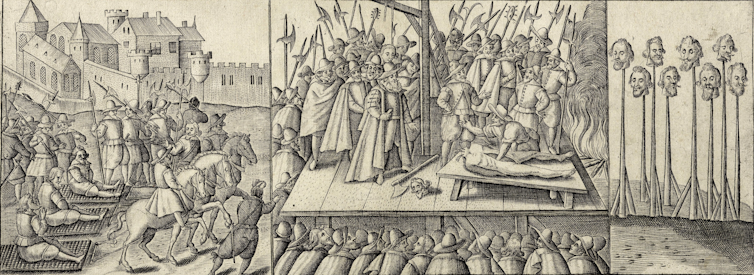
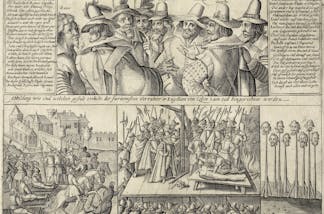
Fawkes and his co-conspirators were sentenced to hanging, drawing and quartering. Crispijn van de Passe the Elder/ Wikimedia Commons

Michelle Spear, University of Bristol

After their infamous plot to destroy parliament was foiled, Guy Fawkes and his co-conspirators received one of the most severe judicial sentences in English history: hanging, drawing and quartering. According to the Treason Act 1351, this punishment involved:

That you be drawn on a hurdle to the place of execution, where you shall be hanged by the neck and being alive cut down, your privy members shall be cut off and your bowels taken out and burned before you, your head severed from your body and your body divided into four quarters to be disposed of at the King’s pleasure.

This process aimed not only to inflict excruciating pain on the condemned, but to serve as a deterrent – demonstrating the fate of those who betrayed the Crown. While Fawkes reportedly jumped from the gallows – which meant he avoided the full extent of his punishment – his co-conspirators apparently weren’t so lucky.

By dissecting each stage of this medieval punishment from an anatomical perspective, we can understand the profound agony each of them endured.

Torture for confession

Before his public execution on January 31 1606, Fawkes was tortured to force a confession about his involvement in the “gunpowder plot”.

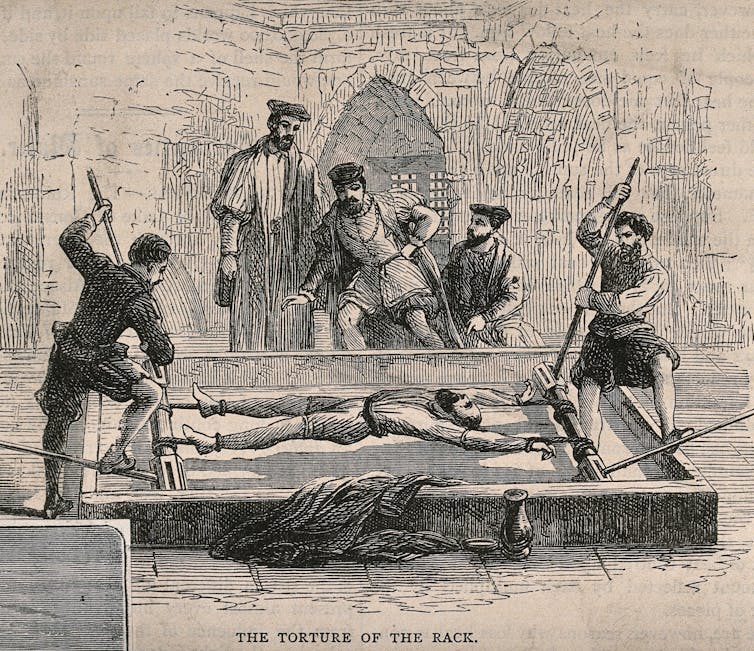
The Tower of London records confirm that King James I personally authorised “the gentler tortures first”. Accounts reveal that Fawkes was stretched on the rack – a device designed to slowly pull the limbs in opposite directions. This stretching inflicted severe trauma on the shoulders, elbows and hips, as well as the spine.

The forces exerted by the rack probably exceeded those required for joint or hip dislocation under normal conditions.

Substantive differences between Fawkes’ signatures on confessions between November 8 and shortly before his execution may indicate the amount of nerve and soft tissue damage sustained. It also illustrates how remarkable his final leap from the gallows was.

An engraving depicting a person being tortured on the rack.
The rack slowly pulled a prisoner’s limbs in opposite directions. Wellcome Collection/ Wikimedia Commons, CC BY-SA

Stage 1: hanging (partial strangulation)

After surviving the torture of the rack, Fawkes and his gang faced the next stage of their punishment: hanging. But this form of hanging only partially strangled the condemned – preserving their consciousness and prolonging their suffering.

Partial strangulation exerts extreme pressure on several critical neck structures. The hyoid bone, a small u-shaped structure above the larynx, is prone to bruising or fracture under compression.

Simultaneously, pressure on the carotid arteries restricts blood flow to the brain, while compression of the jugular veins causes pooling of blood in the head – probably resulting in visible haemorrhages in the eyes and face.

Because the larynx and trachea (both essential for airflow) are partially obstructed, this makes breathing laboured. Strain on the cervical spine and surrounding muscles in the neck can lead to tearing, muscle spasms or dislocation of the vertebra – causing severe pain.

Fawkes brought his agony to a premature end by leaping from the gallows. Accounts from the time tell us:

His body being weak with the torture and sickness, he was scarce able to go up the ladder – yet with much ado, by the help of the hangman, went high enough to break his neck by the fall.

This probably caused him to suffer a bilateral fracture of his second cervical vertebra, assisted by his own bodyweight – an injury known as the “hangman’s fracture”.

Stage 2: Drawing (disembowelment)

After enduring partial hanging, the victim would then be “drawn” – a process which involved disembowelling them while still alive. This act mainly targeted the organs of the abdominal cavity – including the intestines, liver and kidney, as well as major blood vessels such as the abdominal aorta.

The physiological response to disembowelment would have been immediate and severe. The abdominal cavity possesses a high concentration of pain receptors – particularly around the membranous lining of the abdomen. When punctured, these pain receptors would have sent intense pain signals to the brain, overwhelming the body’s capacity for pain management. Shock would soon follow due to the rapid drop in blood pressure caused by massive amounts of blood loss.

Stage 3: quartering (dismemberment)

Quartering was also supposed to be performed while the victim was still alive. Though no accounts exist detailing at what phase victims typically lost consciousness during execution, it’s highly unlikely many survived the shock of being drawn.

So, at this stage, publicity superseded punishment given the victim’s likely earlier demise. Limbs that were removed from criminals were preserved by boiling them with spices. These were then toured around the country to act as a deterrent for others.

Though accounts suggest Fawkes’s body parts were sent to “the four corners of the United Kingdom”, there is no specific record of what was sent where. However, his head was displayed in London.

Traitor’s punishment

The punishment of hanging, drawing and quartering was designed to be as anatomically devastating as it was psychologically terrifying. Each stage of the process exploited the vulnerabilities of the human body to create maximum pain and suffering, while also serving as a grim reminder of the consequences of treason.

This punishment also gives us an insight into how medieval justice systems used the body as a canvas for social and political messaging. Fawkes’s fate, though unimaginable today, exemplifies the extremes to which the state could, and would, go to maintain control, power and authority over its subjects.

The sentence of hanging, drawing and quartering was officially removed from English law as part of the Forfeiture Act of 1870.

Michelle Spear, Professor of Anatomy, University of Bristol

This article is republished from The Conversation under a Creative Commons license. Read the original article.

Guy Fawkes night: celebrating the most famous act of counter-terrorism in history

The Joker to Guy Fawkes: why protesters around the world are wearing the same masks

Guy Fawkes night’s oddest traditions are due to a 1606 law

The Gunpowder Plot: torture and persecution in fact and fiction

Continue ReadingGuy Fawkes’ punishment was one of the most severe in English history – here’s what happens when a body is hung, drawn and quartered