Hundreds protest in Tunisia over crackdown on freedoms

Spread the love

https://morningstaronline.co.uk/article/hundreds-protest-tunisia-over-crackdown-freedoms

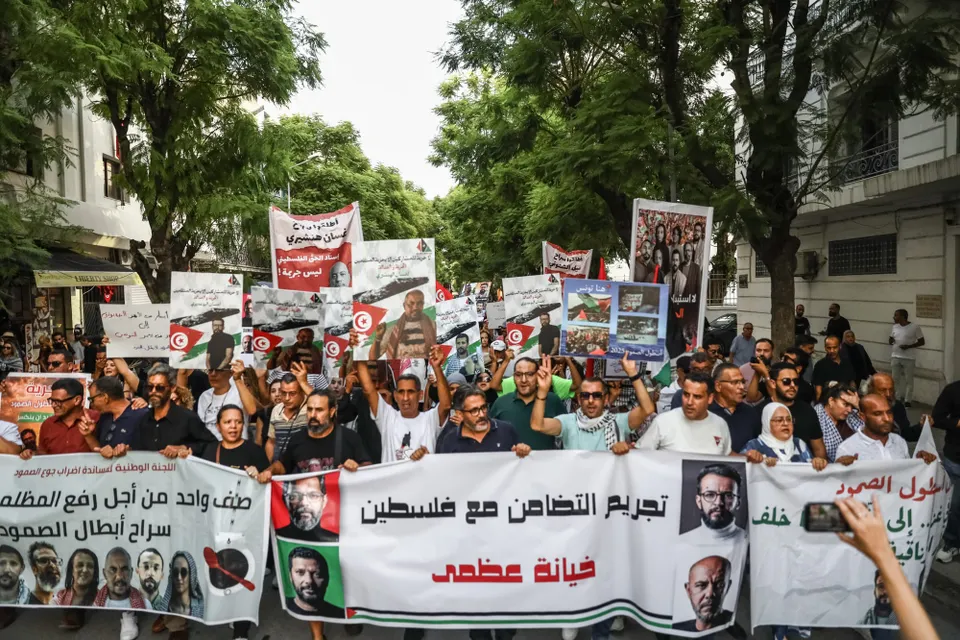
 People take part in a protest against Tunisian president Kais Saied’s rule and demanding the release of political prisoners in Tunis, Tunisia, November 22, 2025
TUNISIANS took to the streets of central Tunis on Saturday over President Kais Saied’s increasingly authoritarian rule and demanded the release of all political prisoners.

The Against Injustice rally brought together families of political detainees and activists from different ideological backgrounds.

The demonstration drew more than 1,000 protesters chanting anti-regime slogans, including: “No fear no terror, the street belongs to the people.”

The protest came as part of a broader surge in protests nationwide over political and economic turmoil.

Protesters also called out President Saied’s interference in the judiciary and accused him of using the police to target political opponents.

Article continues at https://morningstaronline.co.uk/article/hundreds-protest-tunisia-over-crackdown-freedoms

Continue ReadingHundreds protest in Tunisia over crackdown on freedoms

‘We Refuse to Remain Silent’: 1,000 North African Volunteers Make Their Way to Gaza to Break Israeli Siege

Spread the love

Original article by Julia Conley republished from Common Dreams under Creative Commons (CC BY-NC-ND 3.0).

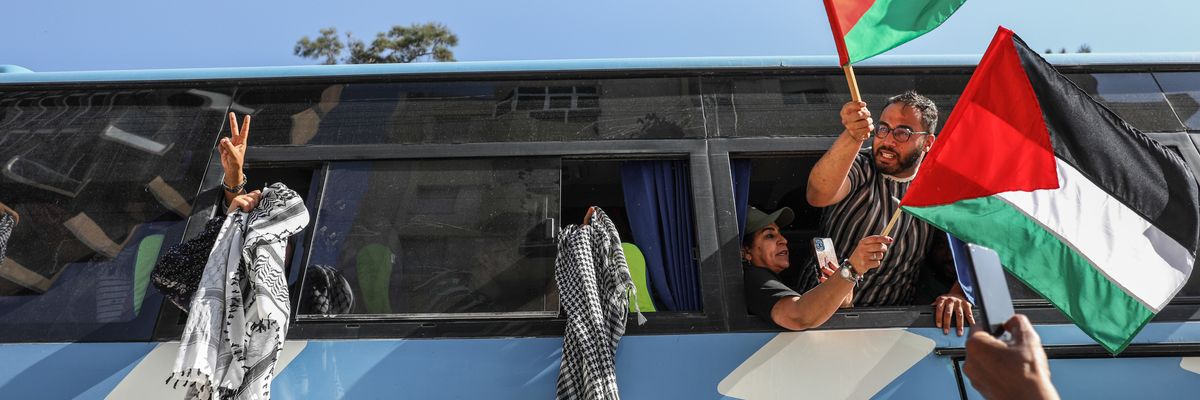
Pro-Palestinian activists wave Palestinian flags and keffiyehs from open bus windows as they, along with around 1,000 other participants in the Sumud or “Resilience” Convoy, depart from Tunis, Tunisia, on June 9, 2025. (Photo: Chedly Ben Ibrahim/NurPhoto via Getty Images)

“A tsunami of humanity is rising for Gaza.”

As Israeli forces unlawfully boarded the Madleen, a boat carrying humanitarian aid to Gaza, and detained the volunteers on the vessel on Monday, approximately 1,000 pro-Palestinian advocates from across Northwest Africa were boarding a convoy of buses and cars in Tunisia—planning to travel for days to the Rafah crossing, where they aim to break Israel’s blockade that’s starving people across the war-torn enclave.

The Sumud Convoy, whose name means “steadfastness” or “resilience” in Arabic, is carrying aid and being led by the Coordination of Joint Action for Palestine in Tunisia, and has ties to the Global March for Gaza, which includes rights advocates from about 50 countries across the world who were en route to Cairo on Wednesday.

“This is a civil and popular initiative in response to the ongoing genocide in Gaza,” Wael Naouar, a member of the organizing team, told The New Arab. “We refuse to remain silent.”

The convoy crossed into Libya on Tuesday and has been resting after a full day of travel as organizers wait for permission to cross the eastern part of the divided country.

In Tripoli in the western region, the volunteers have been welcomed by hundreds of locals, and fuel station owners have reportedly said they will provide free gas to all cars, buses, and trucks that join the convoy.

“This visit brings us joy,” architect Alaa Abdel Razzaq told Agence France-Presse.

Along with the current delay in receiving approval from eastern Libyan authorities to cross the region, the convoy and the Global March for Gaza could face resistance from the Egyptian government as organizers plan to march for three days from El Arish in the Sinai Peninsula to the Rafah crossing.

Egypt classifies the area between El Arish and Rafah as a military zone and has not released a statement on whether it will allow the march.

If the volunteers make it to the Rafah crossing, they will have to contend with the Israel Defense Forces. In addition to abducting international activists including Swedish climate leader Greta Thunberg and Palestinian-French member of European Parliament Rima Hassan this week, Israeli forces killed 10 activists carrying humanitarian aid to Gaza on a Turkish flotilla in 2010.

Ghaya Ben Mbarek, an independent journalist from Tunis, told Al Jazeera that people in the convoy “are feeling courage and anger” as they head toward the Gaza border.

“The message people here want to send to the world is that even if you stop us by sea, or air, then we will come, by the thousands, by land,” Ben Mbarek told Al Jazeera. “We will literally cross deserts… to stop people from dying from hunger.”

Fadi Quran of the U.S.-based advocacy group Avaaz said the journey of the convoy—which has been growing as more people have joined since leaving Tunisia—is “one of the most beautiful things humanity has to offer in 2025.”

“A tsunami of humanity is rising for Gaza,” said Quran. “Amplify it.”

The Sumud Convoy is supported by the Tunisian General Labor Union, the National Bar Association, the Tunisian League for Human Rights, and the Tunisian Forum for Economic and Social Rights, while groups including the Palestinian Youth Movement and CodePink are affiliated with the Global March for Gaza.

Advocates from countries including the NetherlandsCanada, and Ireland plan to arrive in Cairo on Thursday, when they hope to begin the three-day march to Rafah.

Canadian Sen. Yuen Pau Woo wrote to the Egyptian government on Tuesday, asking for support for the march.

“I believe that Egypt’s support for this humanitarian action would send a powerful message to the international community,” said Woo.

Kellie McConnell, a member of Irish Healthcare Workers for Palestine, also expressed hope that the international action will force governments around the world, including those that have backed Israel’s bombardment and blockade of Gaza, to “pay attention and do everything in their power” to end the attacks that have killed more than 55,000 Palestinians.

https://twitter.com/IrishhcwforPal/statuses/1932675184437178587

Sorry, this content could not be embedded.
X

“We can turn the tables in this genocide,” said McConnell. “We can stop the absolutely appalling brutalization and desperate treatment of people in Palestine.”

If the advocates are blocked at the border like the Madleen was intercepted on Monday, one activist in the Sumud Convoy told The New Arab, “even that will send a message.”

“People over power,” they said. “If they stop dozens, thousands will rise.”

Original article by Julia Conley republished from Common Dreams under Creative Commons (CC BY-NC-ND 3.0).

Experiencing issues with this image not appearing. I suspect because it's so critical of Zionist Keir Starmer's support of and complicity in Israel's genocides.
Genocide denier and Current UK Prime Minister Keir Starmer is quoted that he supports Zionism without qualification. He also confirms that UK air force support has been essential in Israel’s mass-murdering genocide. Includes URLs https://www.declassifieduk.org/keir-starmers-100-spy-flights-over-gaza-in-support-of-israel/ and https://youtu.be/O74hZCKKdpA
UK Labour Party government ministers Keir Starmer, Angela Rayner and Rachel Reeves explain that they are partners complicit in Israel's Gaza genocide. The UK has provided Israel with arms, military and air force support. They explain that they don't do gas chambers but do do forced marches, starvation, destroy hospitals, mass-murders of journalists and healthcare workers.
UK Labour Party government ministers Keir Starmer, Angela Rayner and Rachel Reeves explain that they are partners complicit in Israel’s Gaza genocide. The UK has provided Israel with arms, military and air force support. They explain that they don’t do gas chambers but do do forced marches, starvation, destroy hospitals, mass-murders of journalists and healthcare workers.
Vote Labour for Genocide.
Continue Reading‘We Refuse to Remain Silent’: 1,000 North African Volunteers Make Their Way to Gaza to Break Israeli Siege

We saved lives at sea. So why did Italy detain our boat?

Spread the love

Original article by Nathan Akehurst republished from Open Democracy under a Creative Commons Attribution-NonCommercial 4.0 International licence

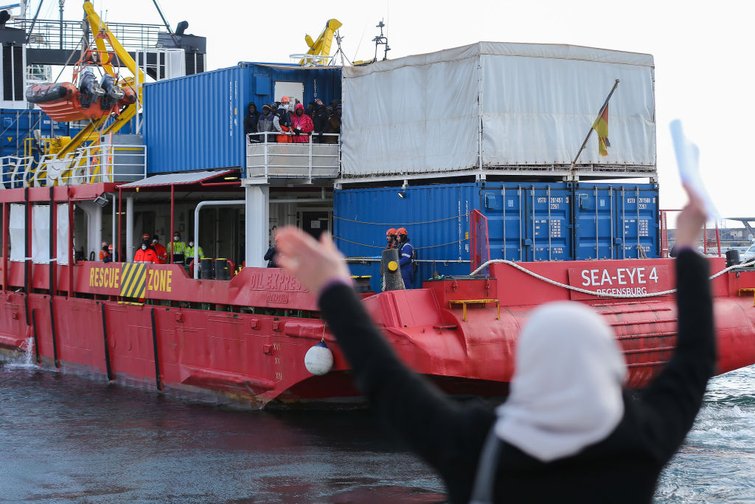
A woman greets the people on board the Sea-Eye 4 rescue ship as it arrives in Naples, Italy in June 2023  | Marco Cantile/LightRocket/Getty Images. All rights reserved

We were fined and our boat blocked after we rescued 114 people. It’s a political campaign to make movement illegal

Hope arrived on the radio, late in the afternoon with August sunshine blasting the deck.

After tortuous negotiations with authorities from four countries, Italy had finally granted us a port of safety. We were allowed to disembark the people we had rescued, in accordance with international law.

We had 114 passengers on board our ship, the Sea Eye 4, where I was volunteering as part of the crew. Overall, we had rescued three boats in distress. Some of the rescued had drifted without food, fuel, or water for days. One man had been unconscious for over 24 hours and would have been unlikely to survive much longer without aid.

But the rescue operation was not where the troubles ended. On reaching port in Salerno, we found our ship detained for 20 days and its operator, the NGO Sea Eye, fined €3,000.

We were one of three ships detained during that week in August 2023. This represented a total loss of 60 operating days during high summer, in a year where at least 2,000 people had already died while trying to cross the Mediterranean.

We were detained under the 2023 Piantedosi Decree, an Italian law which mandates immediate return to port after just one rescue. The law forces crews to make impossible choices. Should you ignore incoming distress calls and risk lives in the present, or risk detention and the ability to save lives in the future?

The decree is not an isolated piece of legislation – in Italy or the EU. It is just one of dozens of policies and laws that have been created to limit the movement of people across borders, and to limit other people’s capacity to help them. For over a decade, European states have withdrawn, denied, or evaded their responsibility to carry out rescues or provide safe ports.

Criminalisation: a refined tactic

It didn’t start off this way. In 2013, horrific twin shipwrecks near Lampedusa led to a serious response from the Italian government – a year-long rescue operation called Mare Nostrum, which saved thousands of lives.

But as the claims grew that Europe was experiencing a ‘migration crisis’, and with wider European support significantly lacking, the mood in Italy changed. Mare Nostrum was cancelled, and in 2017 a ‘code of conduct’ was introduced that restricted the actions of civil rescue ships.

This “Minniti Code” was brought in by centrists seeking to blunt a right-wing surge by proving they were sufficiently tough on irregular migration. It had little effect. Instead, the code handed tools to the far-right (such as the mainstreaming of an anti-migrant narrative and demonisation of rescue operations) that they would build on in later years to make additional gains.

At the end of last decade, rescue crews were being surveilled, wiretapped, and threatened with jail in a vicious offensive led by the Italian right. The sweeping crackdowns were an undeniable effort to criminalise humanitarian action and the movement of people across borders.

This campaign was eventually seen by policymakers as counterproductive. It had caused a huge public backlash, and taking NGOs and individuals to court with little evidence proved costly and time consuming. Undeterred, however, the Italian state switched to bureaucratic harassment.

Using a combination of fines, blockades, the assignment of distant ports of safety and weaponised inspections, they continued to significantly limit the ability of rescue crews to save lives at sea. They just kept a lower profile this time, lessening the potential for public outcry.

Block the rescuers, enable the militias

While Italy harassed rescue workers, it was also busy – together with the EU – handing over responsibility for rescue to violent criminals. The so-called Libyan Coast Guard (LCG) has received boats, equipment, funding, and support to establish a wider search and rescue area. It is routinely given the coordinates of boats in distress by Frontex, the EU border agency.

The LCG attacks, abuses, and violates the rights of people in distress at sea. It also returns them to detention camps in Libya where extortion, torture and exploitation are rife.

When the Libyan coast guard first spotted the rescue boat, they threatened to shoot at the rescuers

On their first mission back at sea after Sea Eye 4’s detainment, the crew arrived at a scene where the LCG was dangerously manoeuvring around a boat in distress, causing people to fall into the water. And when the LCG first spotted the rescue boat, they threatened to shoot at the rescuers.

Sea Eye 4 ultimately did respond to the people in distress, but was unable to prevent four people drowning. When they returned, Italy once again detained the ship and fined its crew for failing to “cooperate” with Libyan forces.

Over a year later, I returned to the central Mediterranean aboard the Humanity 1, a rescue ship run by the organisation SOS Humanity. The day before we sailed, Tunisia’s president Kais Saied was re-elected. He has joined Libya as a staunch ally in Europe’s fight against people migrating. Tunisia, Libya and Morocco have carried out countless “desert dumps”, in which thousands of mostly Black migrants are transported to and abandoned en masse in the Sahara.

Tunisia’s coast guard, which also has a grim record of rights abuses, is becoming more active too. Our most recent mission took place near the recently expanded Tunisian zone of rescue responsibility in the Mediterranean. The expansion of the zone has left rescue crews in that area at even further risk of detainment if they don’t return rescued people to Tunisia.

Whilst we were at sea, Giorgia Meloni launched a new attempt to forcibly transfer people disembarked in Italy to camps in Albania to await deportation. This proved a costly failure when the first twelve detainees immediately returned to Italy after a court judgment. But it provides just one more indication of a very worrying direction of travel for Italy and the EU.

All these efforts to hinder civilian rescue are, of course, partially about limiting the number of people arriving by sea to Europe. But that’s not the whole picture.

All together, the civil fleet only carries out a small proportion of overall rescues in the Med. Its ships brought in just 8% of those arriving in Italy in 2023. The Italian coast guard is still rescuing the rest of those delivered to the country’s shores – even though their area of operations has now shrunk to an area relatively close to the shoreline.

So why go to such great effort to stymie and discredit civil sea rescue? Something else is going on here.

Making movement illegal

Europe speaks loudly about its commitment to human rights and humanitarian values. For years, rescue organisations have pointed to the shallowness of these commitments in the face of thousands dying off European shores.

Europe and its member states have responded by delegitimising rescue workers’ motives and their voices, impugning them as not genuine humanitarians. They accuse the civil fleet of unprofessionalism, of being too political, and of cooperating with ‘smugglers’. When they’re feeling generous, they say rescuers are well-intentioned but their presence at sea encourages people to risk dangerous crossings.

None of this has ever been proven. Every single smuggling case brought against rescue crews has collapsed. And comprehensive studies have debunked the link between the presence of rescue assets and people’s decisions to cross the Mediterranean.

As the EU rewrites its anti-smuggling policy, there is a real risk that the criminalisation of people migrating, and people who assist them, will deepen

But it does not matter anymore. Humanitarian actors in the Mediterranean have already become associated with criminality, and that idea is now embedded in European political discourse. Justified by the claim of ‘countering smuggling’, the EU is seeking to undermine every aspect of irregular movement by criminalising more and more parts of it outright and framing the rest as criminal in essence.

It’s not just rescue workers. From 2015 to 2018 alone, Italy arrested 1,300 people they accused of driving small boats. An Iranian women’s rights activist fleeing persecution and four Libyan refugee footballers who survived a shipwreck were among those caught up in this campaign. Greece has engaged in similar tactics, with thousands of trials taking place and ‘boat drivers’ handed sentences of over 100 years in prison.

Many of the trials are deeply legally unsound, and some have lasted as little as 30 minutes. But their effect on the framing of humanitarian action has a much longer shelf life. Europe and Italy are seeking to tar everyone associated with irregular migration as criminals in the court of public opinion – those on the move and those extending a hand.

‘Counter-smuggling’ doesn’t work

The EU is currently rewriting its anti-smuggling policy, and there is a real risk that the criminalisation of people migrating, and people who act in solidarity with them, will deepen. As with the war on drugs and prohibition-type policies in general, the strategy won’t stop people from doing either of these things. But it will likely get more people killed.

Neither smuggling groups nor rescue actors create the demand for their services. Poverty, violence, and the absence of safe routes do. As borders are enforced more harshly, people attempting to move are forced to rely on more dangerous routes, and sometimes more dangerous actors. More people end up in distress, and more people need to be rescued.

It’s a loop, but not one created by smuggling profits. It exists because governments refuse to see reason.

Another way to understand this is to see ‘countering smuggling’ not so much as a policy approach, but as a political convergence. It’s where the demands of the right for evermore violent border control and the demands of liberals for lip-service to humanitarian principles meet.

This convergence reframes border enforcement as ‘protecting’ migrants from the brutality of gangs. It conjures up a simple enemy, obscuring the agency of people migrating and the reality of their journeys. And it treats movement as a crime, one which necessitates a multinational police and military response.

In turn, this helps the lucrative border and surveillance industry to hijack policy, selling ever more expensive ‘solutions’ to monitoring and controlling movement. Those resources should be going into helping people, not harming them. The first imperative should not be to “smash gangs” but to save lives.

We need the restoration of coordinated search and rescue by the competent authorities. We need safe routes. And we need funding and support both for people arriving and the wider communities they settle in.

At the moment, such vision and compassion seem a long way from the reality of European politics. But the emergency at Europe’s shores is not going anywhere. Not until we reach an approach founded on hope and courage rather than fear and division.

Original article by Nathan Akehurst republished from Open Democracy under a Creative Commons Attribution-NonCommercial 4.0 International licence

Continue ReadingWe saved lives at sea. So why did Italy detain our boat?

Right to Asylum Must Be Protected in EU, Says Human Rights Coalition

Spread the love

Original article by Jessica Corbett republished from Common Dreams under Creative Commons (CC BY-NC-ND 3.0).

The Doctors Without Borders vessel Geo Barents intercepted two small boats full of migrants navigating toward Europe
in the Central Mediterranean on March 16, 2024. (Photo by Simone Boccaccio/SOPA Images/LightRocket via Getty Images)

“As this legislative cycle starts, the E.U. can and must do better than abandon its commitment to the global refugee protection regime,” said an Amnesty campaigner.

Nearly 100 human rights organizations came together Tuesday to emphasize that members of the European Union “must guarantee the right to seek and enjoy asylum and uphold their commitments to the international refugee protection system.”

The joint statement from groups including Amnesty International, Human Rights Watch, and Oxfam came as members of the European Parliament prepare for the July 16 plenary sitting, the first meeting scheduled since the bloc’s June elections, which resulted in the far-right “Patriots for Europe” becoming the third-largest alliance in the legislative body.

The human rights coalition underscored obligations under Article 18 of the E.U. Charter of Fundamental Rights and expressed concern about “the recent and increasing attempts by the E.U. and its member states to evade their asylum responsibilities by outsourcing asylum processing and refugee protection risk undermining the international protection system.”

As the groups detailed:

Italy, for instance, is currently seeking to process asylum applications of certain groups of asylum-seekers outside of its territory, from detention in Albania—which risks leading to prolonged, automatic detention, a denial of access to fair asylum procedures with necessary procedural guarantees, and delayed disembarkation for people rescued or intercepted at sea. Others, such as Denmark and Germany, are assessing the feasibility of this type of arrangement. Fifteen E.U. member states and some political groups have endorsed similar shortsighted measures to shift asylum processing outside E.U. territory and encouraged the European Commission to explore ways to facilitate this through further legislative reform, including through a watered-down ‘safe third country’ concept.

These attempts must be seen in the context of parallel containment efforts that seek to stem departures and prevent the arrival of asylum-seekers to E.U. territory through partnership agreements with third countries, with little to no attention to the human rights records of those authorities.

The coalition stressed that “as the extensive track record of human rights violations in partner countries such as Libya demonstrates, the E.U. and Member States have no adequate tools and competencies to effectively monitor or enforce human rights standards outside of E.U. territory.”

A report published in November by Doctors Without Borders features stories of violence that migrants endured in nations including Libya and Tunisia while trying to get to the E.U. That publication also points out that 2023 was the deadliest year for migration in the Central Mediterranean since 2017, due in part to E.U. countries failing to assist those at risk of drowning.

In addition to sounding the alarm about current E.U. policies and practices, the coalition on Tuesday cited examples including Australia’s offshore detention scheme, which “demonstrates how these models have created prolonged confinement and restricted freedom of movement, deeply harming both the mental and physical health of people seeking protection.”

The organizations also pointed to an asylum scheme attempted by the United Kingdom—which left the E.U. in 2020 following the 2016 Brexit vote—and Rwanda, which the statement notes “is not yet in effect following the U.K. Supreme Court declaring it unlawful and in any event is unlikely to be operationalized at any significant scale.”

The U.K.’s failed attempt to forcibly remove people to the African country was “projected to cost a staggering £1.8 million per asylum-seeker returned,” which is equal to €2.13 million or $2.3 million. The coalition called such schemes “not only an unjustifiable waste of public money, but also a lost opportunity to spend it in ways that would truly aid people seeking asylum by investing in fair and humane asylum systems and the communities that welcome them.”

Olivia Sundberg Diez, Amnesty’s E.U. advocate on migration and asylum, said in a statement Tuesday that “attempts by states to outsource their asylum responsibilities to other countries are not new—but have long been criticized, condemned, and rejected for good reason.”

“Just as the U.K.-Rwanda scheme is, rightly, collapsing, the E.U. and its member states should pay attention, stop making false promises, and wasting time and money on expensive, inhumane, and unworkable proposals,” she continued. “As this legislative cycle starts, the E.U. can and must do better than abandon its commitment to the global refugee protection regime.”

The meeting scheduled for next week will follow the Pact on Migration and Asylum that the European Parliament passed in April and the Council of the E.U. adopted in May. The coalition highlighted that “civil society organizations have been clear about their serious concerns” regarding the reforms while also explaining that “the transfer of asylum-seekers outside of E.U. territory for asylum processing and refugee protection is not provided for in the pact, nor within current E.U. law.”

“After the E.U. and member states have spent close to a decade attempting to reform the E.U.’s asylum system, they should now focus on implementing it with a human rights-centered approach that prioritizes the right to asylum per E.U. law and fundamental principles of international refugee law to which they remain bound,” the coalition concluded. “They should not, mere weeks after the reform has passed, waste further time and resources on proposals that are incompatible with European and international law.”

Original article by Jessica Corbett republished from Common Dreams under Creative Commons (CC BY-NC-ND 3.0).

Continue ReadingRight to Asylum Must Be Protected in EU, Says Human Rights Coalition