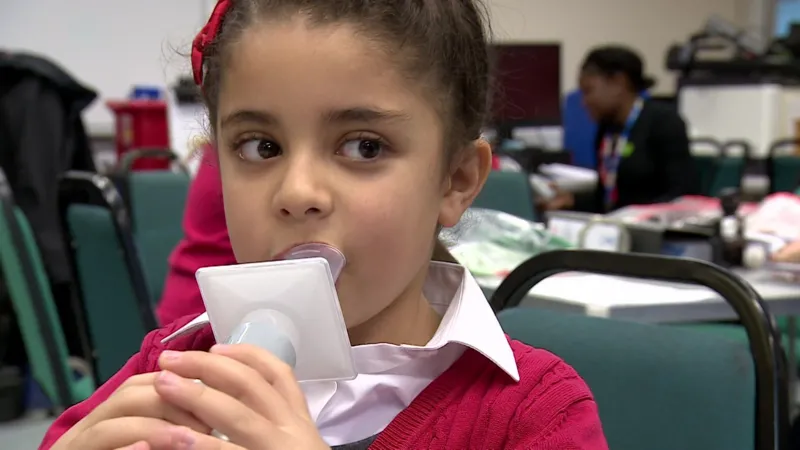
Scientists say they have been “stunned” by how quickly young children’s lungs began to recover and grow after pollution restrictions were brought in where they lived.
Researchers found that children in London whose lung growth had been stunted by pollution showed impressive improvements after the introduction of an Ultra Low Emission Zone (Ulez) in 2019 reduced emissions.
The study followed more than 3,400 primary school children in London and Luton and provides what scientists believe is the strongest evidence yet that local clean air zones could help reduce some of the harm caused by pollution during childhood.
…
“I was absolutely stunned when I first saw the results,” Prof Chris Griffiths, a senior author on the study, at Queen Mary University of London, told the BBC.
“The speed of catch up in lung capacity in the London group was surprising and impressive.
“This shows an ambitious clean air zone can drive pollution levels down, rapidly restoring children’s stunted lung growth.”
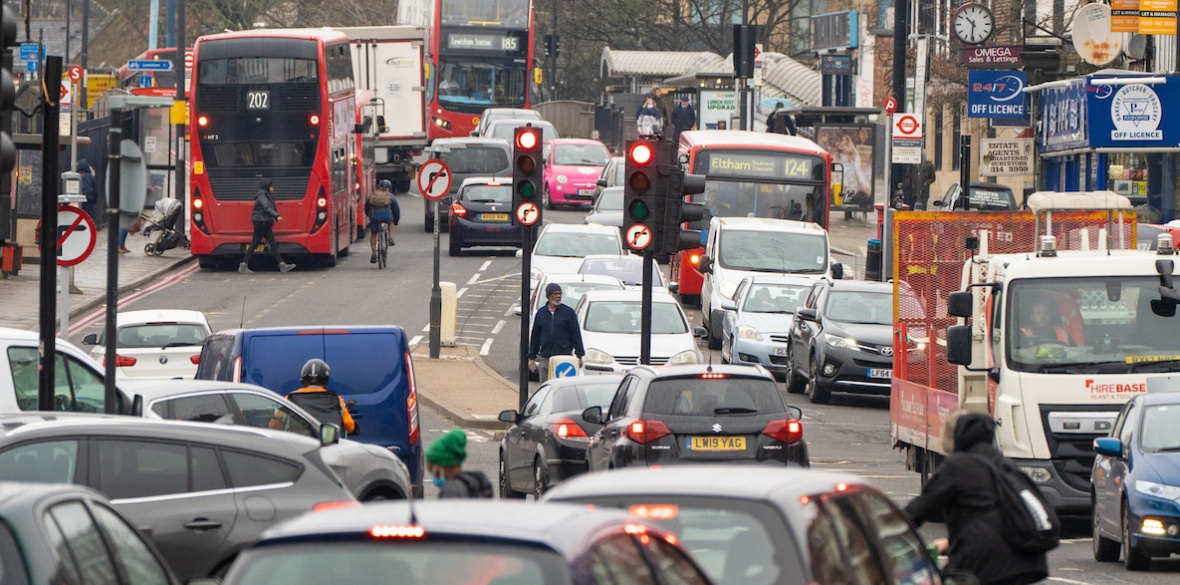
Ulez has improved London’s air quality across the board. Photograph: Yui Mok/PA
Levels of deadly pollutants have dropped, with significant improvements in capital’s most deprived areas
People in London have been breathing significantly cleaner air since the expansion of the ultra low emission zone (Ulez), a study has found.
Levels of deadly pollutants that are linked to a wide range of health problems – from cancer to impaired lung development, heart attacks to premature births – have dropped, with some of the biggest improvements coming in the capital’s most deprived areas.
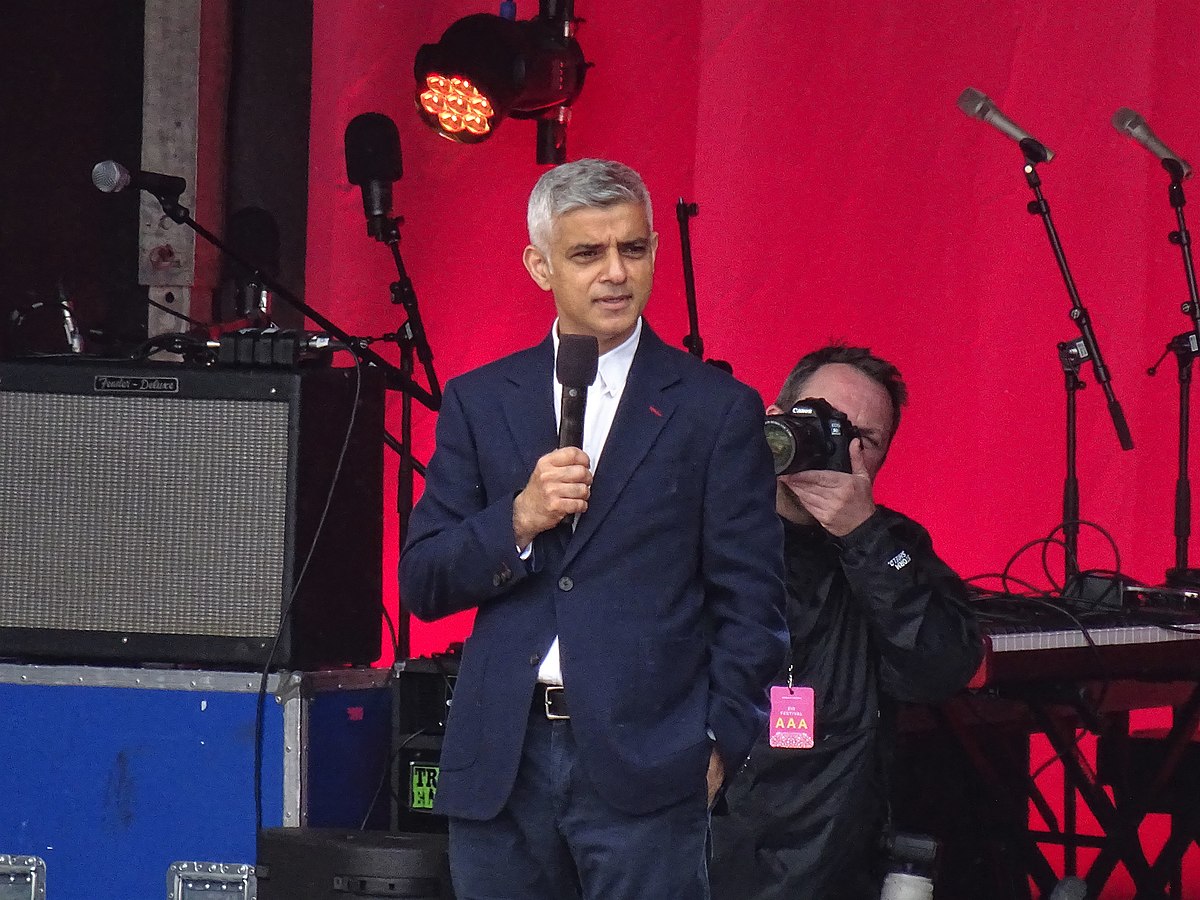
Sadiq Khan had faced severe opposition to the 2023 expansion of Ulez to outer London boroughs. But on Friday as the report was published, the mayor of London said the scheme had driven down pollution, taken old polluting cars off the roads and brought cleaner air to millions more people.
He said: “When I was first elected, evidence showed it would take 193 years to bring London’s air pollution within legal limits if the current efforts continued. However, due to our transformative policies we are now close to achieving it this year.”
A screenshot of a Conservative advert on Meta during the 2024 general election campaign. Credit: Conservatives / Meta
The party has pumped out hundreds of adverts falsely stating that Labour would introduce a “national ULEZ”, and pay per mile charges.
The Conservative Party has reached millions of people with digital adverts that falsely claim Labour would impose new taxes on drivers.
In recent days the Tories have launched hundreds of new online adverts falsely claiming that Labour would introduce a nationwide ultra-low emission zone (ULEZ) that would charge people for using highly-polluting vehicles.
Labour’s London Mayor Sadiq Khan introduced and recently extended the capital’s ULEZ, which only applies to around 10 percent of vehicles, but the party has no plans to roll out the scheme to the rest of the country.
New analysis by advertising experts ACT Climate Labs, shared with DeSmog, finds the Tories have spent tens of thousands of pounds since the start of the general election campaign on digital adverts, which have appeared on the likes of Google, Facebook and Instagram, attacking climate and anti-pollution policies.
“Unfortunately, the Conservative leadership has increasingly used environmental and climate policies as collateral damage lately, in an attempt to secure more support for the party,” Sean Buchan, intelligence lead at ACT Climate Labs, told DeSmog.
“Clearly, it is not working – in fact, poll after poll shows us that Conservative voters, along with the vast majority of Brits, want climate action.
“However, the ripple effects of these adverts may last well beyond 4 July. The climate movement needs to ensure the public is seeing pro-climate messaging that truly speaks to them, through creative and local campaigns, and where possible with multi-channel advertising of its own.”
One Tory advert on Meta (Facebook and Instagram) read: “This is not a test. Keir Starmer will force pay per mile driving, costing you £THOUSANDS [sic] a year.”
This false claim – Labour doesn’t intend to introduce pay per mile charges – was seen between 150,000 and 175,000 times, costing between £1,000 and £1,500.
During the London mayoral election in May, the Conservatives claimed that Labour would introduce pay per mile road charges in the city, despite Khan having publicly ruled out the policy. A Tory leaflet featuring the claim was reported by Labour to the Crown Prosecution Service, with the party saying it may have broken election law.
While serving as chancellor, now Prime Minister Rishi Sunak reportedly said he was “very interested” in introducing a national pay per mile scheme.
“Voters are badly served by any party which repeatedly spreads misinformation or disinformation online,” said former Liberal Democrat MP Tom Brake, director of the campaign group Unlock Democracy. “If parties cannot commit to accurate advertising on a voluntary basis, bringing political ads under advertising rules may provide the only solution.”
ULEZ Blitz
Another Meta advert from the Conservatives, costing between £400 and £499 and gaining upwards of 50,000 impressions, claimed “Keir Starmer will force a local ULEZ near you”.
The party is now pumping out hundreds of similar adverts spreading this claim, each tailored to a local constituency, estimated to be costing up to £65,000. “With his supermajority, Keir Starmer could steamroll through plans to introduce a ULEZ near you,” the adverts state.
The Tory campaign has been warning voters against handing Labour a large majority, despite the size of a government’s majority making little difference to its ability to pass legislation.
“The Tory strategy of the last few weeks has been to focus on their core supporters, as well as those who might vote Reform, so these ads are another thing designed for them,” Sam Jeffers, executive director of the advertising monitoring platform Who Targets Me, told DeSmog.
The Tories have also paid for a Google advert attacking Labour’s decarbonisation plans, which has been viewed more than five million time, costing between £25,000 and £30,000. The advert features an “explainer” video on how much a Labour government would allegedly cost households, with decarbonising the electricity grid the first cost named.
Labour plans to decarbonise the electricity grid by 2030, while the Conservatives have pledged that 95 percent of the UK’s electricity will be generated by low-carbon sources by 2030, achieving full decarbonisation by 2035.
Political parties have spent huge sums on digital adverts during the campaign so far. As of 25 June, the Tories and Labour combined had spent over £3 million on Meta adverts that had gained an estimated 400 million impressions.
“Advertising blasts like this – especially when micro-targeted – can have a significant influence on people’s thoughts and behaviours,” said Buchan.
“In an increasingly fragmented media environment, digital advertising can be a fantastic way to target hard-to-reach people with your message. In an election where honesty is at a premium, it’s very concerning to see so much money – up to £70,000 on the adverts we’ve counted – spent on such spurious claims.”
Study found evidence that 20mph zones also improve walking and cycling in areas. Traffic in South London.
Study in 2018 found most drivers backed plans despite PM’s claim they ‘don’t reflect people’s priorities’
The majority of drivers support 20mph speed limits, according to the government’s own research, despite Rishi Sunak claiming they are an “attack on motorists”.
The prime minister is reportedly set to announce a number of new policies aimed at drivers during the Conservative Party conference that begins this weekend, including possible limits on the powers of councils in England to impose 20mph speed limits.
Sunak today criticised Wales’ new default 20mph speed limit, describing it as “absolutely not right” and saying: “It doesn’t reflect people’s priorities.” Commons leader Penny Mordaunt had previously called the scheme “absolutely insane”.
But research commissioned by the Department for Transport in 2018 found that “20mph limits are supported by the majority of residents and drivers”.
The study, produced by the consultancy firms Atkins and AECOM and professor Mike Maher of University College London, combined “evidence from 12 case study schemes” and “feedback from over 5,400 questionnaires with a range of road users”.
It found that in areas that had introduced 20mph zones: “The majority of residents (78%) and non-resident drivers (67%) felt that 20mph was an appropriate speed for the area.
“There is little call for the limit to be changed back to 30mph (12% support amongst residents and 21% amongst non-resident drivers).”
The study also found evidence that the introduction of 20mph zones encouraged residents to use other forms of transportation or walk more often.
Lowering speed limits to 20mph was at one point Conservative Party policy: the Department for Transport commissioned the study in 2014 to “evaluate the effectiveness of 20mph” limits after publishing guidelines the previous year “encouraging traffic authorities to consider introducing more 20mph limits over time”.
Sunak has sought to present himself as being on the side of motorists following the Conservative Party’s surprise win in a July by-election in Uxbridge. The result came after the Tories campaigned heavily against the expansion of the Ultra Low Emission Zone charge to the most polluting vehicles to outer London.
Following the party’s victory, Sunak ordered a review of low-traffic neighbourhoods (LTNs) and claimed that the Labour Party was “anti-driver”.
The proposals to limit 20mph would come just weeks after the prime minister U-turned on key net zero pledges by pushing back the deadlines for banning the sale of new petrol and diesel cars and the phasing out of gas boilers.
The Conservatives have overseen 13 years of decline – with soaring rents and mortgages, devastated public services, sky-high bills and the highest tax burden on working people in a generation. They have nothing to offer.
That’s why they are desperate to confect a bogus war on the motorist. Division is both their strategy and overriding priority.
Regrettably, fostering this type of damaging politics is more important to Rishi Sunak right now than the harm being done to our children’s lungs by air pollution or the decline forced on our economy because of their recklessness and incompetence.
Serious, robust, reasoned discussion is essential in any democratic society, and something I have always welcomed.
My objection is not to good-faith debate, but to the Tories sowing discord and division, in a desperate attempt to distract from the mess they’ve made of our country.