‘Grotesque’: Israeli Knesset Bans UN Agency in Charge of Humanitarian Aid in Gaza

Spread the love

Original article by Jessica Corbett republished from Common Dreams under Creative Commons (CC BY-NC-ND 3.0). 
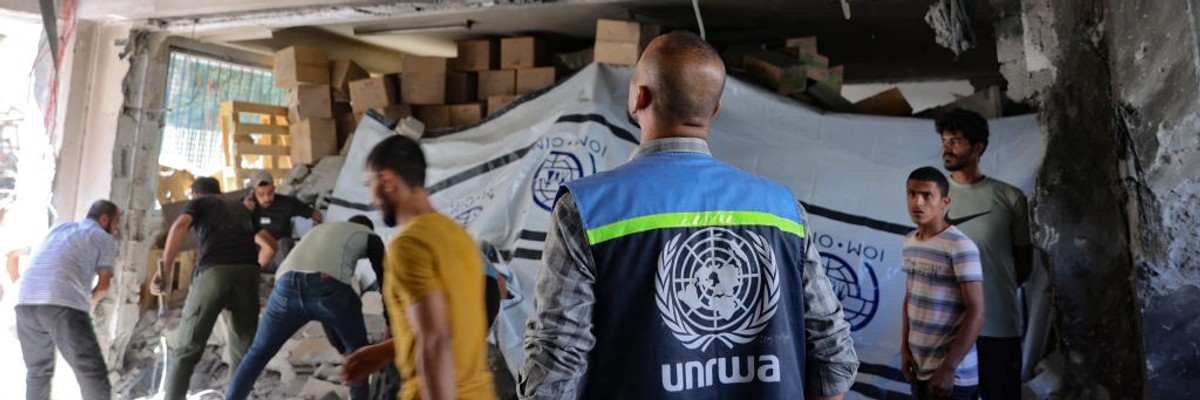
A worker with the United Nations Relief and Works Agency for Palestine Refugees in the Near East and displaced Palestinians check the damage inside a U.N. school-turned-shelter near Gaza City after a reported Israeli strike on October 19, 2024. (Photo: Omar al-Qattaa/AFP via Getty Images)

“This legislation not only contravenes the basic principles of human rights that led to the U.N. General Assembly’s founding of UNRWA, but also violates a range of Israel’s international legal obligations.”

Over a year into Israel’s obliteration of the Gaza Strip, Israeli lawmakers faced sharp criticism on Monday after voting for a pair of bills targeting the United Nations agency responsible for humanitarian aid in the illegally occupied Palestinian territories.

The first bill, which says that the United Nations Relief and Works Agency for Palestine Refugees in the Near East (UNRWA) “will not operate any missions, won’t provide any service, and won’t hold any activity—directly or indirectly—in the sovereign territory of the state of Israel,” passed the Israeli parliament 92-10.

The second legislative proposal—under which the Israeli agency that handles humanitarian issues, the Coordinator of Government Activities in the Territories (COGAT), will have to cut off contact with UNRWA—passed the 120-member Knesset 87-9. Critics called the votes “grotesque” and “outrageous.”

The Israel-based organization Adalah said in a statement that “despite widespread international pressure and condemnation, the Knesset has nearly unanimously passed two bills aimed at dismantling UNRWA, all while Israel continues its genocidal assault on Gaza and intensifies violence across the West Bank, including East Jerusalem.”

“This legislation threatens a vital lifeline for over 2.5 million Palestinian refugees throughout the occupied Palestinian territory,” the group warned. “It represents a deliberate attempt to fundamentally undermine UNRWA and its essential mission of supporting the relief, education, and human development of Palestinian refugees. Specifically, the laws aim to strip Palestinians—who were forcibly displaced from their homes during the 1948 Nakba and the 1967 war—of their status as refugees and their right of return.”

The United Nations General Assembly created UNRWA in 1949, in the wake of the Nakba, or “catastrophe,” when more than 750,000 Palestinians fled or were forced from their homeland to establish the modern state of Israel—whose officials have claimed without providing evidence that a dozen of the agency’s 13,000 staffers in Gaza were involved with the Hamas-led October 7, 2023 attack on Israel.

“This legislation not only contravenes the basic principles of human rights that led to the U.N. General Assembly’s founding of UNRWA, but also violates a range of Israel’s international legal obligations, including those under the Genocide Convention and the Rome Statute of the International Criminal Court,” said Adalah. “The international community must hold Israel accountable.”

Although Israel faces a South Africa-led genocide case at the International Court of Justice over its war on Hamas-controlled Gaza—which has killed at least 43,020 people and injured another 101,110 since last October—governments around the world have not acted to stop the bloodshed. The U.S. Congress and President Joe Biden’s administration have even provided Israel with billions of dollars in military aid and blocked cease-fire resolutions at the United Nations.

Earlier this month, the Biden administration finally threatened to cut off weapons if the Israeli government does not take “urgent and sustained actions” to improve humanitarian conditions in Gaza within 30 days. U.S. Secretary of State Antony Blinken and Secretary of Defense Lloyd Austin’s letter specifically raised concerns about the legislation that passed the Knesset Monday.

Asked about the Israeli bills on Monday, Matthew Miller, a U.S. State Department spokesperson frequently slammed for his statements about Israel, pointed to the secretaries’ criticism of the legislation in the recent letter and acknowledged that UNRWA serves the West Bank and plays “an irreplaceable role” in Gaza, where Palestinians are starving to death.

Sally Abi Khalil, Oxfam’s regional director in the Middle East and North Africa, said Monday that “Israel has bombed Palestinians to death, maimed them, starved them, and is now ridding them of their biggest lifeline of aid. Piece by piece, Israel is systemically dismantling Gaza as a land that is autonomous and liveable for Palestinians.”

“Its banning of UNRWA today is condemnable and another step in this crime,” she argued. “The decision will further undermine the ability of the international community to provide sufficient humanitarian aid and to save lives in any safe, independent, and impartial way. UNRWA was not only the biggest and most established agency that has been delivering aid and sustenance to the people of Gaza for years, it was also a thread that connected them in some hope of solidarity and security to the United Nations.”

“We are in no doubt that Israel and its allies are fully aware of the terrible consequences that this decision will have on Palestinians living in Gaza, many of whom are already starving,” she added. “We join others in warning again that this will result in more death, more suffering, and more forced displacement of people from their besieged homeland. It is impossible not to believe that this is their aim.”

Leading up to the votes, human rights advocates have been sounding the alarm. On Saturday, over 50 groups including Oxfam, Human Rights Watch, and ActionAid released a joint statement demanding action and warning that “dismantling UNRWA would be catastrophic for Palestinians especially in Gaza and the West Bank as they are deprived of essentials such as food, water, medical aid, education, and protection. It will also have catastrophic consequences for millions of Palestinian refugees in Lebanon, Jordan, and Syria, where essential humanitarian aid is crucial for both the refugees and the host communities.”


Philippe Lazzarini, the UNRWA commissioner-general, delivered a similar warning on social media Monday, declaring that the Knesset action not only “is unprecedented and sets a dangerous precedent” but “it opposes the U.N. Charter and violates the state of Israel’s obligations under international law.”

“This is the latest in the ongoing campaign to discredit UNRWA and delegitimize its role towards providing human-development assistance and services to Palestine Refugees,” he continued. “These bills will only deepen the suffering of Palestinians, especially in Gaza where people have been going through more than a year of sheer hell.”

“It ⁠will deprive over 650,000 girls and boys there from education, putting at risk an entire generation of children,” Lazzarini added. “These bills increase the suffering of the Palestinians and are nothing less than collective punishment.”

Original article by Jessica Corbett republished from Common Dreams under Creative Commons (CC BY-NC-ND 3.0). 

Continue Reading‘Grotesque’: Israeli Knesset Bans UN Agency in Charge of Humanitarian Aid in Gaza

Israeli Bombings Kill More Palestinians as 250,000 Ordered to Evacuate Khan Younis

Spread the love

Original article by JULIA CONLEY republished from Common Dreams under Creative Commons (CC BY-NC-ND 3.0). 

Displaced Palestinians from areas in east Khan Younis, Gaza flee after the Israel Defense Forces issued a new evacuation order for parts of the city on July 2, 2024.  (Photo: Eyad Baba/AFP via Getty Images)

“It means yet another day, week, chapter of misery for these hundreds of thousands of people,” said one United Nations worker.

Hearing once again from the Israel Defense Forces that they must evacuate to a so-called “humanitarian zone,” hundreds of thousands of Palestinian people in the southern Gaza city of Khan Younis on Tuesday were forced to search for safety ahead of a likely ground offensive in the city.

The United Nations Relief and Works Agency for Palestine Refugees in the Near East (UNRWA) said that roughly 250,000 people are living and seeking shelter in the evacuation zone—more than 10% of Gaza’s population of 2.3 million.

The evacuation order, which was posted on social media on Monday, also includes nearby localities including al-Qarara and Bani Suhaila.

The IDF said after the order was announced that patients and healthcare providers at European Hospital, the largest operating medical facility in Gaza, were not required to evacuate, but the hospital director told the Associated Press that most had already been relocated.

“The hospital staff and the patients decided to already evacuate themselves,” said Rik Peeperkorn, World Health Organization representative for the occupied Palestinian territories, in a press briefing. “We plea the European Gaza hospital will be spared, will be non-damaged.”

Peeperkorn said three patients remained at the hospital.

Since Israel began its assault on Gaza and its near-total blockade on humanitarian aid in retaliation for a Hamas-led attack in October, the IDF has attacked hospitals across the enclave, even as they have served as shelters for forcibly displaced people.

The IDF has ordered evacuations from places including northern Gaza and the southern city of Rafah—only to bomb so-called “safe” zones after displacing people.

In late May, at least 46 people were killed when Israel bombed a tent encampment in a “humanitarian area” in Rafah after beginning a full-scale ground invasion of the city, where more than a million people had been displaced. At least 25 people were killed in another attack on an encampment in the area last month.

Sam Rose, a planning director for UNRWA, told Al Jazeera that the latest evacuation order put a quarter of a million people in a “harrowing, horrific, and incredibly difficult” situation.

“It means yet another day, week, chapter of misery for these hundreds of thousands of people,” said Rose. “Most of them have been displaced several times. Some had just returned from Rafah where they were displaced a few weeks ago… They go without knowing precisely where they will end up because this evacuation order told people to go urgently—they know that if they don’t go out within 24 hours the worst is to come.”

Soon after the evacuation order, at least nine people were killed in an Israeli strike on a home near European Hospital in Khan Younis.

Rose noted that the coastal area of al-Mawasi, where many people will likely go, is “already so overcrowded. There is no room to pitch a tent, there is no water, no infrastructure, no sanitary services. Many spend the night in vehicles or they sleep on their donkey carts.”

Louise Wateridge, a spokesperson for UNRWA, told The Washington Post that the forced displacement is taking place amid temperatures over 86°F “every day.”

“Even the healthiest people will struggle to make a move in this heat with lack of food, with lack of water,” she said. “And then where do they go? That’s the next question.”

Ahmed al-Najjar, a 26-year-old resident of the Bani Suhaila neighborhood, told Agence France Presse that with nowhere to flee, his family has been forced to stay in the area after first attempting to leave.

“We did not know where we would go and we do not have enough money to buy a new tent,” he said. “We had to spend the night on the street and that has increased our stress. This morning we decided to go home again. There is nowhere else… Whatever happens, happens. We have nothing to lose now.”

The IDF’s apparent plan to expand its assault on Khan Younis came as The New York Times reported that security leaders in Israel are pushing for a cease-fire in Gaza, objecting to Prime Minister Benjamin Netanyahu’s plan to continue the assault until Hamas is eliminated—an objective even some top Israeli military officials believe is impossible—and all Israeli hostages are released.

The Times reported that senior military officials believe a cease-fire is the “swiftest way” to free captives remaining in Gaza.

Original article by JULIA CONLEY republished from Common Dreams under Creative Commons (CC BY-NC-ND 3.0). 

Vote For Genocide Vote Labour.
UK Labour Party Shadow Foreign Secretary repeatedly heckled at a speech to the Fabian Society over his and the Labour Party's support for and complicity in Israel's genocide of Gaza.
UK Labour Party Shadow Foreign Secretary repeatedly heckled at a speech to the Fabian Society over his and the Labour Party’s support for and complicity in Israel’s genocide of Gaza.
Continue ReadingIsraeli Bombings Kill More Palestinians as 250,000 Ordered to Evacuate Khan Younis

As Gaza Starves, Israeli Minister Ben-Gvir Calls to Reduce Humanitarian Aid

Spread the love

Original article by JULIA CONLEY republished from Common Dreams under Creative Commons (CC BY-NC-ND 3.0). 

Israeli Minister of National Security Itamar Ben-Gvir speaks during an event on June 3, 2024 in Jerusalem. (Photo: Amir Levy/Getty Images)

The national security minister’s comments came as the number of Palestinian children who have died of malnutrition reached at least 30.

Humanitarian aid deliveries to Gaza remained almost entirely halted by Israeli forces on Friday, but Israel’s national security minister, Itamar Ben-Gvir, suggested he was dissatisfied with the mounting death toll from starvation and called for a complete blockade to be resumed.

“In our opinion Israel should withhold fuel from Gaza and reduce the humanitarian [aid] that enters,” Ben-Gvir said on social media, adding that he would not support a cease-fire deal put forward by Israel because it “would endanger the future of the state of Israel.”

Ben-Gvir’s comments came as just two crossings into Gaza were open—the Western Erez crossing from Israel into the northern part of the enclave and the Karem Abu Salem crossing, which has had “limited functionality” since May 8.

In recent days the number of aid trucks that have entered through the Karem Abu Salem crossing has plummeted from nearly 200 per day in early May to fewer than 50 per day, with as few as just one truck per day entering since mid-May.

With the Rafah crossing closed to all aid shipments since the Israel Defense Forces (IDF) launched a full-scale invasion of the southern city on May 6, deliveries through the Karem Abu Salem entry point is the best chance that people in Rafah and southern Gaza have for obtaining desperately needed relief.

More than 1 million Palestinians have been displaced to Rafah since Israel began its bombardment of Gaza in October, and the United Nations has said that roughly that number have again fled the city in the past month, trying to escape Israel’s incursion.

More than 36,000 Palestinians have been killed in Israel’s attacks since October, including at least 30 children who have died of starvation. Nearly all of them died in northern Gaza, where World Food Program Executive Director Cindy McCain said “full-blown famine” had taken hold last month.

Along with Israel’s closure of border crossings, Doctors Without Borders said this week that the “systematic obstruction at Israeli-controlled crossing points” has kept trucks from reaching people who need relief. Israeli officials have turned away deliveries that include certain items, like medical kits, that they say could have a “dual use.”

Louise Wateridge a communications officer for the United Nations Relief and Works Agency for Palestine Refugees in the Near East (UNRWA), toldCNN on Friday that intense military action has kept the Karem Abu Salem crossing from operating fully, leaving trucks full of relief deliveries stuck on the Israeli side.

“It’s just a complete waste of vital humanitarian aid, and it’s such a manmade situation,” Wateridge told the outlet.

Amid the ongoing starvation crisis, Ben-Gvir’s call to even further reduce humanitarian aid came a day after he said in a video posted to social media that Israel intends to “occupy all the land” in Gaza, establish settlements like those in the West Bank, and encourage the so-called “voluntary migration” of Palestinians from Gaza—echoing a call from Prime Minister Benjamin Netanyahu which rights advocates denounced as an open endorsement of ethnic cleansing.

Ben-Gvir has opposed a cease-fire deal supported by U.S. President Joe Biden, which calls for Israel’s withdrawal from population centers in Gaza, a release of hostages by Hamas in exchange for the release of hundreds of Palestinian detainees held in Israeli prisons, and Israel’s eventual withdrawal from the enclave entirely.

One researcher on Wednesday objected to Ben-Gvir’s portrayal in corporate media reports as a far-right extremist figure who is pushing Israel’s government toward a fringe movement.

“It’s time for people to stop calling [Finance Minister Bezalel] Smotrich, Ben-Gvir, and Netanyahu ‘fringe,'” they said. “They’re not fringe. They’re quite literally the figureheads of the Israeli establishment.”

Original article by JULIA CONLEY republished from Common Dreams under Creative Commons (CC BY-NC-ND 3.0). 

Continue ReadingAs Gaza Starves, Israeli Minister Ben-Gvir Calls to Reduce Humanitarian Aid

‘Unlawful and Catastrophic’: IDF Begins Forced Evacuation of Rafah

Spread the love

Original article by JAKE JOHNSON republished from Common Dreams under Creative Commons (CC BY-NC-ND 3.0). 

Displaced Palestinians in Rafah in the southern Gaza Strip gather their belongings following an evacuation order by the Israeli military on May 6, 2024. (Photo: AFP via Getty Images)

The head of one humanitarian group called the Israeli military’s directives “a serious violation of international law.”

Israel’s army on Monday ordered roughly 100,000 people living in eastern Rafah to evacuate ahead of an imminent military assault on the area, terrifying families who have been forcibly displaced to the southern Gaza city in recent months and intensifying warnings of a bloodbath.

The Israel Defense Forces (IDF) dropped leaflets over Rafah ordering some of its 1.4 million residents to move to a strip along Gaza’s coast, a signal that a long-feared ground assault on the overcrowded city is set to begin in the face of vocal opposition from the international community and humanitarian organizations.

The U.S., Israel’s top arms supplier, has said it would oppose a Rafah assault without a credible plan to evacuate civilians from the city. Humanitarian groups and analysts have said such a plan is impossible because there is no genuinely safe place for Gazans to go. Israeli forces have repeatedly attacked so-called “safe zones” and designated routes Palestinians have used to flee in compliance with past IDF orders.

“Israel’s military offensive in Rafah could lead to the deadliest phase of this conflict, inflicting horrific suffering on approximately 1.4 million displaced civilians in the area,” said Jan Egeland, secretary-general of the Norwegian Refugee Council. “The relocation orders issued by Israel today to thousands of Gazans, directing them to move to Al-Mawasi, are beyond alarming. The area is already overstretched and devoid of vital services. It lacks the capacity to house the number of people currently seeking refuge in Rafah, with no assurances of safety, proper accommodation, or return once hostilities end for those forced to relocate.”

“The absence of these fundamental guarantees of safety and return, as required by international humanitarian law, qualifies Israel’s relocation directives as forcible transfer, amounting to a serious violation of international law,” Egeland said. “Any Israeli military operation in Rafah—which has become the largest cluster of displacement camps in the world—will cause potential mass atrocities.”

“If large-scale military operations start, not only will children be at risk from the violence, but also from chaos and panic, and at a time where their physical and mental states are already weakened.”

Israel reportedly notified the U.S. of the evacuation orders overnight, and CIA Director William Burns is set to arrive in Israel on Monday to discuss the operation in Rafah, a city along Gaza’s border with Egypt that has become a critical point of entry for humanitarian aid. The new evacuation orders, expected to be just the first round of directives, include Rafah’s largest medical facility.

The United Nations Relief and Works Agency for Palestine Refugees in the Near East (UNRWA), the main relief agency in Gaza, said in response to the IDF’s orders that it would not leave Rafah.

“An Israeli offensive in Rafah would mean more civilian suffering and deaths. The consequences would be devastating for 1.4 million people,” the organization wrote in a social media post. “UNRWA is not evacuating: The agency will maintain a presence in Rafah as long as possible and will continue providing lifesaving aid to people.”

The far-right Israeli government, led by Prime Minister Benjamin Netanyahu, has been threatening a ground invasion of Rafah for months, characterizing the city as Hamas’ last major stronghold. Avichay Adraee, an IDF lieutenant colonel, said Monday that the Israeli military would use “extreme force” in the evacuation areas and warned that “anyone who is close to terrorist organizations puts his life and the life of his family at risk.”

According to the United Nations Children’s Fund (UNICEF), around 600,000 children are currently sheltering in the city, including many who have been displaced multiple times since Israel’s assault began in October following a Hamas-led attack.

“More than 200 days of war have taken an unimaginable toll on the lives of children,” Catherine Russell, UNICEF’s executive director, said Monday. “Rafah is now a city of children, who have nowhere safe to go in Gaza. If large-scale military operations start, not only will children be at risk from the violence, but also from chaos and panic, and at a time where their physical and mental states are already weakened.”

Omar Shakir, Israel and Palestine director at Human Rights Watch, called the IDF’s evacuation push in Rafah “unlawful and catastrophic.”

“There’s nowhere safe to go in Gaza,” Shakir added. “The international community should act to prevent further atrocities.”

The IDF began issuing its evacuation orders in Rafah a day after the Netanyahu government voted to shut down Al Jazeera‘s operations in the country, a brazen attack on press freedom.

“The fact that Israel banned Al Jazeera hours before beginning its assault on Rafah is not a coincidence,” said author and Middle East analyst Assal Rad. “After everything we’ve seen in the last seven months, imagine what they’ll do when they think no one is watching.”

Original article by JAKE JOHNSON republished from Common Dreams under Creative Commons (CC BY-NC-ND 3.0). 

Israeli Plan To Evacuate Rafah By Force Sparks Warnings Of ‘Ethnic Cleansing’

Continue Reading‘Unlawful and Catastrophic’: IDF Begins Forced Evacuation of Rafah