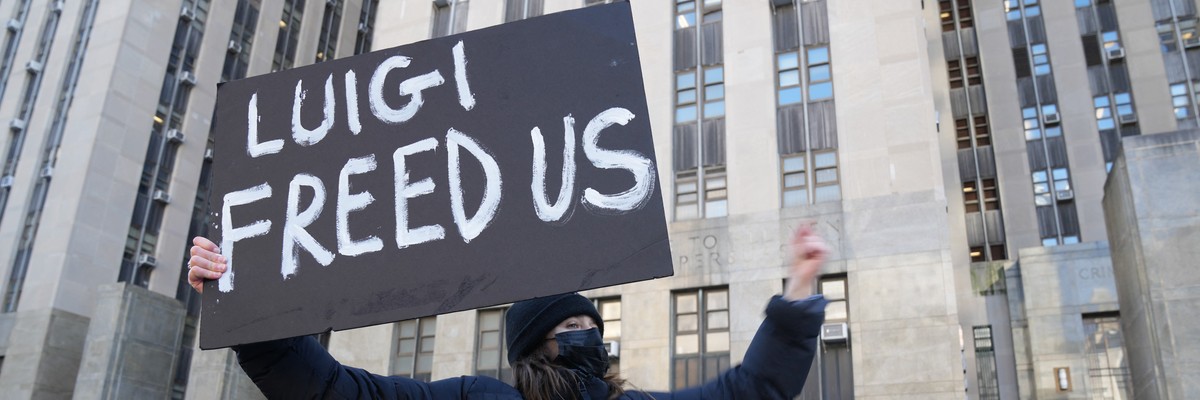
A woman named Mary holds a sign in support of Luigi Mangione outside the Criminal Court building in lower Manhattan as Luigi Mangione, the suspect in the United Healthcare CEO killing, waived extradition to New York on December 19, 2024. (Photo: Bryan R. Smith/AFP via Getty Images)
To honor Brian Thompson, and to ensure his death is not in vain, we can engage in the needed conversation about the extreme depravity of our healthcare system which his death revitalized.
Early this month Luigi Mangione, 26, University of Pennsylvania graduate, allegedly gunned down CEO of UnitedHealthcare, Brian Thompson, 50. The public response has been varied, with many supporting Mangione. Some fear the positive regard of Mangione is indicative of a shift into a new era where violence is glorified and humanity is lost. As a sociology professor who teaches Poverty, Wealth, and Privilege, I disagree. This failure of subsets of the public to broadly denounce the actions of Mangione does not herald a cultural shift in appreciation of violence.
Instead this unusual display of class consciousness reflects two things. First, the reaction is due to the shift in who bore the cost of violence. Class under-resourced; Black, Indigenous, Latinx and people of color; women; and queer and trans people are the normal recipients of societal violence. Wealthy, cishet, white men in positions of power are not. Wealthy, white communities are conditioned to expect protection, and the revocation of that sheltering is rare.
Second, the working classes are weary from surviving an unnecessarily violent and unjust society. We live amid staggering class, race, and gender-based stratification and life and death stakes everyday. The ruling class profits from our blood, sweat, and tears. And yet, when one of the elite passes, they want us to give them more. They ask us to give them our love. Yet, they remain calloused to our pain and ignore our pleas for fairness.
We, as a community, might ask, how are the elite and their apologists not appalled by a harm-rich system that normalizes the idea that humans are only as valuable as their economic worth?
Recently, a magician performed at a kid’s birthday party. Magic tricks work through deception. A magician distracts the audience to hide what else they are doing. Similar dynamics play out in our public life. The wealth gap continues to grow, yet we voted in a billionaire to be president. The public is shamed for failing to appropriately sympathize with Brian Thompson and his family, yet everyday targeted attacks and systemic neglect accumulate to harm and render disposable historically and strategically marginalized communities, such as class under-resourced, BIPOC, women, and trans and queer people.
Let us stop this charade. Our healthcare system is not pro-health. The World Health Organization (WHO) names universal healthcare as a worldwide goal. The United States has not complied. Most Americans are insured through private companies. Many Americans struggle to pay for healthcare, they postpone receiving care, and are in medical debt. The healthcare system has practices, such as using AI to deny a high number of healthcare claims, which put profits over people. There is something deeply inhumane and harmful about this disregard for health in a healthcare system. It may not be illegal, but it is savage.
The elite and their apologists ask, “How could they not be appalled by Thompson’s murder?” Instead we, as a community, might ask, how are the elite and their apologists not appalled by a harm-rich system that normalizes the idea that humans are only as valuable as their economic worth? Decades ago, Larry Summers, currently on the board of directors of OpenAI, famously wrote that people who produce less are more expendable. This classist ideology pervades our healthcare system.
To honor Brian Thompson, and to ensure his death is not in vain, we can engage in the needed conversation about the extreme depravity of our healthcare system which his death revitalized. A path forward that reforms a calloused healthcare system can provide benefits to all of us. Those among us who deeply mourn Brian’s death can take solace that it can impart a legacy of positive, sustainable, and overdue social change. Those among us who view Mangione’s action as predictable, if not understandable, can appreciate the same reform.
To be sure, there are people who claim that human fallibility is a predestined curse that we cannot overcome, that we are born sinners and that we cannot do better than prioritize greed over care of each other, even within our healthcare system. There will be those of us who feel that disproportionate wealth is a triumph and that our healthcare should reflect the position we hold in our socioeconomic system. However, 73 countries have universal healthcare, including China, Russia, Mexico and Canada. Us Americans are also worthy.
Wealthy and powerful people are the most protected against societal harms, and they also have disproportionate control over them. We need the CEOs, billionaires, and other power elites to do better. The system does not have a great way to hold those in charge accountable for bad behavior. Can they figure out a way to hold themselves accountable? Can they reorganize to prioritize care, a virtue, over greed, a vice, in our healthcare system? If they are immune to this self-correcting recovery, we need to organize around collective action, such as voting, for example for single-payer healthcare, because our lives depend on it. We don’t want anyone dying in the street. We also don’t want anyone dying or in pain due to a broken so-called healthcare system.
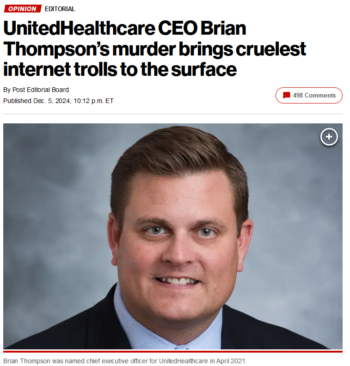
Slain health CEO Brian Thompson’s tenure was marked by skyrocketing prior authorization denials, leading to increased profits
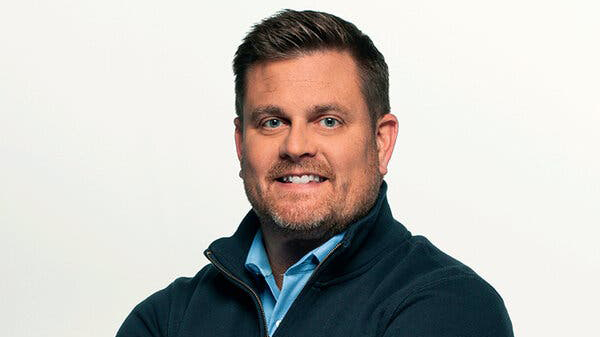
Brian Thompson, slain CEO of UnitedHealthcare, was responsible for skyrocketing prior authorization denials (Photo: UnitedHealthcare)
The assassination of UnitedHealthcare CEO Brian Thompson on December 4 has sparked a reaction that few may have suspected. The perpetrator has received an outpouring of popular support, and a profound debate on the brutality of the US for-profit healthcare system has been sparked, with many accusing healthcare corporations of reaping their profits directly from human misery.
Thompson was shot and killed while heading to an investors meeting in Midtown Manhattan on December 4. Police have arrested 26-year-old Luigi Mangione in connection with the crime, who quickly has become a working class hero in the eyes of many in the US public, especially after his alleged manifesto revealed that he was motivated by outrage towards healthcare corporations. “A reminder: the US has the #1 most expensive healthcare system in the world, yet we rank roughly #42 in life expectancy,” reads the alleged manifesto, which law enforcement claim to have found in his backpack. “It is not an issue of awareness at this point, but clearly power games at play. Evidently I am the first to face it with such brutal honesty.”
The reactions to Thompson’s death show that this outrage is echoed by the US public. UnitedHealthcare had to remove a Facebook post mourning Thompson after it received over 42,000 laughing reactions. Comments on social media regarding Thompson’s death made insurance-related quips including “unfortunately my condolences are out-of-network,” and “thoughts and deductibles to the family.”
Health beyond the for-profit system
People in the US are increasingly demanding alternatives to the present for-profit healthcare system. A Gallup poll taken shortly before Thompson’s assassination shows that the highest percentage of US adults in over a decade believe it is the government’s responsibility to ensure that people have healthcare coverage—62%, as opposed to 36% who insist it is not the government’s responsibility. Gallup data also indicates that most in the US have a negative view of the healthcare industry.
Data for Progress polling indicates that people across the political spectrum support policies that make healthcare more equitable, with 75% of both Democrat, Republican, and independent voters opposing allowing insurers to deny coverage or charge more based on pre-existing conditions. Also across party lines, 70% of voters oppose stopping Medicare (US public insurance) from being able to negotiate lower costs for drug prices.
The unpopularity of the healthcare insurance industry becomes obvious when one examines how exactly insurance companies wield their power over the healthcare system to extract profits from working people.
Cost cutting through denial of service
Shortly before Thompson’s killing, another insurance corporation, Anthem Blue Cross Blue Shield, announced that it would not pay for the complete duration of anesthesia for surgical procedures. This move was denounced by the American Society of Anesthesiologists (ASA). “This is just the latest in a long line of appalling behavior by commercial health insurers looking to drive their profits up at the expense of patients and physicians providing essential care,” said Dr. Donald E. Arnold of ASA. “It’s a cynical money grab by Anthem, designed to take advantage of the commitment anesthesiologists make thousands of times each day to provide their patients with expert, complete and safe anesthesia care. This egregious policy breaks the trust between Anthem and its policyholders who expect their health insurer to pay physicians for the entirety of the care they need.”
Following Thompson’s assassination and the subsequent outrage over the state of the healthcare industry, Anthem walked back this decision, with a company spokesperson stating that “there has been significant widespread misinformation about an update to our anesthesia policy. As a result, we have decided to not proceed with this policy change.”
Regardless of Anthem’s flip-flopping, the corporation was willing to cut anesthesia for patients mid-surgery simply to cut costs. This is only one example of how health insurance companies are able to reap their enormous profits from policies which maximize human misery.
Under the current privatized healthcare system in the US, working people and their employers pay hundreds of billions of dollars to private insurance companies in the hopes of receiving adequate coverage when most needed. Insurance companies, which under a capitalist system exist only to make a profit, not to actually provide coverage, do whatever they can do to deny coverage to patients in their hour of need—enabling them to pocket the billions they receive from people in the US and increase their revenue.
Companies such as UHC, which is the nation’s largest health insurer with over 15% of the market share, cut costs by denying coverage to patients, including through a process called prior authorization, a process which insurance companies utilize to determine if they will cover a prescribed procedure, service, or medication. Prior to Thompson’s tenure as UHC CEO, which began in 2021, the rate of prior authorization denials was 8%. By 2022, the rate of denial had skyrocketed to 22.7%. According to personal finance platform ValuePenguin, UHC denies Medicare and non-Medicare insurance claims at a rate that is double the rate of the national average.
UHC’s prior authorization denials increased so sharply that they prompted an investigation by media outlet ProPublica as well as the US Senate. ProPublica found that UHC had culled therapy expenses by using an algorithm to restrict mental healthcare coverage. A report by the Senate Permanent Subcommittee on Investigations found that UHC used artificial intelligence to deny claims at an increasing rate. In November of 2023, UHC was hit by a class action lawsuit filed by the families of two former UHC beneficiaries, which alleged that the company had illegally denied “elderly patients care owed to them under Medicare Advantage Plans” by utilizing an AI algorithm with a 90% error rate.
“The elderly are prematurely kicked out of care facilities nationwide or forced to deplete family savings to continue receiving necessary medical care, all because [UHC’s] AI model ‘disagrees’ with their real live doctors’ determinations,” said the complaint.
These sharp increases in claim denials served a particular purpose: under Thompson’s leadership, UHC profits increased from USD 12 billion in 2021 to USD 16 billion in 2023. UnitedHealthcare Group, of which UHC is a part, is now the largest health insurance company is the US, with an annual revenue of over USD 189 billion.
Hey @UHC. Completed a hysterectomy yesterday afternoon, discharged her home in the evening (saving @UHC and everyone some money). Discharge medications included 12 Vicodin. (retail cost $30). Vicodin DENIED pending prior authorization. Patient in pain all night. Way to go.
As health insurance companies extract their enormous profits from those left without coverage, some are seeking to propose and organize alternatives to the for-profit healthcare system. Progressive demands for Medicare for All, a single-payer healthcare program in which the costs of essential healthcare for all US residents are covered under a public health plan that would replace almost all other existing public and private health plans, have reignited following Thompson’s assassination. Organizations such as Physicians for a National Health Program have advocated for such a policy. As PNHP outlines, under a single-payer program, “over $500 billion in administrative savings would be realized by replacing today’s inefficient, profit-oriented, multiple insurance payers with a single streamlined, nonprofit, public payer.”
“There is no justification for violence,” said California Representative Ro Khanna, who supports the policy. “But the outpouring afterwards has not surprised me.
Zeynep Tufekci (New York Times, 12/6/24) “can’t think of any other incident when a murder in this country has been so openly celebrated.”
The early morning murder of UnitedHealthcare CEO Brian Thompson was met on social media with a “torrent of hate” for health insurance executives (New York Times, 12/5/24). Memes mocking the insurance companies and their callous disregard for human life abound on various platforms (AFP, 12/6/24).
Internet users are declaring that the man police believe to be the shooter, 26-year-old Luigi Mangione, is certifiably hot (Rolling Stone, 12/9/24; KFOX, 12/10/24). A lookalike contest for the shooter was held in lower Manhattan (New York Times, 12/7/24).
If so many people are unsympathetic at best in response to such a killing, that might be a reason to revisit why health insurance companies are so loathed. The rage “was shocking to many, but it crossed communities all along the political spectrum, and took hold in countless divergent cultural clusters,” the New YorkTimes (12/6/24) noted. Mangione was reportedly found with an anti-insurance manifesto that stated “these parasites had it coming” (Newsweek, 12/9/24), echoing a resentment largely felt by a lot of Americans, and targeted fury at UnitedHealthcare specifically.
UnitedHealthcare has always stood out for exceptionally high rate of claims denial generally in the industry (Boston Globe, 12/5/24; Forbes, 12/5/24). For example, a Senate committee found that “UnitedHealthcare’s prior authorization denial rate for post-acute care jumped from 10.9% in 2020 to 22.7% in 2022” (WNYW, 12/7/24).
The Times (12/5/24) reported that the Senate committee found that “three major companies—UnitedHealthcare, Humana and CVS, which owns Aetna—were intentionally denying claims” related to falls and strokes in order to boost profits. UnitedHealthcare “denied requests for such nursing stays three times more often than it did for other services.”
Increasing dissatisfaction
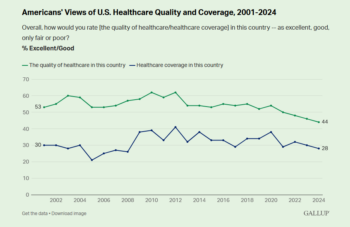
The perception of the quality of US healthcare has been on the decline since 2012 (Gallup, 12/6/24).
On top of that, Americans generally believe their insurance-centered system is a mess. Gallup (12/6/24) reported that “Americans’ positive rating of the quality of healthcare in the US is now at its lowest point in Gallup’s trend dating back to 2001.”
It continued:
The current 44% of US adults who say the quality of healthcare is excellent (11%) or good (33%) is down by a total of 10 percentage points since 2020 after steadily eroding each year. Between 2001 and 2020, majorities ranging from 52% to 62% rated US healthcare quality positively; now, 54% say it is only fair (38%) or poor (16%).
As has been the case throughout the 24-year trend, Americans rate healthcare coverage in the US even more negatively than they rate quality. Just 28% say coverage is excellent or good, four points lower than the average since 2001 and well below the 41% high point in 2012.
Most Americans are unsatisfied with the healthcare system, say the health insurance system is confusing and opaque, and many have skipped or delayed care because of a bad experience or the lack of timely appointments. A small, but not insignificant number, of Americans believe they have had a negative health outcome as result of their experiences within the healthcare system.
When this inefficient system doesn’t literally kill Americans, it can still kill them financially. “Almost a third of all working adults in the United States are carrying some kind of medical debt—that’s about 15% of all US households,” Marketplace (3/27/24) reported. It added: “This debt is also the leading cause of bankruptcies in the country.”
Many news outlets’ pontificators, however, were incensed that anyone would voice frustration with health insurance when an industry CEO has fallen.
‘Not the time to offer criticism’
After Brian Thompson’s killing, the New York Post (12/5/24) condemned those on social media who “swooned over his killer, speculated on his motives, and wondered if Timothée Chalamet would play him in the movie.”
Responding to the memes and the jokes, many of which were more about the unjust health insurance system than support for vigilante murder, the New York Post editorial board (12/5/24) asked:
Do the jokes point to a society that has become so desensitized by the coarseness of online discussion, so disassociated from kindness, that a baying mob cheers a man’s murder and cries out for more?
And upon Mangione’s arrest, the Post (12/9/24) complained that on social media, “tasteless trolls showered praise on the Ivy League grad.” The Post (12/11/24) also fretted about fake “Wanted” posters for insurance company executives that the paper considered a “a fear-mongering social media stunt to incite hysteria,” adding that the “murder has also spawned a stream of merchandise sympathetic towards the 26-year-old being sold by online retailers, forcing Amazon to pull them from its website.”
Fox News (12/6/24) quoted one of its own contributors, Joe Concha, saying, “I think this encapsulates the far left’s worldview: If you run a company that isn’t to their liking, you deserve to die.” The network (12/7/24) praised Democratic Sen. John Fetterman of Pennsylvania for “tearing into” a New York article (12/7/24) that the outlet characterized as saying “resentment over denied insurance claims made…Thompson’s murder inevitable.”
The dismay was felt in other corners of right-wing media. At the Free Press (12/5/24), the brainchild of anti-woke crusader Bari Weiss, Kat Rosenfield wrote:
The people celebrating Brian Thompson’s murder by turning him into an avatar for everything wrong with the American healthcare system remind me of nothing so much as Hollywood screenwriters, cunningly manipulating an audience into cheering on unforgivable acts of fictional violence.
This is not the time to offer your criticisms of the health-insurance industry. And there is never a time to believe that corporate executives are, by their very nature, evil people who deserve to be killed. Yet that is what you’ll see if you go on social media right now and look at comments on news stories about this assassination.
Yet all of these outlets at the same time have run support for Daniel Penny, the man recently acquitted for killing a Black homeless man on the New York City subway (National Review, 6/17/23; Free Press, 10/20/24; New York Post, 12/4/24; Fox News, 12/6/24). These outlets likewise expressed support for Kyle Rittenhouse after he gunned down Black Lives Matter protesters (National Review, 11/19/21; Free Press, 11/17/21; New York Post, 11/19/21; Fox News cited by Media Matters, 11/11/21), and for George Zimmerman when he shot Trayvon Martin (National Review, 6/22/20; New York Post, 7/15/13; Fox News, 7/18/12). In other words, it’s fine to defend vigilantes when they kill unarmed Black people or anti-racist activists, but when a CEO’s life is taken, we must solemnly stay silent on the reasons why such a person might be targeted or why bystanders might not be crying.
Piers Morgan (New York Post, 12/10/24) made this clear when he said “I cheered when I heard” Penny’s acquittal, and felt “shocked and saddened when I saw the footage” of the Thompson shooting. “Those two reactions would surely be the correct and appropriate ones for anyone with an ounce of fairness and humanity in their heart,” he said—because Thompson was “a non-violent, non-threatening, non-criminal man in the street,” whereas Penny’s victim was “a dangerous, mentally ill, homeless man.”
Blame it on Medicare
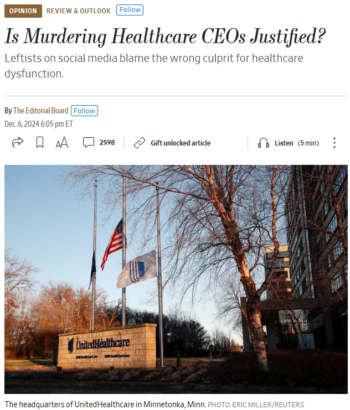
The Wall Street Journal (12/6/24) made the absurd claim that a medical system based on private insurance is better than any other kind of healthcare system.
It was the Wall Street Journal, the more erudite of Murdoch’s media properties, that really addressed the question of why people might hate health insurance companies. The anger was misdirected, the editorial board (12/6/24) said. Rather, we should look to federally funded healthcare if we want to get mad: “Medicare and Medicaid, two government programs, cover about 36% of Americans,” the paper observed; because they “pay doctors and hospitals below the cost of providing care…many providers won’t see Medicaid patients, resulting in delayed care.”
It’s an odd argument, given that people who receive Medicaid report being happier with their health insurance than people who get it through their employers or pay for it themselves—and people with Medicare are the happiest of all (KFF, 6/15/23). If the federal programs are underpaying healthcare providers, the obvious solution would be to increase funding for them—an initiative the Journal would be unlikely to support.
The board (Journal, 10/10/24) later dismissed critiques of the health insurance industry and passed off Mangione as a “disturbed individual” radicalized by the Internet and said it is “a dreadful sign of the times that Mr. Mangione is being celebrated.”
Journal editorial board member Allysia Finley (12/8/24) followed up by placing the blame on the Affordable Care Act (aka “Obamacare”). “Having insurance doesn’t change people’s behavior,” she wrote, but does “cause them to use more care.” The situation, she said, “has gotten worse since Obamacare expanded eligibility” for Medicaid. This portrait of US patients overusing healthcare like sweet-toothed children let loose in a candy store is belied by (among other things) the fact that Americans live 4.7 fewer years than the average of comparable countries (KFF, 1/30/24).
The Journal editorial went on to complain that “some providers prescribe treatments and tests that may be medically unnecessary,” and so “insurers have tried to clamp down on such abuse by requiring prior authorization.” While this “can result in delayed care that is medically necessary…it’s also how insurers control costs.”
In reality, doctors are complaining that insurance bureaucrats are impeding their ability to deliver needed healthcare because of this cost-slashing system (Forbes, 3/13/23). The American Medical Association found “94% of doctors say prior authorization leads to delays in patient care” (Chief Medical Executive, 3/14/23); “one in three doctors (33%) say prior authorization has led to serious adverse events with their patients.”
Journal editorialists appear to believe that doctors are jauntily giving away expensive blood pressure medicine and signing up patients for brain surgery for no particular reason, and the only thing that can stop this carnival of care is some bureaucrat who is trained to say “no.” The reality is that the private insurance system “saves insurance companies money by reflexively denying medical care that has been determined necessary by a physician,” as pediatrician William E. Bennett Jr. (Washington Post, 10/22/19) wrote. This is why people are so unsympathetic to Thompson, who was paid an estimated $10 million annually for imposing medical austerity on patients and providers (PBS, 12/7/24).
Pity the insurance giants
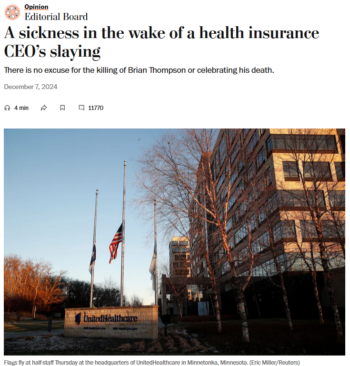
The Washington Post (12/7/24) criticized those who tried to use Thompson’s killing “as an occasion for policy debate about claim denial rates by health insurance companies.” (Note that both the Post and the Wall Street Journal used the same photo of flags at half-mast.)
Right-wing media weren’t the only engaging in scolding. At the Jeff Bezos–owned Washington Post, the editorial board (12/7/24) criticized those “who excuse or celebrate the killing,” as well as those “who do not countenance the killing itself” but “have nevertheless tried to treat it as an occasion for policy debate about claim denial rates by health insurance companies, an admittedly legitimate issue.” The Post added that debate was “fine in principle, but we’re skeptical that this particular moment lends itself to nuanced discussion of a complicated, and heavily regulated, industry.”
The editors nevertheless spent a lengthy paragraph explaining to readers that “controlling healthcare costs requires difficult trade-offs,” and that “even the most generous state-run health systems in other countries also have to face” these trade-offs. The editorial attempted to summon sympathy for
insurers, whose profits are capped by federal law, [and] must contend with consumer demand for ready access to high-priced specialists and prescription drugs—and, at the same time, premiums low enough that people can afford coverage.
Note that insurance company profits are “capped” by requiring them to spend at least 80% of premiums on claims, a percentage known as their loss ratio—but those claims can be paid to providers that are owned by the insurers themselves, “a loophole that makes loss ratio requirements meaningless” (Physicians for a National Healthcare Program, 7/16/21). United Healthcare has been particularly aggressive at this, which is part of the reason its “capped” profits soared to $22.4 billion in 2023.
As for the Post’s assertion that insurance providers should keep “premiums low enough that people can afford coverage,” KFF (10/9/24) found that “Family premiums for employer-sponsored health insurance rose 7% this year to reach an average of $25,572 annually, marking the “second year in a row that premiums are up 7%.” The Center for American Progress (11/29/22) found that employer sponsored insurance “premiums have risen above the rate of inflation and have outpaced wage growth” over the course of a decade. “Escalating grocery bills and car prices have cooled, but price relief for Americans does not extend to health care,” USA Today (10/9/24) reported.
The Post added that all this talk about how Americans are being tortured by the insurance system should wait until next year, “when Congress is to consider whether to keep temporary Obamacare enhancements that have boosted enrollment.”
It is easy to see the material interests of the Washington Post‘s owner at work. Jeff Bezos’ Amazon does not run a health insurance company, but it is fully entrenched in the for-profit medical system. It offers a health insurance marketplace through AmazonFlex, acquired the healthcare provider One Medical last year (NPR, 11/12/23; Forbes, 4/5/24), and offers a pharmacy and other health services.
As one of the world’s richest people, Bezos might have another reason to be worried about people cheering on the murder of CEOs: Amazon is often hated for its monopoly-like grip on online retail (FTC, 9/26/23), as well as charges of price-gouging (Seattle Times, 8/14/24) and union-busting (Guardian, 4/3/24).
‘Last or near last’
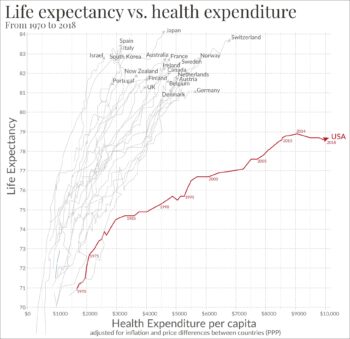
The failure of the US healthcare system in one chart: life expectancy plotted against healthcare spending.
The Washington Post‘s line about the comparable ills of “generous state-run health systems” echoed a similar argument from the Wall Street Journal‘s editorial, which concluded:
Government healthcare is a recipe for more care delays and denials. Witness the fiasco in the United Kingdom, where the Labour government reports that more than 120,000 people died in 2022 while on the National Health Service’s waitlist for treatment. To adapt a famous Winston Churchill phrase, private insurance is the worst form of healthcare, except for all others.
The statement that the British or European health systems are worse for people than the US private insurer–dominated system is simply false. Just months ago, the Commonwealth Fund (NBC, 9/19/24) found that the United States
ranks as the worst performer among 10 developed nations in critical areas of healthcare, including preventing deaths, access (mainly because of high cost) and guaranteeing quality treatment for everyone.
The US “ranked last or near last in every category except one,” precisely because
the complex labyrinth of hospital bills, insurance disputes and out-of-pocket requirements that patients and doctors are forced to navigate put the US second to last in administrative efficiency.
The Commonwealth Fund (CNN, 1/31/23) also found that
the United States spends more on healthcare than any other high-income country, but still has the lowest life expectancy at birth and the highest rate of people with multiple chronic diseases.
Healthcare providers in Mexico and Costa Rica are huge draws for Americans in need of care who can’t make it through America’s Kafkaesque system (NPR, 3/8/23). Spain and Portugal are attracting American retirees, and good low-cost health care is one incentive (Travel + Leisure, 6/20/24).
Retreat to the castle
Apparently the CEOs that Fox News (11/13/24) is so concerned about don’t qualify as “professional elites.”
While the Washington Post’s position clearly falls in line with its material allegiance to a system where its owner sits at the apex, the positions from Murdoch are more interesting. As the Democratic Party has lost support among the working class (NPR, 11/14/24; USA Today, 11/30/24), Murdoch’s outlets have touted Donald Trump and the Republican Party as alternatives for working-class voters.
Murdoch and other purveyors of Republican propaganda have promoted the idea that Democrats serve only financial elites and Hollywood producers, and that protectionist policies under Trump will help US workers (New York Post, 7/16/24; Fox News, 11/13/24). Republicans were able to woo voters by complaining about the high price of gasoline and groceries under the Biden administration (CNBC, 8/7/24).
Now Murdoch outlets are fully retreating into their elite castle and telling the rabble to stop complaining about the lack of access to healthcare. The Republicans and their news outlets have worked hard to recharacterize themselves as something more populist, but the Thompson killing has brought back the old narrative that they are, proudly, the champions of the 1 Percent.
FAIR’s work is sustained by our generous contributors, who allow us to remain independent. Donate today to be a part of this important mission.
Suspected shooter Luigi Mangione is led into the Blair County Courthouse for an extradition hearing on December 10, 2024 in Hollidaysburg, Pennsylvania. (Photo: Jeff Swensen/Getty Images)
“A reminder: the U.S. has the #1 most expensive healthcare system in the world, yet we rank roughly #42 in life expectancy,” the 26-year-old accused of assassinating a health insurance CEO reportedly wrote.
This is a breaking story… Please check back for possible updates…
A day after Luigi Mangione was arrested and charged as the alleged killer of UnitedHealthcare CEO Brian Thompson, independent journalist Ken Klippenstein on Tuesday published what he said was the 26-year-old’s highly reported on manifesto.
The existence of the handwritten document found on Mangione when he was taken into custody in Pennsylvania on Monday was confirmed by the New York Police Department, and major media outlets have quoted from it, but none had released it in full.
“My queries to The New York Times, CNN, and ABC to explain their rationale for withholding the manifesto, while gladly quoting from it selectively, have not been answered,” Klippenstein said on his Substack.
According to Klippenstein—who previously published dossiers on Vice President-elect JD Vance and Sen. Marco Rubio (R-Fla.), the nominee for U.S. secretary of state—Mangione’s manifesto reads:
To the Feds, I’ll keep this short, because I do respect what you do for our country. To save you a lengthy investigation, I state plainly that I wasn’t working with anyone. This was fairly trivial: some elementary social engineering, basic CAD, a lot of patience. The spiral notebook, if present, has some straggling notes and To Do lists that illuminate the gist of it. My tech is pretty locked down because I work in engineering so probably not much info there. I do apologize for any strife of traumas but it had to be done. Frankly, these parasites simply had it coming. A reminder: the US has the #1 most expensive healthcare system in the world, yet we rank roughly #42 in life expectancy. United is the [indecipherable] largest company in the US by market cap, behind only Apple, Google, Walmart. It has grown and grown, but as our life expectancy? No the reality is, these [indecipherable] have simply gotten too powerful, and they continue to abuse our country for immense profit because the American public has allwed them to get away with it. Obviously the problem is more complex, but I do not have space, and frankly I do not pretend to be the most qualified person to lay out the full argument. But many have illuminated the corruption and greed (e.g.: Rosenthal, Moore), decades ago and the problems simply remain. It is not an issue of awareness at this point, but clearly power games at play. Evidently I am the first to face it with such brutal honesty.
Common Dreams has not independently verified its authenticity.
Klippenstein said on social media that the manifesto he published is “the real one, not the fake one circulating online.”
NBC News deputy technology editor Ben Goggin noted that language shared by Klippenstein “matches what NBC has reported here as real.”
Earlier on Tuesday, Klippenstein published leaked talking points that UnitedHealthcare reportedly circulated to its employees as the insurance company faces widespread public criticism.