Welfare reform bill: what changes did the government make to get it over the line?

Spread the love
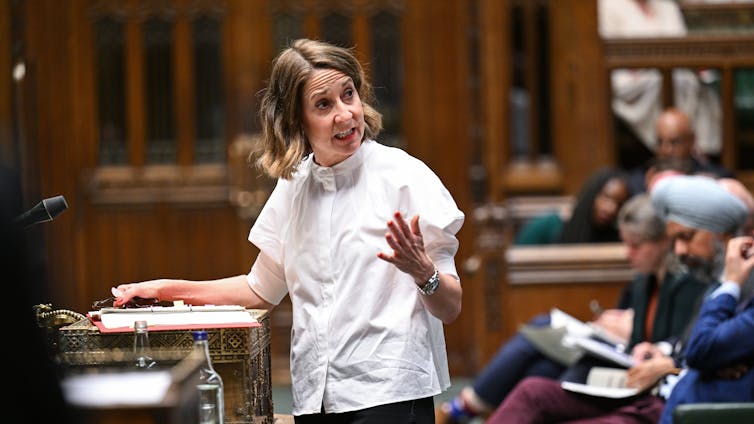
Liz Kendall, the work and pensions secretary, speaks to the Commons ahead of the crucial vote on welfare reform. House of Commons/Flickr, CC BY-NC-ND

Richard Machin, Nottingham Trent University

The government’s landmark bill on welfare reform passed by 335 to 260 votes on Tuesday evening, after staving off a major rebellion from Labour MPs. To win over backbench MPs who had opposed the bill, the government made a series of concessions, including a last-minute compromise agreeing that any changes to personal independence payment (Pip) will not be introduced until the outcome of a review.

In March, the government introduced the universal credit and personal independence bill. The aim was to create a sustainable welfare system in response to changing demographics and population health.

In recent years, the UK has seen an increase in people claiming benefits for long-term health conditions, with one in ten people of working age claiming a sickness or disability benefit. Welfare expenditure has increased, and is projected to be £70 billion a year by the end of the parliament.

Recalibrating the welfare system is not an easy task. The government has said reform is needed to support those with highest needs and assist more people into work. However, critics of the bill, raised concerns that it would result in an overly restrictive disability benefits system and push more people into poverty.

Here’s what’s the bill initially proposed and what was changed ahead of the vote.


Get your news from actual experts, straight to your inbox. Sign up to our daily newsletter to receive all The Conversation UK’s latest coverage of news and research, from politics and business to the arts and sciences.


Personal independence payment

The bill initially proposed significant changes to personal independence payments (Pip) from November 2026. Pip is a working-age benefit to help people with the costs associated with a long-term health condition or disability. It has two elements, a daily living component and a mobility component.

A points-based system is used to assess eligibility for Pip. Currently, to qualify for the daily living component a claimant must have limited ability in relation to a range of ten activities. These include washing and bathing, dressing and undressing, eating and drinking and managing medication or therapy.

Eight to 11 points leads to qualification for the standard rate and over 12 points for the enhanced rate. On the current system, a claimant can score one or two points across a range of activities, it doesn’t matter how the points are made up.

In March, the government announced that from November 2026, claimants will need to score at least four points on at least one of the ten activities to qualify. The amount of points available ranges from zero to 12, depending on the activity.

Critics argued that this places the bar at too high a level, making it more difficult for people whose health problems are spread across a range of activities, rather than meeting the criteria in one.

Close up of hands of a nurse helping a woman count out medication tablets
Needing assistance managing medication is one area where Pip points are measured. Yuri A/Shutterstock

Concerns were raised that this change could disproportionately affect people with mental health problems. Research shows that previous changes to Pip have caused uncertainty and anxiety for many people with mental health problems.

Typically if the help required relates to being reminded or encouraged to compete a task, only two points are awarded. This can be a common way for people with mental health problems to qualify for Pip, including those with severe conditions such as bipolar disorder. It is estimated that between 800,000 and 1.2 million people would have lost entitlement to Pip under the four-point proposal.

After it became clear that dozens of Labour MPs planned to vote against the bill, the work and pensions secretary, Liz Kendall, announced a concession on the Pip proposals. First, that four-point rule should only apply to new claimants, with people already in receipt of Pip remaining within the current rules. Second, there will be a review of the Pip assessment led by Stephen Timms, the minister for social security and disability, alongside people with disabilities and representative organisations.

But for some MPs and campaigners, this raised the spectre of a two-tier system which protects existing claimants but not future ones. Two hours before the Commons vote, Timms announced that no changes would be made to Pip eligibility before the review. The bill passed without any changes to Pip.

Universal credit

What remains in the bill are changes to universal credit, the UK’s main means-tested benefit, primarily for claimants who are unfit for work.

Over 3 million claimants (out of a total of over 7 million) are not required to look for work as a result of a health condition. They receive an additional health-related payment of more than £400 per month. The bill reduces the health element for new claims from £97 to £50 per week from April 2026 and restricts payment to claimants over the age of 22.

Under original proposals, the higher health-related rate was to be frozen for existing claimants. This will now be increased every year for the rest of the parliament, at least in line with inflation.

A £1 billion back-to-work support package, originally scheduled to be introduced in 2029, will be accelerated.

The Department for Work and Pensions estimates that 730,000 future universal credit claimants will lose an average of £3000 per year compared to current claimants.

What happens next?

The government’s original plans were estimated to save £5 billion a year by 2030. Last weeks’ concessions would cost £3 billion. The last-minute compromises mean that there will be virtually no medium-term savings.

Labour minister Pat McFadden has ruled out raising income tax, VAT or national insurance, but questions remain on how these concessions will be paid for.

The government technically won the vote on welfare reform, but was unable to push through its most significant reforms. The debate over the future of the welfare system will continue (and probably intensify) as the Timms review begins.

Richard Machin, Associate professor (Social Policy), Nottingham Trent University

This article is republished from The Conversation under a Creative Commons license. Read the original article.

Keir Starmer says that the Labour Party under his leadership all feel a small part of Scunthorpe.
Keir Starmer confirms that he's proud to be a red Tory continuing austerity and targeting poor and disabled scum.
Keir Starmer confirms that he’s proud to be a red Tory continuing austerity and targeting poor and disabled scum.
Continue ReadingWelfare reform bill: what changes did the government make to get it over the line?

Charities respond to Spring Statement

Spread the love
Keir Starmer says that his Labour Party is intensely relaxed about assaulting the very poorest and most vulnerable.

https://socialcare.today/2025/03/27/charities-respond-to-spring-statement

Lynn Perry, Chief Executive of the children’s charity Barnardo’s, says: ‘The Spring Statement today offered little hope to the 4.3m children and their families who are living in poverty. In fact, the welfare changes announced today will make things even worse, putting an extra 50,000 children into relative poverty. These children face devastating impacts on their health, well-being and life opportunities long into adulthood. 

‘While we welcome the investment to recruit 400 new foster carers, much more action is urgently needed to achieve the government’s ambition to create the healthiest generation of children. Planned freezes to universal credit will add to the worry facing families already struggling to make ends meet. Looking ahead to the Spending Review, we urge the government to prioritise investment in lifting children out of poverty – an investment in children is an investment in the country’s future.’ 

Dr Sarah Hughes, CEO of mental health charity Mind, adds: ‘The extra cuts to benefits announced today are devastating and will push more people into a mental health crisis. 

‘It’s a political choice to try fixing the public finances by cutting the incomes of disabled people, including people with mental health problems. Benefits are a lifeline for so many people. Cuts will push people into poverty. This is policy making by numbers with little recognition of the impact on real people’s lives. 

https://socialcare.today/2025/03/27/charities-respond-to-spring-statement

Keir Starmer explains the moral case for cutting disability benefits. He says work will set you free.
Continue ReadingCharities respond to Spring Statement

The cuts agenda: disabled people in Labour’s sights

Spread the love

https://morningstaronline.co.uk/article/cuts-agenda-disabled-people-labour’s-sights

HARMFUL RHETORIC: Keir Starmer and Liz Kendall

Far from addressing the causes of ill-health and disability, Starmer, Reeves and Kendall are committed to unleashing more misery for disabled people, argues Dr DYLAN MURPHY

In 2016 the UN Committee for the Rights of Persons with Disabilities conducted an investigation into the treatment of disabled people in Britain.

It produced a damning report, which concluded that disabled people in this country faced systematic discrimination on multiple levels.

In 2024, following the submission of evidence by Disabled People Against Cuts and other disability rights groups, the UN investigated Britain for a second time.

In late April the UN committee for disabled people issued a 14-page report which concluded that Britain “has failed to take all appropriate measures to address grave and systematic violations of the human rights of persons with disabilities and has failed to eliminate the root causes of inequality and discrimination.”

It also called on Britain to take measures to prevent disabled people on benefits from killing themselves. At the UN committee hearing in March 2024 it noted how hundreds of disabled people had killed themselves due to sanctions and other repressive measures of the Department for Work and Pensions (DWP), which really should be called the Department for War on the Poor.

Since this UN report Labour has been elected with a landslide majority. Yet in the many Bills announced for the new parliament not one addresses the serious issues raised by the United Nations.

Sadly, both Liz Kendall, new boss of the DWP, and Rachel Reeves the Chancellor, between them have made it clear that people on sickness benefits are a burden on our society and that the money spent on sick people claiming universal credit, employment support allowance (ESA) and personal independence payments (PIP) could be better spent on more “important things” in our society. They have repeated reactionary Tory propaganda which the UN cites as a reason for a spike in disability hate crime which is massively under reported and rarely investigated by the police.

Original article continues at https://morningstaronline.co.uk/article/cuts-agenda-disabled-people-labour’s-sights

Keir Starmer confirms that he's proud to be a red Tory continuing austerity and targeting poor and disabled scum.
Keir Starmer confirms that he’s proud to be a red Tory continuing austerity and targeting poor and disabled scum.
Keir Starmer, Angela Rayner and Rachel Reeves wear the uniform of the rich and powerful. They have all had clothes bought for them by multi-millionaire Labour donor Lord Alli. CORRECTION: It appears that Rachel Reeves clothing was provided by Juliet Rosenfeld.
Continue ReadingThe cuts agenda: disabled people in Labour’s sights

Plans to spy on Disabled people’s bank accounts show Labour isn’t for change

Spread the love

Original article by Mikey Erhardt republished from Open Democracy under a Creative Commons Attribution-NonCommercial 4.0 International licence.

The prime minister may have changed, but the welfare policies are the same | Anthony Devlin/Bloomberg via Getty Images

Disabled people are once again living under a government pursuing ever more surveillance of our lives

The Labour government is barely 100 days into office and even its supporters have been reduced to half-hearted attempts at optimism. But this ‘it’s not all doom and gloom’ narrative rings hollow to many Disabled people.

Yet again, we are living under a government pursuing ever more surveillance of our lives. Another prime minister is happy to subject us to increased benefit sanctions and reduced rights.

So much for the party of change. Keir Starmer used his first Labour Party Conference in power last month to make clear that when it comes to Disabled people, his government’s priorities are the same as its predecessors – namely “getting the welfare bill down”.

To this end, the prime minister will continue plans set out by the previous Conservative government to monitor the bank accounts of the 6.3 million people claiming disability benefits without their knowledge. The proposals are expected to be included in the Fraud, Error and Debt Bill, which was announced by the government last month.

Kieran Lewis, rights and migration policy officer at National Survivor User Network (NSUN), told openDemocracy that he is “disappointed at Keir Starmer’s repackaging of invasive bank-spying powers that we and so many other groups pushed back against under the last government”.

The NSUN – which works with people who have lived experience of mental ill-health, distress, and trauma – was a core part of the coalition opposing these powers when the Tory government proposed them mere months ago.

Lewis continued: “Surveillance of this kind is a threat to everyone, and those of us who live with mental ill-health, distress and trauma will feel its effects particularly sharply.

“The harsh rhetoric espoused by Keir Starmer, a continuation of previous governments’ negative messaging, has had considerable impact on Disabled people and other groups of marginalised people.”

Starmer’s conference pledge to “legislate to stop benefit fraud” may be a familiar rhetoric – but it’s one built on shaky foundations. Some 75% of Universal Credit overpayments recorded by the Department for Work and Pension’s debt manager system in 2021 were due to an ‘official error’ – meaning the government miscalculated the amount to be paid – according to new research from the Public Law Project.

The research also found that the subsequent deductions that the DWP inflicts following such ‘overpayments’ led 26% of people to report resorting to food banks. Almost one in ten said they had slept rough due to a deduction.

Elsewhere in his conference speech, Starmer vowed to be “a great reforming government”. Disabled people have already lost an average of £1,200 a year thanks to the ‘reforms’ of the past 15 years, including the introduction of Employment and Support Allowance, the Work Capability Assessment, Personal Independence Payment, the bedroom tax, the benefit cap, the two-child limit, and Universal Credit.

All of these measures have combined to leave the UK with one of Western Europe’s least generous welfare systems. Staff at the Greater Manchester Disabled People’s Panel, which runs regular peer-support group sessions for those navigating the social security system, told openDemocracy there is a serious risk that Starmer’s plans will lead to welfare payments for Disabled and working-class people being wrongfully suspended, forcing them to deal with burdensome appeals processes.

It is important to recognise that ‘benefits fraud’, which the Labour Party appears likely to dedicate so much time to, is a non-issue. The fraud rate for disability benefits is 0.2%. That’s far lower than the percentage of Labour ministers who took free Taylor Swift concert tickets this summer. When will there be a crackdown on that?

Ironically, Starmer closed his conference speech by saying that “every community” should have “the breathing space, the calm, the control to focus on the little things they love in life, not the anxiety and insecurity we have now.”

This is at odds with the experiences of the Greater Manchester Coalition, whose staff told openDemocracy: “We see Disabled people struggling to obtain much-needed benefits, and if obtained, struggling to keep those benefits.

“Having to already prove and then re-prove they’re not fraudsters, being assessed, reassessed and reviewed is a relentless often degrading, soul-destroying experience that leads many to abandon the process.”

This dire situation will only be worsened by the Fraud, Error and Debt Bill, which will massively increase financial surveillance and create yet another punitive, disabling barrier for Disabled people to contend with.

It will put many of us under tremendous stress and, as the Greater Manchester Coalition noted, could leave even more of us “isolated and particularly vulnerable. For some, especially those in mental health crisis, this places them in great harm.”

In short, Disabled people know this bill is not the way forward. If only our community had more music festivals and football games to invite ministers to – imagine how our social security system could look then.

Original article by Mikey Erhardt republished from Open Democracy under a Creative Commons Attribution-NonCommercial 4.0 International licence.

Keir Starmer confirms that he is continuing Tory policies and that he's proud to be a red Tory.
Keir Starmer confirms that he is continuing Tory policies and that he’s proud to be a red Tory.
Continue ReadingPlans to spy on Disabled people’s bank accounts show Labour isn’t for change

How the UK’s social security system stopped tackling poverty

Spread the love
Ultraskrip/Shutterstock

Sharon Wright, University of Glasgow

The cost of living is the most important issue for many voters this election. It’s no surprise why. In 2022, nearly 4 million people in the UK experienced destitution, meaning they could not meet their basic physical needs such as having enough to eat and staying warm.

The UK’s social security system is failing in its core purpose to prevent poverty. And yet the Conservatives have promised more crackdowns on welfare, with the prime minister linking this with his pledge to lower taxes.

When the Conservative-Liberal Democrat coalition government came to power in 2010, they inherited a social security system in radically better shape than it is now. What happened?

During the previous Labour governments (1997-2010), 2.4 million people were lifted out of poverty, including 700,000 children. This was done during favourable economic conditions, but was also the result of progressive social security measures such as tax credits and child benefits.


Want more election coverage from The Conversation’s academic experts? Over the coming weeks, we’ll bring you informed analysis of developments in the campaign and we’ll fact check the claims being made. Sign up for our new, weekly election newsletter, delivered every Friday throughout the campaign and beyond.


People received working-age benefit payments for different needs: jobseeker’s allowance, income support for single parents and incapacity benefit for long-term illness and disability. Housing benefit went directly to landlords to cover claimants’ rent.

Enter the global financial crisis. The Conservative-led government’s response was austerity cuts: cutting back on welfare to tackle the budget deficit.

Lowering the value of benefits is the biggest austerity cut to have affected incomes. In 2010, the government switched from uprating the value of benefits each year in line with the retail price index to using a different measure of inflation, the consumer price index, instead. This is usually lower and effectively makes payments worth less.

This was expected to save the government around £6 billion pounds a year. In 2012, the value of benefits was capped to increase at 1% while inflation was forecast at 5.2%.

Benefit sanctions and caps

In 2012, the government introduced a new system of tougher rules and sanctions on people receiving benefits. Conservative politicians said this would end “the ‘something for nothing’ culture”, but the change has had lasting negative effects.

Benefit sanctions were always part of the system, but became extreme in 2012. If, for example, someone misses one Jobcentre appointment their benefit could be reduced or removed for 28 days.

Woman looking worried and tired sat by window with toddler
Many people receiving benefits have been penalised with sanctions. Bricolage/Shutterstock

Nearly a quarter of all jobseeker’s allowance claimants were sanctioned between 2010 and 2015. Research shows that sanctions have “profoundly negative outcomes”, including on people’s mental health.

Other cuts to incomes followed the Welfare Reform Act 2012. The “bedroom tax” penalised social housing tenants who had “extra” bedrooms. The idea was to reduce renters’ housing benefit so they would downsize to a smaller home. However long-term housing shortages mean that smaller properties are rarely available.

In 2013, the household benefit cap was introduced to limit the maximum amount a family could receive in benefits payments. It had the most impact on families with children and those with high rents.

Universal credit

Universal credit, introduced in 2013, was billed as the biggest shake-up of benefits in 70 years. It promised to make work pay and simplify the system. It replaced separate tax credit, unemployment, lone parent, disability and housing payments with a single payment.

Research from think tank the Resolution Foundation suggests that universal credit provides more support for working people who rent their homes than the previous system. But disabled people who cannot work are likely to be much worse off than under the old system.

There are other problems with universal credit. Unlike under the previous system that gave housing benefit straight to landlords, claimants have to pay their rent from a pot of money provided by the government that is almost certainly too small to cover all their costs.

The first universal credit payment takes around five weeks to arrive, meaning people may fall into rent arrears. A result is that some landlords take legal action to evict those receiving universal credit.

Further cuts

In 2015, the Conservatives abandoned targets set by Labour to reduce child poverty. Then in 2016, new legislation slashed spending again. Benefits were frozen for four years.

The two-child limit was applied to tax credits and universal credit in 2017 to remove income for third or subsequent children. Large families faced increased poverty as a result.

In 2020, the pandemic hit. Universal credit and tax credits were raised by £20 per week, but this ended in late 2021. The cost of living crisis has since widened the gap between benefits and prices.

Today, the value of universal credit falls £890 per month short of the cost of living for single people over 25. This is because of the changes to uprating and the benefit freeze.

In Feburary 2024, charity the Trussell Trust published research showing that over half of people on universal credit had run out of money for food in the previous month.

What can the next government do?

The next UK government must make emergency repairs to social security to halt harrowing declines in health and life expectancy. This should ensure a minimum acceptable standard of living, including restoring the value of benefits such as universal credit to cover the costs of living.

Since 71% of children living in poverty are in working families, employers should be required to pay the real living wage. In-work universal credit also needs to top up wages enough to make work pay.

Repairing the social safety net is an enormous challenge, but public support for it has been on the rise for years. In 2010, many people thought benefit claimants didn’t deserve any help. But from 2015 there has been a growing preference to help people receiving benefits.

Sharon Wright, Professor of Social Policy, University of Glasgow

This article is republished from The Conversation under a Creative Commons license. Read the original article.

Continue ReadingHow the UK’s social security system stopped tackling poverty