HOUSEHOLD energy debt has soared to £4.43 billion, leaving hundreds of thousands trapped in arrears, new figures revealed today.
Figures from Ofgem show that energy debt has more than tripled since the end of 2020, when the figure stood at £1.45bn.
The regulator reported that there are currently 1,133,683 electricity customers and 926,545 gas customers in debt without any repayment arrangement in place.
The debt is leaving households facing up to an extra £145 a year on their bills to cover the collective shortfall.
End Fuel Poverty Coalition co-ordinator Simon Francis said: “Energy debt is now driving people into dangerous financial positions as we approach the fifth winter of the energy bills crisis.
…
A new analysis by think tank Common Wealth shows that 24 per cent of the average energy bill went towards pre-tax profits by the energy industry.
Robert Palmer, deputy director of Uplift, said: “Yet again while shareholders are celebrating rising prices and huge profits, people are facing stark choices of how to ration their energy.
“Only by supporting struggling households now, improving energy efficiency and getting us off expensive gas through homegrown renewable energy will ministers be able to get a grip on the situation.”
Keir Starmer confirms that he’s proud to be a red Tory continuing austerity and targeting poor and disabled scum.Keir Starmer says that the Labour Party under his leadership all feel a small part of Scunthorpe.Zionist Keir ‘Kid Starver’ Starmer. Image thanks to The Skwawkbox.
Reform is also giving a platform to a number of groups belonging to the Tufton Street network – an alliance of anti-government campaign outfits that lobby for more fossil fuel extraction and keep their donors a secret.
For the second year in a row, DeSmog has been banned from attending the event, which will be held in Birmingham.
The conference will also feature Together, a prominent anti-vaccine conspiracy theory group that has launched a campaign against the UK’s 2050 net zero emissions target.
“By giving a platform to climate deniers like Net Zero Watch and the Heartland Institute, Reform is showing open contempt for the British public already living with the realities of climate breakdown,” said Tessa Khan, executive director of the research and campaign group Uplift.
“Homes are being flooded again and again, farmers are losing billions to drought, and Scotland’s firefighters are battling wildfires. This is not theory – it’s people’s lives and livelihoods at stake,” Khan said.
“Reform’s deluded energy policy wilfully ignores the fact that the UK has already burnt most of its gas. Official projections show, even with new drilling, the UK will be 94 percent reliant on expensive, dirty imports by 2050. All this while Reform seeks to block the UK from profiting from some of the world’s best resources for offshore wind.
“Our dangerous dependence on fossil fuels is exactly why energy bills are so high and why millions of families across the UK have been driven into fuel poverty. Reform knows this. And it simply does not care.”
Most senior Reform politicians, including Farage, deny basic climate science. At the Alliance for Responsible Citizenship conference in February, the Reform leader said it was “absolutely nuts” for CO2 to be considered a pollutant. In the same month, Farage’s deputy Richard Ticetold Sky News: “There’s no evidence that man-made CO2 is going to change the climate. Given that it’s gone on for millions of years, it will go on for millions of years.”
Last month, Reform’s Great Lincolnshire Mayor Andrea Jenkynssaid in an interview with Times Radio: “Do I believe that climate change exists? No.”
They have expressed these views despite representing areas exposed to the worst effects of extreme heat.
Reform received 92 percent of its donations between the 2019 and 2024 UK elections from polluting sources and climate science deniers, while its treasurer Nick Candy has claimed the party is actively raising money from oil executives.
In Farage’s constituency of Clacton, 68 percent of the public is worried about rising temperatures, according to a YouGov poll published last August – slightly above the national average of 66 percent.
A recent report by the New Economics Foundation found that Reform’s climate policies would cost more than 60,000 jobs and wipe £92 billion off the UK economy. The science of climate change is also unequivocal: scientists at the UN’s Intergovernmental Panel on Climate Change (IPCC) have stressed that “it is a statement of fact, we cannot be any more certain; it is unequivocal and indisputable that humans are warming the planet”.
DeSmog previously revealed that Reform is offering access to Farage during the conference in exchange for hefty donations. A sum of £250,000 buys 10 seats at a champagne breakfast with the Reform leader during the two-day event, as well as “chauffeur-driven travel”, a personal assistant, and the sponsor’s logo on the main conference stage and battle bus.
Reform didn’t respond to DeSmog’s request for comment.
Below is a summary of the key anti-climate groups to be given a platform at Reform’s conference.
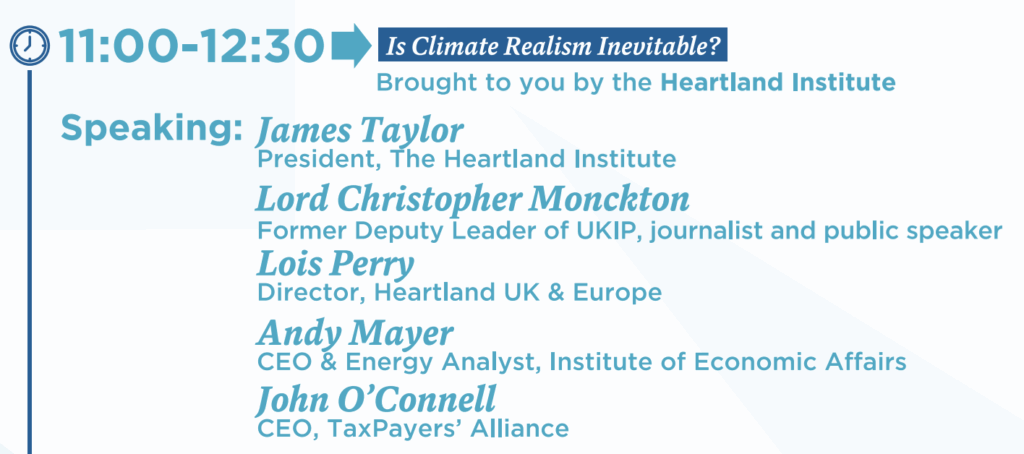
Heartland Institute
The Heartland Institute is a U.S. climate science denial group with close ties to the Trump administration.
It has denied that humans are driving climate change, which it has called a “delusion”. The group claims it is “the world’s most prominent think tank supporting scepticism about man-made climate change”.
Heartland received at least $676,000 between 1998 and 2007 from U.S. oil giant ExxonMobil, and has received donations from foundations linked to the owners of Koch Industries – a fossil fuel giant and a leading sponsor of climate science denial.
The Heartland Institute previously told DeSmog that it ”stands resolute in its mission to advance sound science, economic prosperity, and individual liberty”. It added that “our support comes from a diverse array of individuals and organisations who share our vision for a freer, more prosperous world.”
Heartland was one of the groups involved in drafting Project 2025, the radical blueprint for Trump’s second term, which proposed reversing climate policies, slashing restrictions on fossil fuel extraction, scrapping state investment in renewable energy, and gutting the Environmental Protection Agency (EPA).
Earlier this month, President Trump hired Roy Spencer, a policy advisor at the Heartland Institute and a former fellow at the Heritage Foundation – the key group behind Project 2025 – as an advisor to the Department of Energy.
Heartland’s UK-EU director Lois Perry has claimed that the institute boasts “very strong affiliations” with “certain big individuals” in Trump’s team.
Nigel Farage attended a fundraising dinner for the institute in September 2024 during which he called for more fossil fuel extraction and the victory of Trump in November’s presidential election, saying: “Let’s get Trump back; let’s drill baby drill”.
He also advocated what he called “a bit of reverse colonialism”.
“Maybe it’s time that Heartland came and set up in Britain and Europe and brought some of the wisdom that you’ve brought to the American debate,” he said – adding: “I’d love to see Heartland on the other side of the pond.”
Farage soon got his wish. In December, Heartland announced it was setting up a UK-EU branch. The Reform leader was the “special guest of honour” at the group’s launch event in London, which also featured disgraced former Conservative prime minister Liz Truss.
Cementing his Heartland links, Farage headlined an invite-only event in June this year entitled “Net Zero: The New Brexit?” held at 55 Tufton Street.
As revealed by DeSmog, Heartland has been working closely with far-right politicians in Europe to undermine the bloc’s green reforms.
Perry, who is speaking at Reform’s conference, has previously said she does not believe climate change is caused by humans. She has said it’s her “personal belief” that climate change “is happening” but “is not man made”.
Like Farage, Perry is a former leader of the UK Independence Party (UKIP). She used to run the anti-net zero pressure group CAR26, which has claimed that carbon dioxide is “essential to all life” and that its “welcome growth has greened our planet saving countless human and other lives”.
She recently claimed on a Heartland Institute podcast that she “knows for a fact” Farage credits Heartland with helping to shape Reform’s climate policies.
Heartland Institute president James Taylor told DeSmog: “Climate realism and energy realism are gaining traction throughout the world. The Heartland Institute appreciates that the Reform Party is on board and recognises Heartland as the global leader courageously providing truthful information on these topics. We also appreciate the encouragement and support provided by many policymakers among the UK Conservative Party. A rising tide lifts all boats and we are excited to be prominently leading the charge in the UK and throughout Europe.”
Institute of Economic Affairs
The Institute of Economic Affairs (IEA) is a radical anti-government campaign group that is part of the Tufton Street network.
The IEA, which has close ties to Liz Truss, advocates for increased fossil fuel production and against state-led climate action.
The IEA is a prominent supporter of the continued and extended use of fossil fuels. The group has advocated for the ban to be lifted on fracking for shale gas, calling it the “moral and economic choice”. The IEA has also said that the ban on new North Sea oil and gas licences is “madness”, has criticised the windfall tax imposed by the UK on fossil fuel firms, and said that the previous government’s commitment to “max out” the UK’s oil and gas reserves was a “welcome step”.
In 2018, Greenpeace’s investigative journalism unit Unearthed revealed that the IEA had received funding from oil major BP every year since 1967. In response to the story, an IEA spokeswoman said: “It is surely uncontroversial that the IEA’s principles coincide with the interests of our donors.”
The IEA also received a £21,000 grant from U.S. oil major ExxonMobil in 2005. The IEA is a member of Atlas Network, a Washington-based umbrella organisation that suppors over 450 “free market” groups around the world. Both the IEA and Atlas were founded by Antony Fisher. Fisher’s daughter, Linda Whetstone, was chair of the Atlas Network as well as a director of the IEA until her death in December 2021.
The IEA does not publicly declare its donors, and it’s not known if the pressure group has received funding from BP or ExxonMobil in more recent years.
The group is currently under investigation by the Charity Commission. The IEA was approached for comment.
TaxPayers’ Alliance
The TaxPayers’ Alliance (TPA), based in 55 Tufton Street, also campaigns in favour of fossil fuel extraction and against climate policies.
The group, which claims to be a grassroots movement while being supported by anonymous private donors, has supported ending the windfall tax on oil companies, scrapping the UK’s 2050 net zero target, and restarting fracking.
The TPA was approached for comment.
Net Zero Watch
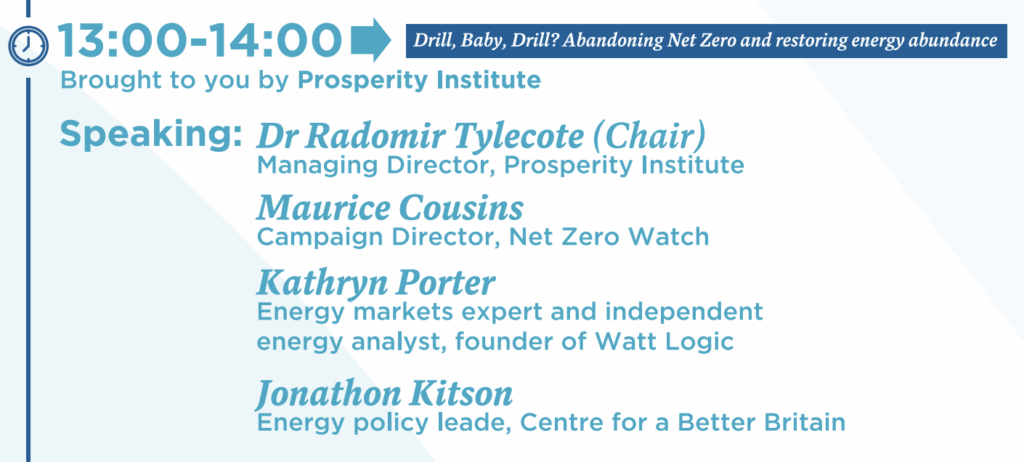
Reform’s conference will also feature Net Zero Watch – one of the UK’s most notorious anti-climate campaign groups – on a panel entitled “Drill baby drill: abandoning net zero and restoring energy abundance”.
Net Zero Watch has urged the government to “recommit to fossil fuels”, including “a new fleet of coal fired power stations”, and has called for renewable energy from wind and solar to be “wound down completely”. From May 2023 to 2025, Reform’s Andrea Jenkyns sat on the Net Zero Watch board.
In a report published last March, the GWPF claimed it was “naive and entirely unrealistic” to believe that CO2 is causing climate change, that record global temperatures are “normal”, and that “there is no observational evidence for any global climate crisis”.
The group has previously expressed the view that carbon dioxide has been “mercilessly demonised”, when in fact it is a “benefit to the planet” and should be “two or three times” higher than its current level.
Net Zero Watch campaign director will be speaking alongside Kathryn Porter, a fossil fuel industry consultant who has written several reports for the GWPF and Net Zero Watch.
Net Zero Watch and the GWPF were approached for comment.
Prosperity Institute
The Prosperity Institute – formerly known as the Legatum Institute – is hosting several events at Reform conference.
A pro-Brexit think tank, the Prosperity Institute is run by the Dubai-based investment firm Legatum Group, which co-owns the anti-climate broadcaster GB News alongside hedge fund mogul Paul Marshall. GB News employs Farage to the tune of more than £300,000 a year.
In May, after Reform’s local election gains, Prosperity published an article entitled “Farage has the power to defund Net Zero” which claimed that “energy bills have skyrocketed, industries have fled and living standards have fallen” due to the UK’s climate policies.
According to the Spectator Australia, at a Prosperity Institute event in July, Farage said he would need the think tank to bring “fresh young talent into current affairs” and provide “policy solutions we can give to the electorate next time round”.
He said “the great revolution that took place from 1979” – a reference to the election of Margaret Thatcher – was based on the “hard work and good thinking” of neo-liberal economists like Keith Joseph and Milton Friedman.
“That in many ways is your role today”, he told the Prosperity Institute audience – urging the group to produce “the ammunition” to “those of us on the front lines”.
As revealed by DeSmog, the Prosperity Institute previously donated £50,000 to the New Conservatives – a faction of the Conservative Party.
Centre for a Better Britain
The conference will also feature the Centre for a Better Britain – a new Reform-aligned think tank set to launch this month.
The group is funded by Mark Thompson, an investor with interests in metals, fossil fuels, and renewable energy, and his business associate David Lilley, a senior metals trader and former Conservative donor who has given over £270,000 to Reform.
The Centre for a Better Britain, which is attempting to raise £25 million – including from Trump donors – intends to “support Reform with policy development, briefing and rebuttal,” according to plans seen by the Financial Times.
The think tank is chaired by James Orr, a Cambridge academic who has been described as the “philosopher king” of U.S. Vice President JD Vance.
Orr has expressed radical anti-climate positions, claiming in an interview with the European Conservative last month that the UK’s energy policies are “crazy” and that the pursuit of net zero is “fiscal suicide”.
At an event in Hungary last month hosted by the oil-funded think tank Mathias Corvinus Collegium (MCC), Orr also accused the UK of adopting a “naive and dangerous” approach to Russia’s invasion of Ukraine and instead praised Hungary’s approach, which has seen the country systematically block and delay EU military aid packages, and sanctions on Russian oligarchs.
In the European Conservative interview, Orr suggested the war was a “regional Slavic conflict”.
“It is a conflict happening in the world that I don’t care very much about,” he added.
Farage, who used to appear regularly on state broadcaster Russia Today, has previously said that Putin is the world leader that he most admires, though he has also called him a “bad man”.
Together and Farmers to Action
Established in 2021 to oppose mandatory Covid-19 protection measures, such as lockdowns and vaccines, Together has since launched a “no to net zero” campaign that calls for the UK to scrap climate policies.
In January last year, the group said it was “incredible” that the then prime minister Rishi Sunak should “mindlessly assert ‘Covid vaccines are safe’” in a post on X. It has also backed a report which called for the government to pause its vaccination programme over a number of widely debunked conspiracy theories about its safety, including that the vaccine alters human DNA.
Together has recently partnered with Farmers To Action – a protest group also set to feature at Reform’s conference. The group has used recent anti-inheritance tax campaigns to spread anti-climate views.
The leader of Farmers to Action, Justin Rogers, has claimed that “climate change is one of the biggest scams that has ever been told”, propagated by “our governments and their puppet masters.” He has also claimed that oil and gas are renewable, and that carbon dioxide cannot be dangerous because it “feeds plants”.
At an event co-hosted by Together and Farmers to Action in February, Farage endorsed a conspiracy theory popular among the far-right.
Speaking in front of around 50 tractors at Belmont Farm in North London, Farage insinuated that the Labour government had a “sinister agenda” to acquire “lots of land because they’re planning for another five million people to come into the country”.
This claim is borne from the “Great Replacement” conspiracy theory, which holds that progressive immigration policies are a mechanism to replace white people in the West, and has been cited by Donald Trump in recent months.
Farmers to Action and Together were approached for comment.
Nigel Farage urges you to ignore facts and reality and be a climate science denier like him. He says that Reform UK has received millions and millions from the fossil fuel industry to promote climate denial and destroy the planet.Nigel Farage explains the politics of Reform UK: Racism, Fake anti-establishmentism, Deregulation, Corporatism, Climate Change Denial, Mysogyny and Transphobia.Nigel Farage reminds you that he’s the man that brought you Brexit and asks what could possibly go wrong.
The Prime Minister is facing a growing internal backlash from Labour MPs after Treasury sources indicated Rachel Reeves is likely to give her backing for the proposed Rosebank development (Image: PA/Henry Nicholls)
WESTMINSTER politicians are reportedly at “breaking point” with Keir Starmer over the potential of approving a new oil and gas field in the North Sea.
The Prime Minister is facing a growing internal backlash from Labour MPs after Treasury sources indicated Rachel Reeves is likely to give her backing for the proposed Rosebank development.
MPs have reportedly called for Starmer to reiterate his own commitments to no further oil and gas licences.
Last week a judge ruled the Rosebank development, which was given the green light by the previous Tory administration, as unlawful following a legal challenge brought by Greenpeace and Uplift.
Previously the energy secretary, Ed Miliband, described the licence issued to Rosebank as “climate vandalism”.
Reeves is reportedly supportive of a new application for environmental consent for the North Sea development, despite Labour’s manifesto promising not to issue any new exploration licences.
MPs who are concerned about the climate emergency are reported to be likely to make their appeals directly to Keir Starmer about the importance of being seen to stand by the party’s manifesto commitment of no new oil and gas licences.
A court has ruled that consent for two new Scottish oil and gas fields was granted unlawfully and their owners must seek fresh approval from the UK government before drilling can begin.
The written judgement on the Rosebank and Jackdaw fields came after a case brought by environmental campaigners, Uplift and Greenpeace, at the Court of Session in Edinburgh.
In his judgement, Lord Ericht said a more detailed assessment of the fields’ environmental impact was required, taking into account the effect on the climate of burning any fossil fuels extracted.
He said work on both fields could continue while the new information was gathered but no oil and gas could be extracted unless fresh approval was granted.
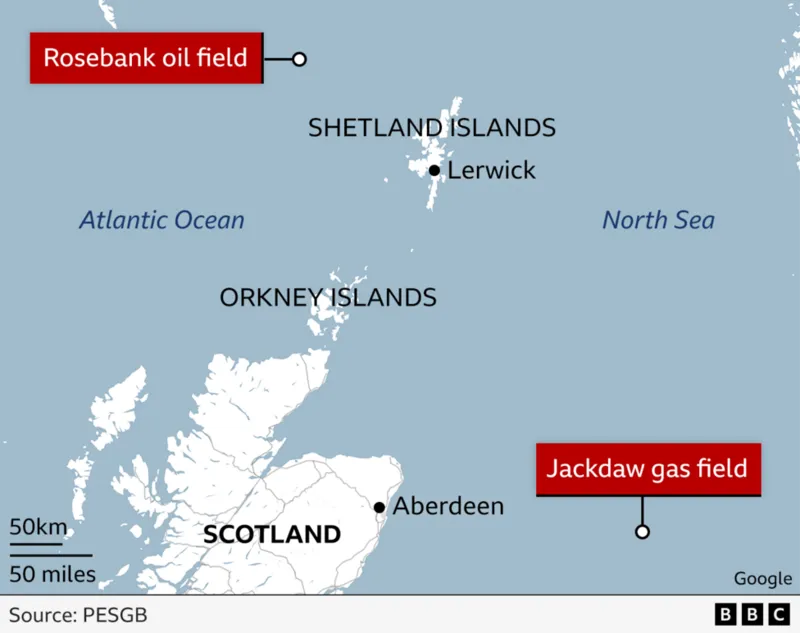
Permission for the Rosebank oil development, 80 miles west of Shetland in the North Atlantic, was granted in autumn 2023.
In a 57-page judgement, Lord Ericht wrote that there was a public interest in having the decision “remade on a lawful basis” because of the effects of climate change – which he said outweighed the interests of the developers.
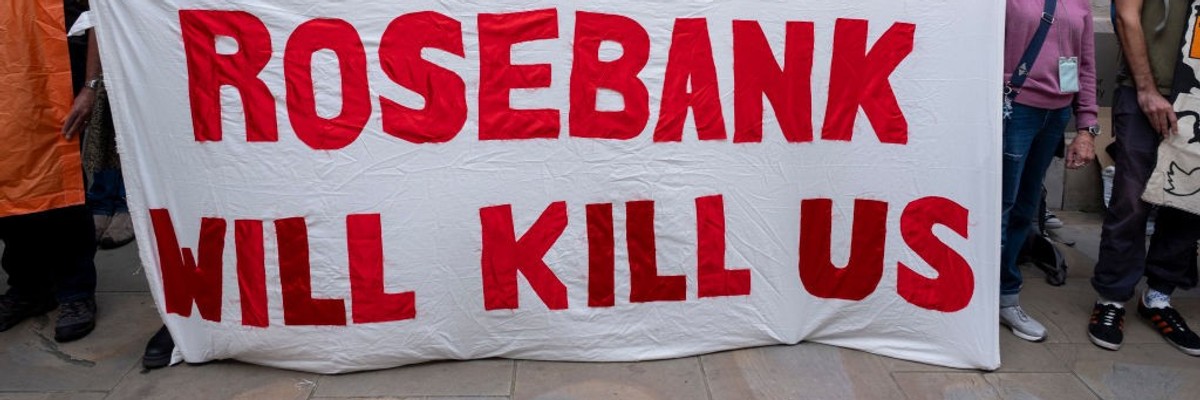
Activists hold a white sign reading “Rosebank will kill us” on September, 27, 2023 in London, United Kingdom. (Photo: Mike Kemp/In Pictures via Getty Images)
Oceana U.K.’s leader called the decision “a massive win for campaigners and another step towards… a cleaner, greener future for our seas, planet, and climate.”
Climate campaigners celebrated Thursday after the United Kingdom’s new Labour government announced it will not legally defend decisions to allow controversial offshore drilling in a pair of areas in the North Sea.
The two sites are Shell’s Jackdaw gas field and the Rosebank oil field, owned by Equinor and Ithaca Energy. Both projects have been loudly criticized by international green groups as well as U.K. opponents.
“This is amazing news and a BIG WIN for the climate. The government must now properly support affected workers and prioritize investment in green jobs,” declared Greenpeace U.K., which along with the group Uplift had demanded judicial reviews.
The approvals for both North Sea sites occurred under Conservative rule—in 2022 for Jackdaw and last year for Rosebank, the country’s biggest untapped oil field. Voters handed control of the government back to the Labour Party in May.
Then, as The Guardian detailed, “in June, the cases against the oil and gas fields received a boost when the Supreme Court ruled in a separate case that ‘scope 3’ emissions—that is, the burning of fossil fuels rather than just the building of the infrastructure to do so—should be taken into account when approving projects.”
“Now we need to see a just transition plan for workers and communities across the U.K. and an end extraction in the North Sea for good!”
The U.K. Department for Energy Security and Net Zero, led by Secretary Ed Miliband, cited the “landmark” Supreme Court ruling in a Thursday statement that highlighted the government’s decision not to defend the approvals “will save the taxpayer money” and “this litigation does not mean the licences for Jackdaw and Rosebank have been withdrawn.”
“Oil and gas production in the North Sea will be a key component of the U.K. energy landscape for decades to come as it transitions to our clean energy future in a way that protects jobs,” the department claimed, while also pledging to “consult later this year on the implementation of its manifesto position not to issue new oil and gas licenses to explore new fields.”
Welcoming the U.K. government’s acceptance of the recent high court ruling, Uplift founder and executive director Tessa Khan said on social media that “the immediate consequence… is that the Scottish Court of Session is very likely to quash the decision approving Rosebank, although we’re likely to have to wait a while before that’s confirmed.”
“If Equinor and Ithaca Energy decide they still want to press ahead with developing the field,” Khan explained, “then the next step will be for them to submit a new environmental statement to the [government] and regulator… that includes the scope 3 emissions from the field.”
“If you need reminding, those emissions are massive: the same as 56 coal-fired power plants running for a year or the annual emissions of the world’s 28 poorest countries,” she added. “If Equinor and Ithaca try to push Rosebank through again, the U.K. [government] must reject it.”
The government has made the right decision not to waste time and money trying to defend the indefensible.
The oil and gas industry will fight back. But the days where they can cause such devastating harm while everyone else pays the price are over.
Greenpeace similarly stressed that “Rosebank and Jackdaw would generate a vast amount of emissions while doing nothing to lower energy bills,” and “the only real winners from giving them the greenlight would be greedy oil giants Shell and Equinor.”
“To lower bills, improve people’s health, upgrade our economy,” the group argued, the government must: increase renewable energy; better insulate homes; and boost support for green jobs.
Celebrations over the government’s decision and calls for further action weren’t limited to the groups behind the legal challenges.
Oceana U.K. executive director praised the “incredible work” by Greenpeace and Uplift, and called the government dropping its defense “a massive win for campaigners and another step towards… a cleaner, greener future for our seas, planet, and climate.”
“There is no defending more fossil fuel extraction,” the organization said. “Now we need to see a just transition plan for workers and communities across the U.K. and an end extraction in the North Sea for good!”
Global Witness similarly celebrated the government’s move, declaring on social media that “this is brilliant news!”
“New oilfields are an act of climate vandalism,” the group added. “Governments must prioritize people, not polluters’ profit.”