Advocates Warn of ‘Forced Labor’ Camp for Homeless People in Utah Designed to Enforce Trump Order

Spread the love

Original article by Stephen Prager republished from Common Dreams under a Creative Commons (CC BY-NC-ND 3.0).

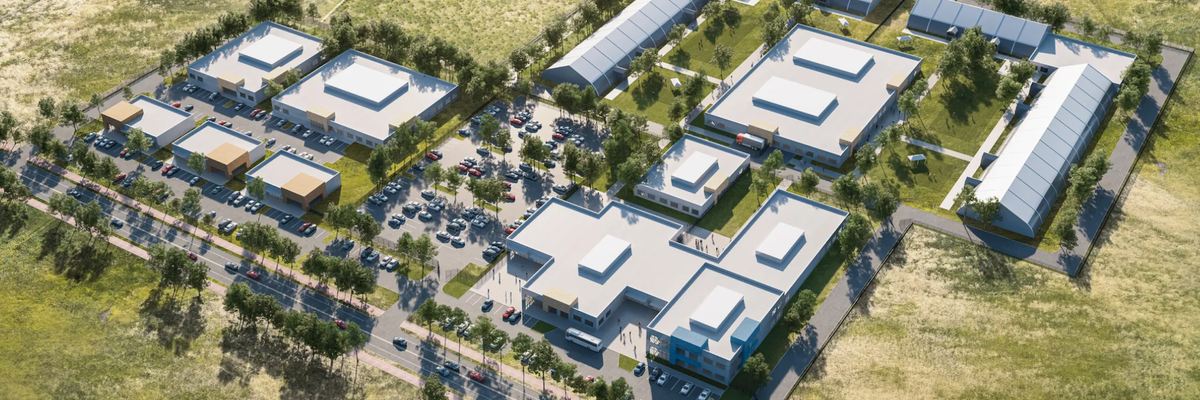
A conceptual rendering of Utah’s planned homeless services campus north of Salt Lake City, published on September 3, 2025. (Image from the Utah Office of Homeless Services)

An advocate for the National Homelessness Law Center warned that the 1,300-bed facility could be a “pilot” to put homeless people into similar conditions to Florida’s “Alligator Alcatraz.”

In an effort to fulfill President Donald Trump’s executive order on homelessnessUtah is building a massive facility that housing advocates warn will function as an “internment camp” where the unhoused will be subject to forced labor.

Last month, Utah’s homeless services agencies came to an agreement for the state to acquire a nearly 16-acre parcel of rural land in the Northpoint area of northwest Salt Lake City to construct the first-of-its-kind facility, which is slated to have 1,300 beds.

The genesis of the project began in July, following Trump’s “Ending Crime and Disorder on America’s Streets” executive order, which threatened to withhold funding from states and cities unless they criminalized homeless people camping on streets and ordered the attorney general to expand the use of involuntary civil commitment for adults experiencing homelessness.

Despite a large body of evidence showing their effectiveness at curbing crime while keeping people off the street, the order also required the Department of Housing and Urban Development (HUD) to end its support of “Housing First” policies that provide unhoused people with homes without the requirement of behavioral health treatment or sobriety.

Less than a week after Trump’s homelessness order, Utah’s Republican Gov. Spencer Cox, as well as the state Senate president and House speaker—both Republicans—sent a letter to the state’s Homeless Services Board, which was created last year following a legislative push by the Cicero Insitute—a far-right think tank that has proposed aggressive measures to criminalize homelessness and which has had major influence over Trump’s crackdown on the homeless during his second term.

In the letter, the leaders agreed with the Trump administration that they “do not support ‘Housing First’ policies that lack accountability.” They directed the Board to “accelerate progress on a transformative, services-based homeless campus that prioritizes recovery, treatment, and long-term outcomes, not just emergency shelter.”

As far back as 2023, Trump has proposed using “large parcels of inexpensive land” to set up “tent cities” or camps for homeless people, coupled with a pledge to use “every tool, lever, and authority” to clear encampments from city streets. On the podcast Invisible People, which focuses on homelessness in America, Eric Tars of the National Homelessness Law Center said Utah’s new facility could be a “pilot program” for that effort around the country.

“Their end goal is not just jail,” Tars said. “They want to put up more of these Alligator Alcatraz sprung structure type facilities,” referring to the ramshackle immigration detention facility constructed in a remote part of Florida’s Everglades earlier this year, where detainees have been cut off from access to their lawyers and are widely reported to suffer from inhumane treatment.

He noted that, under a proposal drafted by the chair of Utah’s Homeless Services Board, Randy Shumway, more than 300 of the beds in the facility are slated for involuntary commitment. Other homeless people will be sent there for substance abuse treatment “as an alternative to jail” and will “receive care in a supervised environment where entry and exit are not voluntary.” Shumway referred to the facility as an “accountability center.”

“An individual would be sanctioned to go there. It would not be voluntary, Shumway said during a presentation, according to the Standard-Examiner. ”They would be there for a period of probably 90 days with the opportunity to detox in order to get mental and behavioral health care, to get substance use disorder support, to get physical health care, and to be surrounded by a community that’s helping them in healing.“

According to the proposal, the beds not slated for civil commitment will include “work-conditioned housing.” Tars said that this is “the thing that scares me the most,” because it “means forced labor.”

He noted that other anti-homeless bills recently proposed in Republican states have a “forced labor element” to them. In Louisiana, a bill punishing outdoor camping introduced earlier this year proposes requiring those convicted to serve up to two years of “hard labor.” Another bill introduced in West Virginia would have required those arrested for camping to take part in “facility upkeep” and other forms of vocational training.

Tars said that at the Utah facility, “even though theoretically you could come and go, they’re going to be actively enforcing anti-camping, anti-loitering, all these other laws… if you step foot off the campus,” which he noted is over seven miles away from downtown Salt Lake City and “in the middle of nowhere,” with “no public transportation.”

State officials have said they expect the facility to cost $75 million to construct, plus more than $30 million per year for ongoing operations. Bill Tibbitts, deputy executive director of Crossroads Urban Center, a low-income advocacy nonprofit based in Utah, has said that for a facility to treat such a large number of people adequately, the cost “will be much higher than $75 million.”

Tibbitts also warned that the construction of a homeless shelter in such close proximity to a facility for involuntary commitment would create an atmosphere of fear that would deter homeless people from seeking help.

“A 300-400-bed mental and behavioral health facility that people are not allowed to leave is not a shelter but an incarceration option,” Tibbitts wrote in an email to the Utah News Dispatch. “Having such a facility colocated with a shelter would probably lead to a sense that if you do not follow the rules in one facility, you could be moved into the other.”

Although the Trump administration has portrayed homelessness as primarily the result of addiction or mental illness, Tibbitts noted that “the majority of the people who visit a shelter are not chronically homeless—they just need a place to stay following a short-term period of financial hardship.”

“A senior citizen who had their rent increased beyond what they could afford,” he said, “is not going to want to go to a quasi-correctional facility to get help finding a place to live that they can afford.”

Original article by Stephen Prager republished from Common Dreams under a Creative Commons (CC BY-NC-ND 3.0).

Donald Fuhrump says that Amerikkka doesn't bother with crimes or charges anymore, not being 100% Amerikkkan and opposing his real estate intentions is enough.
Donald Fuhrump says that Amerikkka doesn’t bother with crimes or charges anymore, not being 100% Amerikkkan and opposing his real estate intentions is enough.
Orcas discuss how Trump was re-elected and him being an obviously insane, xenophobic Fascist.

Continue ReadingAdvocates Warn of ‘Forced Labor’ Camp for Homeless People in Utah Designed to Enforce Trump Order

Utah’s anti-union bill sparks outcry as labor movement fights back

Spread the love

https://peoplesdispatch.org/2025/02/14/utahs-anti-union-bill-sparks-outcry-as-labor-movement-fights-back

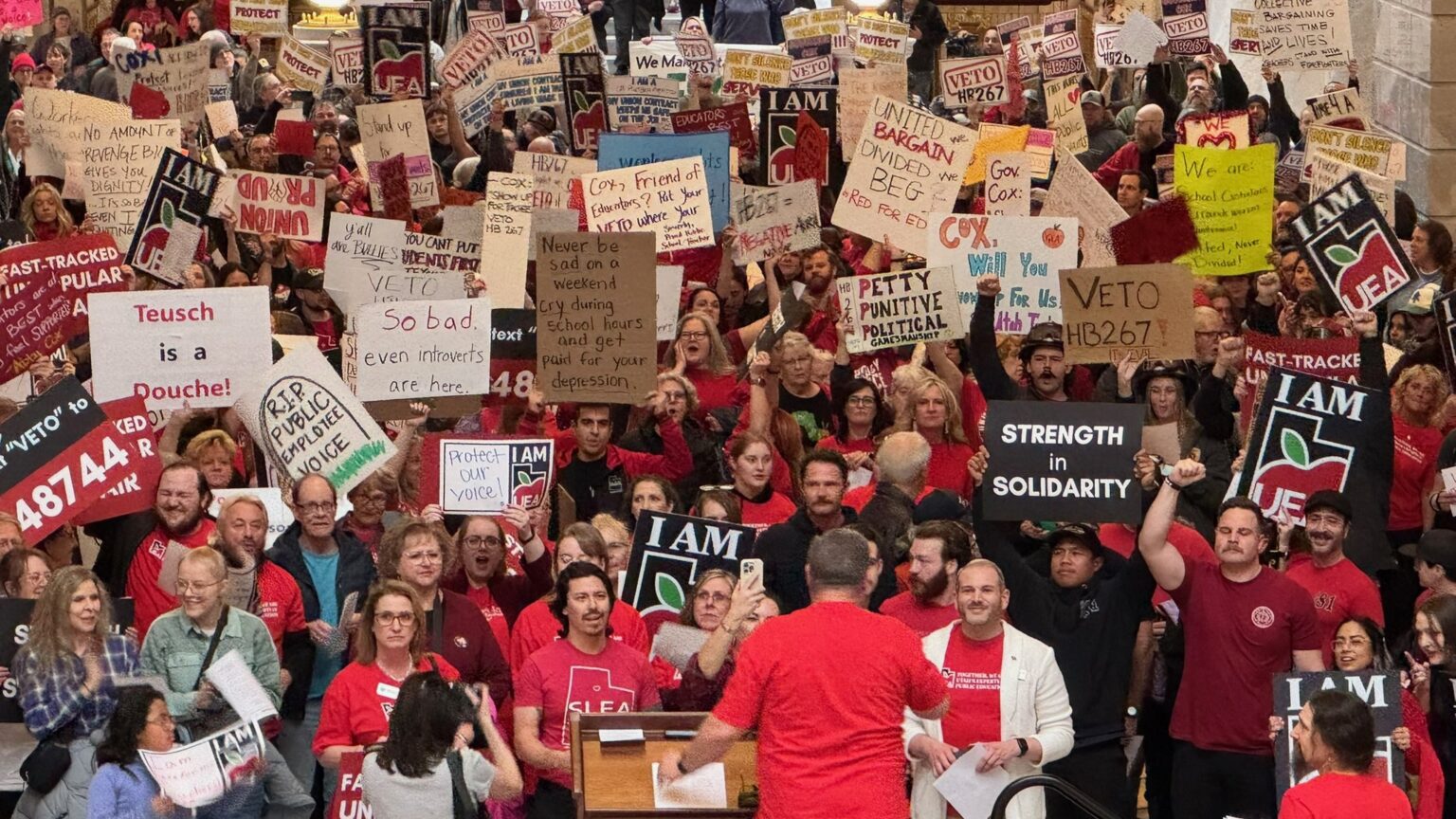
Workers pack the State Capitol building in Salt Lake City, Utah demanding Governer Cox veto HB 267. Photo: UEA

Utah’s controversial HB 267 seeks to ban collective bargaining for federal workers, drawing fierce opposition from unions and activists.

A controversial bill in the US state of Utah, HB 267, is making its way through the state legislature, sparking intense debate and widespread opposition. 

If signed into law, the bill would make it illegal for any federal agency in Utah to recognize labor unions or engage in collective bargaining with their employees. This sweeping measure would impact thousands of workers, including teachers, health care workers, emergency responders, and a variety of other workers employed by federal agencies. Many federal employees rely on unions to fight for fair wages, benefits, and working conditions.

The bill has been met with fierce opposition from labor unions, federal workers, civil rights groups, and grassroots organizations. Many of whom see HB 267 as not just harmful to individual employees, but having far-reaching consequences for the broader labor movement and worker’s rights in Utah.

Despite the opposition, HB 267 passed the House floor on January 26 with a 42-32 vote and narrowly passed the Senate on February 6 with a 16-13 vote. It now awaits a decision from Utah Governor Spencer Cox, who must choose to either sign or veto the bill in the coming days. 

Labor movement fights back against HB 267

The American Federation of Government Employees (AFGE), Utah AFL-CIO, and the Utah Education Association (UEA) have held several rallies at the State Capitol in protest of HB 267. Thousands of workers packed the building after the Senate passed the bill, demanding a veto from the Governor. 

Workers carried signs with statements like, “Workers rights are worth the fight!” and “Bust the billionaires, not the unions!”

Michael, a pipefitter with Local 140 who is involved in the growing movement against HB 267 explained:

“I feel like it’s a power grab. I feel like they’re taking away our voice…Teachers, first responders, nurses. Those industries are under huge attacks since COVID. So therefore, you’re taking an industry that’s already been depleted and depleting it even further by taking away their voice.” 

The anti-union bill, and the fight against it, reminds labor leaders of a similar anti-union bill in Wisconsin in 2011, called Act 10. That bill sparked an unprecedented worker’s movement that almost culminated into a general strike in Madison. 

UEA leads resistance against legislative attacks

In response to the Utah bill passing the House floor, the UEA stated:

“We believe HB 267 represents a dangerous precedent that undermines the principles of democracy and the rights of public employees to organize and advocate for their professions. It is an attack on public educators who dedicate their lives to teaching Utah’s children, ultimately threatening the quality of public education across the state.”

The UEA is the largest teacher’s union in the state. In 2024, they led a broad coalition in a successful fight to shut down Constitutional Amendment A, which would have opened up the use of the income tax fund allocated to public education for other “needs” like private school vouchers. 

“The teachers were able to fight hard and [Constitutional Amendment A] got removed from the ballot. It’s clear that the legislature is retaliating against teachers and retaliating against unions,” said Dodge Hovermale, a member of United Campus Workers of Utah Local 7765, speaking with Peoples Dispatch.

Article continues at https://peoplesdispatch.org/2025/02/14/utahs-anti-union-bill-sparks-outcry-as-labor-movement-fights-back

Continue ReadingUtah’s anti-union bill sparks outcry as labor movement fights back

Extreme Heat Expected to Impact Millions of Americans Again This Summer

Spread the love

Original article by JULIA CONLEY republished from Common Dreams under Creative Commons (CC BY-NC-ND 3.0). 
Heat waves rise near a heat danger warning sign in Death Valley National Park, California.
 (Photo: David McNew/Getty Images)

“These are not your grandparents’ heatwaves,” said one meteorologist.

Millions of people in the United States are facing the high likelihood of extreme heat in the coming weeks, with northern states that frequently have relatively temperate summers among those where higher-than-average temperatures are expected this summer, according to federal data.

As The Guardian reported Monday, the National Oceanic and Atmospheric Administration’s (NOAA) new predictions for the summer months state that most of New Mexico and Utah have a 60%-70% chance of hotter-than-normal weather, along with parts of Arizona, Texas, and Colorado.

Houston and the surrounding area has already experienced spiking temperatures that were tied to a heat dome that was positioned over Mexico for several weeks. The high atmospheric pressure drove record-breaking heat across Mexico and in Texas, as well as a powerful storm earlier this month that killed at least seven people and left hundreds of thousands of people in the Houston area without power.

NOAA’s Heat Risk tool showed that on Monday, a significant stretch of southern Texas was experiencing an “extreme” level of heat, defined as including “little to no overnight relief” and affecting the health and safety of “anyone without effective cooling and/or adequate hydration.”

The new tool takes into consideration whether the heat is unusual for the time of the year, whether residents get relief with cooler temperatures in the evenings, and whether temperatures pose an elevated risk of health impacts like heat stroke or heat exhaustion.

NOAA found that the entire Northeast, from Maine to New Jersey and Pennsylvania, has a 40%-50% chance of having above-average temperatures from June through August.

“We can expect another dangerous hot summer season, with daily records already being broken in parts of Texas and Florida,” Kristy Dahl, climate scientist for the Climate and Energy program at the Union of Concerned Scientists, told The Guardian. “As we warm the planet, we are going to see climate disasters pile up and compound against each other because of the lack of resilience in our infrastructure and government systems.”

The predictions come days after the consumer advocacy group Public Citizen released a reportScorched States, about state laws that protect outdoor workers from extreme heat—and those that don’t.

As many as 2,000 U.S. workers die every year from laboring in extreme heat, said Public Citizen, even though “every workplace illness, injury, and fatality caused by heat stress is avoidable, and relatively simple preventative measures—water, shade, and breaks—have proven extremely effective at protecting workers.”

The Occupational Safety and Health Administration’s forthcoming heat standard rules are not expected to be finalized until at least 2026, but states including Washington, Colorado, and Minnesota have issued their own labor laws to protect workers from heat-related injuries.

The Guardian pointed out that the extreme heat expected this summer will likely take hold as the Earth transitions away from El Niño—the natural phenomenon that causes ocean temperatures to rise—and toward La Niña.

“As we transition to La Niña, it still looks to be a potentially record-breaking year. That clearly suggests to me that the anthropogenic signal is there,” James Marshall Shepherd, director of the University of Georgia’s atmospheric sciences program, told The Guardian. “I am also worried about the ocean temperatures, which are very warm, particularly as we approach the Atlantic hurricane season.”

“Attribution studies are pretty decisive that heatwaves will continue to be more intense and frequent” as the planet warms, Shepherd said. “These are not your grandparents’ heatwaves.”

Last year, scientists found that neither the hot and dry conditions that led to destructive wildfires in Canada, nor extreme heatwaves that took hold in Europe and North America, would have been as likely to occur without the planetary heating that’s been linked to continued fossil fuel extraction.

Original article by JULIA CONLEY republished from Common Dreams under Creative Commons (CC BY-NC-ND 3.0). 

Continue ReadingExtreme Heat Expected to Impact Millions of Americans Again This Summer