WaPo Provides Cover for Musk’s Government Takeover

Spread the love

Original article by Pete Tucker republished from FAIR under a Creative Commons Attribution-NonCommercial-NoDerivs 3.0 Unported License.
Adam Johnson (Column2/3/25): “The New York TimesWashington Post and CNN ran with the framing that ‘DOGE’ was some good-faith, post-ideological effort to ‘cut costs,’ ‘find savings’ and ‘increase efficiencies.’”

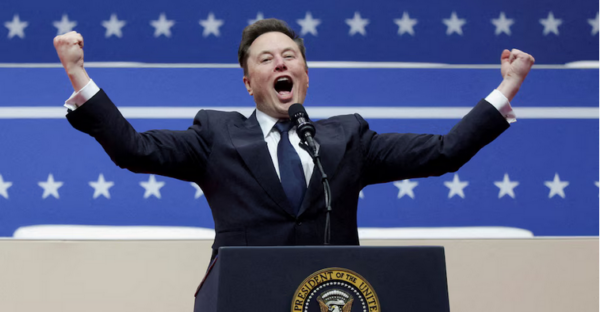
Having spent nearly $300 million to purchase the US presidency for Donald Trump, Elon Musk now feels entitled to do with it as he pleases. Just how radically Musk plans to remake the country was conveyed to the American people only after the election, when Musk stood behind the presidential seal on Inauguration Day and gave a Nazi salute. Then did it again. Maybe that sort of thing was OK to do in apartheid South Africa, where Musk grew up, but it’s jarring to see here in the United States.

Reporters initially struggled to meet the moment (FAIR.org2/4/25), downplaying Musk’s salute (the Washington Post described a “high-energy speech“), as well as his broader agenda, which Musk now openly declares a “revolution,” and consists of an unelected billionaire wresting control of nearly the entire executive branch of government. Early media reports went along with Musk’s “efficiency” mantra (Column2/3/25), but more recently reporters have started to find their footing, and the dangers of Musk’s project are being conveyed. Sort of.

“Reporters on the battlefield are doing what they can” to expose the radical nature of Trump’s second term, writes media columnist Oliver Darcy (Status2/5/25). “The news generals back in the command center, however, are largely abdicating their duties.”

‘Musk’s audacious goal’

Nowhere is this discrepancy more apparent than at the Washington Post, a newspaper famed for opposing a prior Republican president with an expansive view of executive power. These days, however, even as Post reporters like Jeff Stein are busy breaking stories (e.g., 1/28/252/8/25) about the Trump power grab, the paper’s higher-ups are careful not to offend the president or Musk. The Post is even, incredibly, calling on the Constitution-defying billionaire duo to push further.

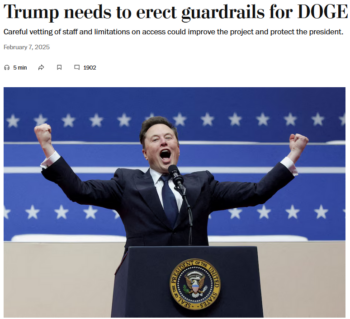
As Elon Musk seizes extraconstitutional control of the federal budget, Washington Post editors (2/7/25) urge him to use that power to go after Social Security and Medicare.

“To have any chance of achieving Musk’s audacious goal of $2 trillion in cuts,” the Post editorial board (2/7/25) wrote, “Trump will need to work with elected representatives in Congress to reform entitlement programs such as Social Security and Medicare before they become insolvent.”

While claiming it wants Trump to “erect guardrails” for Musk, the Post urges the president to abandon one of the only guardrails he established—the cutting of Social Security and Medicare, which Trump repeatedly said he wouldn’t do, but recently started waffling on.

To be clear, the Post has long called for cutting so-called entitlements (FAIR.org11/1/116/15/23). But to do so at this moment—by encouraging a coup attempt to push further—is quite extraordinary.

The Post’s move comes as its billionaire owner, Amazon founder Jeff Bezos, is lavishing praise and millions of dollars on Trump and his family, while coaching his paper to take a less critical approach in its coverage (FAIR.org1/22/25). Bezos’s ingratiation toward Trump started prior to the election, when Bezos personally spiked the Post’s endorsement of Kamala Harris (FAIR.org10/30/24).

Good news for X from Amazon

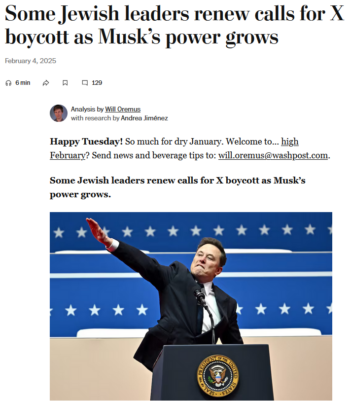
The Washington Post (2/4/25) reports on “divergent views among Jewish leaders in how to respond to Musk”: Some object to his ” Nazi-esque salute and Holocaust jokes,” others appreciate his censorship of criticism of Israel.

Bezos has also been busy making nice with Musk, his longtime rival for most powerful man on Earth and in space. On both fronts, Musk now has a decided edge, aided by his control over much of the US government, which both men’s sprawling empires rely on for billions of dollars in contracts.

With Musk’s hand on the public-money spigot, Bezos apparently did him a favor. After Musk openly heiled Hitler, Jewish leaders renewed calls to boycott Musk’s social media platform, (Washington Post2/4/25). “To advertisers—including GoogleAmazon and the ADL: Pull your ads now,” the Jewish leaders wrote. “The pressure is working. X’s financial difficulties prove it.”

But the boycott’s pressure was countered by Bezos’s company. “[X] got good news last week, with Amazon reportedly planning to hike its advertising on the site,” the Post (2/4/25) reported, without mentioning Bezos.

While X’s finances “were once so bad that Musk floated the idea of filing for bankruptcy,” things are suddenly looking up, the Financial Times (2/12/25) reported:

Musk famously admitted to overpaying for Twitter after he bought the social media platform known now as X for $44 billion in 2022. But the billionaire’s foray into government has coincided with a turnaround in X’s fortunes, as advertisers, including Amazon, flock back to the platform.

‘Lemmings leaping in unison’

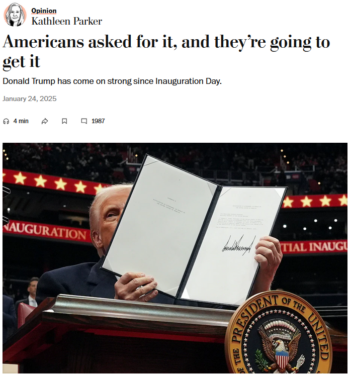
Kathleen Parker (Washington Post1/24/25) likened those who condemned Musk’s Nazi gesture to “lemmings leaping in unison from a cliff”—because it’s suicidal to notice fascism in high places?

It wasn’t just Bezos’s company that threw Musk a lifeline, but also his newspaper. An initial Post headline (1/20/25), which omitted mention of Musk’s Nazi salute, read “Elon Musk Gives Exuberant Speech at Inauguration.” The following day, Post columnist Megan McArdle, echoing the ADL, downgraded Musk’s salute to an “awkward gesture,” the same phrase Post columnist Kathleen Parker used to dismiss those who saw something more sinister as “lemmings leaping in unison from a cliff” (Washington Post1/24/25).

Interestingly, one of the most vociferous “lemmings” was Post columnist Catherine Rampell, who brilliantly called out Musk’s Nazi salute, but on CNN, and noticeably not in the Post, except once in passing (1/30/25).

Musk responded to Rampell’s CNN appearance by threatening to sue her in a post (1/27/25) to his over 200 million X followers.

I noted at the top that Musk spent nearly $300 million to elect Trump, but that’s only part of the story. Musk also provided inestimable support by transforming X into a pro-Trump bullhorn. Personally, when I logged onto X during the campaign, I routinely saw Musk’s pro-Trump tweets at the top of my feed, even though I didn’t follow Musk at the time.

Since the election, Musk ’s gifts to Trump have continued. X recently agreed to pay Trump $10 million to settle Trump’s 2021 lawsuit against the company, even though the case was dismissed in 2022. Trump was still appealing the ruling two-and-a-half years later when a deal was cut. “The settlement talks with X began after the election and were more informal, with both Trump and Musk personally involved in hammering out the $10 million number,” the Wall Street Journal (2/13/25) reported.

‘Cheering for change’

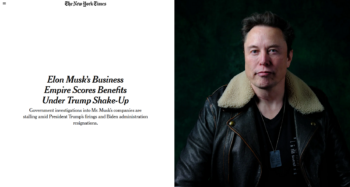
New York Times (2/11/25): Many of the federal agencies targeted by Musk “were leading investigations, enforcement matters or lawsuits pending against Mr. Musk’s companies.”

It’s quite something for Elon Musk—the world’s richest human and one of the largest government contractors—to gleefully slash public spending benefiting others. Especially when, by one measure, “virtually all of his net worth can be pinned to government help,” CNN (11/20/24) reported.

While Musk claims to wield a populist’s pitchfork as he attacks “the bureaucracy,” a closer look reveals the work of an oligarch’s scalpel. Musk’s coup team—called DOGE, and consisting mostly of twentysomething male engineers, several of whom appear to share Musk’s racist ideology (New York Times2/7/25)—is targeting the federal agencies investigating Musk’s companies, which in addition to X, include Tesla and SpaceX.

“President Trump has been in office less than a month, and Elon Musk’s vast business empire is already benefiting—or is now in a decidedly better position to benefit,” read the opening lines of a New York Times story (2/11/25):

At least 11 federal agencies that have been affected by [Trump’s] moves have more than 32 continuing investigations, pending complaints or enforcement actions into Mr. Musk’s six companies.

While Trump claims Musk is “not gaining anything” from the arrangement, and Musk says the same, Wall Street sees things differently. Even as Musk says he’s turning his “efficiency” revolution to the Pentagon—the only federal agency never to pass an audit, and where any honest attempt to rein in government spending would begin—stocks for armsmaking companies associated with Musk are surging, while those without ties to him languish. “Palantir, as well as Musk’s SpaceX, OpenAI and robotics and AI specialist Anduril Industries, are cheering for change,” the Wall Street Journal (2/10/25) reported.

In other words, having seized control of the levers of government, an oligarch will now be directing funding to himself and his cronies. That’s Wall Street’s view, anyhow.

It seems to be Bezos’s as well. With Amazon and Blue Origin, Bezos’s space company, competing for billions in government contracts, it makes perfect business sense for Bezos to cozy up to Musk and Trump. From a journalistic perspective, however, it’s nothing short of a disaster, one that’s playing out daily in the pages of the Washington Post.


You can send a message to the Washington Post at letters@washpost.com (or via Bluesky@washingtonpost.com).

Please remember that respectful communication is the most effective. Feel free to leave a copy of your message in the comments thread on FAIR.org.

FAIR’s work is sustained by our generous contributors, who allow us to remain independent. Donate today to be a part of this important mission.

Original article by Pete Tucker republished from FAIR under a Creative Commons Attribution-NonCommercial-NoDerivs 3.0 Unported License.

Elon Musk urges you to be a Fascist like him, says that you can ignore facts and reality then.
Climate Science Denier Donald Trump says Burn, Baby, Burn.

Continue ReadingWaPo Provides Cover for Musk’s Government Takeover

WaPo Says Not to Worry About Climate Disruption’s Disastrous Costs: 

Spread the love

Original article by Julie Hollar republished from FAIR under a Creative Commons Attribution-NonCommercial-NoDerivs 3.0 Unported License.

Reassuring report based on long-debunked climate contrarian

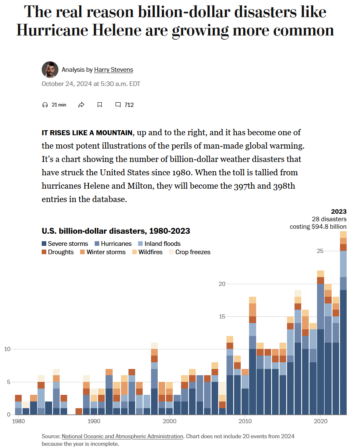
The Washington Post (10/24/24) claims that “the rise in billion-dollar disasters, while alarming, is not so much an indicator of climate change as a reflection of societal growth and risky development.”

As the country begins to vote in an election that will be hugely consequential for the climate crisis, the central task of news outlets’ climate beats should be informing potential voters of those consequences. Instead, the Washington Post‘s “Climate Lab” seems to be working hard to cast doubt on whether climate change is really causing weather disasters to be more expensive.

In a lengthy piece (10/24/24) headlined “The Real Reason Billion-Dollar Disasters Like Hurricane Helene Are Growing More Common,” Post Climate Lab columnist Harry Stevens highlighted a NOAA chart depicting a notable increase in billion-dollar weather disasters hitting the US that he says is widely used by government reports and officials “to help make the case for climate policies.” But, in fact, Stevens tells readers:

The truth lies elsewhere: Over time, migration to hazard-prone areas has increased, putting more people and property in harm’s way. Disasters are more expensive because there is more to destroy.

The takeaway is clear: The (Democratic) government is lying to you about the supposedly devastating impacts of climate change.

Distorting with cherry-picked data

The problem is, it’s Stevens’ story that’s doing the misleading. It relies heavily on the work of one source, Roger Pielke Jr., a longtime climate contrarian beloved by climate denial right-wingers, who cherry-picks data to distort the truth.

What’s worse, from a media critic’s perspective, is that it’s not even a new story; it’s been debunked multiple times over the years. Pielke—a political scientist, not a climate scientist, which Stevens never makes clear—has been promoting this tale since 1998, when he first published a journal article that purported to show that, as Stevens describes, “after adjusting damage to account for the growth in people and property, the trend [of increasing economic costs from weather disasters] disappears.”

A review of Roger Pielke’s book The Climate Fix in the journal Science (11/26/10) accused him of writing “a diatribe against the IPCC and other scientists that is based on highly selective and distorted figures and his own studies.”

When Pielke published the argument in his 2010 book, the journal Science (11/26/10) published a withering response, describing the chapter as “a diatribe against the IPCC and other scientists that is based on highly selective and distorted figures and his own studies.” It detailed the multiple methodological problems with Pielke’s argument:

He makes “corrections” for some things (notably, more people putting themselves in harm’s way) but not others. Some adjustments, such as for hurricane losses for the early 20th century, in which the dollar value goes up several hundred–fold, are highly flawed. But he then uses this record to suggest that the resulting absence of trends in damage costs represents the lack of evidence of a climate component. His record fails to consider all tropical storms and instead focuses only on the rare land-falling ones, which cause highly variable damage depending on where they hit. He completely ignores the benefits from improvements in hurricane warning times, changes in building codes, and other factors that have been important in reducing losses. Nor does he give any consideration to our understanding of the physics of hurricanes and evidence for changes such as the 2005 season, which broke records in so many ways.

Similarly, in discussing floods, Pielke fails to acknowledge that many governing bodies (especially local councils) and government agencies (such as the US Army Corps of Engineers) have tackled the mission of preventing floods by building infrastructure. Thus even though heavy rains have increased disproportionately in many places around the world (thereby increasing the risk of floods), the inundations may have been avoided. In developing countries, however, such flooding has been realized, as seen for instance this year in Pakistan, China and India. Other tenuous claims abound, and Pielke cherry-picks points to fit his arguments.

That year, climate expert Joe Romm (Climate Progress2/28/10) called Pielke “the single most disputed and debunked person in the entire realm of people who publish regularly on disasters and climate change.”

Debunked a decade ago

In response to Pielke, climate scientist Kerry Emanuel (5383/31/14) pointed out that it’s not necessarily appropriate to normalize damages by gross domestic product (GDP) if the intent is to detect an underlying climate trend,” since “GDP increase does not translate in any obvious way to damage increase,” as “wealthier countries can better afford to build stronger structures and to protect assets.”

Pielke peddled the story in 538 (3/19/14) four years later—and lost his briefly held job as a contributor for it, after the scientific community spoke out against it in droves, as not being supported by the evidence.

The backlash led 538 to give MIT climate scientist Kerry Emanuel (3/31/14) a column to rebut Pielke, in which she explained that while it’s of course true that “changing demographics” have impacted the economic costs of weather disasters, Pielke’s data didn’t support his assertion “that climate change has played no role in the observed increase in damages.” She pointed to the same kinds of methodological flaws that Science did, noting that her own research with Yale economist Robert Mendelsohn projected that through the year 2100, “global hurricane damage will about double owing to demographic trends, and double again because of climate change.”

That all happened ten years ago. So why is Pielke’s same old ax-grinding getting a platform at the Washington Post shortly before Election Day?

Stevens does tell readers—quite far down in the article—that Pielke has “clashed with other scientists, journalists and government officials” over his research—though Stevens doesn’t give any details about those clashes, or about Pielke’s reputation among climate scientists more generally.

Stevens also briefly notes that Pielke was recently hired by the American Enterprise Institute, which Stevens characterizes as “center-right,” but more helpfully might have characterized as “taking millions from ExxonMobil since 1998.” But in the same paragraph, Stevens also takes pains to point out that Pielke says he’s planning to vote for Harris, as if to burnish Pielke’s climate-believer bonafides.

Pielke agrees with Pielke

Roger Pielke “agrees with studies that agree with Pielke” (Environmental Hazards10/12/20).

Stevens tells Post readers that the science is firmly on Pielke’s side:

Similar studies have failed to find global warming’s fingerprint in economic damage from hurricanes, floods, tornadoes and crop losses. Of 53 peer-reviewed studies that assess economic damage from weather events, 52 could not attribute damage trends to global warming, according to Pielke’s 2020 review of the literature, the most recent and comprehensive.

You’ll notice Stevens just used Pielke’s own review to bolster Pielke’s argument. But the journal that published that review (Environmental Hazards8/5/20) immediately followed up with the publication of a critique (10/12/20) from researchers who came to the opposite conclusion in their study on US hurricanes. They explained that there are “fundamental shortcomings in this literature,” which comes from a disaster research “field that is currently dominated by a small group of authors” who mostly use the same methodology—adjusting historical economic losses based strictly on “growth in wealth and population”—that Pielke does.

The authors, who wrote a study that actually accounted for this problem and did find that economic losses from hurricanes increased over time after accounting for increases in wealth and population, point out that Pielke dismissed their study and two others that didn’t agree with his own results essentially because they didn’t come to the same conclusions. As the authors of the critique write drily: “Pielke agrees with studies that agree with Pielke.”

A phony ‘consensus’

Stevens includes in his article an obligatory line that experts say

disputing whether global warming’s influence can be found in the disaster data is not the same as questioning whether climate change is real or whether society should switch from fossil fuels.

He also adds that

​​many scientists say that global warming has intensified hurricanes, wildfires, droughts and other extreme weather, which must be leading to greater economic losses.

Note that he frames it as only “many,” and suggests they are only using (faulty, simplistic) logic, not science. But of course, climate change is intensifying extreme weather, as even Stevens has reported as fact recently (in the link he provides in that passage). In contrast, Stevens writes that

the consensus among disaster researchers is that the rise in billion-dollar disasters, while alarming, is not so much an indicator of climate change as a reflection of societal growth and risky development.

But in fact, as mentioned above, there’s not consensus even among disaster researchers (who are primarily economists). And the “many scientists” who disagree with Pielke aren’t the scientists the Post chooses to focus on. While Stevens quotes a number of different experts, including some who disagree with Pielke, they are not given anywhere near the space—or credence—Pielke and his arguments are. (Pielke’s name appears 15 times across the article and its captions.)

When he does get around to quoting some of the scientists, like MIT’s Emanuel, whose research shows that extreme weather events are intensifying, Stevens presents the conflicting conclusions as a back-and-forth of claims and counterclaims, giving the last word in that debate to a disaster researcher whose goal is to refocus blame for disasters on political decisions—like supporting building in vulnerable locations—rather than climate change.

Changes in our built environment, and governments’ impact on those changes, are certainly an important subject when it comes to accounting for and preventing billion-dollar disasters—which virtually no one disputes. (Indeed, the four government reports Stevens links to in his second paragraph as supposedly misusing the NOAA data explicitly name some variation of “increased building and population growth” as a contributing factor to growing costs.) It’s simply not an either/or question, as the Post‘s teaser framed it: “Many blame global warming. Others say disasters are more expensive because there is more to destroy.” So it’s bizarre and frankly dangerous that ten years after climate scientists debunked Pielke’s claim that there’s no evidence climate change is increasing extreme weather costs, Stevens would take, as the “urgent” question of the moment, “Is global warming to blame” for the growing billion-dollar disaster tally?

By giving the impression that the whole thing is basically a government scam to justify climate policies, Stevens’ direct implication is that even if climate change is indisputable, it doesn’t really matter. And it feeds into climate deniers’ claims that the climate change-believing government is lying about climate change and its impacts, at a time when a large number of those deniers are seeking office.

Continue ReadingWaPo Says Not to Worry About Climate Disruption’s Disastrous Costs: