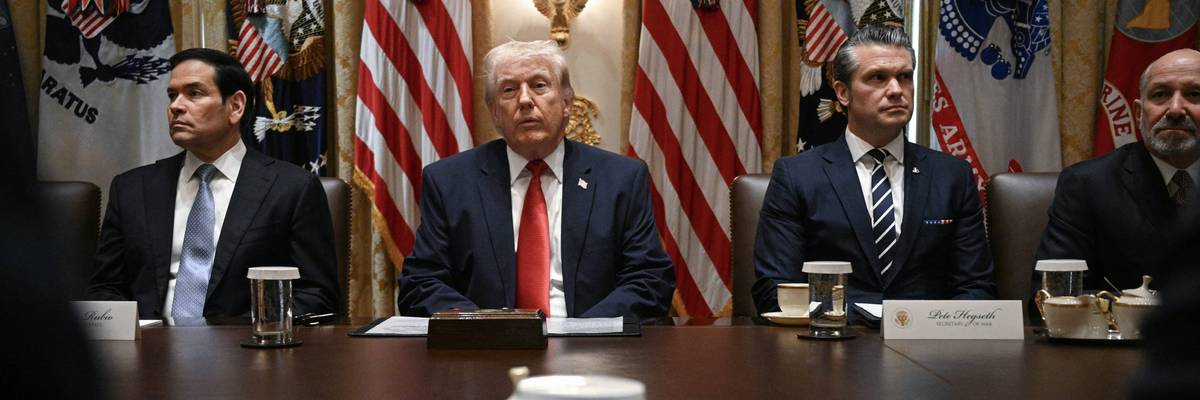
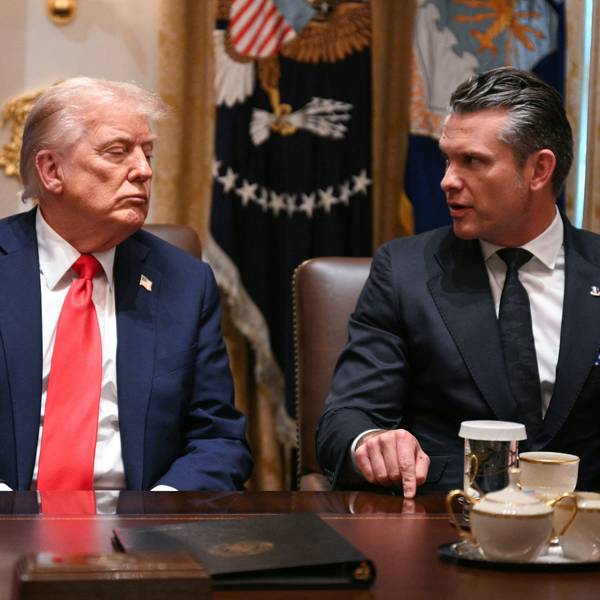
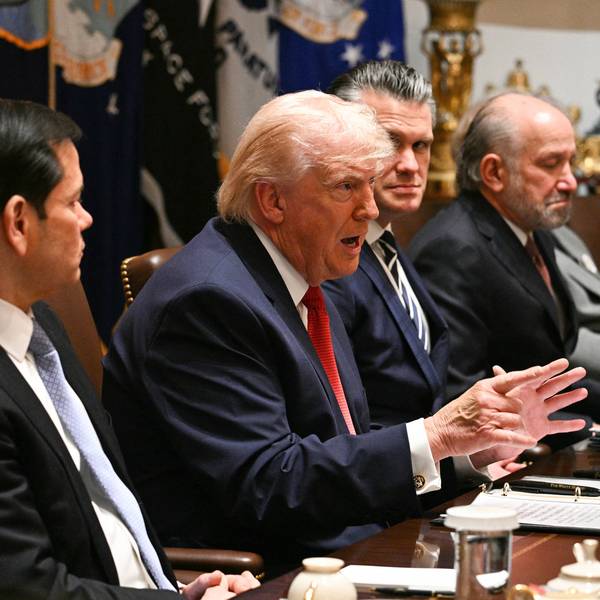
US President Donald Trump hosts a cabinet meeting in the Cabinet Room of the White House in Washington, DC, on March 26, 2026. (Photo by Jim Watson/AFP via Getty Images)
“The United States is inarguably in a weaker position than when it began this war of choice, with core US strategic objectives harmed.”
President Donald Trump’s illegal war of choice with Iran has dealt the United States an even bigger strategic defeat than the one it suffered in the Vietnam War, according to one expert.
In an essay published on Tuesday by Foreign Policy, Paul Musgrave, associate professor of government at Georgetown University in Qatar, made the case that the damage done to the United States’ reputation and credibility in the wake of the Iran war are significantly more severe than anything the country suffered in the wake of Vietnam.
Even though the Vietnam War went on for far longer and resulted in far more deaths than Trump’s Iran war, Musgrave argued, the US nonetheless exited it with little long-term damage to its global power.
“Compare that situation with the aftermath of Trump’s war,” Musgrave continued. “The United States is inarguably in a weaker position than when it began this war of choice, with core US strategic objectives harmed.”
Musgrave noted that while the US and Israel had initial success in decapitating Iran’s leadership at the beginning of the conflict, this only left the hardliners in the Islamic Revolutionary Guard Corps (IRGC) to run the country.
By failing to achieve the stated aim of regime change and by empowering even more radical elements within Iran, Musgrave added, Trump has severely damaged other nations’ willingness to trust the US for national security protection.
“Regional allies, many of whom reportedly argued against the venture, bore the brunt of the costs of the fighting,” the scholar wrote. “Most tellingly, Iran learned that its capacity to throttle the Strait of Hormuz could deliver economic leverage on a worldwide scale.”
Writing in The New York Times on Wednesday, national security journalist WJ Hennigan argued that the United States’ strategic defeat has laid bare the limits of US military power to bend weaker nations to its will.
In particular, he pointed out that the US, which spent $1 trillion on its military last year, could not take out even a majority of Iran’s missile stockpiles.
“Yes, the wonder weapons that American industry cranks out, like cruise missiles and air-defense interceptors, have proven impressive on the battlefield,” Hennigan wrote. “But the war has exposed the underlying weaknesses of depending on weaponry that’s extremely expensive and time-consuming to deliver. During an April 30 congressional hearing, Defense Secretary Pete Hegseth estimated it could take ‘months and years’ to replenish the stocks that had been used in the war.”
Matt Duss, executive vice president at the Center for International Policy, similarly said that Trump’s Iran war had resulted in a strategic defeat for the US. However, he also expressed hope that this defeat could mark a turning point in US foreign policy circles regarding the applications of American power throughout the world.
“There’s a longstanding US bipartisan consensus around wildly inflating the Iranian threat,” Duss wrote in a social media post. “Trump’s war, a strategic defeat, was an expression of that consensus. If… ending the war puts the US and Iran on path to a more normal relationship, that will be a positive thing.”
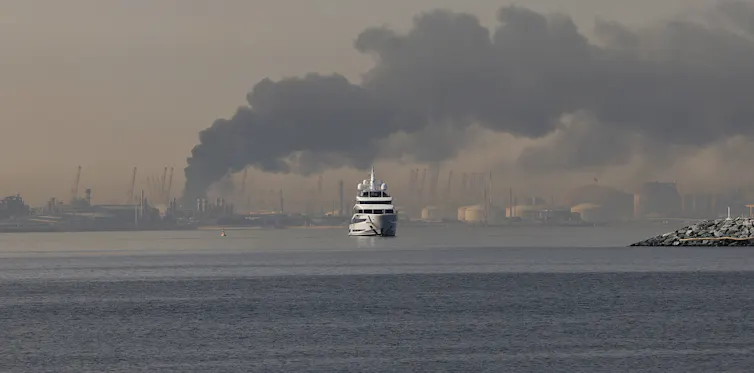
A yacht sails past a plume of smoke rising from the port of Jebel Ali following a reported Iranian strike in Dubai on March 1, 2026. Fadel Senna/AFP via Getty Images
Military facilities in Bahrain, Kuwait, Oman, Qatar, Saudi Arabia and the United Arab Emirates have all been hit. But the missiles and drones from Iran have been aimed at civilian infrastructure, too, including airport, ports and hotels in the opening days of U.S. and Israeli operations against Iran.
In scale and scope, the barrage marks a major departure from Iran’s previous response to being attacked by U.S. and Israeli airstrikes. In contrast, during a 12-day war in June 2025, Tehran only attacked one base in Qatar, and even then forewarned authorities in Doha.
Instead, what is occurring in the region is a scenario that planners in Persian Gulf capitals have long warned about: a deliberate attempt by Tehran to widen conflict and hit nations it sees as allied to the West.
As an expert on Gulf dynamics, I see the unfurling events as undoing years of work to de-risk the region and placing in jeopardy the unique selling point and business models that have underpinned the Gulf states’ global rise.
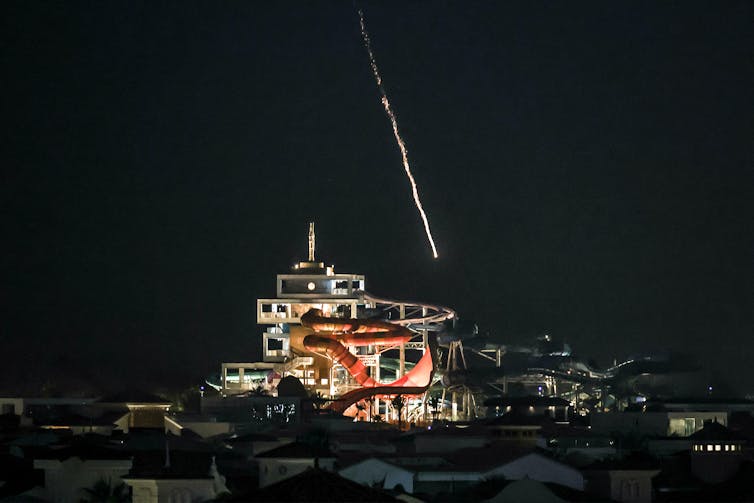
An intercepted projectile falls into the sea near Dubai’s Palm Jumeirah archipelago on March 1, 2026. Fadel Senna/AFP via Getty Images
A cornered regime fighting for survival
Ever since the Oct. 7, 2023, attacks by Hamas and other Palestinian militants on Israel, policymakers in the Gulf nations have sought to avoid the regionalization of conflict.
Each of the successive escalations between Israel and Iran – in April and October 2024 and then in June 2025, with the joint U.S.-Israeli strikes – brought the region closer to, without tipping over into, all-out war.
But Iran’s actions in the opening days following what Washington has named “Operation Epic Fury” have signaled that the comparative restraint it showed during the 12-day war is firmly off the table.
The Islamic Republic is now a cornered regime fighting for its survival. As such, it is lashing out and seeking to spread the pain to regional neighbors. The logic in this approach is that Gulf nations could put pressure on the U.S., which may fear the cascading costs of a prolonged regional conflict.
Gulf nations are also obvious targets for Iran. With Iran lacking the capability to hit the U.S. mainland through conventional weapons, the American military bases that dot the Gulf region are within the reach of Tehran’s ballistic arsenal.
Psychological impact on Gulf nations
The scale of the Iranian attacks on targets in the Gulf nations in the opening two days of the current conflict underscores the extent to which Iran’s response now differs from that of June 2025: In the first two days of the conflict, Iran had fired at least 390 ballistic missiles and 830 drones at the Gulf states. By comparison, the Iranian strike on the Al-Udeid air base in Qatar last year involved 14 ballistic missiles and was a one-off attack on a single target.
Air defense systems in Gulf nations have neutralized most of the incoming Iranian missiles, to date, and actual damage and casualties have been limited to a handful of deaths and injuries in the dozens.
But it is the intangible and psychological impact on Gulf cities under attack that threatens to inflict profound damage on the reputation and image of cities such as Dubai, Abu Dhabi and Doha. In recent years, Gulf Cooperation Council nations have presented the Gulf as an oasis of stability and havens to live and work.
This is especially the case for Dubai, which has marketed itself strongly as a hub for business and tourism. But it is also applicable to other Gulf nations as well, such as Qatar, which relies heavily on a steady stream of large-scale meetings and events.
Iran’s attacks on civilian infrastructure and soft targets – airports in Bahrain, Dubai, Abu Dhabi and Kuwait, and hotels in Bahrain and Dubai – serve to puncture this image of safe and secure Gulf capitals.
This choice of targets by Iran likely reflects a calculation that leaders in the Gulf countries would immediately feel the full impact of the war and push Washington hard to find a resolution and quick.
The subsequent targeting by Tehran on oil and gas facilities, including Ras Laffan in Qatar and Ras Tanura in Saudi Arabia, serves as a further and highly consequential step. It has already triggered a forceful response from Qatar, which shot down two Iranian jets on March 2.
There is concern among Gulf nations that the next step in the ladder of escalation could involve targeting the desalination plants that are so vital to overcoming water scarcity in the region.
As critical hubs in the global economy by virtue of their reserves of oil and gas and centrality to international shipping and aviation, the Gulf nations are uniquely vulnerable to further escalation by Iran.
Dubai, Abu Dhabi and Doha have invested heavily in creating airlines that function as “super-connectors” capable of linking any two destinations worldwide with a stop in the Gulf. A Feb. 28 drone strike on Dubai International Airport, the world’s busiest for international travel, illustrated the impact that Iran’s asymmetric responses could have on the global hub model that has come to dominate world air travel.
Already, closure of airspaces over Qatar and the UAE, as well as in Bahrain and Kuwait, has stranded tens of thousands of passengers and created the biggest disruption to global travel since the COVID-19 pandemic.
In addition, cargo operations essential to local supply chains have been heavily impacted, at the same time that seaborne trade through the Strait of Hormuz has been similarly interrupted.
Whereas initial spikes in oil prices and insurance premiums at the start of the 12-day war last year fell away as it became clear that energy infrastructure was not significantly targeted, the opposite has happened this time.
Peril and uncertainty
But the short-term shock to the global economy is not what will be of primary concern to the Gulf Cooperation Council members. Not since the Gulf crisis of 1990-91, with the Iraqi invasion of Kuwait and subsequent Gulf War, has the region faced so much peril and uncertainty.
And that is what Iran’s leaders are banking on. The attacks across the Gulf by Tehran are not, after all, without strategy. The intent is to expand the conflict, thereby significantly raising costs to the U.S. and its partners in the Gulf.
Tehran’s hope is that the economic impact will encourage Gulf leaders to press Trump for an endgame. But in attacking capitals across the region, Iran risks perhaps doing the opposite: rupturing any chance of bettering ties with rivals in the region and instead pushing them further back into Washington’s orbit after a period of drift.
Orcas discuss rotting brain. Front Orca says “Wish someone would lock him up”.Donald Fuhrump says that Amerikkka doesn’t bother with crimes or charges anymore, not being 100% Amerikkkan and opposing his real estate intentions is enough.Elon Musk urges you to be a Fascist like him, says that you can ignore facts and reality then.