Original article by Orla Dwyer republished from Carbon Brief under a CC license.
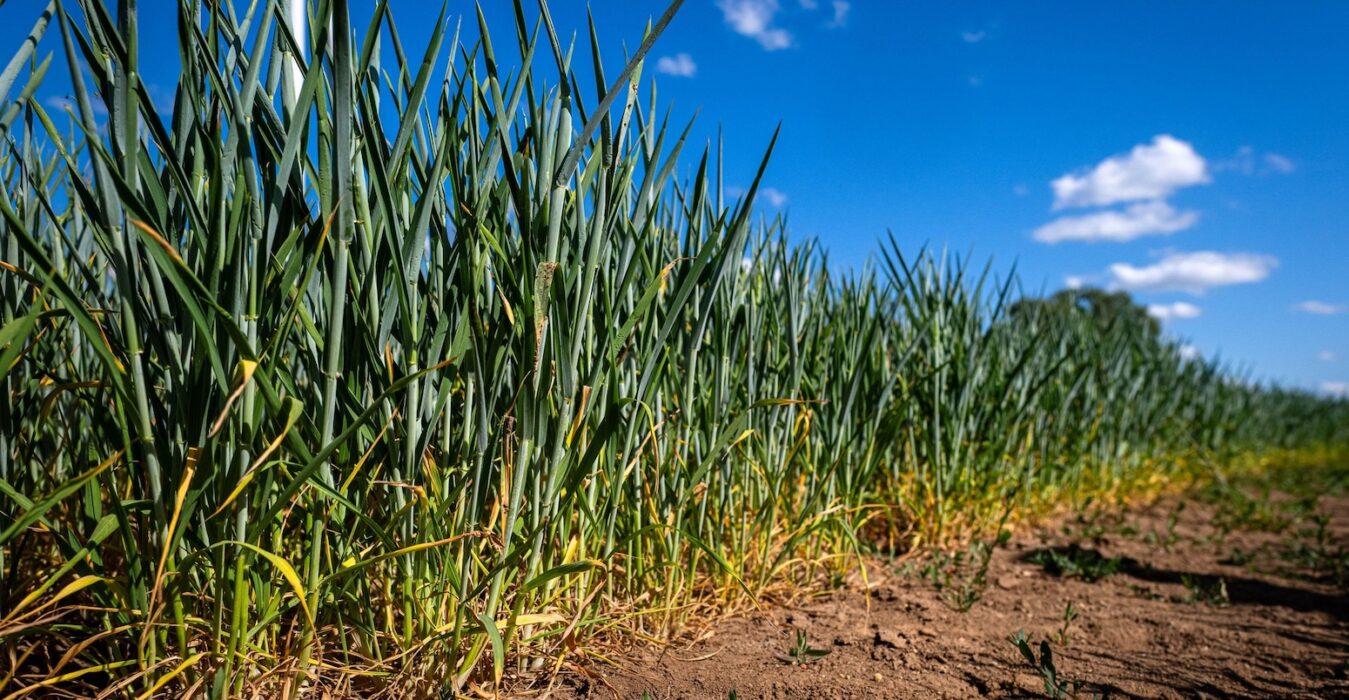
Global yields of wheat are around 10% lower now than they would have been without the influence of climate change, according to a new study.
The research, published in the Proceedings of the National Academy of Sciences, looks at data on climate change and growing conditions for wheat and other major crops around the world over the past 50 years.
It comes as heat and drought have this year been putting wheat supplies at risk in key grain-producing regions, including parts of Europe, China and Russia.
The study finds that increasingly hot and dry conditions negatively impacted yields of three of the five key crops examined.
Overall, global grain yields soared during the study period due to technological advancements, improved seeds and access to synthetic fertilisers.
But these yield setbacks have “important ramifications for prices and food security”, the study authors write.
Grain impacts
Most parts of the world have experienced “significant” yield increases in staple crops since the mid-20th century.
The new study notes that, in the past 50 years, yields increased by 69-123% for the five staple crops included in the research – wheat, maize, barley, soya beans and rice.
But crop production is increasingly threatened by climate change and extreme weather. A 2021 study projected “major shifts” in global crop productivity due to climate change within the next two decades.
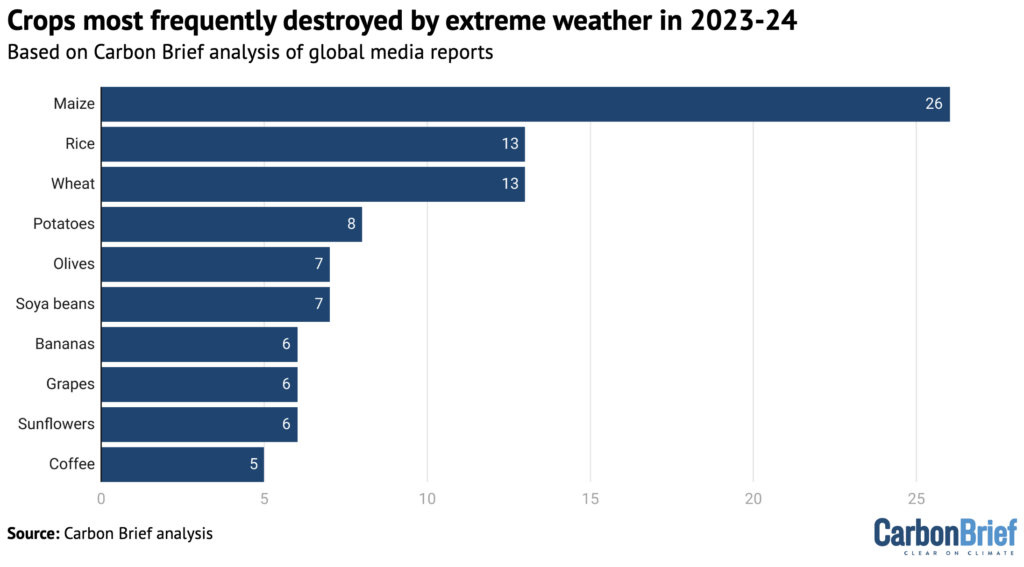
Earlier this year, Carbon Brief mapped out news stories of crops being destroyed around the world by heat, drought, floods and other weather extremes in 2023-24. Maize and wheat were the crops that appeared most frequently in these reports.
Hot and dry weather is currently threatening wheat crops in parts of China, the world’s largest wheat producer, Reuters reported this month.
In the UK, wheat crops are struggling amid the “driest start to spring in England for almost 70 years”, the Times recently reported. Farm groups say some crops are already failing, the Guardian said.
As a result, global wheat supplies are “tight”, according to Bloomberg, with price rises possible depending on weather conditions in parts of Europe, China and Russia.
Food security and prices
The study uses climate datasets, modelling and national crop statistics from the UN Food and Agriculture Organization to assess crop production and climate trends in key grain-producing countries over 1974-2023, including Argentina, Brazil, Canada, China, the EU, Russia and the US.
The researchers assess climate observations and then use crop models to calculate what yields would have been with and without these climate changes.
For example, “if it has warmed 1C over 50 years and the model says that 1C leads to 5% yield loss, we’d calculate that the warming trend caused a loss of 5%”, Prof David Lobell, the lead study author and a professor at Stanford University, tells Carbon Brief.
The study looks at two reanalysis climate datasets that include information on temperature and rainfall over the past 50 years: TerraClimate (TC) and ERA5-Land. (Reanalysis data combines observations with a modern forecasting model.)
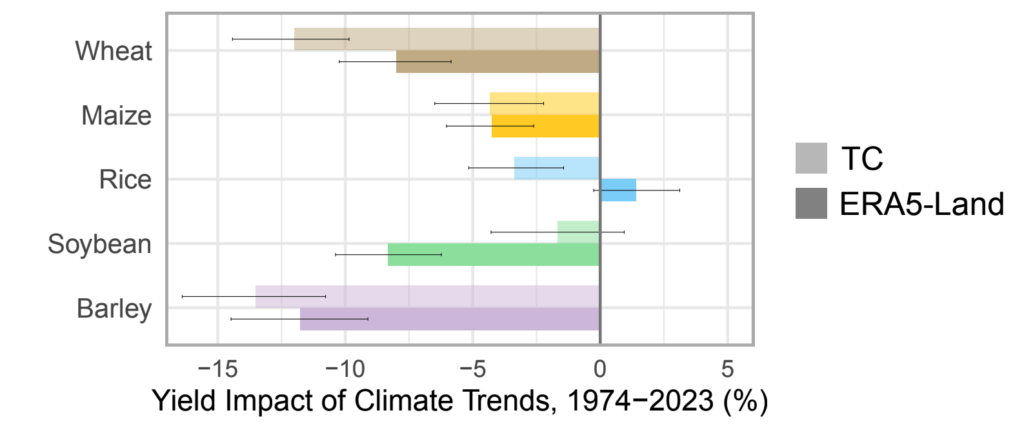
The researchers find that yields of three of the five crops are lower than they would have been without warmer temperatures and other climate impacts in the past 50 years.
Yields were lower than they otherwise would have been by 12-14% for barley, 8-12% for wheat and 4% for maize.
The impacts on soya beans were less clear as there were “significant differences” between data sources. But both datasets show a negative impact on yields, ranging from 2% to 8%.
The effects on rice yields were inconclusive, with one dataset showing a positive effect of around 1% while the other showed a negative effect of about 3%.
The chart below shows the estimated yield impacts for each crop based on the calculations from the two climate datasets.
Given soaring overall crop yields during this time, impacts of 4-13% “may seem trivial”, the researchers write. But, they say, it can have “important ramifications for prices and food security” given growing food demand, noting:
“The overall picture of the past half-century is that climate trends have led to a deterioration of growing conditions for many of the main grain-producing regions of the world.”
Water stress and heat
The study also assesses the impacts that warming and vapour pressure deficit – a key driver of plant water stress – have on crop yields.
Vapour pressure deficit is the difference between the amount of water vapour in the air and the point at which water vapour in the air becomes saturated. As air becomes warmer, it can hold more water vapour.
A high deficit can reduce plant growth and increase water stress. The models show that these effects may be the main driver of losses in grain yield, with heat having a more “indirect effect”, as higher temperatures drive water stress.
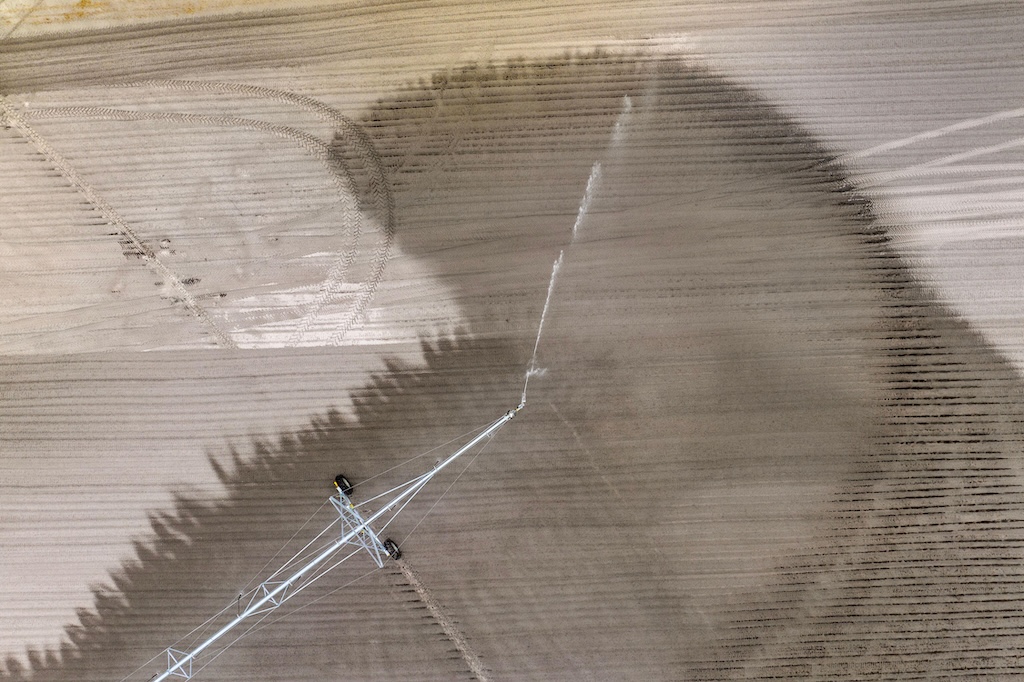
The study finds that vapour pressure deficit increased in most temperate regions in the past 50 years.
The researchers compare their data to climate modelling simulations covering the past 50 years. They find largely similar results, but notice a “significant underestimation” of vapour pressure deficit increases in temperate regions in most climate models.
Many maize-growing areas in the EU, China, Argentina and much of Africa have vapour deficit trends that “exceed even the highest trend in models”, they write.
The researchers also find that most regions experienced “rapid warming” during the study period, with the average crop-growing season now warmer than more than 80% of growing seasons 50 years ago.
The findings indicate that, in some areas, “even the coolest growing season in the present day is warmer than the warmest season that would have occurred 50 years ago”.
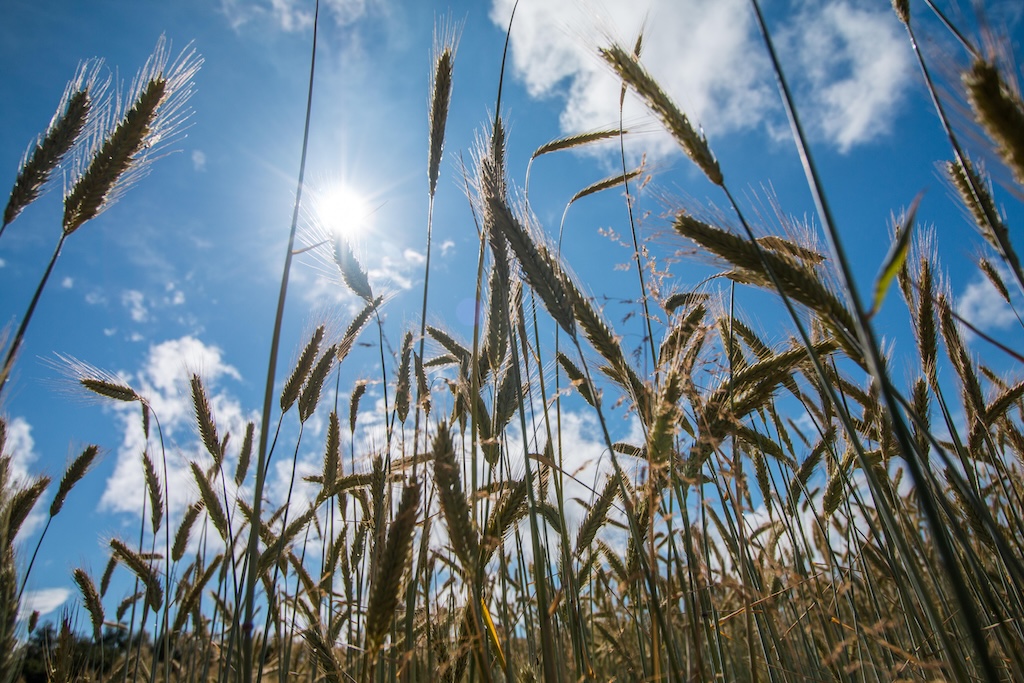
An exception to this is in the US and Canada, they find, with most maize and soya bean crop areas in the US experiencing lower levels of warming than other parts of the world and a “slight cooling” in wheat-growing areas of the northern Great Plains and central Canada.
(The central US has experienced a cooling trend in summer daytime temperatures since the middle of the 20th century, according to the National Oceanic and Atmospheric Administration. There are many theories behind this “warming hole”, which has continued despite climate change.)
CO2 greening
Dr Corey Lesk, a postdoctoral researcher at Dartmouth College who studies the impacts of climate on crops, says these findings are in line with other recent estimates. He tells Carbon Brief:
“There are some uncertainties and sensitivity to model specification here – but it’s somewhat likely climate change has already reduced crop yields in the global mean.”
The study’s “main limitation” is that it is “behind” on including certain advances in understanding how soil moisture impacts crops, Lesk adds:
“Moisture changes and CO2 [carbon dioxide] effects are the largest present uncertainties in past and future crop impacts of climate change. This paper is somewhat limited in advancing understanding on those aspects, but it’s illuminating to pause and take stock.”
The research looks at whether the benefits of CO2 increases during the past 50 years exceed the negative effects of higher levels of the greenhouse gas.
Rising CO2 levels can boost plant growth in some areas in a process called “CO2 fertilisation”. However, a 2019 study found that this “global greening” could be stalled by growing water stress.
Yield losses for wheat, maize and barley “likely exceeded” any benefits of CO2 increases in the past 50 years, the study finds.
The opposite is true for soya beans and rice, they find, with a net-positive impact of more than 4% on yields.
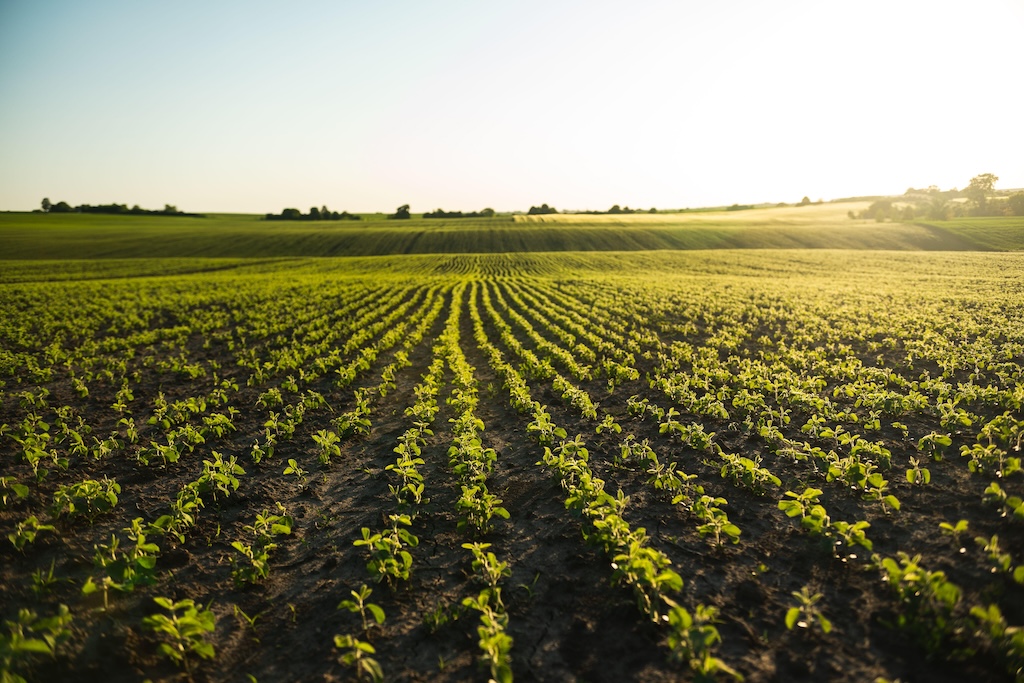
Climate science has “done a remarkable job of anticipating global impacts on the main grains and we should continue to rely on this science to guide policy decisions”, Lobell, the lead study author, says in a press release.
He adds that there may be “blind spots” on specialised crops, such as coffee, cocoa, oranges and olives, which “don’t have as much modelling” as key commodity crops, noting:
“All these have been seeing supply challenges and price increases. These matter less for food security, but may be more eye-catching for consumers who might not otherwise care about climate change.”
Lobell et al. (2025), A half-century of climate change in major agricultural regions: Trends, impacts, and surprises, Proceedings of the National Academy of Sciences, doi:10.1073/pnas.2502789122
Original article by Orla Dwyer republished from Carbon Brief under a CC license.