The UK’s most hazardous nuclear site, Sellafield, has been hacked into by cyber groups … the Guardian can reveal.
The astonishing disclosure and its potential effects have been consistently covered up by senior staff at the vast nuclear waste and decommissioning site, the investigation has found.
The Guardian has discovered that the authorities do not know exactly when the IT systems were first compromised. But sources said breaches were first detected as far back as 2015, when experts realised sleeper malware – software that can lurk and be used to spy or attack systems – had been embedded in Sellafield’s computer networks.
…
The full extent of any data loss and any ongoing risks to systems was made harder to quantify by Sellafield’s failure to alert nuclear regulators for several years, sources said.
The revelations have emerged in Nuclear Leaks, a year-long Guardian investigation into cyber hacking, radioactive contamination and toxic workplace culture at Sellafield.
The site has the largest store of plutonium on the planet and is a sprawling rubbish dump for nuclear waste from weapons programmes and decades of atomic power generation.
…
In one highly embarrassing incident last July, login details and passwords for secure IT systems were inadvertently broadcast on national TV by the BBC One nature series Countryfile, after crews were invited into the secure site for a piece on rural communities and the nuclear industry.
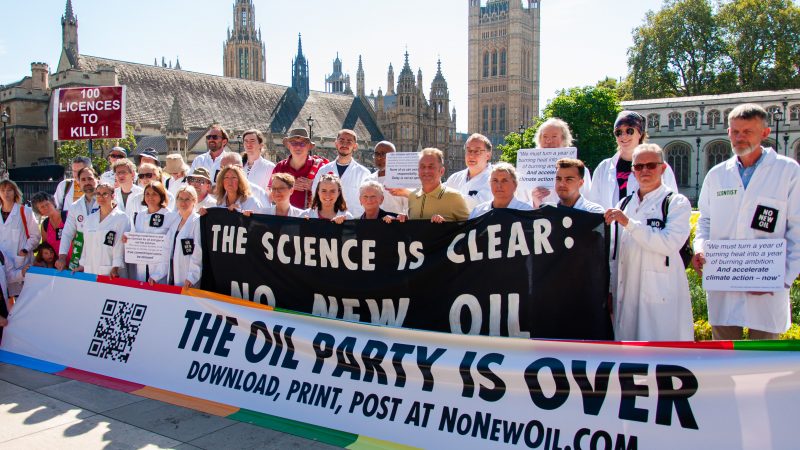
‘We need you,’ says Scientist Rebellion, which includes authors of IPCC reports on climate breakdown, as diplomats meet for Cop28
Wolfgang Cramer’s first involvement with the Intergovernmental Panel on Climate Change was in the 90s. He worked on the second assessment report, delivered in 1995, which affirmed the science of anthropogenic climate breakdown. At that point, no one could say they did not know what was happening.
Almost three decades on, Cramer was part of the international scientific team that prepared the sixth IPCC report. Its conclusion, delivered in March, issued human civilisation a bleak “final warning” – the biosphere stands on the brink of irrevocable damage.
“Wherever you are, become a climate advocate or activist,” the letter, published on Monday by Scientist Rebellion, a climate activist group, implores. “Join or start groups pushing for policies that help secure a better future. Contact groups that are active where you are, find out when they meet and attend their meetings.
“If we are to create a liveable future, climate action must move from being something that others do to something that we all do.”
Chris Packham has filed a high court legal challenge to the UK government over its decision to weaken key climate policies.
The broadcaster and environmental campaigner has applied for a judicial review of the government’s decision to ditch the timetable for phasing out petrol and diesel powered cars and vans, gas boilers, off-grid fossil fuel domestic heating and minimum energy ratings for homes.
A Department for Energy Security and Net Zero spokesperson said it rejected Packham’s claims and would “robustly” defend the challenge. The measures and their schedule had been set out in the government’s carbon budget delivery plan, which was put before parliament in March this year.
In September, Rishi Sunak announced he would delay the ban on selling new diesel and petrol cars from 2030 to 2035 and that 20% of households would be exempt from a new gas boiler ban among other changes, arguing that he did not want to burden ordinary people with the costs.
Following the announcement, Packham wrote to Sunak, the energy secretary and the transport secretary to challenge the decision, arguing that the prime minister did not have the legal right to change the timeline of carbon budget pledges at will, since the actioning of the carbon budget delivery plan was governed by statute.
Packham said he did not receive a satisfactory response to his letter and therefore filed the judicial review application.
…
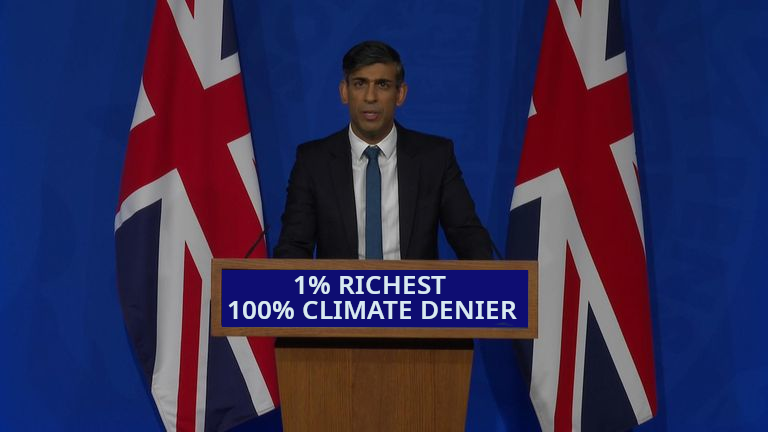
Image of UK Prime Minister Rishi Sunak reads 1% RICHEST 100% CLIMATE DENIER
According to the president of COP28, the latest round of UN climate negotiations in the United Arab Emirates, there is “no science” indicating that phasing out fossil fuels is necessary to restrict global heating to 1.5°C.
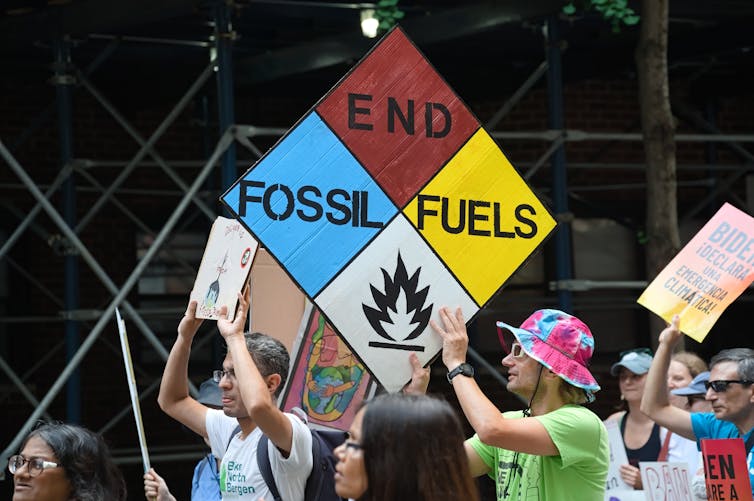
President Sultan Al Jaber is wrong. There is a wealth of scientific evidence demonstrating that a fossil fuel phase-out will be essential for reining in the greenhouse gas emissions driving climate change. I know because I have published some of it.
Back in 2021, just before the COP26 climate summit in Glasgow, my colleagues and I published a paper in Nature entitled Unextractable fossil fuels in a 1.5°C world. It argued that 90% of the world’s coal and around 60% of its oil and gas needed to remain underground if humanity is to have any chance of meeting the Paris agreement’s temperature goals.
Crucially, our research also highlighted that the production of oil and gas needed to start declining immediately (from 2020), at around 3% each year until 2050.
This assessment was based on a clear understanding that the production and use of fossil fuels, as the primary cause of CO₂ emissions (90%), needs to be reduced in order to stop further heating. The Intergovernmental Panel on Climate Change (IPCC) says that net zero CO₂ emissions will only be reached globally in the early 2050s, and warming stabilised at 1.5°C, if a shift away from fossil fuels to low-carbon energy sources begins immediately.
If global emissions and fossil fuel burning continue at their current rates, this warming level will be breached by 2030.
Since the publication of our Nature paper, scientists have modelled hundreds of scenarios to explore the world’s options for limiting warming to 1.5°C. Many feature in the latest report by the IPCC. Here is what they tell us about the necessary scale of a fossil fuel phase-out.
Fossil fuel use must fall fast
A recent paper led by atmospheric scientist Ploy Achakulwisut took a detailed look at existing scenarios for limiting warming to 1.5°C. For pathways consistent with 1.5°C, coal, oil and gas supply must decline by 95%, 62% and 42% respectively, between 2020 and 2050.
However, many of these pathways assume rates of carbon capture and storage and carbon dioxide removal that are likely to be greater than what could be feasibly achieved. Filtering out these scenarios shows that gas actually needs to be eliminated twice as fast, declining by 84% in 2050 relative to 2020 levels. Coal and oil would also see larger declines: 99% and 70% respectively.
In fact, oil and gas may need to be eliminated even quicker than that. A study by energy economist Greg Muttitt showed that many of the pathways used in the most recent IPCC report assume coal can be phased out in developing countries faster than is realistic, considering the speed of history’s most rapid energy transitions. A more feasible scenario would oblige developed countries in particular to get off oil and gas faster.
A fair and orderly transition
The International Energy Agency (IEA) has added to evidence in favour of phasing out fossil fuels by concluding that there is no need to license and exploit new oil and gas fields, first in a 2021 report and again this year.
This latest IEA analysis also estimates that existing oil and gas fields would need to wind down their production by 2.5% a year on average to 2030, accelerating to 5% a year from 2030 (and 7.5% for gas between 2030-40).
A separate analysis of the IPCC’s scenarios for holding global warming at 1.5°C came to the same conclusion. Since no new fields need to be brought into development, global production of oil and gas should be falling.
This message was reinforced by the UN’s recent production gap report, which concluded that producer countries including the United Arab Emirates need to be moving towards a rapid phase-out of fossil fuels, not expanding production. Instead, the report estimated that in CO₂ terms, planned fossil fuel production in 2030 is projected to be 110% higher than the required phase-out trajectory to meet 1.5°C.
The evidence for a fossil fuel phase-out is clear. The debate should now turn to executing it.
A fair and orderly transition from fossil fuels must acknowledge the differing capacity of countries: developing countries are more economically dependent on fossil fuels and have less money to switch to cleaner technologies. Some investment in oil and gas will be needed for existing infrastructure. This would maintain the minimum level of production necessary for a carefully managed transition. Overall though, fossil fuels should now be in rapid decline.
Rich countries need to phase out fossil fuels now and raise the funding to help developing countries make the transition.
Don’t have time to read about climate change as much as you’d like?
“This dismisses decades of work by IPCC scientists,” said one expert. “Disgraceful.”
Scientists and climate advocates responded with outrage Sunday to COP28 president Sultan Ahmed Al Jaber’s claim that there is “no science” behind the push to rapidly phase out planet-warming fossil fuels, which Al Jaber’s company is extracting on a large scale .
Al Jaber’s comments, first reported by The Guardian on Sunday, came in response to questioning from Elders chair Mary Robinson during a virtual She Changes Climate discussion. Robinson told Al Jaber that “we’re in an absolute crisis that is hurting women and children more than anyone… and it’s because we have not yet committed to phasing out fossil fuel.”
The COP28 chief and Abu Dhabi National Oil Company (ADNOC) CEO responded dismissively, saying he “accepted to come to this meeting to have a sober and mature conversation” and not to take part in “any discussion that is alarmist,” according to audio published by The Guardian .
“There is no science out there, or no scenario out there, that says that the phaseout of fossil fuel is what’s going to achieve 1.5°C,” Al Jaber added. “Please help me, show me the roadmap for a phaseout of fossil fuel that will allow for sustainable socioeconomic development, unless you want to take the world back into caves.”
That position runs directly counter to the outspoken stance of United Nations Secretary-General António Guterres, who said Friday that “the 1.5°C limit is only possible if we ultimately stop burning all fossil fuels,” arguing that “the science is clear.”
“This dismisses decades of work by IPCC scientists,” Gergis wrote on social media.
“‘Sending us back to caves’ is the oldest of fossil fuel industry tropes: it’s verging on climate denial.”
The IPCC, which has synthesized the research of hundreds of climate scientists from around the world, has argued that any successful effort to prevent catastrophic planetary warming “will involve a substantial reduction in fossil fuel use.”
“More than a century of burning fossil fuels as well as unequal and unsustainable energy and land use has led to global warming of 1.1°C above pre-industrial levels,” the IPCC said following the release of its latest report earlier this year. “This has resulted in more frequent and more intense extreme weather events that have caused increasingly dangerous impacts on nature and people in every region of the world.”
Other recent research has warned that rich nations must completely halt oil and gas production by 2034 to give the world a 50% chance of limiting warming to the 1.5°C target set by the Paris Agreement.
Bill Hare, chief executive of Climate Analytics, told The Guardian that Al Jaber’s response to Robinson was “extraordinary, revealing, worrying, and belligerent.”
“‘Sending us back to caves’ is the oldest of fossil fuel industry tropes: it’s verging on climate denial,” said Hare.
Al Jaber’s comments, which he says have been misrepresented , were seen as further confirmation that he is ill-suited to lead a climate summit given his simultaneous role as the top executive at one of the world’s largest fossil fuel firms. A Global Witness analysis released over the weekend found that ADNOC is on track to become the second-largest oil producer in the world by 2050, and Al Jaber has been accused of using his position as COP28 president to pursue oil and gas deals.
“ADNOC plans to produce more oil than any of the ‘Big 5’ supermajors—ExxonMobil, Chevron, Shell, BP, TotalEnergies,” Global Witness found. “In fact, its projected output will positively dwarf that of the European majors; ADNOC’s 35.9 billion barrels is 49% higher alone than the projected 24.1 billion barrels production of Shell, BP, and Total combined.”
On Monday, the COP28 presidency published a summary of the World Climate Action Summit, a gathering of more than 150 heads of state aimed at facilitating coordinated climate action.
The document states that world leaders “highlighted the opportunities to cut emissions in every sector and to accelerate the technology innovation to address scope 3 emissions, as well as the phase-down of fossil fuels in support of a transition consistent with limiting warming to 1.5°C.”
Romain Ioualalen, global policy lead at Oil Change International , said in a statement that “strong support from the leaders’ summit to address fossil fuels in the final COP28 agreement is a promising sign, but it is just good enough.”
“Leaders must raise their ambition above a phase-down, and agree to immediately stop new fossil fuel expansion, and build a fast, full, fair, and funded phaseout of all fossil fuels while rapidly phasing in renewables,” said Ioualalen. “Contrary to the COP28 president’s assertions, the science is abundantly clear that warming will continue as long as we keep producing and burning fossil fuels.”