Getting shorter and going hungrier: how children in the UK live today

Spread the love
Keir Starmer says pensioners can freeze to death and poor children can starve and be condemned to failure and misery all their lives.
Keir Starmer says pensioners can freeze to death and poor children can starve and be condemned to failure and misery all their lives. The child poverty and neglect discussed in this article occurred previously to Keir Starmer and the Labour Party being in office. They polices are however certainly continuing and reproducing child poverty and destitution.

Danny Dorling, University of Oxford

Children’s lives in the UK are changing.

They are becoming shorter in height. More of them are going hungry than they were a few years ago. Recently, more have died each year than they did a few years ago. Increased poverty, more destitution and the effects of ongoing austerity are the clear culprits.

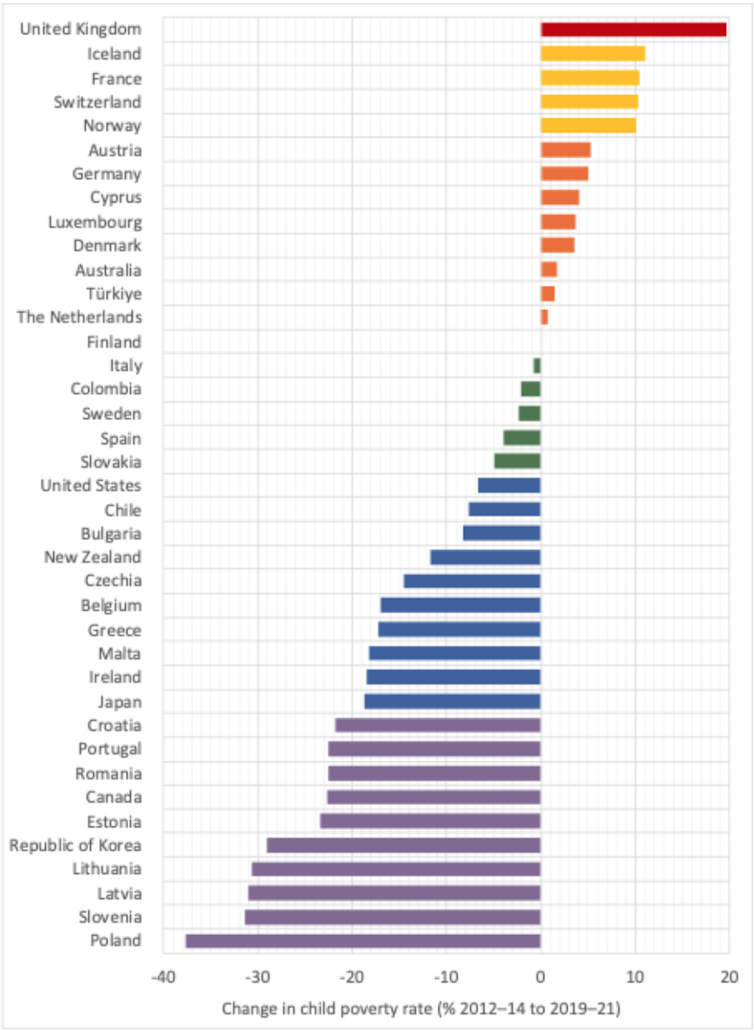
But why did this happen to our children? This rise in child poverty is a change that has not been found to have occurred to the same extent anywhere else in the world, among all the places that the United Nations measures in the same way.

Change in child poverty, 2012–14 to 2019–21
Bar chart
UNICEF Innocenti—Global Office of Research and Foresight (2023) ‘Innocenti Report Card 18: Child poverty in the midst of wealth’, CC BY-NC-ND


This graph tells a story of hope and success. In much of Eastern Europe, child poverty has fallen by between as much as a third – and often at least a quarter – in a mere seven years.

But it also shows that child poverty has risen the most in the UK. The poorest fifth of households in the UK are poorer than the poorest fifth in most of Eastern Europe. For many people in the UK, this will come as a surprise. Some will refuse to believe it can be this bad.

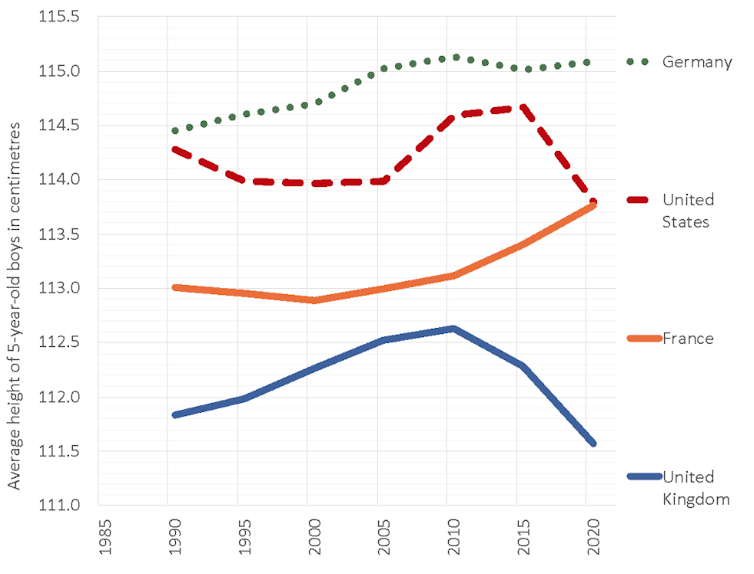
The evidence for this poverty is seen in the declining heights of five-year-olds since 2010.

Average height of five-year-old boys, 1985–2020
Line graph
Average height of 5-year-old boys, 1985–2020. Redrawn by the author from data in Press Association (2023) ‘British children shorter than other five-year-olds in Europe’, ITV News, 21 June., CC BY-NC-ND


A 5-year-old in 1990 would have been born in 1985 and their height influenced mostly by nutrition in the years 1985–1990. Those were hard years for the UK: mass poverty resulting from over three million people being out of work in the early 1980s. But the average height of children was still increasing.

It was not until 2010, for those children who had lived between 2005 and 2010, that we first saw heights plateau and then fall, coinciding with the post-2010 austerity years.

My forthcoming book attempts to make sense of what has happened to the UK: why, in 2024, it is not merely one of the countries in Europe with a high rate of child poverty, but the one country above all others that the UN has singled out as having had the greatest rises in child poverty among all those it surveyed.

Seven children

To try to understand more about children’s lives in the UK, I constructed seven typical children. I divided all 14 million children living in the UK into seven groups of 2 million, according to the income of their families in 2018 and 2019. I then chose the middle child of each 2 million. I next looked at what had happened to those families between 2018 and 2024.

The graph below shows the annual income of each of the seven households the children were drawn from.

Annual household incomes after tax, benefits and housing costs in the UK, families with children 2019/20
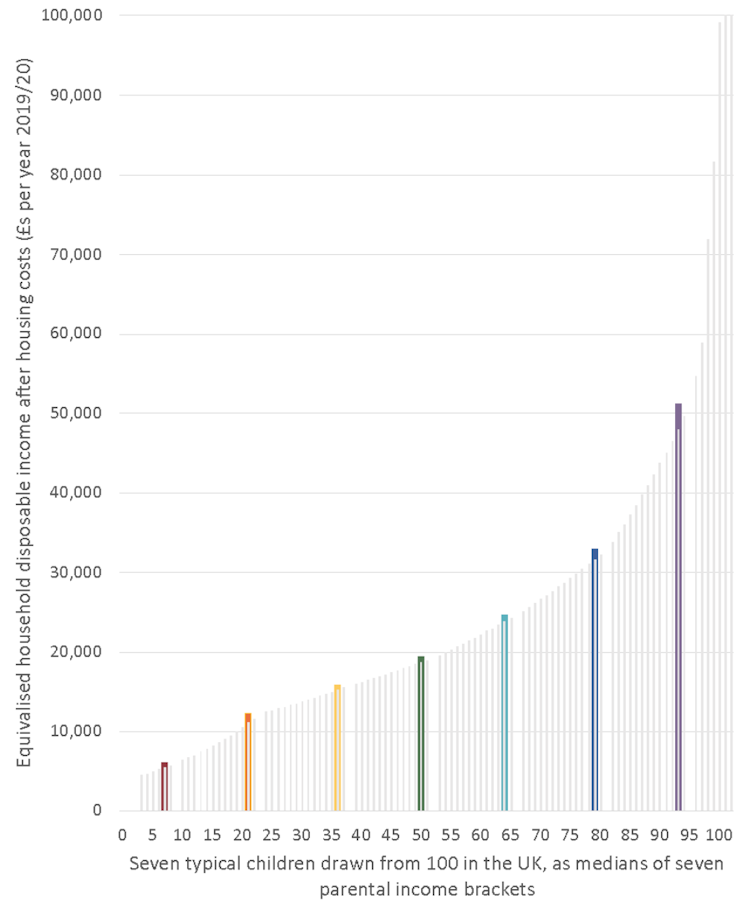
Annual household incomes after tax, benefits and housing costs in the UK, families with children 2019/20: seven typical children marked in colour. Danny Dorling, CC BY-NC-ND


The first thing to note is just how incredibly well-off the children are who are better-off than our seven typical children.

Some 6% of all children in the UK live in households richer than the best-off typical child in my analysis. Those 6% of children, the best-off children of all, live in families that each year receive and spend a third of all the income in the UK.


Want more politics coverage from academic experts? Every week, we bring you informed analysis of developments in government and fact check the claims being made.

Sign up for our weekly politics newsletter, delivered every Friday.


These 6% are not typical, and neither are the 6% poorest: those most destitute, those whose families are most likely to use food banks. If you pick seven typical children, equally spaced out across the income scale, then these extremes are not part of what you see.

But four of our typical seven children now live lives that most better-off people would consider to be in poverty. The other three are hardly well-off.

The least well-off are in families struggling to pay bills and making sacrifices others do not have to think about. For instance, whether to save £10 a month, or have insurance against the effects of flood, fire or theft. Increasingly often they cannot afford both.

But even the most well-off of our seven children lives in a family that worries about paying for an annual holiday. That is rare among the most affluent two million families, but possible.

The UK in 2024 demonstrates to the world what living with high inequality means in a once affluent country. It means a few using up far more resources than the vast majority of other children, such as having access to many more school teachers – per child – as compared to the rest, better food, better shelter, more warmth, more toys, better material everything; often more than you might think any child needed.

In future, almost all our children will tell their stories of growing up in the UK of the 2020s and – hopefully – what changed to make things better. It is hard to imagine them becoming much worse.

Danny Dorling, Halford Mackinder Professor of Geography, University of Oxford

This article is republished from The Conversation under a Creative Commons license. Read the original article.
Continue ReadingGetting shorter and going hungrier: how children in the UK live today

Coming Soon :: UK Labour Party Conference 2024

Spread the love
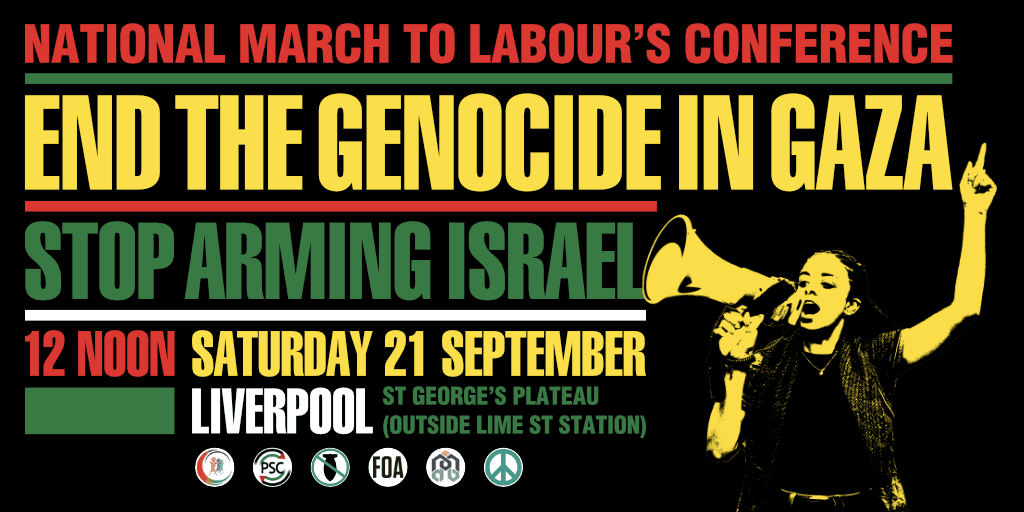
End the genocide in Gaza protest at Labour Party Conference, Liverpool 21 September 2024.

UK Labour Party Conference is starting on Sunday 22 September 2024. A protest has been announced on the 21st protesting the Labour party’s support for Israel’s genocide in Gaza.

I oppose Keir Starmer and the UK Labour Party for many reasons: their complicity in and support for Israel’s Zionist genocide in Gaza and the West Bank and attacks on the poor and disabled e.g. denying winter fuel payment benefits from poor and disabled pensioners likely to result in many deaths and the refusals to repeal the two-child benefit cap and the bedroom tax. Essentially the Labour Party are Zionist scum Blue Tories pretending to be Socialists. They are part of a global agenda to diminish international law to facilitate and support Israel’s racist, Fascist, genocide in Gaza and the West Bank.

I object to Labour Party Deputy Angela Rayner’s efforts to attack me while hiding – actually very typical of New Labour sihts in my experience.

Deputy Labour Party Leader Angela Rayner calls for police to kill and harass innocent people.

May be elaborated and extended.

Keir Starmer says pensioners can freeze to death and poor children can starve and be condemned to failure and misery all their lives.
Continue ReadingComing Soon :: UK Labour Party Conference 2024

Deadly Flooding in Europe Shows ‘Dramatic Consequences’ of Climate Change

Spread the love

Original article by Olivia Rosane republished from Common Dreams under Creative Commons (CC BY-NC-ND 3.0). 

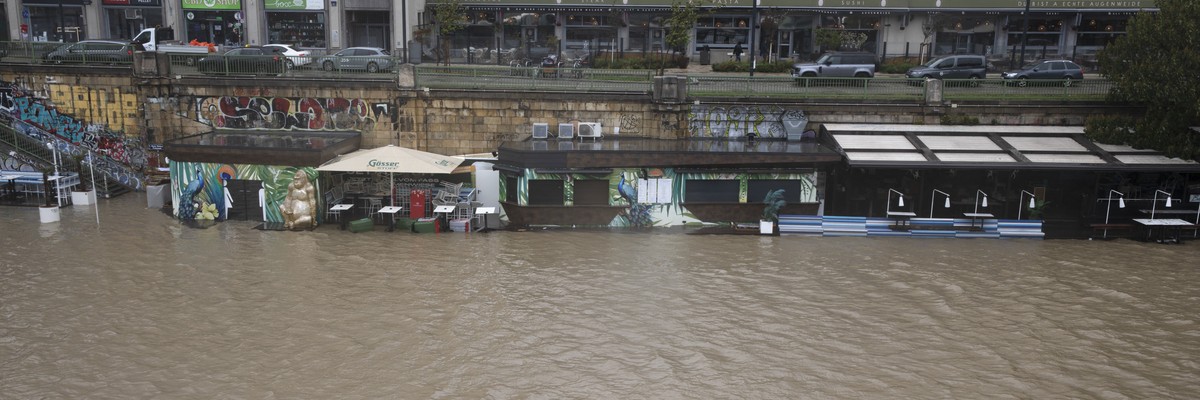
The Danube Canal overflows its banks in Vienna’s city center on September 15, 2024. 
(Photo: Alex Halada/AFP via Getty Images)

“What you see here is worse than in 1997, and I don’t know what will happen because my house is under water and I don’t know if I will even return to it,” one storm evacuee said.

Extreme flooding has claimed the lives of at least seven people in Central and Eastern Europe and forced thousands to flee their homes over the weekend.

Storm Boris—a low pressure system—has been lashing the area since Thursday, with major cities seeing a month’s worth of rain and some areas seeing their heaviest rainfall in 100 years between Saturday and Sunday.

“We are again facing the effects of climate change, which are increasingly present on the European continent, with dramatic consequences,” Romanian President Klaus Iohannis said, as The Guardian reported.

The storm has been deadliest in Romania, where four people were killed on Saturday and a fifth on Sunday, according toCNN. Hundreds of people also had to be rescued from rising waters.

The most impacted part of Romania was Galati, where the storm damaged around 5,400 homes—and around 700 in the village of Slobozia Conachi alone.

“This is a catastrophe of epic proportions,” Mayor Emil Dragomir said, as The Guardian reported.

“The idiotic media have failed to make it clear what’s coming—and this is still the beginning.”

The sixth death came in Austria, where a firefighter battling flooding perished on Sunday. Authorities have declared a disaster for Lower Austria, where Vienna is located, and staged nearly 5,000 rescues there Saturday night. The storm also shut down rail service in the eastern part of the country.

“We are experiencing difficult and dramatic hours in Lower Austria,” said the provincial governor Johanna Mikl-Leitner, as The Associated Press reported. “For many people in Lower Austria these will probably be the most difficult hours of their lives.”

In Poland, one person drowned in the hardest-hit region of Kłodzko, where around 1,600 people were forced to evacuate and 17,000 lost power.

In another town of Stonie Slaski, flood waters overwhelmed a dam and collapsed a bridge, while the river in Glucholazy overflowed its banks.

“The situation is still very dramatic in many place[s],” Polish Prime Minister Donald Tusk said on Sunday, according to CNN. “Unfortunately, these situations are repeating themselves in many places… but some residents sometimes underestimate the level of threat and refuse to evacuate.”

The storm also pummeled parts of Slovakia, Hungary, and the Czech Republic, where some of the highest rainfall totals in the region were reported and where four people are still missing.

The storm forced 10,000 people from the city of Opava to flee their homes, and Mayor Tomáš Navrátil said conditions were worse than in 1997’s so-called “flood of the century,” according to AP.

“What you see here is worse than in 1997, and I don’t know what will happen because my house is under water and I don’t know if I will even return to it,” Lipová-lázne resident Pavel Bily said, as The Guardian reported.

The rains are expected to continue at least through Monday.

In 2021, World Weather Attribution said that the climate emergency has made extreme flooding in Europe more likely. The storm also followed the hottest summer on record, as well as a warm beginning to September in the region, and warmer air can hold more moisture.

“People are in prison today for trying to warn the public how bad things are going to get,” author Matthew Todd wrote on social media in response to footage of a dam bursting in Poland. “Scientists have taken to the streets to warn us.”

“The idiotic media have failed to make it clear what’s coming—and this is still the beginning,” Todd continued. “Educate everyone you know.”

Original article by Olivia Rosane republished from Common Dreams under Creative Commons (CC BY-NC-ND 3.0). 

Continue ReadingDeadly Flooding in Europe Shows ‘Dramatic Consequences’ of Climate Change

Jury refuses to convict four Palestine Action activists

Spread the love

https://morningstaronline.co.uk/article/jury-refuses-to-convict-four-palestine-action-activists

Palestine Action activists outsite Bradford Crown Court

A CROWN Court jury has refused to convict four Palestine Action activists accused of causing more than £500,000 of damage at a factory supplying weaponry to Israel.

The four faced charges of criminal damage to a Teledyne Defence and Space factory at Shipley in West Yorkshire.

The activists were reported to have used sledgehammers to smash the roof, windows and the interior of the factory.

In closing speeches, the activists reminded jurors of their rights to acquit according to their conscience.

https://morningstaronline.co.uk/article/jury-refuses-to-convict-four-palestine-action-activists

Continue ReadingJury refuses to convict four Palestine Action activists

Venezuela announces dismantling of CIA-backed coup plot, arrest of active-duty Navy Seal

Spread the love

Original article by republished from peoples dispatch under a Creative Commons Attribution-ShareAlike 4.0 (CC BY-SA) license.

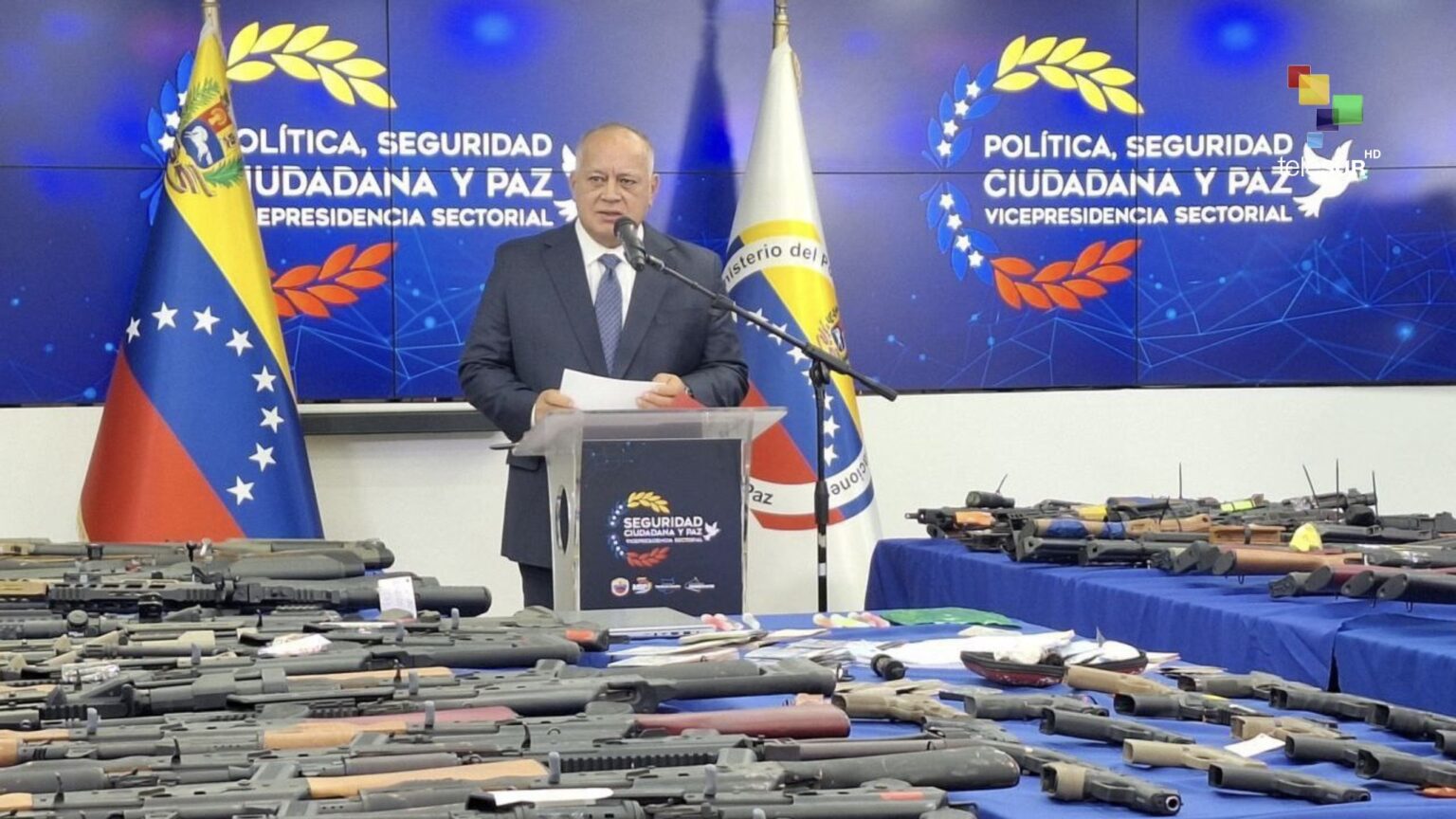
The coup plot comes just a month and a half after President Nicolás Maduro was reelected in the presidential election, which to date, the US has refused to recognize

In a press conference given on September 14, Venezuelan Interior Minister Diosdado Cabello announced that authorities had dismantled an operation reportedly backed by the Central Intelligence Agency of the United States and the National Intelligence Center of Spain, which sought to assassinate President Nicolás Maduro, Vice President Delcy Rodríguez, Cabello, and other government officials. The minister announced that Venezuelan authorities had seized 400 weapons from the US and arrested 14 mercenaries who were involved in the plot. Among the arrested is Wilber Joseph Castañeda, an active US military officer and Navy Seal. Two Spanish citizens were reportedly also arrested, José María Basua and Andrés Badasbe.

Officials stated that according to a document they seized from one of the detainees, the plot included attacking the Miraflores Palace and other public institutions, in addition to carrying out sabotage actions against various public services to generate chaos.

According to officials, those arrested possessed between 10-12 weapons in their homes that were set to be used in the destabilization plan. Cabello noted that many of those arrested also have links to Venezuela’s far-right opposition network.

He added that the weapons seized by authorities were brought to the country in “apparently legal” shipments and received by groups linked to the extreme right.

One of the leaders of the illegal arms trafficking network in the country, Cabello claimed, is a man who is already a fugitive from Venezuelan justice, Iván Simonovis. “Because of the capture of this weaponry here in Venezuela, they have taken actions in other countries that have included the murder of people. Simonovis knows what I am talking about,” he stated.

Venezuela has demanded that the United States government respond to the incident and “clarify the use of its agencies and the use of its territory to traffic weapons aimed at overthrowing a democratically elected government.”

Cabello declared: “The United States is behind this operation, they are delivering these weapons so that they circulate freely and reach Venezuela…They can say what they want, their agents are confessing. Castañeda is the head of the operation [of] the CIA here and they have a link with criminal groups in Venezuela.”

Regarding the Venezuelan state’s intelligence capacities, Cabello stated: “Let the world know that we are going to use all the necessary mechanisms to repel, to defeat these groups of mercenaries, of terrorists who try to undermine peace and order in Venezuela…prepare to be defeated again.”

Original article by republished from peoples dispatch under a Creative Commons Attribution-ShareAlike 4.0 (CC BY-SA) license.

Continue ReadingVenezuela announces dismantling of CIA-backed coup plot, arrest of active-duty Navy Seal