Analysis Details How Israel’s Gaza Siege ‘Is Driving a Humanitarian Disaster’
Original article by Brett Wilkins republished from Common Dreams under Creative Commons (CC BY-NC-ND 3.0).
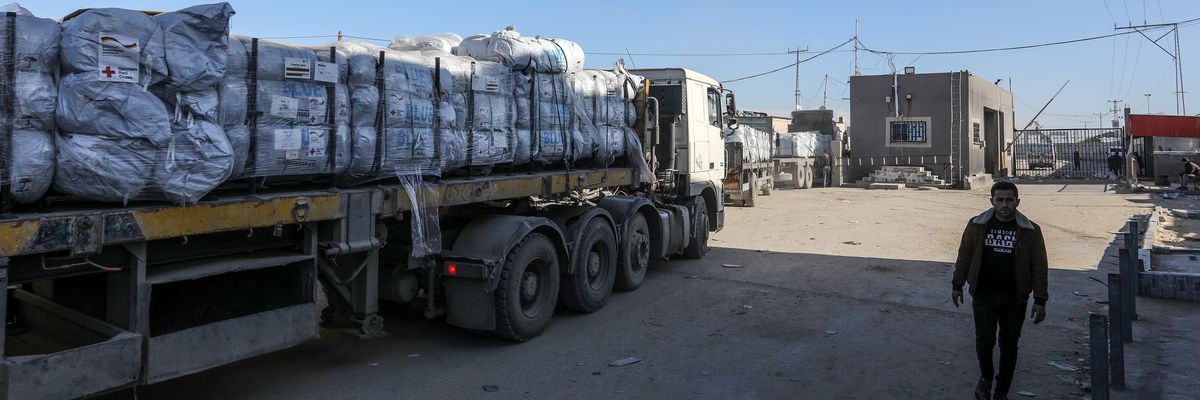
“Over 11 months, we have reached shocking levels of conflict, displacement, disease, and hunger,” said one campaigner.
Israel’s “complete siege” of the Gaza Strip “is driving a humanitarian disaster,” with 83% of required food aid failing to enter the embattled enclave, where the entire population is facing hunger and disease and almost half a million Palestinians are at risk of starvation, an analysis published Monday revealed.starvation,
The analysis by 15 international aid organizations noted that a record-low average of just 69 aid trucks are entering the Gaza Strip each day, compared with an already insufficient 500 daily truckloads a year ago. Additionally, the groups said that “only 17 out of Gaza’s 36 hospitals remain partially functional, and “critical infrastructure such as water networks, sanitation facilities, and bread mills” have been destroyed.
“While Israeli military attacks on Gaza intensify, lifesaving food, medicine, medical supplies, fuel, and tents have been systematically blocked from entering for almost a year,” the aid groups—which include ActionAid, American Friends Service Committee, CARE International, Christian Aid, Islamic Aid, Oxfam International, and Save the Children—said in a statement.
The publication highlights numerous ways that “lifesaving aid is systematically obstructed on a daily basis” in Gaza.
“These include the denial of safety, with more than 40,000 Palestinians and nearly 300 aid workers killed since last October; the sharp tightening of a 17-year blockade to a full siege, which prevents aid from entering Gaza; delays and denials which restrict the movement of aid around Gaza; tightly restrictive and unpredictable control of imports; the destruction of public infrastructure such as schools and hospitals; and the displacement of civilians and humanitarian workers,” the analysis’ authors wrote.
Zenab, a 33-year-old Palestinian woman pregnant with her second child, said that her pregnancy “has been the hardest time of my life.”
“It was also hard to get the medication I needed,” she continued. Sometimes I had to walk for hours to different pharmacies, hospitals, and health centers to see if anyone had my medication available. For me as a pregnant woman, there has been hardly any healthcare support, no proper hygiene and sanitation, and no suitable mattress to sleep on.”
“I was suffering from complications during my pregnancy,” Zenab added. “We didn’t have enough water to drink, and had hardly any food. The doctors again told me that my pregnancy was in danger.”
Among the report’s key findings:
- 83% of required food aid doesn’t make it into Gaza, up from 34% in 2023;
- An estimated 50,000 children aged between 6-59 months urgently require treatment for malnutrition by the end of the year;
- 65% of the insulin required and half of the required blood supply are not available in Gaza;
- Availability of hygiene items has dropped to 15% of the amount available in September 2023, with 1 million women now going without the hygiene supplies they need;
- Only around 1,500 hospital beds in Gaza remain operational, compared to around 3,500 beds in 2023 which was already well below sufficient to meet the needs of a population of more than 2 million people; and
- 1.87 million people are in need of shelter with at least 60% of homes destroyed or damaged as of January, yet tents for around just 25,000 people have entered Gaza since May 2024.
“There is a shortage of all humanitarian items. We are overwhelmed [with] these needs and [these] urgent requirements,” said Amjad Al Shawa, director of the Palestinian NGOs Network. “People [are] starving due to the shortage of aid. One hundred percent of the population depends on humanitarian aid.”
The authors of the analysis—which was released ahead of this week’s United Nations General Assembly in New York—are demanding that Israel secure an immediate and lasting cease-fire. They are also calling for an arms embargo on Israel and Israeli compliance with the recent International Court of Justice (ICJ) advisory opinion, which found that the occupation of Palestine is an illegal form of apartheid that must end immediately. Israel is on trial for genocide in a separate ICJ case.
“The situation was intolerable long before last October’s escalation and is beyond catastrophic now.”
“The situation was intolerable long before last October’s escalation and is beyond catastrophic now,” CARE International West Bank and Gaza country director Jolien Veldwijik said in a statement. “Over 11 months, we have reached shocking levels of conflict, displacement, disease, and hunger.”
That includes dozens of children who have died due to malnutrition, dehydration, and lack of adequate medical care.
“Aid is still not getting in, and humanitarian workers are risking their lives to do their jobs while attacks and violations of international law intensify,” Veldwijik added. “Aid, which is urgently required for 2.2 million people at risk of dying in the coming weeks and months, should never be politicized. We demand an immediate and sustained cease-fire, and the free flow of humanitarian aid into and throughout Gaza.”
Original article by Brett Wilkins republished from Common Dreams under Creative Commons (CC BY-NC-ND 3.0).
- Infectious Diseases Surging in Gaza Amid Israeli Siege, Healthcare System Collapse
- As Surgeons, We Have Never Seen Cruelty Like Israel’s Genocide in Gaza
- Newborns in Gaza Dying From Preventable Causes Due to Israeli Siege: Oxfam
- The Gaza Project Exposes Israel’s ‘Chilling Pattern’ of Killing Journalists
- ‘A Massive War Crime’: Israel Announces Total Blockade of Gaza Strip