Just Stop Oil second occasion of souping Van Gogh at the National Gallery 27 Sept 2024. Image by JSO.
Just Stop Oil supporters have thrown soup over two of Vincent Van Gogh’s Sunflowers paintings at the National Gallery in London in a sign of defiance after the original soup throwers, Phoebe Plummer and Anna Holland were imprisoned for up to two years at Southwark Crown Court today. Just Stop Oil is demanding that governments work together to establish a fossil fuel treaty, to end the extraction and burning of oil, gas and coal by 2030.
At around 2:30pm, three supporters of Just Stop Oil entered the Van Gogh ‘Poets and Lovers’ exhibition at the National Gallery and proceeded to throw Heinz vegetable soup over two Van Gogh masterpieces: ‘Sunflowers’ 1889 and ‘Sunflowers’ 1888. The latter was splashed with soup by Phoebe Plummer and Anna Holland in 2022.
Taking off jackets they revealed Just Stop Oil t-shirts and spoke to the assembled crowds. Referring to the 25 Just stop Oil supporters now in prison, Phil Green announced: ” Future generations will regard these prisoners of conscience to be on the right side of history.”
Subsequently Ludi Simpson said: “We will be held accountable for our actions today, and we will face the full force of the law. When will the fossil fuel executives and the politicians they’ve bought be held accountable for the criminal damage that they are imposing on every living thing?”
Just Stop Oil second occasion of souping Van Gogh at the National Gallery 27 Sept 2024. Image by JSO.
One of those taking action today is Phil Green, 24, a community worker from Cornwall who said:
“Whilst deadly flooding, food shortages and extreme heat wreak havoc around the world, the state is choosing to focus energy on prosecuting ordinary people with the harshest sentences. Future generations will see those who stood up against suffering, genocide and greed as heroes and our reckless governments as the real criminals.”
Also taking action today is Ludi Simpson, 71, a retired Professor from Bradford, who said
“My action is from the heart and the head. I know politicians can do the right thing if they listen to the facts, but their inaction is burning up our lives. Is it too much to ask for a safe future? Soup on sunflowers is a splash of protest. The treasured pictures remain unharmed. What is harming our future is the criminal greed of the fossil fuel economy. Our government can choose to end it now.”
Mary Patricia Somerville, 77, a grandmother from Bradford who was also taking action today said:
“I am more and more frightened that we’re running out of time to save humanity from extinction. We desperately need an international Fossil Fuel Treaty to prevent this from happening in the lifetime of my grandchildren. Harvey, aged 8, told me his plans for when he grows up. ‘I’d like to write musicals,’ he said, ‘but with climate change I might be dead.’ “
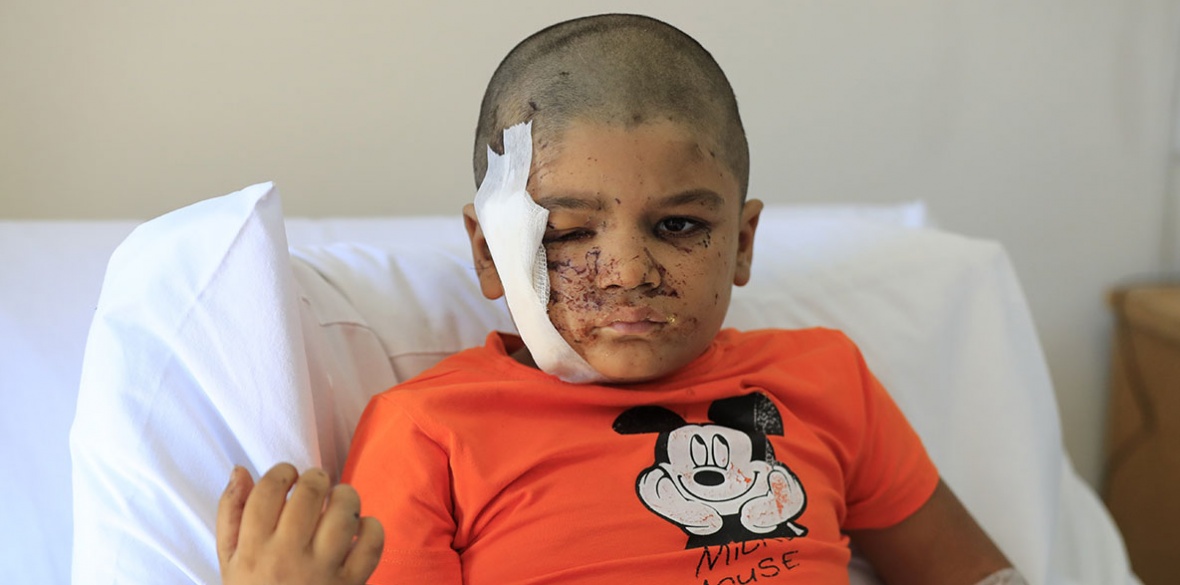
Ali Abdel Rahman Zorout, (5), who was wounded by an Israeli air strike, poses for a picture at the Alaaeddine Hospital in Sarafand, south Lebanon, September 26, 2024
Britain’s call for temporary Israel-Hezbollah ceasefire not enough, campaigners say
BRITAIN came under increased pressure to stop arms sales to Israel today after the Western-backed state snubbed international calls for a 21-day temporary ceasefire and unleashed a “fresh wave of horror” across Lebanon.
Amnesty International UK warned Israel could be committing more war crimes as it raised “deep alarm” over the staggering death toll since it launched an intense series of air strikes that began earlier this week, displacing half a million people.
The Stop the War Coalition (StWC) and former Labour leader Jeremy Corbyn MP were also among the peace campaigners calling for urgent action to prevent an all-out regional war in the Middle East.
Fifty-one people were killed in Israeli air strikes on Wednesday, Lebanon’s Health Ministry says, with more than 90,000 people displaced across the country since Monday, according to the UN.
Amnesty International UK decried the latest onslaught on Lebanon, warning that using explosive weapons with “wide-area effects in the vicinity of densely populated residential areas is likely to violate the prohibition of indiscriminate attacks and can also lead to disproportionate attacks.”
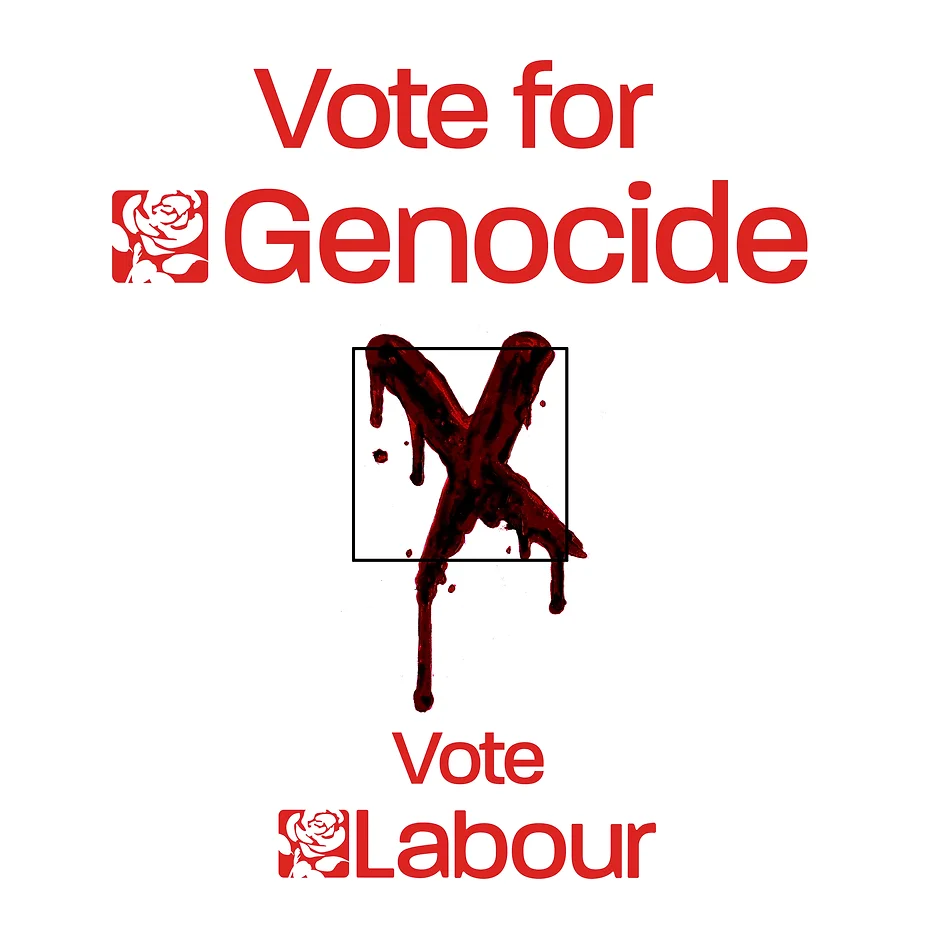
UK Foreign Secretary David Lammy says that UK is suspeding 30 of 350 arms licences to Israel. He also confirms the UK government’s support for Israel’s Gaza genocide.Vote For Genocide Vote Labour.
People bury the bodies of Palestinians taken by the Israeli military during operations in Gaza and returned this week, in Khan Younis, Gaza Strip, September 26, 2024
CAMPAIGNERS across Britain are stepping up pressure on councils to end ties with weapons companies that are complicit in “Israel’s apartheid” through their pensions schemes.
Lewisham residents and activists will hold a rally outside Lewisham Town Hall on Wednesday October 2, as councillors hold their regular meeting.
The rally will demand that the council disclose and divest the pension scheme it manages away from arms manufacturers.
The action follows the passing of a resolution this month by the council’s pensions investment committee to explore divesting Lewisham’s pension funds from companies involved in arms trade, facilitating human rights abuses and operating in illegally occupied Palestinian territories.
Cllr Liam Shrivastava, who seconded the resolution, warned 13.4 per cent of the council’s pension fund is managed by BlackRock, which holds significant investments in Israel and arms companies including Lockheed Martin, RTX Northrop Grumman, Boeing and General Dynamics.
At the UNGA, world leaders condemn Israel for committing genocide in Gaza and provoking a regional war, calling for an immediate ceasefire and de-escalation
The General Debate of the United Nations (UN) General Assembly, an annual meeting of heads of state and government, began on Tuesday, September 24, in New York City. This year’s theme, “Leaving no one behind: acting together for the advancement of peace, sustainable development, and human dignity for present and future generations,” framed the discussion.
So far, the ongoing genocidal war waged by Israel against Gaza, Lebanon, and the occupied West Bank, as well as Israel’s repeated assaults on Palestinians, dominated the interventions of heads of state from all continents in this year’s session.
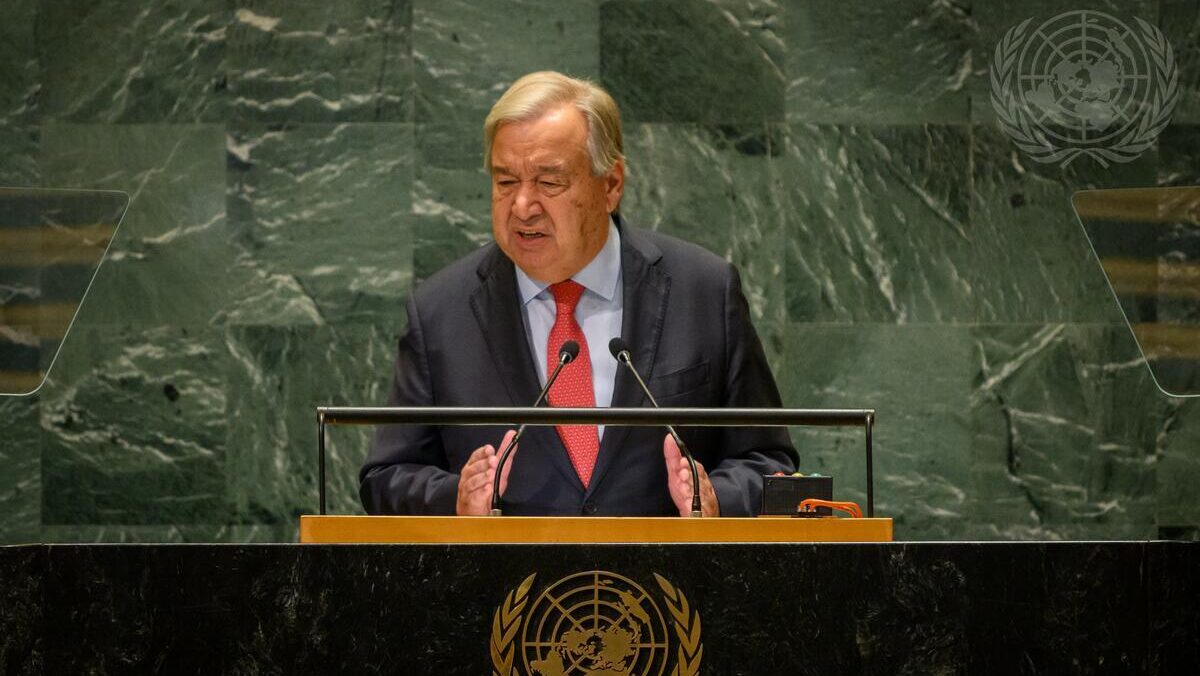
UN Secretary-General António Guterres opened the debate by emphasizing the growing climate of impunity that allows governments and political actors to violate international laws and human rights conventions, including the UN Charter. “We see this age of impunity everywhere—in the Middle East, in the heart of Europe, in the Horn of Africa,” Guterres stated.
He described the mass killings and destruction in Gaza as unprecedented, noting that 200 United Nations staff members had been killed, many slain alongside their families. “The speed and scale of the killing and destruction in Gaza are unlike anything in my years as Secretary-General,” Guterres said. He called for an immediate ceasefire, the unconditional release of hostages, and a committed effort toward a two-state solution. Guterres also warned that Lebanon is on the brink of becoming “another Gaza,” stating that the world cannot afford that. “Meanwhile, Gaza is a non-stop nightmare that threatens to take the entire region with it,” he stated.
Philémon Yang, President of the 79th session of the General Assembly, echoed these concerns. “For almost a year now, the people of Gaza and Israel have been caught in a spiraling cycle of conflict and retribution,” he said. “Indeed, only a two-State solution can end the cycle of violence and instability, ensuring peace, security and dignity for both Palestinians and Israelis.”
Brazilian President Lula da Silva was the first head of state to address the Assembly, describing the Israeli assault on Gaza and the West Bank as one of the worst humanitarian crises in recent history, with the conflict threatening to spill over into Lebanon. He condemned Israel’s actions as genocide and collective punishment that has killed more than 40,000 Palestinians, stating: “The right to defense has turned into a right to vengeance, which prevents an agreement for the release of hostages and postpones the ceasefire.”
US President Joe Biden, whose administration has provided financial and military aid to Israel used to massacre Palestinians, claimed that his country has been working with Qatar and Egypt on a ceasefire and hostage deal with the support of the UN Security Council. “Now is the time for the parties to finalize its terms, bring the hostages home, and secure security for Israel and Gaza,” Biden said, reiterating support for a two-state solution with “Israelis enjoying peace and security” and “Palestinians living in security, dignity and self-determination in a ‘state of their own’.”
While calling for diplomacy, Biden’s remarks were contradictory, as the US has supported Israel’s expansion of the conflict into other parts of the region, including Lebanon, Syria, Yemen, and Iran. Despite this, Biden claimed that “a full-scale war is not in anyone’s interest” and that “a diplomatic solution is still possible.”
Turkish President Recep Tayyip Erdoğan accused Israel of turning Gaza into “the largest cemetery for children and women in the world.” He condemned the United Nations for its inaction, saying that, as children die in Gaza, the UN system is dying too. He asked: “Are those in Gaza and the occupied West Bank not human beings? Do children in Palestine have no rights?”
Erdoğan also held the United Nations Security Council accountable for failing to prevent the genocide in Gaza. “What are you waiting for to prevent the genocide in Gaza and to put a ‘stop’ to this cruelty, this barbarism?” he asked. “How long are you going to be able to carry the shame of witnessing this massacre?” He further criticized countries that offer Israel unconditional support and blamed Israeli Prime Minister Benjamin Netanyahu for escalating the conflict and dragging the ‘Middle East’ deeper into a regional war.
Arab and Latin American leaders demand justice for Gaza
Jordan’s King Abdullah II bin al-Hussein accused Israel of deliberately targeting Palestinian civilians and UN workers, stating, “The UN is under attack, both literally and figuratively.” He criticized the blockade preventing UN aid convoys from reaching Gaza, as aid trucks “sit motionless just miles away from starving Palestinians.” King Abdullah also highlighted the ongoing killings and forced displacement of thousands of Palestinians in the West Bank since October 7. He added that the Arab world had extended its hand to Israel through “the Arab Peace Initiative” for years, but Israel rejected peace and chose confrontation instead.
Qatar’s Emir, Sheikh Tamim bin Hamad al-Thani, whose country has been mediating efforts for a ceasefire and prisoner exchange, described Israel’s actions in Gaza as a “crime of genocide” and “the most barbaric and heinous and extensive in breaching human values, international charters and norms.” He reaffirmed Qatar’s commitment to securing a permanent ceasefire and ensuring Palestinians gain their legitimate rights, above all an independent state with East Jerusalem as its capital.
Colombian President Gustavo Petro reminded the international community that Colombia had called for a peace conference for Palestine a year ago, before 20,000 Palestinian children were killed by Israel. He condemned the global community’s double standards, based on a foundation of racism. “The democratic project of humanity is dying,” Petro said, “while those who stupidly believe that the Aryan race should dominate the world prepare to do just that through bombs and terror.”
“This is what is happening in Gaza and Lebanon,” he added. “When Gaza dies, humanity will die.”
A proposed security bill in the Italian parliament aims to criminalize activism and penalize acts of solidarity
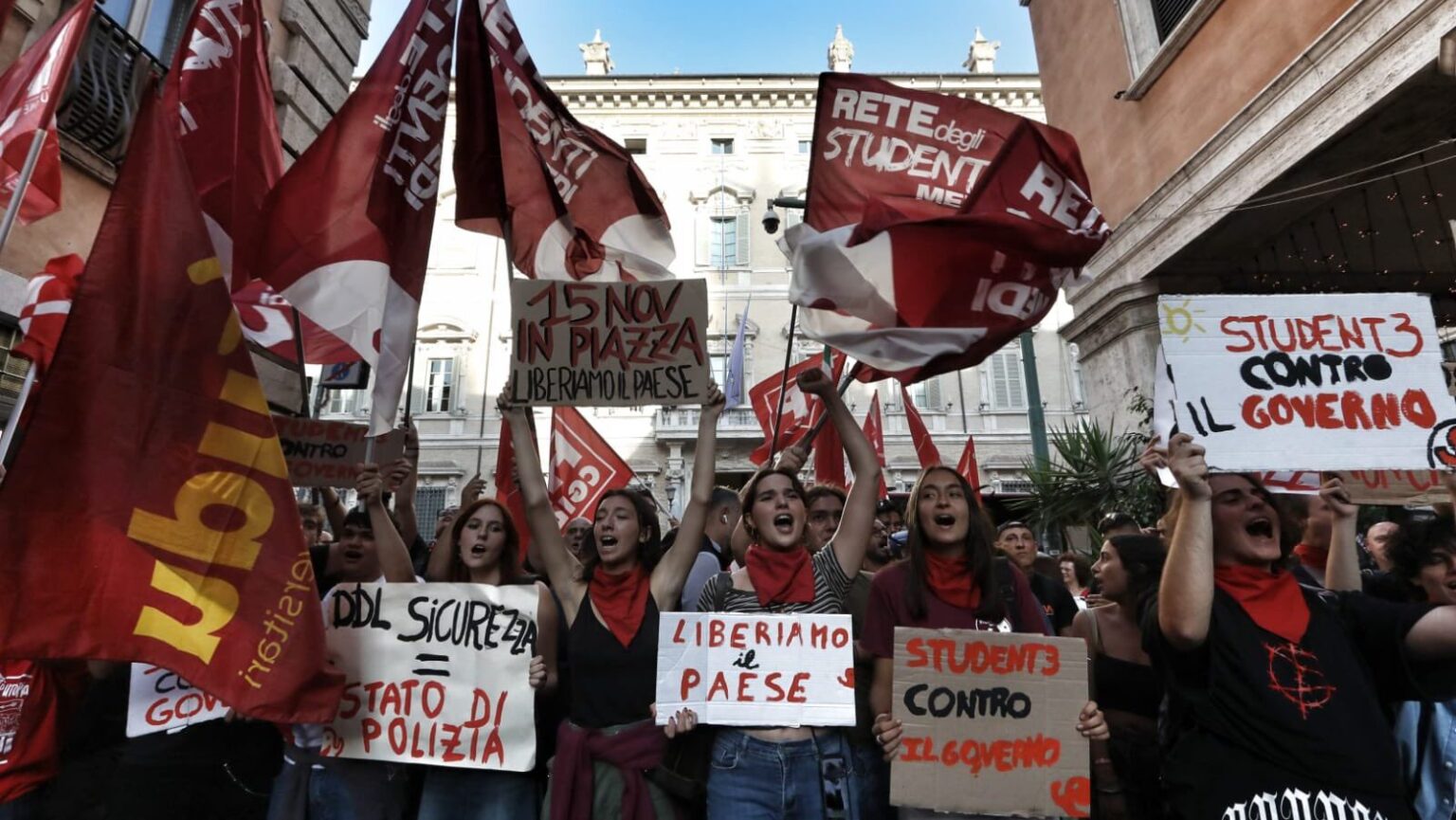
Giorgia Meloni’s government is on a rampage against popular dissent with a new bill under discussion in the Italian parliament. The proposed legislation seeks to penalize solidarity and criminalize activism, with the working class, migrants, and climate activists particularly at risk. In recent days, widespread protests have erupted, with trade unions, anti-fascist networks, and student groups all vowing to resist Meloni’s plans.
Giuliano Granato, a member of the left political party Power to the People (Potere al Popolo), criticized the bill’s framing as security legislation. He argued that it should instead be called the “Repression Bill” because “it responds to the country’s social needs only with more imprisonment and crime.”
“The government is saying that dissent and dispute are crimes in this country,” Granato added. “We believe they are the essence of democracy, and every achievement made over the decades is thanks to the struggles of the working classes.”
One of the bill’s most significant provisions is a crackdown on activists who block roads or railways during protests. Initially seen as targeting climate activists known for these tactics, the left has warned that it will also affect workers’ struggles. Granato pointed out that workers have also used such methods to protest, including during industrial action at Whirlpool factories over the last years.
Italy’s largest trade unions have echoed these concerns. The Italian General Confederation of Labor (CGIL) criticized the bill, arguing it represents an attack on trade union mobilizations aimed at protecting jobs and addressing company crises. In a joint statement with ANPI, the national anti-fascist network, the CGIL wrote: “The right wing continues to regard security only in terms of repression and punishment of social struggles.” Both organizations were at the forefront of protests held in several Italian cities on Wednesday, September 25.
The bill’s impact would extend beyond activists and workers, with prisoners facing harsh consequences. It proposes penalties for peaceful protests in prisons, such as sit-ins. Furthermore, limited protections currently granted to specific groups, like pregnant women or mothers of infants under one year of age, would be taken away. This would mean that babies would remain jailed with their mothers, despite only a handful of facilities being equipped to accommodate them. Legal and psychological experts have warned of the shocking impact this would have on children’s development even if capacities were expanded.
Migrants, the poor, and those showing solidarity with them are also at risk under the proposed law. Anti-eviction actions and those refusing to vacate spaces under threat of homelessness would be criminalized. Migrants without residence permits would be barred from legally obtaining SIM cards, their only connection to family and friends at home. Merchants who disobey this provision would face temporary closures.
While most describe the security bill as paving the way for a permanent police state, some groups might be looking forward to it. Approximately 300,000 police and security personnel would be granted the right to carry unofficial weapons in both private and public spaces – an idea that is likely to instill fear, rather than a sense of security, in the vast majority of the population.
Opposition to Meloni’s security bill is converging with ongoing resistance to her other policies, including the controversial differentiated autonomy reform. On Thursday, September 26, over 1 million signatures calling for a referendum against the reform were submitted by trade union and social movement leaders. These groups have vowed to remain in the streets, defending their right to protest and express dissent despite the government’s attempts to suppress them.