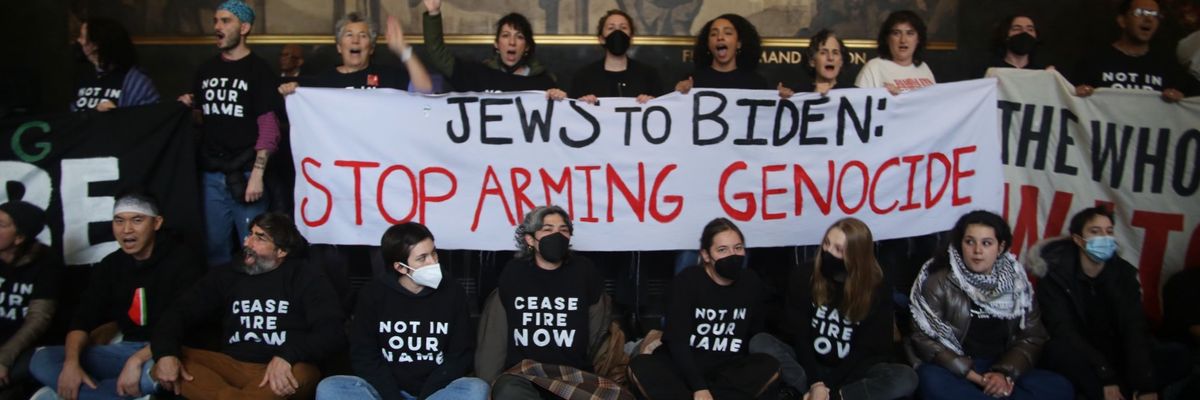
Jewish Voice for Peace activists and allies protest at NBC headquarters in New York City on February 26, 2024. (Photo: Jewish Voice for Peace New York)
“The president needs to start answering to the American people—not the far-right Israeli government indiscriminately bombing the people of Gaza,” said Jewish Voice for Peace.
The historic wave of Jewish-led protests against U.S. complicity in Isreal’s genocidal war on Gaza continued Monday as members of the group Jewish Voice for Peace were arrested for occupying NBC headquarters in New York City in a bid to disrupt the taping of President Joe Biden’s appearance on a popular late-night TV show.
JVP activists wearing shirts reading “Not In Our Name” unfurled banners and chanted slogans inside 30 Rockefeller Center in Midtown Manhattan, where Biden was taping an interview with the eponymous host of the “Late Night Show With Seth Meyers.”
“Biden, Biden, you can’t hide, you are funding genocide,” the protesters chanted. Banners implored the president to “Stop Arming Genocide” and push for a “Lasting Cease-Fire” in Gaza, where more than 100,000 Palestinians have been killed or wounded and around 90% of the population has been forcibly displaced since the October 7 attacks on Israel.
JUST NOW: Hundreds of Jews and allies just took over NBC’s famed 30 Rockefeller Center headquarters in NYC to disrupt @POTUS appearance on @LateNightSeth and make it clear that supporters of genocide are not welcome in our city. 50 protesters were arrested. 🧵 pic.twitter.com/z0bTC7VtcE
“President Biden’s deadly foreign policy has expedited weapons sales to Israel,” said Jewish Voice for Peace New York, which also criticized the administration for ignoring the International Court of Justice’s provisional ruling last month that Israel is “plausibly” perpetrating genocide, suspending funding to the United Nations Relief and Works Agency for Palestine Refugees in the Near East, and vetoing three U.N. cease-fire resolutions.
“The president needs to start answering to the American people—not the far-right Israeli government indiscriminately bombing the people of Gaza, destroying 70% of infrastructure, including hospitals, universities, and the electricity and water grids,” the group added.
Jay Saper of JVP said Monday that “our Jewish tradition teaches us that life is precious.”
“As Jewish New Yorkers, we are absolutely outraged that President Biden is actively supporting a genocide against the Palestinians of Gaza,” he added.
In addition to taping Tuesday’s “Late Night” episode, Biden and Meyers visited the on-site Van Leeuwen ice cream parlor, where the president ordered mint chip in a sugar cone. While there, a reporter asked when there would be a cease-fire in Gaza.
“My national security adviser tells me that we’re close, we’re close; it’s not done yet,” Biden replied. “My hope is by next Monday we’ll have a cease-fire.”
Biden gets ice cream with Seth Meyers . Ceasefire: “My national security adviser tells me that we’re close, we’re close, it’s not done yet. And my hope is that by next Monday." Border: "I've been planning to go Thursday. What I didn't know is my good friend apparently is going" pic.twitter.com/Lwde3FB6yk
Early in the war, Biden proclaimed his “rock-solid and unwavering” commitment to Israel while refusing to call for a cease-fire. As Israeli bombs and bullets killed and maimed tens of thousands of Palestinians—mostly women and children—the president asked for over $14 billion in additional U.S. military aid to Israel, which already receives nearly $4 billion from Washington annually. Biden also repeatedly circumvented Congress to expedite emergency military assistance to the key Middle East ally.
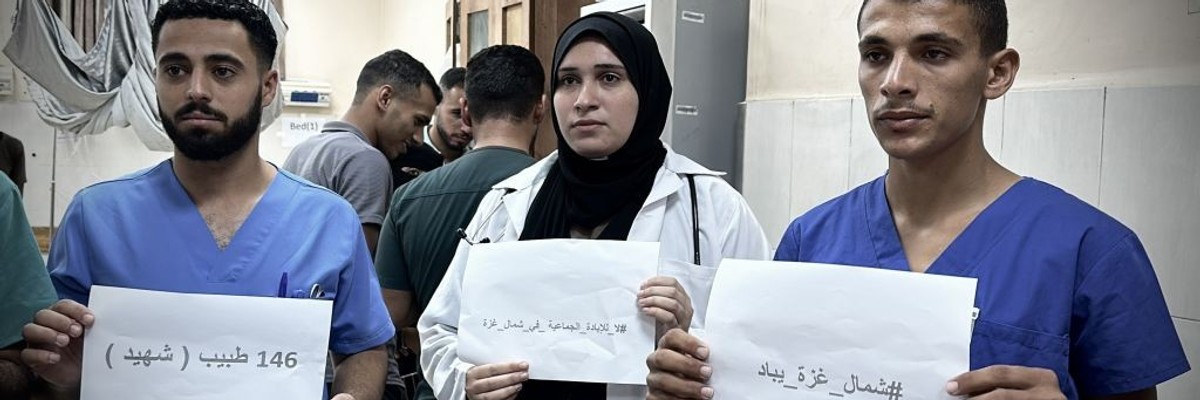
Health workers, holding banners and placards, gather at the Nasser Hospital to protest Israeli army’s attacks on northern Gaza and the prevention of the entry of necessary equipment and supplies to the besieged hospitals in Khan Yunis, Gaza on October 19, 2024. (Photo by Doaa Albaz/Anadolu via Getty Images)
As the situation inside Gaza is increasingly described as “indescribable,” medical NGOs blocked from providing care to Palestinians trapped inside besieged territory demand world leaders to stop turning ‘blind eye’ to Israeli war crimes and violations of humanitarian law.
As more Israeli bombing of the Jabalia refugee camp in northern Gaza killed dozens of people Saturday, health workers from both inside and out of the besieged territory are again pleading with world leaders to bring an end to the indiscriminate attacks and imposed humanitarian crisis that witnesses on the ground increasingly say there are no words to describe.
At al Nasser Hospital in Khan Yunis and elsewhere in Gaza, doctors and other medical staff on Saturday staged protests and held press conferences to call attention to the ongoing attacks in northern areas, including the latest targeting of Jabalia in which reporting indicated anywhere from 33 to over 50 people—including civilian men, women, and children—were killed.
“The world is watching, and history will judge us by how we respond to this grave injustice. I call upon each and everyone one of you to join this fight for the preservation of our shared humanity.” —Dr. Khaled Saleh, FAJR Scientific
Al-Jazeera reports that hospitals, which have repeatedly been bombed by Israel over the last year, were not immune from this latest round:
Three partially functioning hospitals treating severely wounded patients and sheltering thousands of displaced Palestinian civilians in northern Gaza are now out of service after coming under intense Israeli fire, a Gaza health official told Al Jazeera, as the siege on Jabalia enters its third week, with at least 33 more people killed in the northern area.
Israeli forces bombed al-Awda Hospital in Jabalia early on Saturday, and have also shelled Kamal Adwan and the Indonesian hospitals in Beit Lahiya over the past few hours, Al Jazeera correspondents have reported.
Saturday’s attacks come days after Israel barred at least six medical service NGOs from continuing their life-saving work in Gaza. According to the Washington Post:
Two of those medical NGOs, Glia and the Palestinian American Medical Association (PAMA), confirmed to The Washington Post that they were notified by the WHO this week about the bans. Both groups have worked in Gaza for years preceding the war.
“WHO is concerned about the impact of these denials on Gaza’s strained healthcare system,” the organization said Thursday in a statement. It added that international emergency medical teams (EMTs) deployed to Gaza are essential to keeping the system operational, as only 17 of the enclave’s 36 hospitals remain functionaland “healthcare needs far exceed the system’s capacity.”
Dr. Khaled Saleh, chair of FAJR Scientific, which provides surgical expertise and trauma specialists to war-torn regions and was another of the groups notified by the WHO that it had been barred from entering Gaza, said in a statement that the move by the Israeli government filled him with “deep sadness and concern for the current state of our global family, questioning our shared humanity and ethics.”
Blocked from providing aid to people in dire need, Saleh called on people worldwide to push for an end to Israel’s blocking of vital medical aid and those seeking to provide it.
“This is a devastating blow to humanity, representing a level of destruction that we have not witnessed since World War II, yet our world leaders turn a blind eye,” he said.
“As a member of the global community,” Saleh continued, “I implore all of you who value compassion, ethics, and the sanctity of human life to stand with us and raise your voices against this unconscionable decision. Together, we must advocate for the voiceless and demand restoration of the fundamental right to access to medical care.”
Israel’s ban on the medical NGOs comes after a string of healthcare professionals who spent time in the Gaza strip have gone public with what they witnessed on the ground, telling tales of unspeakable horror and trying to shake the world out of its complacency on what experts say is a genocide in motion being carried out by Israeli forces.
Earlier this week, the UN humanitarian office, OCHA, said that Israel’s continued blocking of food and medical supplies to Jabalia and other ares in the northern was “having life-threatening impacts” for the people there.
OCHA spokesperson Farhan Haq said the OCHA was calling on Israeli authorities “to allowed safe, sustained and unimpeded access to Jabalia and all areas of the north where people are in desperate need of assistance.”
In a post on Friday, Oxfam International mourned the killing of Dr. Ahmad Al-Najar and midwife Laila Jneid, both of whom worked with Juzoor, “killed by Israeli airstrikes on Jabalia,” the group said. “They were providing lifesaving health care in Gaza. Attacking aid workers is a war crime.” Oxfam repeated its demand for a “cease-fire now” and said healthcare workers should never be a target.
In a dispatch on Friday, Dr. Taghreed Al-Imawi, Juzoor staff and an OBGYN doctor at Kamal Adwan Hospital in northern Gaza, described the untenable situation on the ground.
“The situation is beyond horrific and is very difficult and indescribable,” said Al-Imawi. “Dead people, severed body parts and injured people everywhere. We are receiving emergency calls from all the areas of the north. Ambulances are not able to reach the injured. We have seen more than 23 pregnant women among the injured coming to the hospital since last week, wounded either by shrapnel or gunfire, suffering from fractures. Some were in a critical condition. Kamal Adwan Hospital and other semi-operational hospitals have received displacement orders but there is no way to evacuate in any case.”
“The pediatrics section is closed as it is full of injured people,” Al-Imawi added, “the surgery section is full of injured people, even the reception, the hospital has been shelled several times and targeted by snipers, people are terrified to come to the hospital now.”
Having recently returned from a field mission in Gaza, pediatric nurse Becky Platt, working through Save the Children—who posted her testimony Saturday—described a situation on the ground that was “like nothing I’ve seen before.”
Platt said the horrific situation is “both in terms of healthcare need and just in terms of the whole humanitarian context—seeing homes and landscapes completely devastated and seeing just the absolute level of human suffering and need as absolutely mind blowing.”
https://twitter.com/i/status/1847518629484478816
“No child should have to be in pain,” she said. “And it just feels like your hands are tied when you can’t do what you know that you could do easily at home or in another context. I think that when it really hits. It’s just—it’s just not fair. It’s not okay that we’ve got children with devastating injuries who don’t have access to pain relief.”
For his part, Dr. Saleh of FAJR Scientific, said it was up to everyone in the world to make their voices heard.
“The world is watching,” he said, “and history will judge us by how we respond to this grave injustice. I call upon each and everyone one of you to join this fight for the preservation of our shared humanity.”
Over 2,000 people took to the streets of Naples against soaring military spending in Europe and increased repression of dissent as G7 defense ministers convened for high-level talks
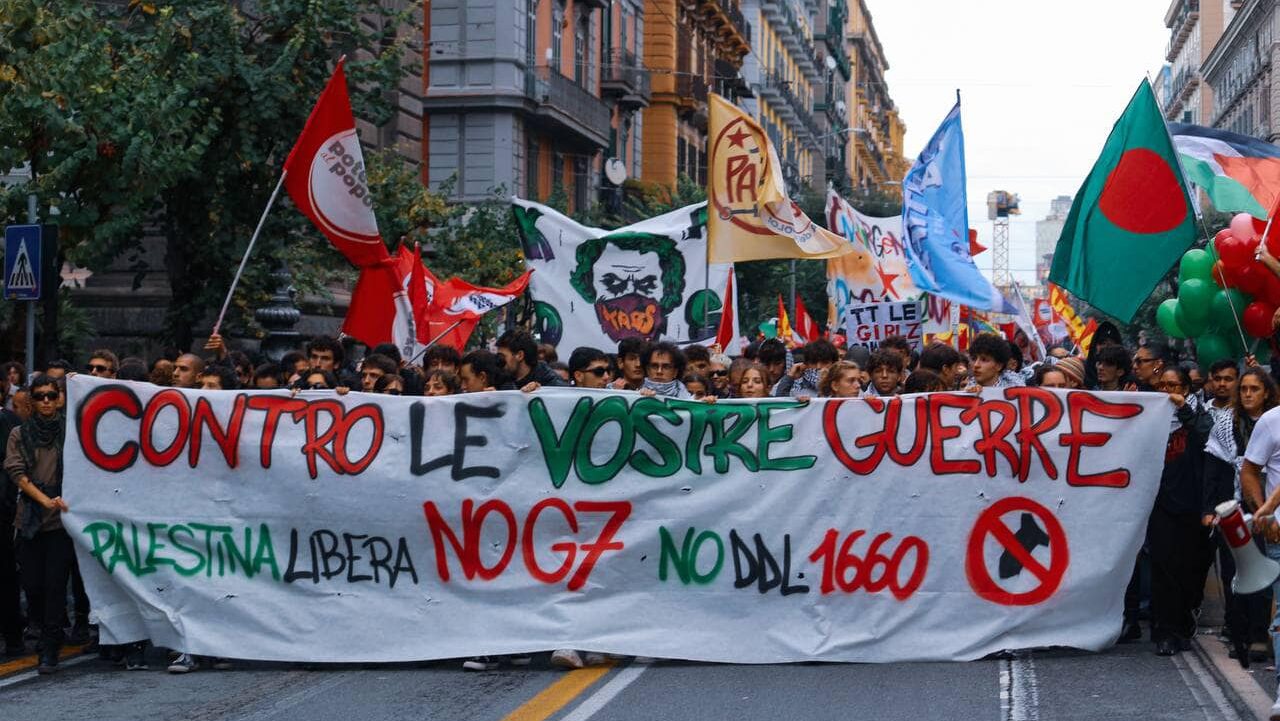
Thousands of people took to the streets of Naples on October 19, demonstrating against the G7 military agenda and Italy’s proposed reforms that would limit the freedom to dissent. Protesters, representing a host of organizations including student associations, trade unions, and community centers, rallied against Prime Minister Giorgia Meloni’s government’s policies, demanding a shift in priorities toward social needs instead of military spending. Side by side with the protest in Naples, demonstrations were held in dozens of cities across Italy, as reported by the left political party, Power to the People (Potere al Popolo).
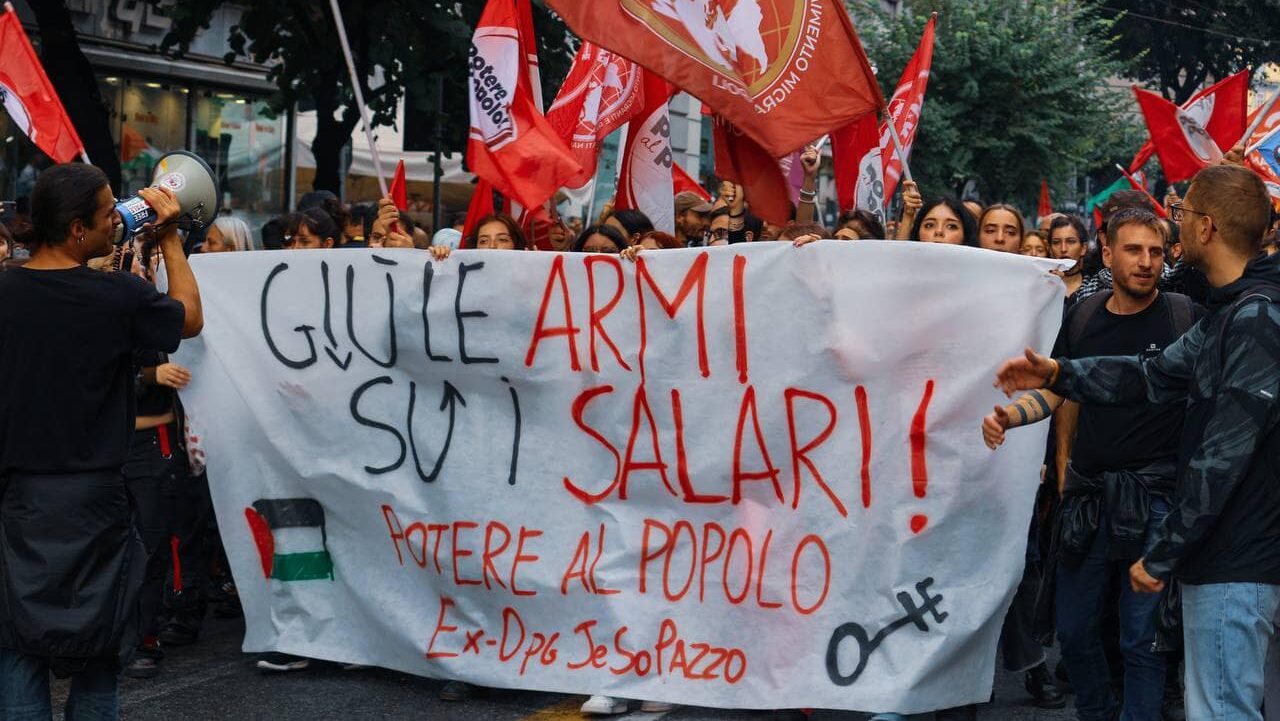
Protesters carrying a banner reading “Cut the weapons, raise the wages!”. Source: Ex OPG occupato – Je so’ pazzo/Facebook
The protest was organized to counter a G7 defense ministers’ meeting that took place in Naples from October 18 to 20, with a focus on global military goals. The meeting was seen by protesters as yet another example of Western countries deepening their involvement in wars, including the ongoing genocide in Gaza and the war in Ukraine, instead of pursuing agendas of social justice and peace. In the lead-up to the meeting, local activists voiced their opposition, stating that “lords of war” were not welcome in their city.
“Never has so much been spent on war, and as a result, war is rampant everywhere,” the associations organizing the march asserted during the preparations. “We refuse to host a meeting in our city that supports the war economy our government has chosen to follow.”
Two central issues dominated the protest in Naples: the West’s support for Israel as it continues to exterminate the people of Gaza and the increasing repression of dissent at home, embodied in Meloni’s proposed security bill. Many protesters pointed out the link between military aggression abroad and domestic policies that seek to criminalize dissent. European countries continue to actively repress solidarity with Palestine and others, like Italy, are doing so while attempting to silence voices against their policies.
The new security bill seeks to impose severe restrictions on protests, including strikes and environmental activism. Progressive associations argue that this is a blatant attempt to stifle opposition and consolidate power, and some of them saw Saturday’s protest as a test run for the government’s strategy of suppressing future mobilizations. Days before the protest, authorities tried to restrict the march route, forcing organizers to end the demonstration a kilometer away from the G7 meeting site.
Despite these attempts, protesters refused to be stopped. They briefly broke through the set course of the rally, marching in areas originally declared off-limits by the authorities. In response, police deployed tear gas and used other forms of violence against them. Naples’ historic center has systematically been blocked off to popular protests, and things are set to get worse if the new bill is passed, protesters said. Because of that, community groups including Ex OPG – Je so’ pazzo called upon people to continue resisting.
“We believe this repressive project must be stopped, and more importantly, we see it as a reflection of the Meloni government’s fear of what might still be burning beneath the surface of the seeming calm in the country,” they said.
Saturday’s protest marked an important moment of resistance against the shrinking of democratic space in Italy, as well as to the strengthening of the armament agenda in Europe. Demonstrators announced they were ready to continue fighting against the security bill and expressed determination to challenge Meloni’s government over announced cuts to social support.
“Today, this square is sending a loud message: if the government thinks it can ignore social needs, public healthcare, workers’ rights, and housing in favor of pouring billions into military spending, it’s headed in the wrong direction,” said Chiara Capretti from Power to the People.
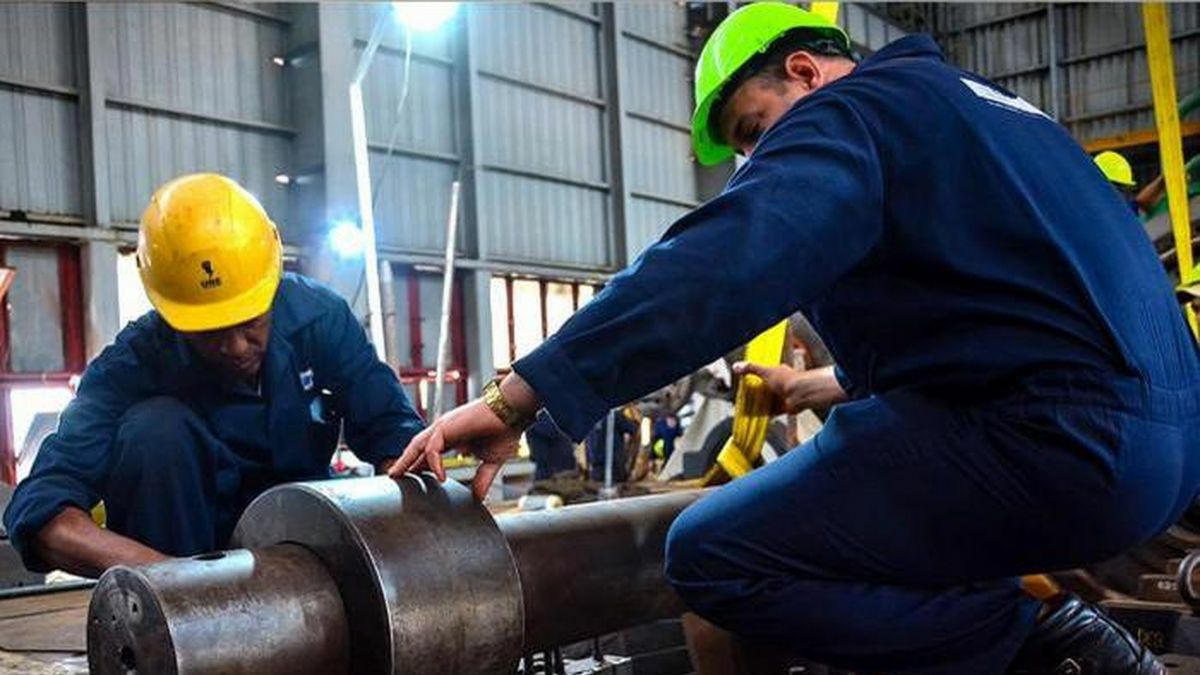
Workers in Cuba have worked to gradually restore the power grid. Photo: Minister of Energy and Mines
After several false starts over the weekend, the efforts to recover Cuba’s electrical system began to make headway on October 21. Meanwhile, authorities have declared that Oscar has become a tropical storm.
In this regard, President Miguel Dïaz-Canel said “We were at the National Load Dispatch since very early in the morning. The microsystems in the country are being strengthened and Havana is gradually receiving energy. It is a complex job, but we are taking sure steps. We said that we will not rest until the total reestablishment.”
In other parts of the country, reconnections continue while attempts are made to repair the damages suffered by the thermoelectric power plants, which, due to the difficulties of access to spare parts and technological elements that help to repower the system (caused fundamentally by the criminal economic blockade suffered by Cuba on the part of the US government), the repair tasks are very complicated.
Tropical Storm Oscar
Amid the critical situation with the collapse of the power grid, Hurricane Oscar made landfall on the Caribbean Island late on Sunday. Fortunately for the inhabitants of eastern Cuba, the storm downgraded its intensity and hit the island as a tropical storm, though still unleashing heavy rains and wind in the eastern region. The level of damage that Oscar can produce is still uncertain.
La tormenta tropical Oscar transita lentamente por el Oriente de #Cuba. Se trabajan intensamente para proteger al pueblo y minimizar las afectaciones. Son múltiples las muestras de solidaridad entre nuestra gente. Como se explicó existe un grupo de recursos para la recuperación. pic.twitter.com/26LzX5Qhqw
According to experts, the storm is now headed to the Bahamas, though authorities have called on the population to not lower their guard and to be alert to official communication channels.
The world stands with Cuba
Amid Cuba’s blackout, the member states of the Bolivarian Alliance of the Peoples of Our America (ALBA-TCP), expressed in a communiqué their support to the Cuban government and offered their help to overcome the difficult times the island is going through: “The complex situation that [Cuba] is experiencing today is a consequence of the economic war, financial persecution and [the refusal to sell] fuel supplies by the US administration, which seeks to asphyxiate Cuba in its commitment to the well-being of the Cuban people”.
Furthermore, the communiqué adds “The policy of maximum pressure through unilateral coercive measures and the blockade against the nation is cruel and inhuman and has been categorically rejected by the majority of the countries of the world, since […] it only seeks a change of regime, in open violation of the purposes and principles of the United Nations Charter and the norms of International Law.”
In a press conference on October 21, the spokesperson of the Ministry of Foreign Affairs of China, Lin Jian, also expressed support to Cuba as it faces unprecedented challenges, “[The] US blockade on Cuba has been catastrophic for Cuba’s socioeconomic development and people’s lives. China once again calls on the US to fully lift the blockade and sanctions on Cuba at once and remove Cuba from the list of ‘state sponsors of terrorism.’”
In a statement, the platform of social movements of Latin America and the Caribbean, ALBA Movimientos, categorized the current situation on the island as one of “anguish and tension, a product of the suffering induced by the criminal blockade.” ALBA Movimientos argues that the US-imposed blockade ultimately seeks to “undermine the role of the Cuban State in satisfying the basic needs of the population, while trying to privilege an incipient private sector, incapable by its condition of providing the levels and extent of social justice achieved by the Revolution.”
In the statement, the movements also warn that this latest episode of blockade-induced hardship on the island could be seized upon by reactionary, counter-revolutionary forces. “At this moment, all the psychological pressure apparatus is being used to induce a social outburst of unforeseeable consequences, using as a basis and pretext the legitimate expressions of social unrest resulting from the current situation, its accumulated and possible solutions,” it warns.
The only viable solution which would respect the sovereignty of Cuba and guarantee the possibility of dignified life, is the immediate and irreversible lifting of the blockade on Cuba, concludes ALBA.
Meanwhile, the White House spokesperson Karine Jean-Pierre claimed in a press conference on October 21, that the US is “not to blame for the blackouts on the island or the overall energy situation in Cuba.”
PEACE: Former Labour Party leader and now independent MP Jeremy Corbyn speaks at a London rally for Palestine, September 11 2024
Speaking at the Podemos congress over the weekend, JEREMY CORBYN MP outlines three crucial areas for building a powerful leftist movement across Europe: opposing austerity, promoting peace and combating the far right
AS we look to build a united left across Europe, there are three key issues that can form the basis of a strong, powerful movement: anti-austerity, peace and opposition to the far right.
Europe is heading toward a renewed era of austerity. We have witnessed attacks on wages and conditions all over Europe. Working-class living standards have fallen. Wages have stagnated. Meanwhile, there are more billionaires than ever before.
Inequality is not inevitable. It is the result of decisions that governments take to take money from the many and give it to the few. Last week, the British government celebrated its 100-day anniversary.
In that time, it has made two supposedly “tough” choices. One is to keep children in poverty by retaining the two-child benefits cap, refusing to lift 250,000 children out of poverty. The second decision was to cut the winter fuel allowance for 10 million pensioners.
We are told that these have been “tough choices.” Every day, my constituents make tough choices. Tough choices like deciding whether to heat their homes or put food on the table. Tough choices like taking out a loan to pay for this month’s rent. Tough choices like selling their home to pay for their family’s social care.
The government knows that there is a range of choices available to them. They could introduce wealth taxes to raise upwards of £10 billion. They could stop wasting public money on private contracts. They could launch a fundamental redistribution of power by bringing water and energy into full public ownership.
Instead, they have opted to take resources away from people who were promised things would change. There is plenty of money, it’s just in the wrong hands — and we will not be fooled by ministers’ attempts to feign regret over cruel decisions they know they don’t have to take.
Austerity is not a tough choice. It is the wrong choice. The British government tells us there is no money. At the very same time, they are committing to raising defence expenditure to 2.5 per cent of GDP.