What legitimacy is the PA talking about?

Spread the love

https://www.middleeastmonitor.com/20250116-what-legitimacy-is-the-pa-talking-about

Palestinian Prime Minister Mohammad Mustafa speaks during the first meeting with the new cabinet at the Prime Minister’s Office in Ramallah, West Bank on April 02, 2024 [Issam Rimawi – Anadolu Agency]

“While we are waiting for the ceasefire, it is important to stress that it won’t be acceptable for any other entity to govern the Gaza Strip but the legitimate Palestinian leadership and the government of the state of Palestine,” the Palestinian Authority’s Prime Minister, Mohammad Mustafa, stated during a meeting of the Global Alliance for the Implementation of the Two-State Solution.

The PA is not a legitimate leadership. In 2006, Hamas won the Palestinian legislative elections, disturbing the Western world’s preferred outcome. Democracy, according to the West, can only conform with Western expectations; therefore Palestinians got a taste of what the US does when democracy crashes imperialist expectations. Instead of respecting the electoral result, the US and Fatah embarked upon a series of destabilisation and coercion tactics, aimed at marginalising Hamas further and ultimately destroying the legitimate representation of Palestinians according to the 2006 electoral result.

While Hamas was shunned and its diplomatic efforts rebuffed, even though it combined resistance and political pragmatism, the PA intensified its efforts at forcing Hamas to relinquish power, enforcing sanctions on an enclave repeatedly bombarded by Israel. When Palestinians in the Occupied West Bank protested against such authoritarianism and cruelty, the PA unleashed its security services on civilians, and continues to do so. As the US and the EU continued funnelling funds to enhance the PA’s brutality under the guise of state-building, and the PA continued harming Palestinians in the name of security, to the point of detaining, torturing and, at times, killing their critics.

READ: Palestinian Authority must run Gaza after war, Prime Minister says

All this was orchestrated because the international community sided with an illegitimate political representation under the auspices of democracy. Are we to assume that legitimacy and democracy change meaning according to colonial and imperialist interests? What of the importance of language, which is of equal importance in the anti-colonial struggle against Israel and the PA?

Back to the present. Since Israel started its genocide in Gaza, the PA has consistently sought to navigate the corridors of power by presenting itself as an alternative to Hamas. Yet, in doing so, it completely neglected the fact that its silence on the genocide is tantamount to tacit support. The PA merely reiterated the importance of the two-state paradigm as it has for decades, with no acknowledgement of the fact that not even the hypothesis can sustain itself, let alone implementation. Meanwhile, to garner favour with Israel and the international community, and possibly prove how relevant it is to post-genocide Gaza governance, the PA started its own attack against the Palestinian Resistance.

The question is, since legitimacy does not hold the same meaning for the PA and its accomplices, what does legitimacy mean in the context of its Prime Minister citing legitimacy as the reason why the PA should return to Gaza? There is no other acceptable entity, according to the PA – based on what parameters? Just as genocide became synonymous with human rights in the Israeli and international narrative, is the PA’s illegitimate rule becoming synonymous with democracy? Why hasn’t the PA suggested elections and why has the international community not voiced any concern over Ramallah wanting to extend its power to Gaza?

The PA’s attempts to prove itself purportedly worthy of governing Gaza are precisely the reason why it should not. The PA’s only foundations are foreign funding and Israeli colonialism. Having sold itself to the two highest bidders (not forgetting the tangible illegitimacy since 2006), what Palestinian leadership and legitimacy is the PA really talking about?

OPINION: What fate awaits Abbas and his Authority?

The views expressed in this article belong to the author and do not necessarily reflect the editorial policy of Middle East Monitor.

This work by Middle East Monitor is licensed under a Creative Commons Attribution-NonCommercial-ShareAlike 4.0 International License

Continue ReadingWhat legitimacy is the PA talking about?

Gaza ‘humanitarian zone’ struck almost 100 times since May, BBC Verify finds

Spread the love

https://www.bbc.com/news/articles/cx2jld7j50eo

The area in Gaza which Israel’s military has told people to go to “for their safety” has been hit by 97 strikes since May, BBC Verify analysis has revealed.

The findings come as negotiations for a ceasefire between Israel and Hamas appear to be nearing a breakthrough. Mediators in Qatar say talks are in their final stages, raising hopes that an agreement could be reached soon.

The “humanitarian zone” was first established by the Israel Defense Forces (IDF) in October 2023 to protect civilians and keep them out of harms way.

On 6 May 2024, the IDF significantly expanded the zone to include the cities of Khan Younis and Deir al-Balah.

The area – much of which is a strip of land along the Mediterranean sea – is densely populated and is estimated to have over a million people living there according to international humanitarian organisations. Many people are living in tents, with limited infrastructure and limited access to aid.

Local media reports indicate more than 550 people have been killed in the 97 strikes mapped by BBC Verify.

In a statement to BBC Verify, the IDF said it was targeting Hamas fighters operating in the “humanitarian zone” and accused the group of violating international law while “exploiting” civilians as human shields and launching rockets from the area.

Article continues at https://www.bbc.com/news/articles/cx2jld7j50eo

Continue ReadingGaza ‘humanitarian zone’ struck almost 100 times since May, BBC Verify finds

Green Party welcomes Gaza ceasefire and calls for root causes of the conflict to be addressed

Spread the love
Ellie Chowns, Green Party MP for North Herefordshire. CC image Wikipedia.

Ellie Chowns, MP for North Herefordshire and Green Party Foreign Affairs spokesperson, said: “I welcome the news of a ceasefire agreement between the Israeli government and Hamas. This is a vital step to halt the devastating violence that has claimed tens of thousands of lives and caused unimaginable suffering, particularly for the people of Gaza. I also welcome reports that hostages are being released, bringing relief to many families.

“The Green Party has been calling for a ceasefire since October 2023, and while this agreement offers hope, it must mark the beginning of addressing the root causes of the conflict. The ongoing occupation, the siege of Gaza, and systemic violations of Palestinian rights cannot continue.

“The UK government must formally recognise the State of Palestine. Recognising Palestine is a vital step toward justice, equality, and a sustainable peace. It demonstrates a commitment to international law and a balanced approach to the region.

“Suspending some arms sales to Israel is not enough. The Green Party has consistently called for a full suspension of all arms exports to the Israeli military. This includes UK-supplied weapons parts, such as components of the F-35 Joint Strike Fighter, which evidence suggests have been used in ways that violate international law and exacerbate the humanitarian crisis.

“The UK must support efforts to hold all those responsible for violations of international law accountable. We must ensure that humanitarian aid flows freely into Gaza to address the urgent needs of those who have endured this catastrophic violence.

“True peace requires justice, dignity, and equality for all people in the region. This is a moment for global leaders to act with courage and commitment, working towards a future where Palestinians and Israelis can live in peace, free from fear, violence, and oppression. Let us ensure that this ceasefire marks not just the end of the bombs, but the beginning of a pathway to lasting peace and justice.”

Experiencing issues with this image not appearing. I suspect because it's so critical of Zionist Keir Starmer's support of and complicity in Israel's genocides.
Genocide denier and Current UK Prime Minister Keir Starmer is quoted that he supports Zionism without qualification. He also confirms that UK air force support has been essential in Israel’s mass-murdering genocide. Includes URLs https://www.declassifieduk.org/keir-starmers-100-spy-flights-over-gaza-in-support-of-israel/ and https://youtu.be/O74hZCKKdpA
UK Foreign Minister David Lammy confirms that UK government and military are active participants in Israel’s genocides and that the F-35 parts that they suspended from supplying to Israel are instead simply diverted via the United States. He says see https://youtu.be/QILgUHrdWRE
Continue ReadingGreen Party welcomes Gaza ceasefire and calls for root causes of the conflict to be addressed

How the UK’s plans for AI could derail net zero – the numbers explained

Spread the love
Data centres use an enormous amount of electricity for cooling and to power servers. Andia/Alamy Stock Photo

Tom Jackson, Loughborough University and Ian R. Hodgkinson, Loughborough University

The UK government’s goal to increase public-controlled artificial intelligence computing power twentyfold by 2030 would significantly raise electricity demand. Can renewable energy supply meet it – and still have enough left over to electrify sectors like heating and transport, which must be fully decarbonised by 2050?

First, let’s discuss why AI is so energy intensive. AI systems demand a huge amount of computing power. The creation and use of AI involves training the programmes on models and algorithms that must be invented and calibrated, all of which demands computing power. Then, that AI model must draw conclusions from the new data it is fed, which is another energy-intensive process in itself.

The need for more and more computing power has risen sharply as AI has become more sophisticated. Computing power is becoming scarce as a result and is a major bottleneck for the further development and use of AI. Indeed, the UK’s national AI strategy published in 2021, recognised that computing power capacity must be increased if the potential of AI is to be realised.

The more sophisticated the AI, typically, the more energy intensive it is. This has significant implications for the UK.

How much energy does the AI rollout need?

Data centres (facilities that store, process and distribute data) are a significant and growing consumer of electricity. From training complex AI models, which requires immense computational power and data storage, to running data through trained AI models to make predictions or solve tasks, data centres are central to every stage of AI’s use and development.

According to estimates by the International Energy Agency, data centres globally account for approximately 1%-1.3% of total electricity consumption. One recent observation suggests that developing the most sophisticated AI systems currently requires a fourfold increase in the amount of computing power annually. The total amount of data required for AI training has also risen by 2.5 times a year, increasing reliance on data centres.

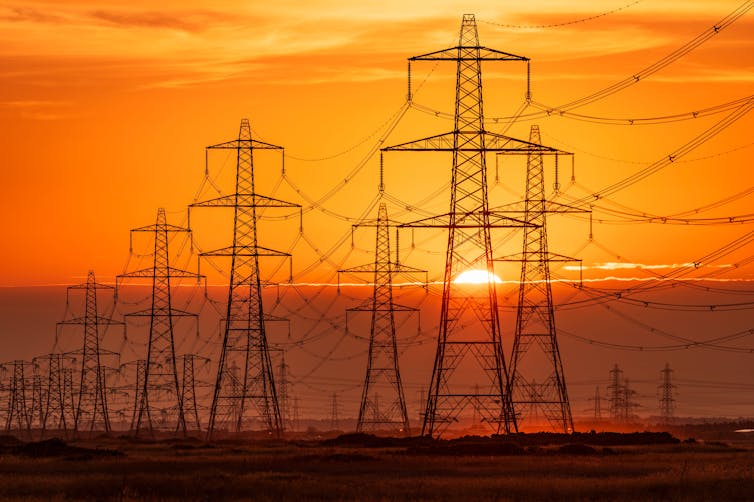
Pylons at sunset.
Britain’s electricity grid will strain to meet rising demand even without AI. SuxxesPhoto/Shutterstock

In the UK, AI and related infrastructure consumed around 3.6 terawatt-hours (TWh) of electricity in 2020. If this consumption increases twentyfold, as per the government’s target, it could reach 72 TWh by 2030. This would represent over one-quarter of the UK’s total electricity consumption in 2021, which was approximately 261 TWh.

The rapid growth in AI computing requires careful planning. However, data centres are only part of the equation. The devices that use AI, such as sensors in smart homes, gas and electricity meters, routers, wifi hubs, streaming devices and social media platforms, could add significant energy demand that is difficult to estimate.

These additional components of AI’s total energy consumption are often overlooked.

Renewable energy growth is insufficient

The UK has made significant strides in renewable energy production, with wind and solar power contributing over 40% of electricity in recent years.

However, our projections, reported in the journal Energy Policy, indicate that global renewable electricity supply will not meet surging demand from global digital data growth.

Our research considered different scenarios for AI’s energy use. The UK’s target of a twentyfold increase in AI computing power by 2030 is certainly a high-consumption scenario, in which energy demand from digital infrastructure alone could outpace the growth of renewable energy capacity.

At the same time, the UK’s decarbonisation hinges on electrifying transport and heating, sectors traditionally reliant on fossil fuels: replacing natural gas boilers with electric heat pumps and combustion engine cars with electric vehicles. These will require substantial increases in electricity supply.

A row of electric cars plugged into public chargers.
Britain’s electric vehicle charging network will need to expand to decarbonise transport. Shutterstock

However, solving this problem will not just require expanding renewable energy production. The energy efficiency of AI systems and related technologies must improve too. Ensuring that the energy needed for AI and other digital advancements is sustainably sourced, without compromising broader net zero goals, will require a combination of government policy, technological innovation and public awareness.

AI’s growing electricity needs could exacerbate competition for limited renewable energy resources. This competition risks increasing reliance on fossil fuels, especially during periods of peak energy demand. If additional renewable capacity cannot be deployed quickly enough, the UK might face a scenario where AI-driven electricity demand increases overall emissions rather than reducing them.

The UK’s commitment to a twentyfold increase in public AI computing power by 2030 presents an immense challenge for the country’s electricity system. Meeting this goal sustainably will require balancing AI’s energy needs with broader electrification goals and renewable energy limitations.

Without immediate and concerted efforts to expand renewable energy and improve efficiency, AI’s electricity demands could hinder the transition to a net zero future.


Don’t have time to read about climate change as much as you’d like?
Get a weekly roundup in your inbox instead. Every Wednesday, The Conversation’s environment editor writes Imagine, a short email that goes a little deeper into just one climate issue. Join the 40,000+ readers who’ve subscribed so far.


Tom Jackson, Professor of Information and Knowledge Management, Loughborough University and Ian R. Hodgkinson, Professor of Strategy, Loughborough University

This article is republished from The Conversation under a Creative Commons license. Read the original article.

Continue ReadingHow the UK’s plans for AI could derail net zero – the numbers explained