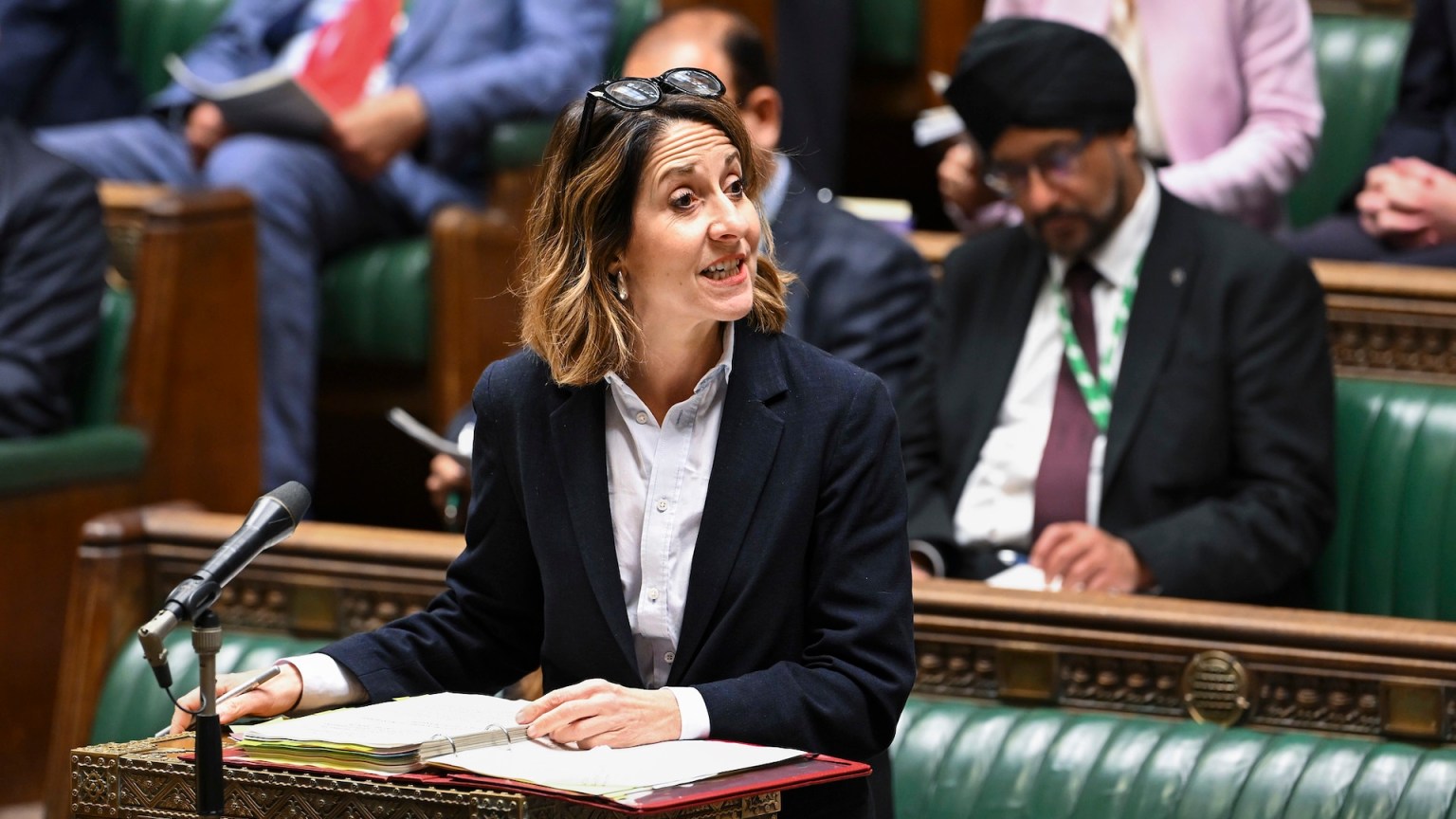
Work and pensions secretary Liz Kendall speaking in parliament. Image: House of Commons/ Flickr
The Labour government has indicated that it will stick with Tory plans to cut disability benefits after a High Court judge ruled the previous government’s consultation into the plans was unlawful.
The proposals would cut around £400 a month from the disability benefits of hundreds of thousands of new applicants by 2029, compared to what they would receive under the current system.
Earlier today (16 January) Mr Justice Calver ruled in favour of disability activist Ellen Clifford, who had brought a judicial review of the public consultation that was held by the Department for Work and Pensions (DWP) in autumn 2023.
The proposals would change the way the work capability assessment (WCA) functions, by reducing the weight attached to difficulties with mobility and getting around in considering applicants’ level of disability.
Responding to today’s verdict, a government spokesperson said: “The judge has found the previous government failed to adequately explain their proposals. As part of wider reforms that help people into work and ensure fiscal sustainability, the government will re-consult on the WCA descriptor changes, addressing the shortcomings in the previous consultation, in light of the judgment.
“The government intends to deliver the full level of savings in the public finances forecasts.”
It is not clear if Labour will consult on all the proposals in the original consultation, some of which were subsequently dropped, or whether it will only consult on the proposals that the last government chose to take forward.
The High Court ruling doesn’t force the government to ditch the proposals, although it would make it very difficult to proceed with them without holding a new consultation first.
A meeting of the child poverty taskforce. From left to right: Mayor of the North East Kim McGuinness, work and pensions secretary Liz Kendall and education secretary Bridget Phillippson. Image: Department for Education/ Flickr
Tory ministers presented reforms to disability benefits as a way to support disabled people into work – and they would have seen many worse off by at least £416.19 per month
The Department for Work and Pensions’ (DWP) consultation into plans to slash billions of pounds from disability benefits has been ruled unlawful in a damning High Court judgement.
In a judgment published this morning (16 January), Mr Justice Calver said that the judicial review, brought by disability activist Ellen Clifford, had “surmounted the substantial hurdle of establishing that the consultation was so unfair as to be unlawful”.
Repeatedly describing the DWP consultation in autumn 2023 as “misleading”, “rushed” and “unfair”, he said:
• The consultation documents failed to highlight the “substantial” loss of benefits facing those affected by the proposals.
• The consultation gave the “misleading impression” that changes were required to ensure deaf and disabled people could access employment support, when they could already choose to access this voluntarily.
• Despite the consultation presenting the changes as being solely about helping disabled people into work, in reality “costs savings was at least one of the two bases, if not the central basis, on which decisions would be taken on which policies would be taken forward by the government”.
• The eight-week consultation was unlawfully short in the circumstances.
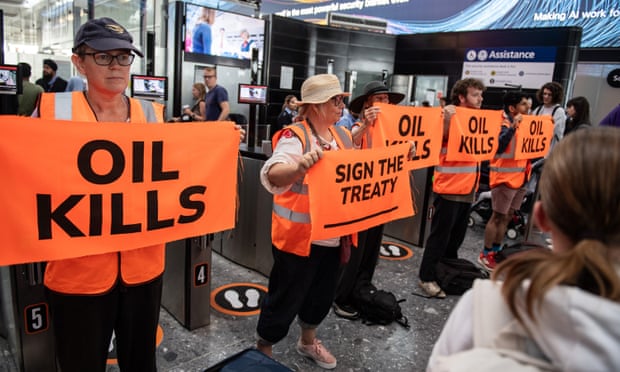
Just Stop Oil protesters at Heathrow airport. New powers granted to police have undermined free speech and peaceful assembly, the NGO says. Photograph: Guy Smallman/Getty Images
British director of Human Rights Watch attacks ‘dangerous hypocrisy’ of government
Britain’s crackdown on climate protest is setting “a dangerous precedent” around the world and undermining democratic rights, the UK director of Human Rights Watch has said.
Yasmine Ahmed accused the Labour government of hypocrisy over its claims to be committed to human rights and international law.
Ahmed said: “We’re at a stage where we’re talking about the … dangerous hypocrisy of what the UK government is saying and doing, and also the fact that the international community and the UN have [raised] and continue to raise the alarm about how this UK government responds to protest, and in particular climate protest.”
In the UK “laws criminalising protests undermine democratic rights”, the NGO says in its latest annual world report, published on Thursday, adding that in the past year “the UK continued to crack down on and criminalise climate protests”.
New powers granted to police by the Police, Crime, Sentencing and Courts Act 2022 and the Public Order Act 2023 have had the effect of undermining “free speech, peaceful assembly, and democratic rights in the UK”, the report says.
One nurse in the south-east of England told how ‘a patient died in the corridor but wasn’t discovered for hours’. Photograph: Jeff Moore/PA
Royal College of Nursing says people ‘routinely coming to harm’ with vital equipment not available and staff too busy
Patients are dying in hospital corridors and going undiscovered for hours, while others who suffer heart attacks cannot be given CPR because of overcrowding in walkways, a bombshell report on the state of the NHS has revealed.
So many patients are being cared for in hospital corridors across the UK that in some cases pregnant women are having miscarriages outside wards while other patients are unable to call for help because they have no call bell and are subjected to “animal-like conditions”, said the Royal College of Nursing.
The RCN warned that patients were “routinely coming to harm” and in some cases dying because vital equipment was not available and staff were too busy to give everyone adequate care.
Dr Adrian Boyle, the leader of Britain’s A&E doctors, said the nurses’ testimonies on which the report was based were so horrendous that it “must be a watershed moment, a line in the sand” and must prompt the government to redouble its efforts to get the NHS working properly again.
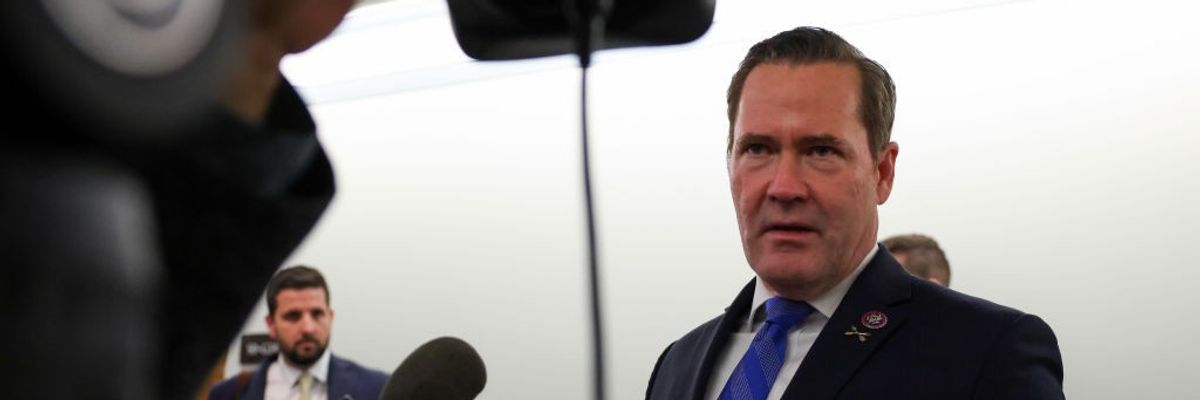
Rep. Mike Waltz (R-Fla.), President-elect Donald Trump’s national security adviser pick, walks to a Senate hearing on January 14, 2025 in Washington, D.C. (Photo: Kayla Bartkowski/Getty Images)
Journalist Jeremy Scahill noted that Mike Waltz’s comments echo “a plan Netanyahu has hinted at: Israel views this deal as only one phase to get the Israeli and U.S. hostages out.”
U.S. President-elect Donald Trump’s pick to serve as national security adviser said late Wednesday that the incoming administration will support future Israeli attacks on Gaza even as Trump hailed the tenuous new cease-fire and hostage-release agreement as a signal “to the entire world that my administration would seek peace.”
In an appearance on Fox News late Wednesday after the agreement was announced, Rep. Mike Waltz (R-Fla.) said that “we’ve made it very clear to the Israelis, and I want the people of Israel to hear me on this: If they need to go back in [to Gaza], we’re with them.”
“Hamas is not going to continue as a military entity and it’s certainly not going to govern Gaza,” Waltz added.
The national security adviser nominee expressed a similar position in a podcast appearance prior to the announcement of the cease-fire deal, which is currently in jeopardy as Israeli Prime Minister Benjamin Netanyahu accuses Hamas of reneging on the terms of the agreement—a claim Hamas has rejected.
Asked whether a cease-fire agreement would mean “the war is over,” Waltz said, “Hamas would like to believe that.”
“But we’ve been clear that Gaza has to be fully demilitarized, Hamas has to be destroyed to the point that it cannot reconstitute, and that Israel has every right to fully protect itself,” he added. “All of those objectives are still very much in place.”
“We need to get our people out,” Waltz continued, “and then we need to achieve those objectives in this war.”
Trump’s national security advisor Mike Waltz lays out a plan Netanyahu has hinted at: Israel views this deal as only one phase to get the Israeli and U.S. hostages out. He says Hamas will be destroyed and Gaza totally demilitarized. pic.twitter.com/4aBsPgXY3q
Drop Site‘s Jeremy Scahill noted that the approach Waltz laid out mirrors “a plan Netanyahu has hinted at: Israel views this deal as only one phase to get the Israeli and U.S. hostages out.”
Last month, Netanyahu said that Israeli forces would “return to fighting” once hostages are freed.
“There is no point in pretending otherwise,” said Netanyahu, “because returning to fighting is needed in order to complete the goals of the war.”
Under the first phase of the deal announced Wednesday, a six-week cease-fire would begin as soon as Sunday and 33 hostages would be freed in exchange for the release of more than 1,000 Palestinian detainees. The second and third stages of the deal are contingent upon negotiations that will take place during the first.
The text also stipulates the “withdrawal of Israeli forces eastwards from densely populated areas along the borders of the Gaza Strip” and a reduction of Israeli troop presence in the Philadelphi corridor—an issue that has repeatedly emerged as a sticking point in cease-fire negotiations.
The agreement states that “the Israeli side will gradually reduce the forces in the corridor area during stage 1 based on the accompanying maps and the agreement between both sides.”
“After the last hostage release of stage one, on day 42, the Israeli forces will begin their withdrawal and complete it no later than day 50,” the text continues.
But Netanyahu’s office insisted Thursday that the same number of forces would remain in the corridor during the deal’s first phase—a position that critics said runs counter to the agreement.
While Trump and his allies celebrated the announced agreement as a master stroke of dealmaking and aid groups voiced hope for some reprieve for devastated Palestinians in Gaza, Netanyahu’s spokesman told The New York Times in a text message that “there isn’t any deal at the moment.”
Israel’s cabinet was expected to vote on the deal Thursday, but Netanyahu delayed the meeting and accused Hamas of trying to “extort last-minute concessions.”
Hamas officials denied the charge, saying they are committed to the agreed-upon text.
Ruby Chen, the father of a 19-year-old Israeli-American soldier who was taken captive by Hamas on October 7, 2023, suggested Thursday that Netanyahu “might be looking to get out of” the deal as he faces backlash from far-right members of his coalition.
Citing unnamed sources, The Washington Post reported Thursday that “behind closed doors, Netanyahu has been promising his far-right allies that the war could resume after the first, 42-day phase of the cease-fire, when Hamas is to release 33 hostages in exchange for the release of more than 1,000 Palestinian prisoners.”
Paul Pillar, a non-resident fellow at the Quincy Institute for Responsible Statecraft, wrote Thursday that “there remains the possibility that a renewed war in Gaza will, beginning a few weeks from now, become a problem for Trump just as it was for Biden.”
“But two main factors will incline President Trump not to exert any pressure on the Israeli government to turn away from renewing its devastation and ethnic cleansing in the Gaza Strip,” Pillar predicted. “One is Trump’s relationship with his domestic evangelical political base, with its unconditional support for most anything Israel does. The other is that his ally Netanyahu has done him a big favor with his handling of the ceasefire negotiations, and now Trump owes Netanyahu favors in return.”
According to one Israeli report, Trump offered Netanyahu a “gift bag” of concessions in exchange for accepting a pre-inauguration cease-fire deal, including sanctions relief for violent Israeli settlers in the illegally occupied West Bank.