Analysis: UK would need forest ‘twice size of London’ to offset new airport expansion

Spread the love

Original article by Josh Gabbatiss Verner Viisainen republished from Carbon Brief.

Planes queuing for takeoff at Heathrow airport in Britain. Credit: david pearson / Alamy Stock Photo

A forest twice the size of Greater London would need to be planted in the UK to cancel out the extra emissions from the expansion of Heathrow, Gatwick and Luton airports, Carbon Brief analysis reveals.

New runaways at these airports surrounding London would result in cumulative emissions of around 92m tonnes of extra carbon dioxide equivalent (CO2e) by 2050, if the number of flights increases in line with their operating company targets.

If the UK is to remain on track for net-zero, it would need to cut emissions further in other sectors of the economy or remove an equivalent amount from the atmosphere.

For example, offsetting these emissions would require more than 300,000 hectares of trees to be planted within just a few years. This equates to all the trees planted in the UK since 2000.

The Labour government is set to back all three airport expansions, according to media reporting ahead of a speech by chancellor Rachel Reeves this week. 

This is in spite of opposition from within the Labour party and the government’s climate advisors recommending against airport expansion. 

Reeves has stressed that “sustainable aviation fuels” (SAFs) and electric planes could help to offset these emissions.

However, such technologies are still in the early stages of deployment and previous Carbon Brief analysis suggests the role of SAFs in achieving net-zero may be limited.

Two Londons

Reeves is expected to reveal plans for a third runway at Heathrow in a speech on Wednesday. 

This, alongside suggestions she will also announce her support for the expansion of Gatwick and Luton airports, has prompted days of political debate over the friction between the government’s climate and economic plans.

Reeves sees the expansion of airports as a key part of the government’s “growth strategy”. However, senior Labour politicians, notably energy secretary Ed Miliband, have previously opposed such expansions on environmental grounds.

For her part, the chancellor told BBC News that she thought “sustainable aviation and economic growth go hand in hand”.

Carbon Brief has used estimates of passenger numbers from the airports’ planning applications, combined with assumptions used by UK government advisors the Climate Change Committee (CCC), to calculate emissions from the three expansions.

As the chart below shows, the CCC assumes aviation emissions fall in the coming years due to technological and efficiency improvements.

However, the expansion of Heathrow, Gatwick and Luton would drive an uptick in emissions around 2040 as the projects are completed, if the expected number of extra flights take off and if there are no additional improvements in aircraft efficiency.

This would amount to an additional 92MtCO2e being emitted cumulatively by 2050.

In order to remain on track for the UK’s net-zero target, these emissions would need to be avoided by additional technological innovations in the aviation sector, balanced by faster cuts in other parts of the economy – or removed from the atmosphere after being emitted.
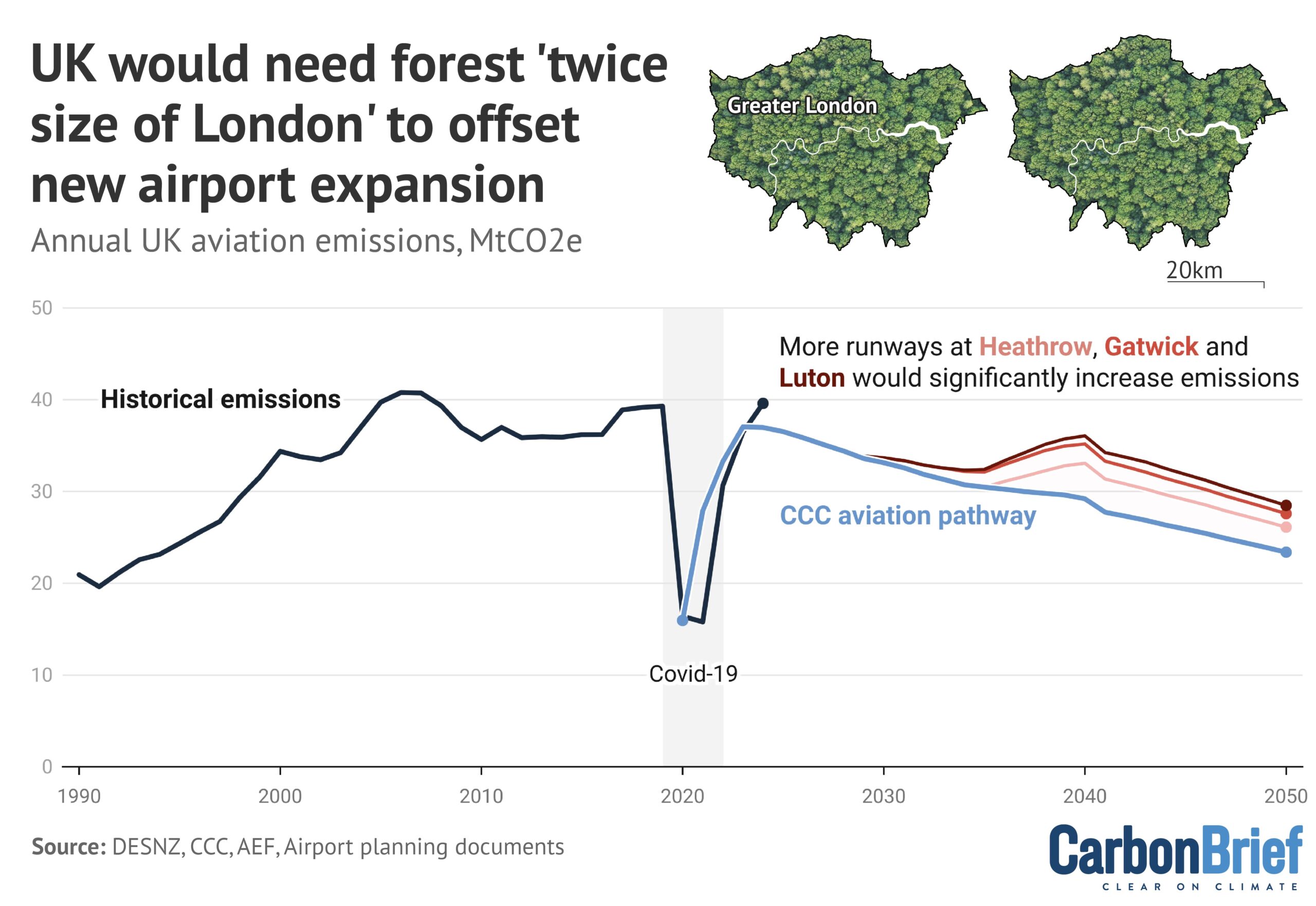
Annual UK aviation emissions, MtCO2e.
Annual UK aviation emissions, MtCO2e. The blue line indicates the trajectory for emissions set out by the CCC. The three red lines indicate the additional emissions that would result from the expansion of Heathrow, Gatwick and Luton airports, plus the resulting flights. The airport expansions are assumed to follow approximate timelines based on their respective planning applications, with some dates assumed based on the views of AEF. The Heathrow expansion is assumed to be in operation in 2035 and at full capacity by 2040. The Gatwick expansion is assumed to be operational in 2028 and at full capacity by 2038. The Luton expansion is assumed to be operational in 2033 and at full capacity by 2043. Sources: DESNZ, CCC, AEF, airport planning documents.

Aviation is generally viewed as a difficult sector to decarbonise, due to the lack of cheap and effective technologies to cut emissions from planes.

This is why campaigners and researchers frequently stress demand reduction as the most effective way to cut aviation emissions.

The UK’s net-zero plans already allow for aviation to be one of the final sectors producing sizable volumes of emissions in 2050, when most of the economy has decarbonised.

One strategy to remove the excess emissions from the additional Heathrow, Gatwick and Luton flights would be to plant more trees. However, this would be a significant undertaking, as Carbon Brief analysis shows.

It would require planting around 301,000 hectares of new forest by around 2028 so that the trees are large enough by the middle of the century to absorb significant amounts of CO2. 

This is equivalent to around twice the size of Greater London, which covers 157,000 hectares. It is 10 times higher than the UK’s most recent annual tree-planting target and equates to all of the trees planted in the past 24 years across the country.

More passengers

Government advisors at the CCC have recommended that there should be no more than a 25% growth in the number of air passengers from 2018 levels, in order to meet the UK’s net-zero goal by 2050.

This amounts to an increase from 292 million passengers to 365 million by 2050. The number of UK flights collapsed during Covid-19 lockdowns and has been slow to recover to pre-pandemic levels, but the number of air passengers in 2023 reached 273 million.

The CCC has consistently stressed that there should be “no net increase” in airport capacity if the UK is to reach net-zero by the middle of the century, meaning any expansion is “balanced by reductions in capacity elsewhere”. It has also stated there should be no airport expansion without a UK-wide framework for managing capacity.

The committee criticised the previous Conservative government for setting “no plans” to limit growth in passenger numbers in its “jet-zero” strategy, which envisaged demand for flying increasing by 70% out to 2050.

Airport expansion at Heathrow, Gatwick and Luton would help bring the total number of passengers at these three sites up to 243 million in 2050, according to the airports’ own planning applications, compiled by the Aviation Environment Federation (AEF).

This amounts to an additional 100m passengers passing through these airports, compared to 2018 levels. This would bring the total number of UK passengers to 392 million – equivalent to a 34% increase in UK airport traffic – meaning that growth at Heathrow, Gatwick and Luton alone would be enough to breach the CCC’s guidance.

(In reality, more than 20 UK airports have plans for more capacity and some already have unused capacity, so it is unlikely that expansion would be limited to three airports around London.)

SAF concerns

The CCC leaves some flexibility in its advice to the government, allowing for future capacity growth, if “the carbon intensity of aviation is outperforming the government’s emissions reduction pathway”. 

Essentially, if clean technologies slash aviation emissions faster than expected, then there will be space for more flights within a pathway to net-zero by 2050.

This has been alluded to by Reeves in recent days. She has stated that a “lot has changed in terms of aviation” and reportedly based an internal proposal to expand Heathrow on the use of “sustainable aviation fuels” (SAFs). 

In reality, there has been very limited progress in developing SAFs or any other technologies to decarbonise planes in the UK. In 2023, the CCC chastised the Conservative government for “rel[ying] heavily on nascent technologies”.

Government modelling has shown SAFs will have a limited impact on cutting UK aviation emissions. Experts have pointed to the issues with the supply of materials for making SAFs and noted that none of the five SAF plants originally pegged to start construction in the UK this year are being built yet.

Methodology

This analysis is based on the CCC’s sixth carbon budget “balanced pathway” for the aviation sector, combined with data obtained from AEF on the expected increase in passenger numbers from the expansion of Heathrow, Gatwick and Luton airports. 

The CCC pathway assumes that the emissions per passenger fall from 0.14 tCO2 in 2020 to 0.06tCO2 in 2050, accounting for the rollout of SAF and more efficient aircraft. It also assumes that no net expansion of airport capacity occurs. 

Therefore, in this analysis, the three airport expansions are considered additional to the emissions included within the CCC pathway. 

To calculate the additional emissions from the expansion of the three airports, the additional passenger numbers this would facilitate are multiplied by the emissions intensity per passenger in each year of the CCC pathway.

The additional passenger numbers from each airport are added to a Department for Transport pathway that assumes no further expansion. Each airport expansion is assumed to ramp up linearly from the year of operation to the year of operation at full additional capacity. 

Based on the airport planning applications and AEF, it is assumed that:

  • The Heathrow expansion will be operational by 2035 and operating at full capacity by 2040.
  • The Gatwick expansion will be operational by 2028 and operating at full capacity by 2038.
  • The Luton expansion will be operational by 2033 and operating at full capacity by 2043.  

The calculated CO2 removals from planting trees are based on assumptions used by the CCC’s sixth carbon budget “balanced pathway”, in which there is a 2:1 ratio of conifers to broadleaves planted across the country.

The CO2 removals per hectare for conifers and broadleaves are taken from the UK Centre for Ecology and Hydrology (CEH), whose numbers are also used by the CCC. 

Based on these numbers, the cumulative emissions removed per hectare of forest after 22 years – from the start of airport expansion in 2028 to 2050 – is 304tCO2. Dividing this value by the total additional cumulative emissions from the airport expansion (92 MtCO2), gives a total area required of 301,000ha. Given that Greater London is 157,200ha, this corresponds to approximately two (1.91) times the area of Greater London.

Historical UK aviation emissions are taken from the Department of Energy Security and Net Zero (DESNZ) up to 2022. For 2023 and 2024, the emissions are estimated based on percentage annual changes in UK jet fuel use, which are then applied to the emissions from 2022.

Original article by Josh Gabbatiss Verner Viisainen republished from Carbon Brief.

Continue ReadingAnalysis: UK would need forest ‘twice size of London’ to offset new airport expansion

We will ‘break your climate of fear’, peace activists warn police and politicians

Spread the love

https://morningstaronline.co.uk/article/we-will-break-your-climate-fear-peace-activists-warn-police-and-politicians

Former Labour leader Jeremy Corbyn, MP John McDonnell (front, fourth from left) and Khalid Abdalla (front row third from right) join people taking part in a national march for Palestine on Whitehall in central London, January 20, 2025

PEACE campaigners vowed to “break the climate of fear” fed by intensified police repression in a weekend rally to defend protest rights.

Hundreds gathered in Bethnal Green’s Atrium to discuss the Metropolitan Police’s mass detentions of marchers, including the violent arrest of chief steward Chris Nineham, at a Palestine solidarity demonstration on January 18, and the subsequent decision to charge Mr Nineham, Palestine Solidarity Campaign (PSC) director Ben Jamal and others with public order offences.

Mr Jamal said the policing that day was “an escalation of repression by the state against our movement.

“Very clearly in my view, the police sought to provoke scenes of disorder on the streets. They began arresting people very early for the crime of standing in the wrong bit of Whitehall at the wrong moment. They brought empty coaches to transport to police stations those they intended to arrest… despite the fact that every single one of our protests has been peaceful and has had a low rate of arrest.”

The PSC leader said police intended to create “a scene of chaos and disorder that would create the political climate to enable [Home Secretary] Yvette Cooper to go into Parliament and announce she was banning all future marches.

“They did not succeed… [because] this is a peaceful and disciplined movement.”

The Metropolitan Police deny having tried to provoke disorder and referred the Morning Star to a previous statement accusing marchers of “a deliberate effort, involving organisers of the demonstration,” to breach the conditions they had imposed on the march, which included blocking a protest outside the BBC.

Article continues at https://morningstaronline.co.uk/article/we-will-break-your-climate-fear-peace-activists-warn-police-and-politicians

Keir Starmer confirms that his government is cnutier than Suella Braverman on killing the right to protest.
Continue ReadingWe will ‘break your climate of fear’, peace activists warn police and politicians

How global inequality hinders climate action

Spread the love
Leaders from around the globe are meeting in Davos. Michael Derrer Fuchs/Shutterstock

Susan Ann Samuel, University of Leeds

World leaders have gathered for the World Economic Forum annual meeting in Davos, Switzerland. One of their main goals is to align their responses to geopolitical shocks such as floods and wildfires that hamper trade, investment and more.

The meeting also supposedly aims to find ways to stimulate economic growth to improve living standards, foster a just and inclusive energy transition, achieve security and cooperation amidst conflicts, and accelerate the economic response to an “intelligent age” of AI.

But, a new report from Oxfam International, published on the first day of the meeting in Davos, highlights how global inequality is more rampant than ever. The report, written by a team of policy campaigners and inequality research advisers outlines how billionaire wealth rose sharply in 2024 worldwide, with the pace of the increase three times faster than in 2023.

The World Economic Forum lists extreme weather as one of the top global risks. But, as world leaders convene in Davos, the high-profile anti-climate stances of some of them stand in stark opposition to any meaningful progress for climate action.

The Oxfam report highlights the exploitation involved in creating and sustaining wealth and outlines how, as inequalities deepen, vulnerable communities are disproportionately affected. The most vulnerable – overwhelmingly women, people of colour, Indigenous groups and low-wage workers – are caught in a cycle of insufficient wages, limited services and minimal political influence.

The report also highlights how wealth inequality is often intertwined with historical processes of extraction — both within countries (for example, through weak labour protections that lowers wages) and between countries (through trade, finance, and resource exploitation).

The climate connection

Other research has also shown how inequality is deeply interwoven with climate breakdown. Each crisis exacerbates the other. Historically, the richest nations – and within them, the wealthiest people – have contributed the most to greenhouse gas emissions.

Meanwhile, lower-income countries that bear little responsibility for global heating suffer the most. These countries, already burdened by debt and systemic inequality, have fewer resources to protect communities from extreme weather, crop failures and infrastructure damage. This makes day-to-day survival a struggle for billions.

When climate change exacerbates existing inequalities, marginalised communities are denied basic human rights. For instance, droughts reduce crop yields and deplete water sources, so more people — often women and children — have to ration supplies or go without. This directly infringes on their rights to food, safe drinking water and sanitation.

In these ways, without climate action, the warming planet threatens to widen inequalities by affecting the poorest people most severely. A 2020 World Bank report estimated that an additional 68 to 135 million people could be pushed into poverty by 2030 because of climate change. French researchers identified that climate change also slows down the economic catch-up of poorer countries.

The reality on the ground is bleak. Floods in Pakistan displaced thousands and affected more than 33 million people in 2023. That’s ten times more than the total population of Los Angeles where, when the recent wildfires struck, 170,000 people had to be evacuated.

Around the world, climate movements continue. Law suits that demand climate action are transforming governance. High-level negotiations like the UN’s annual climate summit carry on seeking progress, although the processes could be improved to accelerate change.

What can Davos do? World leaders need to look at how wealth and power can be redistributed (reparations for climate damages is one way to do this) and low-income, climate-vulnerable nations can be better represented in global decision-making.

Without this kind of change, there’s a risk climate action will perpetuate the same structural imbalances that first enabled environmental exploitation. Only by tackling both climate injustice and economic inequality together can the world prevent further climate disasters and ensure a more equitable future.


Don’t have time to read about climate change as much as you’d like?
Get a weekly roundup in your inbox instead. Every Wednesday, The Conversation’s environment editor writes Imagine, a short email that goes a little deeper into just one climate issue. Join the 40,000+ readers who’ve subscribed so far.


Susan Ann Samuel, PhD Candidate, School of Politics and International Studies, University of Leeds

This article is republished from The Conversation under a Creative Commons license. Read the original article.

Continue ReadingHow global inequality hinders climate action

‘This is Ethnic Cleansing’: Trump’s Idea for Jordan and Egypt to Take Gazans Triggers Outrage

Spread the love

Original article by Eloise Goldsmith republished from Common Dreams under Creative Commons (CC BY-NC-ND 3.0).

A picture painted on the rubble of houses by a Palestinian artist who returned home after the cease-fire and hostage-prisoner swap deal between Hamas and Israel on January 20, 2025. (Photo by Mahmoud Bassam/Anadolu via Getty Images)

After Trump floated a plan to “clean out” Gaza, Israel’s far-right Finance Minister Bezalel Smotrich said that “the idea of helping [Gazans] find other places to start new, better lives is a great idea.”

Speaking to reporters Saturday, U.S. President Donald Trump said he would like to see most of the population of war-torn Gaza be relocated to Jordan and Egypt, a plan that a number of observers said was tantamount to ethnic cleansing. Trump made the remarks the same day that he lifted a Biden-era hold on the supply of 2,000-pound bombs to Israel.

“I’d like Egypt to take people. And I’d like Jordan to take people,” Trump said, according to the Financial Times. “You’re talking about a million and half people, and we just clean out that whole thing.” Gaza’s population was 2.2 million in 2023.

“‘Clean out’ is barely even a euphemism. This is ethnic cleansing, call it what it is,” wrote Assal Rad, the author of a book on modern Iran, on X, reacting to an Associated Press article about Trump’s comments.

The independent reporter Talia Jane wrote: “What’s it called when you clean out an ethnic group from a region.”

“He’s just openly endorsing/encouraging ethnic cleansing,” wrote the journalist Mehdi Hasan on Saturday. Others chimed in with similar remarks.

Trump’s comments were made nearly a week after a cease-fire deal between Israel and Hamas went into effect, halting 15 months of war that was triggered by a Hamas deadly attack on Israel in October, 2023 and which left tens of thousands of Palestinians dead, according to local health officials.

Homes, shelter, and infrastructure has also been largely decimated in the Gaza Strip by Israel’s military campaign there. Trump said that Gaza is “literally a demolition site right now. Almost everything’s demolished and people are dying there, so I’d rather get involved with some of the Arab nations and build housing in a different location where I think they could maybe live in peace for a change,” per CNN.

“What the occupation has failed to achieve through its criminal bombardment and genocide in Gaza will not be implemented through political pressures,” said independent Palestinian politician Mustafa Barghouti, according to CNN. “The conspiracy of ethnic cleansing will not succeed in Gaza or the West Bank.”

Trump also told reporters that he had already discussed the idea to relocate Gazans with King Abdullah of Jordan on Saturday. He said he planned to bring up the plan during a Sunday phone call with Egyptian President Abdel Fattah A-Sisi.

Trump’s proposal would be a departure from the United States’ official position of forging a negotiated “two state solution” for Israel and Palestine, although some say that the United States’ policies towards the region, including the nearly unqualified support for Israel during its campaign in Gaza, have undercut that goal.

Israel’s far-right Finance Minister Bezalel Smotrich endorsed Trump’s remarks, according to CNN, saying “the idea of helping [Gazans] find other places to start new, better lives is a great idea.”

Original article by Eloise Goldsmith republished from Common Dreams under Creative Commons (CC BY-NC-ND 3.0).

Continue Reading‘This is Ethnic Cleansing’: Trump’s Idea for Jordan and Egypt to Take Gazans Triggers Outrage

Elon Musk Expresses Support for Germany’s Far-Right AfD Party—Again

Spread the love

Original article by Eloise Goldsmith republished from Common Dreams under Creative Commons (CC BY-NC-ND 3.0). 

Tech billionaire Elon Musk speaks live via a video transmission during the election campaign launch rally of the far-right Alternative for Germany (AfD) political party as AfD supporters wave German flags on January 25, 2025 in Halle, Germany. (Photo by Sean Gallup/Getty Images)

“All the people who were shrugging and equivocating over Elon and whether he was aligning with Nazi, far-right forces should be launched into the sun,” wrote one observer.

Billionaire Elon Musk made virtual appearance at a Saturday campaign event for the far-right Alternative for Germany party—known by the initials AfD—ahead of a snap federal election in Germany next month. The campaign appearance comes less than a week after Musk was accused of performing a Nazi salute twice on stage at a post-inauguration celebration for U.S. President Donal Trump.

“A nazi speaking at a nazi rally. It’s really not deeper than that,” wrote the independent journalist Marisa Kabas on Saturday.

Musk has endorsed the AfD, known for it’s strong anti-immigrant stance, and earlier this month hosted AfD co-leader Alice Weidel—who was also at Saturday’s campaign event—for an interview on his platform X. Members of the AfD have been accused of downplaying the crimes of Nazi Germany and using Nazi slogans.

Musk told onlookers at the event, which took place in Halle, that he thinks AfD is the best hope for Germany and said that it’s good to be proud of German culture, according to Reuters andThe Guardian.

“It’s good to be proud of German culture, German values, and not to lose that in some sort of multiculturalism that dilutes everything,” Musk said, according to Reuters, addressing the crowd via a live video.

“Children should not be guilty of the sins of their parents, let alone their great grandparents,” Musk also said, which, per Reuters, apparently referred to Germany’s Nazi past.

Musk’s “Nazi-like salutes” earlier this week drew sharp rebuke from some, but not all. The Anti-Defamation League, an organization whose mission is to combat antisemitism, called the move “an awkward gesture” and “not a Nazi salute.”

For his part, Musk wrote on X that the reaction was an example of Democratic “dirty tricks.” He also said that “the ‘everyone is Hitler’ attack is sooo tired.”

Washington Post columnist Karen Attiah, reacting to the news of Musk’s appearance at the rally, wrote that “all the people who were shrugging and equivocating over Elon and whether he was aligning with Nazi, far-right forces should be launched into the sun. May they never be taken seriously again.”

Original article by Eloise Goldsmith republished from Common Dreams under Creative Commons (CC BY-NC-ND 3.0). 

Image of Fascists Mussolini and Hitler
Fascists Mussolini and Hitler
Continue ReadingElon Musk Expresses Support for Germany’s Far-Right AfD Party—Again