Reform UK leader Nigel Farage arrives at the Reform UK South East conference, at Sandown Park Racecourse in Esher, Surrey, January 10, 2025
LABOUR slammed Reform UK today amid a deluge of damning evidence against the right-wing party’s mayoral candidate Chris Parry, who said David Lammy should “go home to the Caribbean.”
Nigel Farage’s party has faced calls to drop the retired Royal Navy officer as mayoral candidate for Hampshire and the Solent after it emerged he had posted on X in February: “Lammy must go home to the Caribbean where (his) loyalty lies.”
In a press conference on Tuesday, Reform deputy leader Richard Tice claimed that he was “not familiar” with Mr Parry’s remarks against the Deputy Prime Minister and Justice Secretary, but added, “whether we think he’s doing a good job or a bad job is just part of politics.”
Reform UK continued to refuse to condemn Mr Parry yesterday amid new reports that he suggested at least eight other politicians from minority ethnic backgrounds do not have a primary loyalty towards Britain.
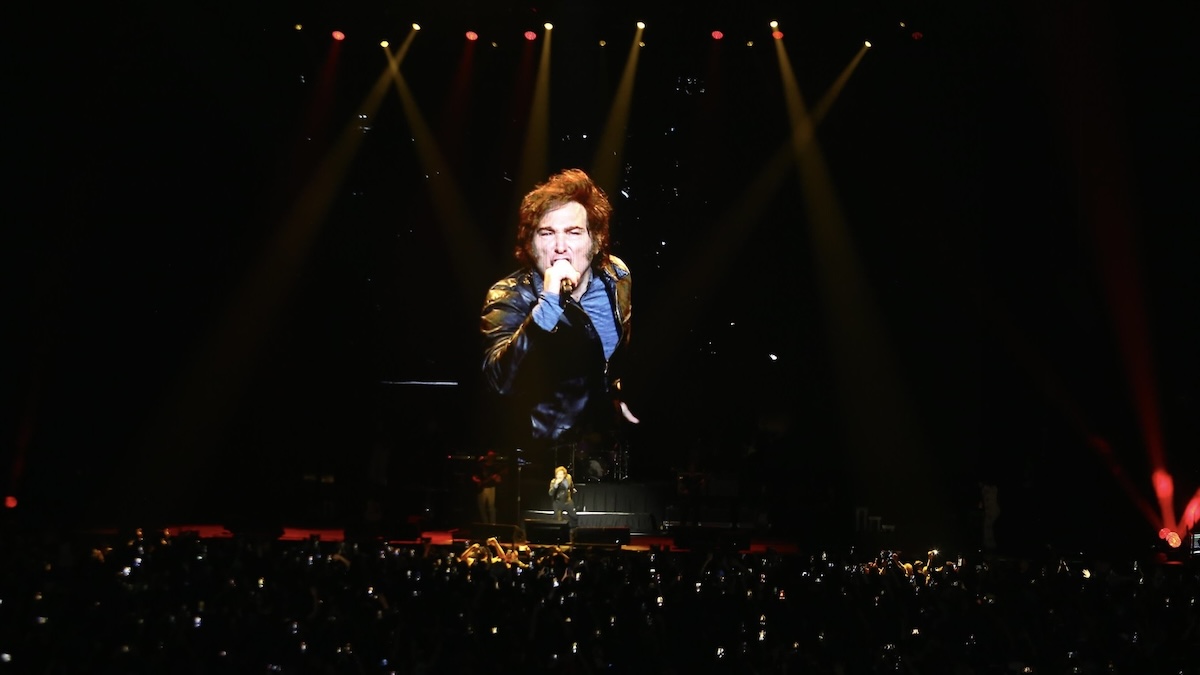
Argentina President Javier Milei. Photo: Javier Milei / X
In this article, we review some of the general trends and attitudes of Milei’s government two years into his term.
Thousands of Argentines endured high temperatures as they took to the streets on December 18 to protest the labor reform of Javier Milei’s far-right government. The call to action by the General Confederation of Labor (CGT) was supported by several trade unions, which claimed that the measure seeks to destroy workers’ rights to benefit big business: “This reform will only deepen poverty, social exclusion, and job insecurity. We will not give up our fight for decent work,” the CGT said in a statement.
The government has justified the measure by citing an alleged need to modernize labor relations: “The text also incorporates specific incentives for the formalization of employment, new rules for the platform economy, more efficient employer contribution schemes, and mechanisms that reduce litigation, providing the system with greater predictability and long-term stability.”
However, organized workers claim that this is a labor flexibility project that aligns with President Milei’s neoliberal agenda. Cristian Jerónimo, leader of the CTE, said: “[The labor reform] does nothing to benefit the world of work; it is written in favor of Argentina’s large corporations and does not favor small and medium-sized enterprises.”
But for the protesters, this reform comes as no surprise. Long before becoming president, Milei announced that it was imperative to reform the entire structure of the Argentine state in order to put it on the “path to freedom,” which means neoliberalizing the economy, reducing state participation in the economy to a minimum, strengthening the apparatus of repression, and aligning the South American country geopolitically with Washington’s interests. In short, to return to the path of the Washington Consensus.
After the day of mass mobilization, the government announced that the debate on the reform would be postponed until February, an initial sign that Milei is feeling the pressure of the popular demonstrations. Yet, after two years in office, Milei has done everything possible to push forward his neoliberal agenda even amid many rounds of mass demonstrations. A series of laws, executive decrees, and international diplomatic engagements have been the clearest signs of the path taken by the right-wing libertarian leader who governs a country that, despite his promises, is once again returning to the path of economic crisis and political instability.
Economy: fiscal adjustment and social tension
In line with neoliberal orthodoxy, Milei has implemented a series of fiscal adjustments to eliminate the deficit, even though this has been at the expense of the material stability of the most disadvantaged sectors, who have taken to the streets to protest against cuts in health, education, and other areas that the Argentine state now refuses to cover in full or adjust in line with the current economic reality. Students, teachers, researchers, and university workers have also taken to the streets consistently, demanding improvements in higher education funding, funding for science and health research, and defending free and public education.
Repression of mass protests, ordered by Security Minister Patricia Bullrich, has been severe. Hundreds have been arrested and injured, including Pablo Grillo, a journalist who was nearly killed when a tear gas canister struck him in the head.
Nevertheless, Milei did not slow down. The elimination of subsidies, wage freezes, and widespread privatization of public companies generated the long-awaited fiscal surplus in more than a decade. Year-on-year inflation, which stood at around 211% at the end of 2023, was reduced to 3% at some point in 2025.
Despite this, several analysts have stated that the 2.3% increase in inflation in October 2025 reflects the shortcomings of a neoliberal model in sustaining a long-term surplus.
Furthermore, it is important to remember that this year, Donald Trump’s administration bailed out Argentina with a record payment of more than USD 20 billion, in addition to the IMF’s generous granting of USD 20 billion to Argentina.
In other words, the surplus that the executive branch promotes as its great economic success has been achieved thanks to enormous support from its international allies, who demand neoliberal macroeconomic change not only in Argentina but throughout the region. This, of course, comes at a price that Argentines will have to pay for decades to come. Argentina has the largest IMF debt in the world. Its debt of more than USD 64 billion is “the price of freedom.”
Politics: reduction of the state and open confrontation
Following his economic model, Milei’s government has pushed radical downsizing. More than 10 ministries and 200 government departments were eliminated in one fell swoop. This meant the dismissal of almost 50,000 people who suddenly found themselves thrown into unemployment and precarity.
These decisions were made abruptly and aggressively, political attitudes that the president has adopted as part of his communication strategy. Bypassing parliamentary approval whenever possible, Milei always sought to govern unilaterally whenever possible.
But Milei has also achieved significant legislative victories. At the beginning of his administration, he had the support of only 39 deputies and six senators; however, he managed to pass several laws, such as the Bases Law (which allowed for the radical privatization of the Argentine state) and tax reforms.
He achieved this thanks to the support of the PRO, a right-wing party led by former president Mauricio Macri, and certain dissident Peronists. The formation of the so-called “May Pact,” a major agreement between Argentina’s right-wing parties and governors, allowed him to negotiate and agree on several reforms desired by right-wing libertarianism.
This pact prevented an increase in pensions for the elderly, who have regularly protested to demand more money to buy medicine and food, which are now major obstacles in their lives. Despite this, the Pact has not budged and continues with its neoliberal drift.
Political and judicial scandals
Milei’s administration has also been marked by several scandals. Very early on, he began a dispute with Victoria Villarruel, his vice president, whom he accused of playing into the hands of his political enemies.
He was also involved in the “$LIBRA” scandal, in which he is accused of being part of an international fraud scheme related to the sale of cryptocurrencies. A parliamentary commission concluded that Milei did use his position as president to promote the scam, which caused millions in losses to investors around the world.
But the event that probably had the greatest impact on Milei’s popularity involved his sister. Karina Milei, who serves as Secretary to the President, is accused of participating in a bribery ring that operated through the National Disability Agency (ANDIS). Many saw the emergence of this scandal as the reason for his resounding defeat in the Buenos Aires Province elections on October 26.
Despite this, Milei managed to recover and his party, La Libertad Avanza (LLA), won the next legislative elections and increased its number of seats in the legislature. His strategy was the usual one: accusing Peronism of destroying Argentina and presenting himself as the only one capable of saving the country. However, this messianic communication strategy has begun to be questioned precisely because of the corruption and fraud scandals that have plagued his government.
Alignment with Washington
Milei has made a significant shift in the country’s foreign policy. Argentina’s vote against the UN resolution condemning the US economic and trade blockade of Cuba reflects an important change. Historically, Argentina has maintained a diplomatic position against any act of imperialism due to its claim over the Malvinas Islands, which, despite being off its coast, are governed by the United Kingdom. The dispute has escalated to military levels despite repeated claims by the Argentine authorities.
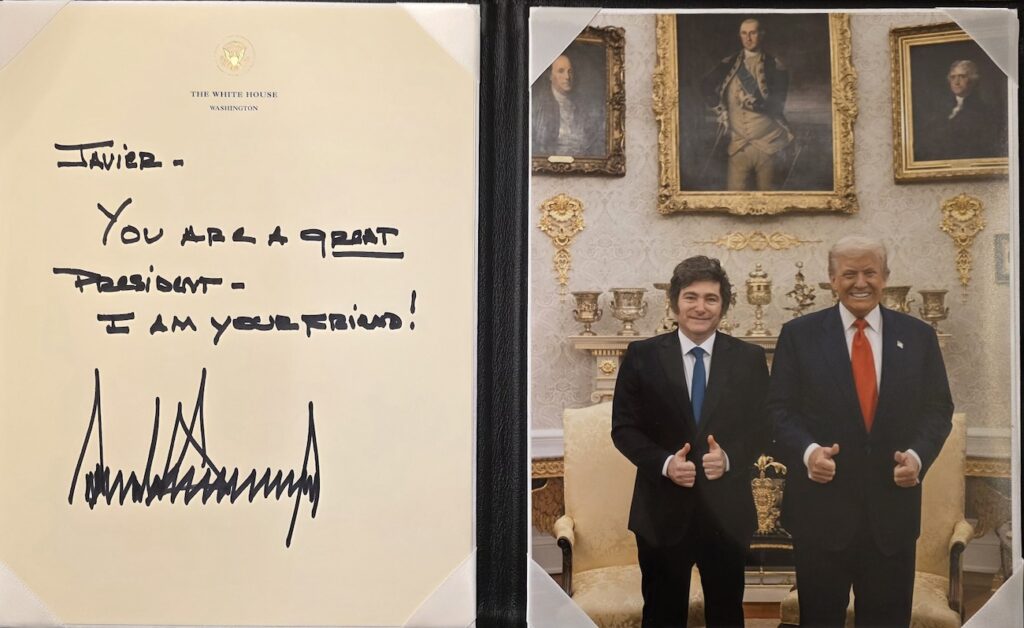
Donald Trump-signed photo of him and Javier Milei. Photo: Javier Milei / X
But the change is much more than nominal. Argentina has become the Trump administration’s greatest ally in South America. Milei has praised Trump’s personality, and Trump has publicly supported him, like when, in the last legislative elections, he suggested an end to cooperation between Buenos Aires and Washington if Milei lost. In response, the Argentine president has repeatedly declared his loyalty to Trump’s geopolitical project and has supported all of his initiatives both within and outside the region.
In this way, Milei has become a sort of archetype for the leaders of the new Latin American right. With radical fiscal adjustment at the expense of the most impoverished sectors, open confrontation with their opponents, and an international policy fully aligned with Washington (which has initiated a new chapter of the Monroe Doctrine), far-right governments are beginning to gain ground in the region: Kast in Chile, Paz in Bolivia, etc., are examples of an ideological and geopolitical shift in the region that is impossible to understand without the figure of Javier Milei.
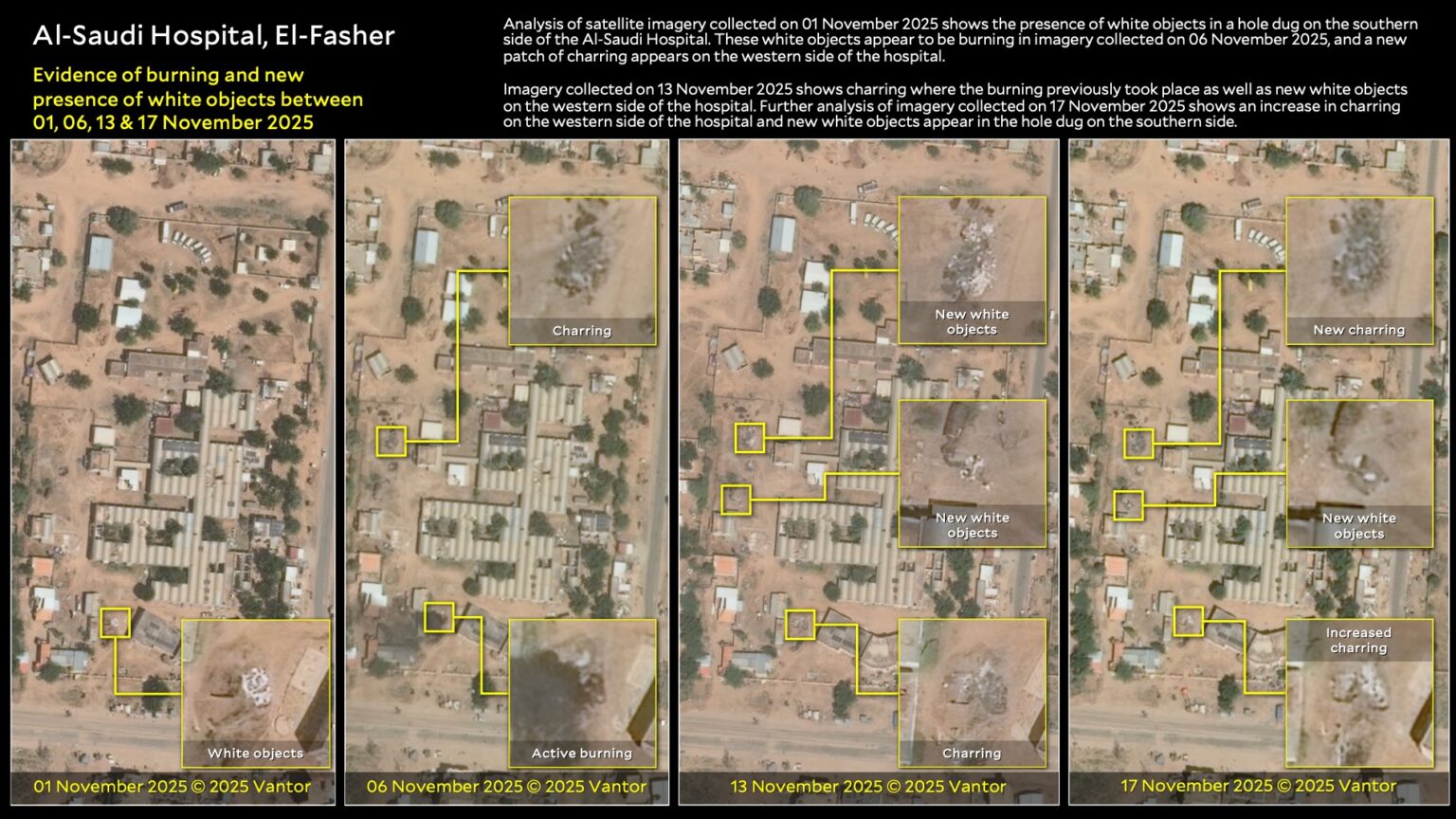
Analyzing satellite images showing “clusters of objects consistent with human remains”, “reddish discoloration consistent with blood”, charred earth and dug up ground consistent with the burning and burial of corpses, Yale HRL assesses that RSF has killed and disposed of people “likely in the tens of thousands”.
Evidence of burning and new presence of white objects collected by satellite imagery in early November. Photo: Yale Humanitarian Research Lab
Sudan’s Rapid Support Forces (RSF) have burnt and buried bodies, likely in the tens of thousands, after massacring civilians while overrunning El Fasher, the last city in Sudan’s western region of Darfur that held out against the paramilitary until late October.
The Yale School of Public Health’s Humanitarian Research Lab (HRL) said in a report published on December 16 that it “assesses to high confidence” that the RSF “engaged in widespread and systematic mass killing” after entering the besieged and starved city on October 26.
Satellite images collected over the next few days, until November 1, showed at least 150 “clusters of objects consistent with human remains”. By November 28, 108 of these 150 clusters had changed in size, growing and shrinking over time, while 57 were no longer visible.
“Disturbed earth”, meaning dug up ground, began to appear “at or in close proximity to locations where clusters” that shrunk or disappeared “were identified.” Several “clusters” were also burnt, visible as charred earth in later satellite images.
The ground around 33 of the 108 clusters identified had a “reddish discoloration consistent with blood or other bodily fluids”, shed on a scale large enough to be visible from space.
In the images, 52 body piles were observed in the neighborhood of Daraja Oula, where the remaining civilians in the city had sheltered before being executed by the RSF on a door-to-door killing spree.
Another 83 clusters were seen outside El Fasher, consistent with footage shared on social media by the RSF troops, showing themselves chasing down the fleeing civilians, capturing and executing them. Indications consistent with “mass killings” were also observed at the sites used by the RSF for detention.
The “RSF subsequently engaged in a systematic multi-week campaign to destroy evidence of its mass killings through burial, burning, and removal of human remains on a mass scale,” states the report, adding, “This pattern of body disposal and destruction is ongoing.”
There are no reliable estimates of the death toll in the absence of access to the area. “Over 260,000 civilians, including 130,000 children, have been trapped” in El Fasher “under siege for more than 16 months, cut off from food, water, and healthcare,” UNICEF had reported on October 23, three days before the RSF entered the city after breaching its defenses.
The International Organization for Migration (IOM) had recorded at least 106,387 people displaced by late-November. The remaining civilians, over 150,000 of them, are unaccounted. How many of them have survived is not known, but “HRL assesses that … RSF has systematically killed and disposed of a number of objects consistent with human remains, likely in the tens of thousands.”
In its aftermath, the city appears depopulated. The “pattern of civilian life in El-Fasher seems to have all but ended following RSF’s total control of El-Fasher,” the report added. “The end of civilian pattern of life is evidenced by abnormal vegetation growth in markets, no visible civilian activity at water points, absence of crowds of people in the street, and no evidence of civilian transport.”
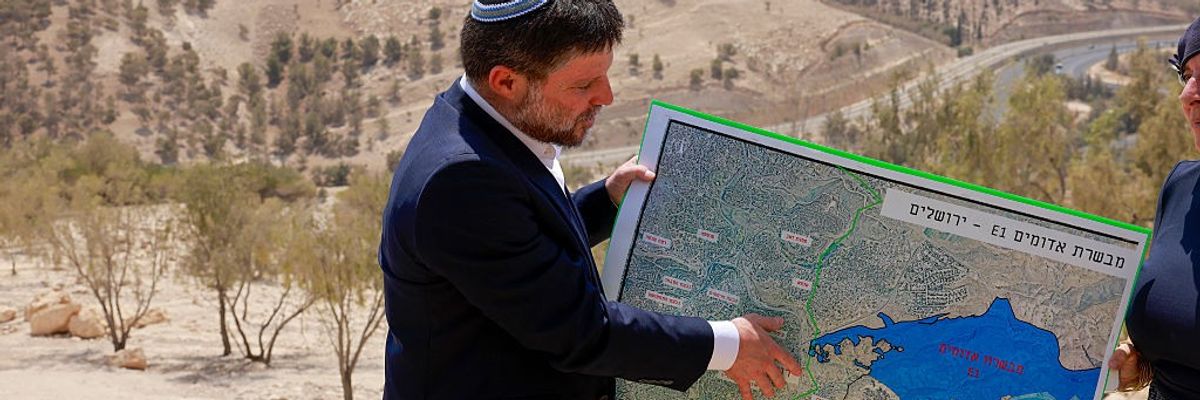
Israeli Finance Minister Bezalel Smotrich holds a map of an area near the apartheid colony of Maale Adumim near Jerusalem in the illegally occupied West Bank of Palestine, on August 14, 2025. (Photo by Menahem Kahana/AFP via Getty Images)
“The ONLY reason Israel gets away with this naked thievery is US military and political support,” said one observer.
Israel’s Cabinet on Sunday finalized approval of 19 new Jewish-only settler colonies in the illegally occupied West Bank, a move the apartheid state’s far-right finance minister said was aimed at thwarting Palestinian statehood.
Cabinet ministers approved the legalization of the previously unauthorized settler outposts throughout the occupied Palestinian territory, bringing the total number of new settlements in recent years to 69.
The move will bring the overall total number of exclusively or overwhelmingly Jewish settlements—which are illegal under international law—to more than 200, up from around 140 just three years ago.
Included in the new approval are two former settlements—Kadim and Ganim—that were evacuated in compliance with the now effectively repealed 2005 Disengagement Law, under which Israel dismantled all of its colonies in the Gaza Strip and four in the West Bank.
“This is righting a historic injustice of expulsion from 20 years ago,” Israeli Finance Minister Bezalel Smotrich—who is a settler—said on Sunday. “We are putting the brakes on the rise of a Palestinian terror state.”
“We will continue to develop, build, and settle the inherited land of our ancestors, with faith in the righteousness of our path,” Smotrich added.
@PeaceNowIL Israel’s security cabinet decided (per media reports) to establish 19 new West Bank settlements, including Kadim and Ganim — settlements evacuated under the 2005 disengagement plan. More: https://t.co/ujJlLBtHGLpic.twitter.com/IxGjMtjSOr
Following an earlier round of approval for the new settlements last week, Palestinian presidential spokesperson Nabil Abu Rudeineh said, “All Israeli settlement activity is illegal and constitutes a violation of international law and international legitimacy resolutions.”
United Nations Secretary-General António Guterres earlier this month denounced Israel’s “relentless” settlement expansion.
Such colonization, said Guterres, “continues to fuel tensions, impede access by Palestinians to their land, and threaten the viability of a fully independent, democratic, contiguous, and sovereign Palestinian state.”
Israeli Prime Minister Benjamin Netanyahu and other Israeli officials—some of whom, including Smotrich, deny the very existence of the Palestinian people—have vowed that such a state will not be established.
Some doubted Trump’s threat, with Democracy for the Arab World Now (DAWN) executive director Sarah Leah Whitson reacting to the new settlements’ approval by posting on X that “the ONLY reason Israel gets away with this naked thievery is US military and political support.”
Israel seized and occupied the West Bank including East Jerusalem along with Gaza in 1967, ethnically cleansing around 300,000 Palestinians. Many of these forcibly displaced people were survivors of the Nakba, the Jewish terror and ethnic cleansing campaign that saw more than 750,000 Palestinians flee or be forced from Palestine during the foundation of the modern state of Israel.
Since 1967, Israel has steadily seized more and more Palestinian land in the West Bank while building and expanding colonies there. Settlement population has increased exponentially from around 1,500 colonists in 1970 to roughly 140,000 at the time of the Oslo Accords in 1993—under which Israel agreed to halt new settlement activity—to around 770,000 today.
Settlers often attack Palestinians and their property, including in deadly pogroms, in order to terrorize them into leaving so their land can be stolen. Israeli colonists have also attackedIsrael Defense Forces soldiers they view as standing in the way of their expansion.
In July 2024, the International Court of Justice—where Israel is currently facing a genocide case related to the Gaza war—found the occupation of Palestine to be an illegal form of apartheid that must be ended as soon as possible. The ICJ also ruled that Israeli settler colonization of the West Bank amounts to annexation, also a crime under international law. Article 49 of the Fourth Geneva Convention states that an “occupying power shall not deport or transfer parts of its own civilian population into the territory it occupies.”
As the world’s attention focused on Gaza during the past two years, Israeli soldiers and settlers have killed at least 1,039 Palestinians—at least 225 of them children—in the West Bank. This year, at least 233 Palestinians, including at least 52 children, have been killed so far, according to the United Nations Relief and Works Agency for Palestinian Refugees in the Near East.
On Saturday, Israeli occupation forces shot and killed two Palestinians in the northern West Bank, including a 16-year-old boy, Rayan Abu Muallah, who the Israel Defense Forces said was shot after he threw an object at its troops.
Genocide denier and Current UK Prime Minister Keir Starmer is quoted that he supports Zionism without qualification. He also confirms that UK air force support has been essential in Israel’s mass-murdering genocide. Includes URLs https://www.declassifieduk.org/keir-starmers-100-spy-flights-over-gaza-in-support-of-israel/ and https://youtu.be/O74hZCKKdpAOrcas discuss Genocide-supporting and complicit Zionists. Donald Trump, Keith Starmer, David Lammy, Rachel Reeves, Angela Rayner and Wes Streeting are acknowledged as evil genocide-complicit and supporting cnuts.Keir Starmer objects to criticism of the IDF. He asks how could anyone object to them starving people to death, forced marches like the Nazis did, bombing Gaza’s hospitals and universities, mass-murdering journalists, healthworkers and starving people queuing for food, killing and raping prisoners and murdering children. He calls for people to stop obstructing his genocide for Israel.
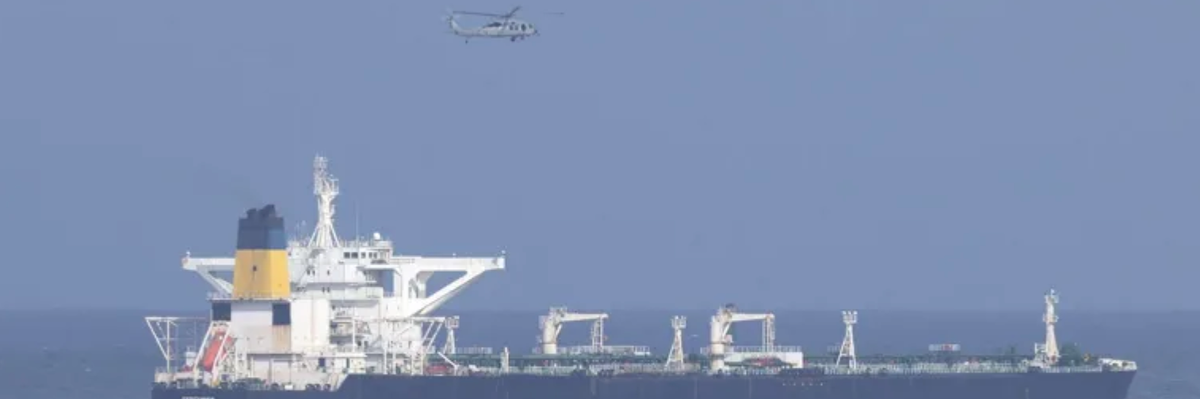
A US military helicopter flies over the oil tanker Centuries in the southern Caribbean Sea on December 20, 2025. (Photo by US Department of Homeland Security)
The Venezuelan government condemned the seizure as “a serious act of international piracy;” meanwhile, a US official said the Coast Guard was pursuing a third tanker in the Caribbean.
The Trump administration’s “total and complete blockade” of “all sanctioned oil tankers” off the Venezuelan coast was already denounced by critics as “an act of war”—and the United States further escalated its aggression on Saturday by seizing a tanker that is not on a list vessels under US sanctions.
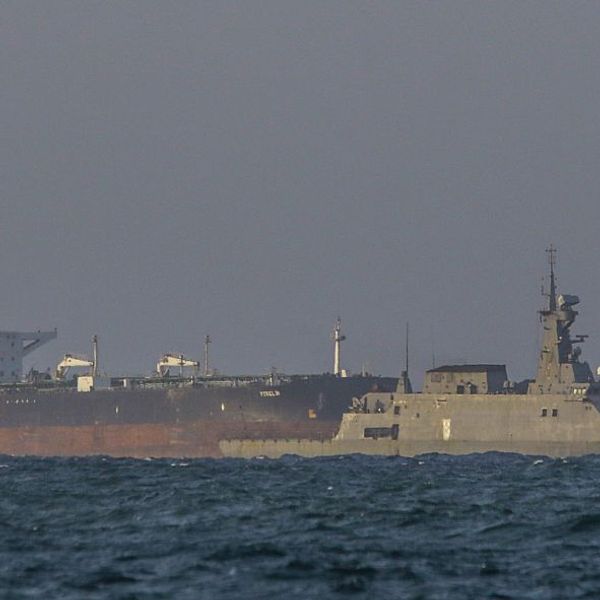
US Coast Guard troops led Saturday’s seizure of the Centuries, a Panamanian-flagged, Chinese-owned oil tanker in the Caribbean Sea, after it left Venezuela.
“The United States will continue to pursue the illicit movement of sanctioned oil that is used to fund narco-terrorism in the region,” US Homeland Security Secretary Kristi Noem said on X. “We will find you, and we will stop you.”
On Sunday, an unnamed US official toldReuters that the Coast Guard “is in active pursuit” of a third tanker near Venezuela, “a sanctioned dark fleet vessel” that “is flying a false flag and under a judicial seizure order.”
The Venezuelan government condemned Saturday’s seizure as “a serious act of international piracy.”
Venezuela “denounces and rejects the theft and hijacking of a new private vessel transporting oil, as well as the forced disappearance of its crew, committed by military personnel of the United States of America in international waters,” Venezuelan Vice President Delcy Rodríguez said in a statement.
“These acts will not go unpunished,” she vowed, adding that Venezuela will pursue “all corresponding actions, including filing a complaint before the United Nations Security Council, other multilateral organizations, and the governments of the world.”
Earlier this week, President Donald Trumpdeclared a blockade of all oil tankers under US sanctions that are traveling to or from Venezuela.
Saturday’s action followed the US seizure of the Panamanian-flagged Skipper—which is under sanctions—off the Venezuelan coast on December 10.
The Centuries seizure also comes amid the Trump administration’s bombing of at least 28 boats allegedly transporting drugs in the Caribbean Sea and Pacific Ocean, attacks that have killed more than 100 people and have been condemned as acts of extrajudicial murder.
In addition to the blockade and boat strikes, Trump has deployed an armada of warships and thousands of troops to the southern Caribbean, authorized covert CIA action against the socialist government of Venezuelan President Nicolás Maduro, and has threatened to invade the South American nation. This latest wave of aggression continues more than a century of US meddling in Venezuela’s affairs and sovereignty.
Numerous world leaders have denounced the US aggression toward Venezuela. On Saturday, leftist Brazilian President Luiz Inácio Lula de Silva said during a summit of the South American Mercosur bloc in Foz do Iguaçu, Brazil that an “armed intervention in Venezuela would be a humanitarian catastrophe.”
In the United States, multiple efforts by members of Congress—mostly Democrats, but also a handful of anti-war Republicans—to pass a war powers resolution blocking the Trump administration from bombing boats or attacking Venezuela have failed.
Echoing assertions by Venezuelan officials and others, one of those Republicans, Rep. Thomas Massie of Kentucky, said earlier this week that Trump’s aggressive escalation “is all about oil and regime change.”
Some critics have called Trump’s actions a renewal of the “gunboat diplomacy” practiced by the US in the 19th and 20th centuries. The US has conducted scores of military interventions in Latin America, including dozens of regime change operations.
Donald Fuhrump says that Amerikkka doesn’t bother with crimes or charges anymore, not being 100% Amerikkkan and opposing his real estate intentions is enough.Orcas discuss how Trump was re-elected and him being an obviously insane, xenophobic Fascist.

 Reform UK leader Nigel Farage arrives at the Reform UK South East conference, at Sandown Park Racecourse in Esher, Surrey, January 10, 2025