Article by Bob Berwyn republished from Inside Climate News under Creative Common License (CC BY-NC-ND 3.0)
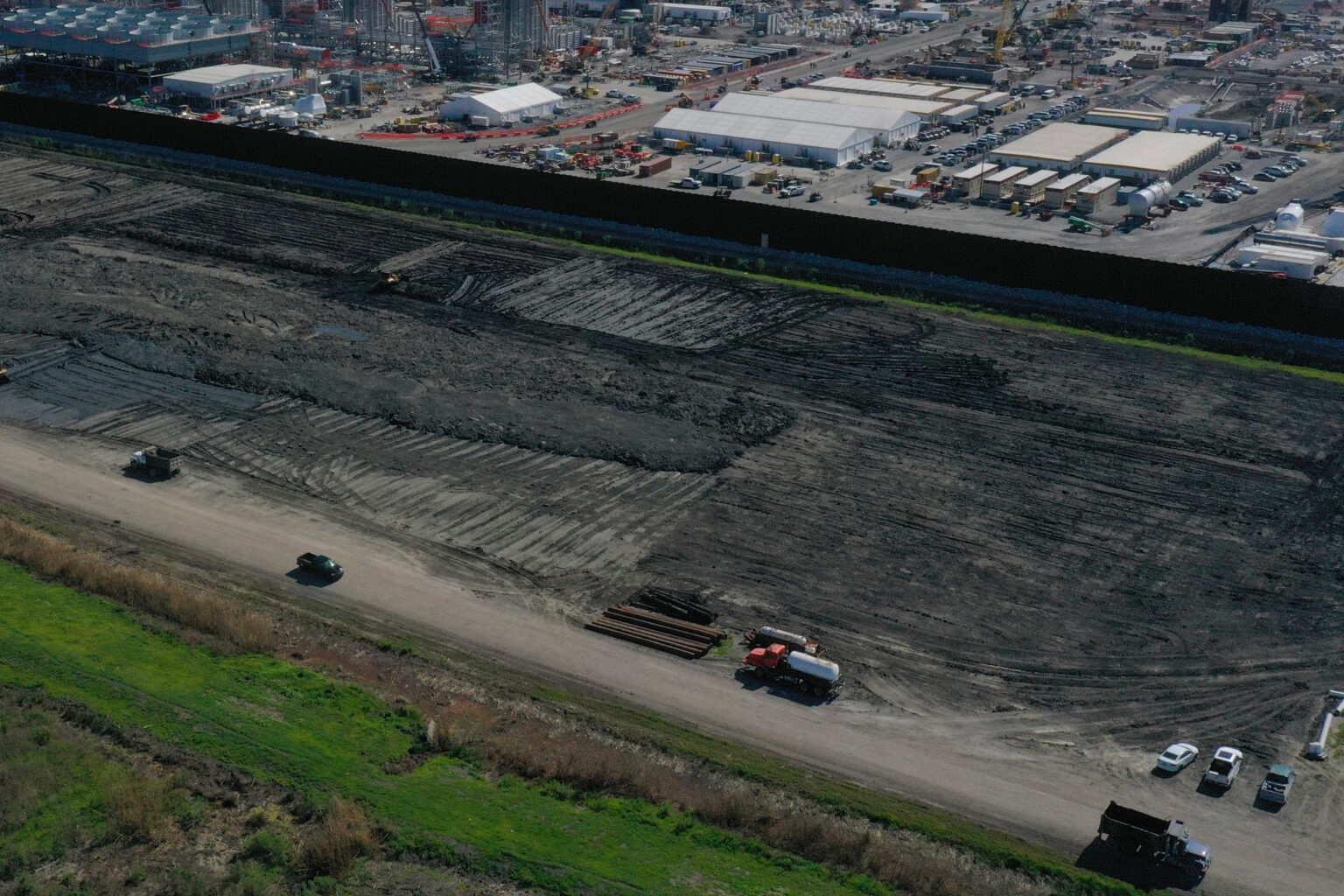
A new report suggests that some governments have ignored legal obligations to prevent climate harm for decades.
A new report strengthens the case that the United States and other major industrialized countries knew, long before they signed the 2015 Paris Agreement to limit global warming, that they could face legal obligations to reduce climate-damaging greenhouse gas emissions.
The “What Countries Knew” report, released Wednesday by the Center for International Environmental Law, traces when climate scientists first presented governments in the United States, Australia, Canada, Germany, Italy, Norway, the United Kingdom and the combined Soviet Union and Russia with research outlining the risks posed by the emissions from burning fossil fuels.
Those countries are responsible for about 40 percent of all emissions since the fossil fuel era began in the late 1800s. Summaries and transcripts from conferences cited in the report indicate that those governments and others were discussing the risks of rising global temperature, melting polar ice caps and sea-level rise as early as 1957, during the International Geophysical Year.
The warnings grew more urgent in the 1960s just as governments and economies of industrialized and industrializing countries placed nearly all their chips on fossil-fueled growth. In 1965, scientists warned U.S. President Lyndon Johnson that rising carbon dioxide could cause “marked changes” in climate. About the same time, researchers at Norway’s and Italy’s state-owned oil companies warned of potential climate impacts while governments encouraged them to expand.
As the reports and warnings piled up, newsreel footage in Germany celebrated record coal hauls with images of miners grinning through sooty faces, and federally subsidized oil production in the U.S. meant prosperity and the freedom to “Put a Tiger in Your Tank” at an Esso gas station.
Lindsay Fenlock, a senior researcher with the Center for International Environmental Law and lead author of the report, said she was continually surprised by the breadth of international government awareness of climate impacts with a “threat of serious implications” as she combed through decades of materials archived from the pre-internet era.
During the International Geophysical Year, about 70 countries collaborated to study Earth as an interconnected system and measure the growing effects of human activities on the planet, she said. The same year, a study by American scientists Roger Revelle and Hans Suess characterized the rising amount of CO2 in the air as an unprecedented and irreversible “large-scale geophysical experiment” unlike anything in human history.
Fenlock noted several other early international conferences that “had particularly striking conversations around what to do to combat climate change and move away from fossil fuel use.”
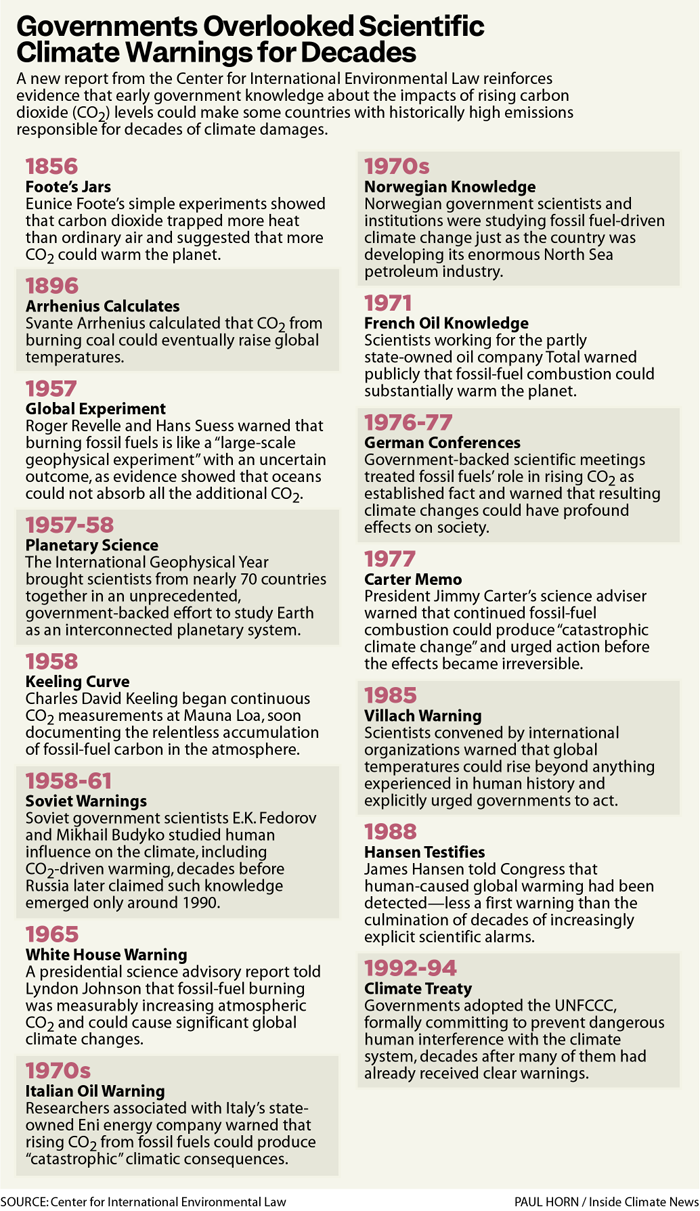
A 1968 government-and-industry symposium in France included detailed discussions on alternatives to fossil fuels. In 1973, the International Institute for Applied Systems Analysis in Austria hosted talks about government responses to climate change. And when Fenlock retrieved old Canadian federal agency employee newsletters, she found that scientists had openly discussed climate change throughout the 1970s.
The report draws “important connections” between the history of government knowledge and the legal obligations outlined in the ICJ’s Advisory Opinion, said Michael Burger, executive director of the Sabin Center for Climate Change Law at Columbia University.
“It’s a warning shot, for those on the lookout for cases that may follow in the wake of the ICJ’s opinion,” he said.
Fenlock said the report wasn’t intended to be comprehensive, but it shows that governments often overlooked scientific evidence with life-and-death relevance.
“I think that just how much was known, and how soon, was pretty shocking,” she said. “But people don’t talk about it now.”
The report may reignite those conversations by framing the historical record in the context of international climate law, said Nikki Reisch, CIEL’s climate and energy program director. What governments knew, and how they responded or failed to respond, took on new legal significance after last year’s advisory opinion from the International Court of Justice, which found that states have longstanding legal obligations to prevent significant climate harm, and may be required to pay reparations when breaches of those obligations cause damage.
Reisch said tracing government knowledge could help determine whether a country’s greenhouse gas emissions violated international obligations to avoid environmental damage beyond its borders, and whether it could be held responsible for the resulting harm.
The report illustrates that the early scientific evidence “didn’t stay in a drawer or on a shelf,” she said. “It was being published, disseminated. Their information was communicated directly to government officials, sometimes at the highest levels and to the broader public. “All this information,” she said, “was in the hands of those who could have acted.”
Under a broad reading of international environmental legal principles, some countries could be held responsible for their share of climate damages caused by their emissions even before they understood the risks, she said. But pinpointing when governments became aware of those risks establishes a clearer threshold for legal liability. From that point onward, governments had the opportunity to change course, and those that instead continued or expanded fossil fuel use bear greater responsibility for resulting harms and for helping affected communities now, she added.
Reisch said governments should be judged by what was reasonable at the time, not by today’s standards. Once they had credible evidence that fossil fuels could cause serious harm, she said, they had a duty to stop expanding their use, develop alternatives and use the tools available to limit the damage.
Documenting widespread knowledge of the dangers undercuts attempts to dismiss governments’ historical responsibility, particularly because many continued to expand fossil fuel production and use and, in some cases, obstructed efforts to scale them back. The report alone does not establish liability, she said, but provides important evidence that could help hold governments accountable for resulting damages and require them to act with greater urgency.
The report’s legal significance can be seen in common-sense terms, added Michael Gerrard, the founder and faculty director of the Sabin Center.
“If I know that the brakes on my car don’t work but I persist in driving, I have heightened culpability when I crash and injure someone,” he said.
Article by Bob Berwyn republished from Inside Climate News under Creative Common License (CC BY-NC-ND 3.0)
Inside Climate News has regular newsletters and invites donations.


Leave a Reply