Kemi Badenoch, the Conservative leader, announced the policy before her party’s conference coming up this weekend. Photograph: Jonathan Brady/PA
Tory leader says she would replace it with ‘cheap energy’ strategy, ending decades-long consensus on climate
Kemi Badenoch has vowed to repeal the Climate Change Act if the Conservatives win the next election, doing away with controls on greenhouse gas emissions and dismantling what has been the cornerstone of green and energy policy for successive governments.
Badenoch said: “Under my leadership we will scrap those failed targets. Our priority now is growth, cheaper energy, and protecting the natural landscapes we all love.”
Under the landmark legislation, which was passed with the almost unanimous support of the Conservative party under David Cameron in 2008, carbon budgets are set for many years beyond the current government’s remit. This in effect binds future governments to adhering to climate policies, though it does not specify what those policies should be.
UK Conservative Party leader Kemi ‘not a genocide’ Badenoch explains her reality that the Earth is flat, the Moon is made of cheese and that she was born from
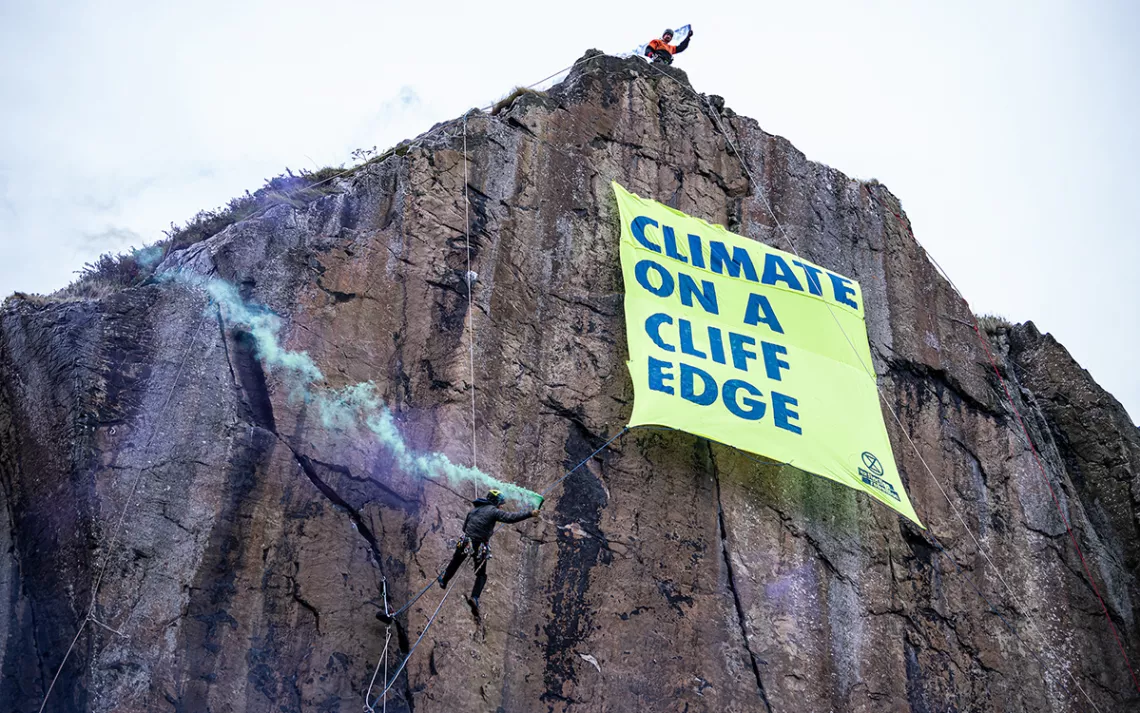
Unicorn horn dustElon Musk urges you to be a Fascist like him, says that you can ignore facts and reality then.Experienced climbers scale a rock face near the historic Dumbarton castle in Glasgow, releasing a banner that reads “Climate on a Cliff Edge.” One activist, dressed as a globe, symbolically looms near the edge, while another plays the bagpipes on the shores below. | Photo courtesy of Extinction Rebellion and Mark Richards
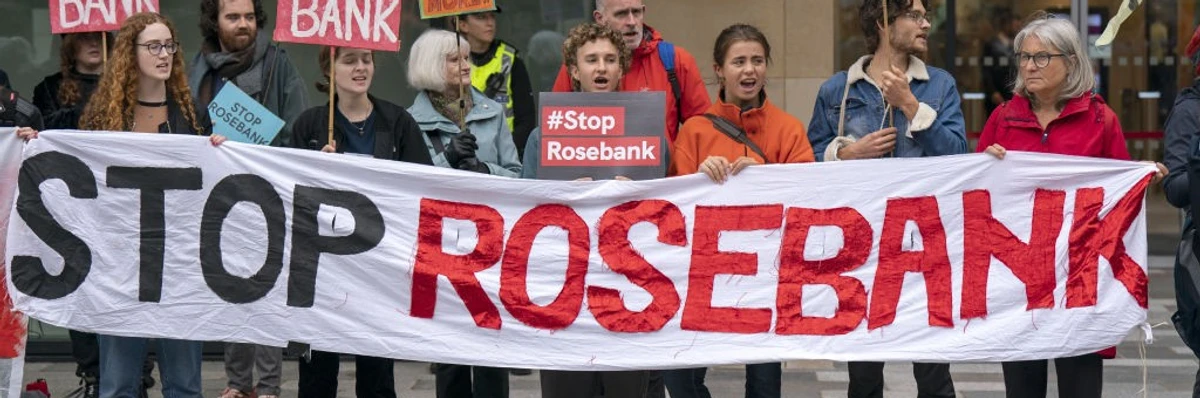
Campaigners take part in a Stop Rosebank emergency protest outside the U.K. Government building in Edinburgh, after the controversial Equinor Rosebank North Sea oil field was given the go-ahead Wednesday, September 27, 2023. (Photo: Jane Barlow/PA Images via Getty Images)
Under pressure Chancellor Rachel Reeves has pledged support to the oil and gas sector through the planned North Sea strategy.
Chancellor Rachel Reeves announced the upcoming North Sea strategy will be published before the Autumn Budget.
In her speech at the Labour Party conference she highlighted that “I talked about homegrown energy, and that is renewables, but it is also in the North Sea as well” before adding she is “not a zealot of green energy”.
Meanwhile, energy secretary Ed Miliband is gearing up to use his speech on Wednesday to attack a “global network of right-wing billionaires” looking to stop net zero developments, and push for unity across the clean energy sector.
“We are going to be reliant on oil and gas for many years to come,” Reeves added, citing a preference to use oil and gas from the UK rather than importing from overseas.
“I am really committed to boosting our energy security, because increasingly energy security is national security, so investing in homegrown energy is really important,” she added.
dizzy: Looks like the Labour Party are shitting on their climate commitments.
Greenpeace activists display a billboard during a protest outside Shell headquarters on July 27, 2023 in London. (Photo: Handout/Chris J. Ratcliffe for Greenpeace via Getty Images)Experienced climbers scale a rock face near the historic Dumbarton castle in Glasgow, releasing a banner that reads “Climate on a Cliff Edge.” One activist, dressed as a globe, symbolically looms near the edge, while another plays the bagpipes on the shores below. | Photo courtesy of Extinction Rebellion and Mark RichardsNeo-Fascist Climate Science Denier Donald Trump says Burn, Baby, Burn.
U.S. Secretary of Defense Pete Hegseth speaks to senior military leaders at Marine Corps Base Quantico on September 30, 2025 in Quantico, Virginia. (Photo by Andrew Harnik/Getty Images)
One critic expressed astonishment that Hegseth “summoned all the US generals from around the globe at great expense to fat shame them.”
US Defense Secretary Pete Hegseth on Tuesday sparked instant ridicule among critics for delivering a speech in front of American generals in which he railed against “dudes in dresses,” “climate change worship,” and “fat” soldiers.
During the address, which US military leaders around the world were summoned to attend in Quantico, Virginia, Hegseth rattled off a long list of culture war grievances that he claimed had weakened the American military, which he asserted is forced to follow “stupid rules of engagement” that limit members of the armed forces. Hegseth has spent much of his tenure taking steps to remake the military into what he has said will be a more aggressive force, including by firing top lawyers.
Among many topics, Hegseth, a former Fox Newshost, took aim at some American soldiers’ physical appearances.
“Frankly, it’s tiring to look out at combat formations and see fat troops,” Hegseth fumed at one point. “Likewise, it’s completely unacceptable to see fat generals and admirals.”
Hegseth also said that the Trump administration had moved to systematically “to remove the social justice, politically correct, and toxic ideological garbage that had infected our department.”
What this means in practice, Hegseth elaborated, was “no more identity months, [diversity, equity, and inclusion] offices, dudes in dresses, no more climate change worship.”
“We are done with that shit!” he emphasized.
Elsewhere in his address, Hegseth announced he was “overhauling” the inspector general process that has been used to investigate allegations of misconduct against military officers. According to Hegseth, the current process has put “complainers, ideologues, and poor performers in the driver’s seat.”
“No more frivolous complaints, no more anonymous complaints, no more repeat complaints, no more smearing reputations, no more endless waiting, no more legal limbo, no more sidetracking careers, no more walking on eggshells!” Hegseth exclaimed.
US President Donald Trump, who spoke at Quantico after Hegseth’s address, called the defense secretary’s speech “great,” even as it was being pilloried as “embarrassing” and “ridiculous” far and wide online.
Watch the complete speeches by both Hegseth and Trump.
New York Times columnist Jamelle Bouie described the speech as “some of the most loser shit I have ever seen in my life” and he marveled that Hegseth had hauled in military leaders away from their jobs to watch it.
“Can you imagine sitting in that audience as a three-star flag officer—decades in the service, multiple post-grad degrees, and a virtually unequaled level of command expertise—and being forced to watch this dunderheaded dry drunk give an off-brand Jordan Belfort seminar?” Bouie asked.
Pamela Herd, a professor of public policy at the University of Michigan, also asserted that senior military personnel likely felt insulted watching Hegseth’s speech.
“I just can’t get over the lack of shame—the unabashed confidence,” she said. “Can you imagine what those generals are thinking being lectured to by someone so inexperienced and incompetent?”
Seth Masket, a political scientist at the University of Denver, expressed astonishment that Hegseth “summoned all the US generals from around the globe at great expense to fat shame them.”
American Immigration Council senior fellow Aaron Reichlin-Melnick argued that Hegseth would open up US defense policy to significant vulnerabilities if he were to move forward with banning the American military from discussing the impacts of climate change.
“Climate change may be the single greatest geopolitical wild card of the next century—a reshaping of countries’ agricultures, economies, and even literal geography,” he wrote. “And here a guy who never rose above the rank of Major says the U.S. military shouldn’t even consider it. We are screwed.”
Attorney Max Kennerly took aim at Hegseth’s comments on military service members’ physical fitness, which he said showed a deep ignorance of how the modern military fights wars.
“I can’t get over how the right-wing doesn’t understand modern militaries, with the majority serving non-combat roles,” he explained. “You think the best IT security and logistics personnel spends two hours in the gym every day to look like the cast of 300? They’re at furry conventions and model train shows.”
Following Hegseth’s speech, the president’s lengthy address included defenses of his policies, including his decision to deploy federal troops to US cities to fight what he called “the enemy within.” Trump has ordered federal troops to cities including Washington, DC; Chicago; and Portland to remove unhoused people from the streets, arrest immigrants, and fight anti-fascist protesters.
“We should use some of these dangerous cities as training grounds for our military,” said Trump.
Elon Musk urges you to be a Fascist like him, says that you can ignore facts and reality then.Donald Trump urges you to be a Climate Science denier like him. He says that he makes millions and millions for destroying the planet, Burn, Baby, Burn and Flood, Baby, Flood.Donald Fuhrump says that Amerikkka doesn’t bother with crimes or charges anymore, not being 100% Amerikkkan and opposing his real estate intentions is enough.
Carbon capture faces significant skepticism from environmentalists who note that the industry’s past is littered with failed projects, missed targets, and an overall net increase in emissions. Credit: Matt Hrkac (CC BY-NC-ND 2.0)NDLA,
CCS can “no longer be considered an unlimited” climate solution, researchers caution after concluding most storage options are in risky regions
As the Trump administration seeks to wipe away environmental rules covering the oil, gas, and coal industries, fossil fuel producers and sellers are reassuring buyers that carbon capture and storage (CCS) could slash climate-altering emissions from a growing range of fossil-fuel projects — like blue hydrogen, LNG export terminals, and data centers.
“That’s right: data centers,” fossil fuel giant ExxonMobil wrote in December, adding that the need for more data centers for AI could represent a fifth of the world’s demand for carbon capture by 2050.
Now, a study published in the journal Nature calls attention to another issue that could loom in the future if CCS were to really take off — a lack of easy-to-develop locations where captured carbon can be buried underground.
The vast majority of places where you can find the kinds of sedimentary rocks that allow carbon dioxide to be stored underground sit in higher risk zones or in areas like the Arctic that are potentially off-limits for practical or political reasons, the study found.
That has big implications for the energy transition, since once carbon dioxide is put into storage, it’s supposed to stay there for as long as possible. Any storage sites we use today can’t be expected to be available for future generations — not just the children and grandchildren of people alive today but “more than ten generations into the future,” the study notes.
“This study should be a gamechanger for carbon storage,” coauthor Joeri Rogelj, director of research at the Grantham Institute at Imperial College London, said in a statement when the study was announced. “It can no longer be considered an unlimited solution to bring our climate back to a safe level. Instead, geological storage space needs to be thought of as a scarce resource that should be managed responsibly to allow a safe climate future for humanity.”
In fact, there may be only enough practical storage to potentially reverse between 0.4 and 0.7 degrees Celsius of warming — a tiny fraction of the five or six degrees experts previously estimated, the researchers said.
The carbon storage that is available “should be used to halt and reverse global warming,” Rogelj added, “and not be wasted on offsetting on-going and avoidable CO2 pollution from fossil electricity production or outdated combustion engines.”
On Track to ‘Overshoot’
International plans to limit climate change tend to assume that we can “overshoot” on climate pollution, pushing the Earth’s climate into dangerous territory past 1.5 or 2 degrees Celsius of warming. That’s because, the argument goes, carbon capture and storage could come to the rescue if we go too far, letting us draw carbon dioxide levels back down.
The new study calls that assumption into question, highlighting uncertainty about how effective carbon removal will be at curbing climate change, in addition to concerns over difficulties in accessing underground carbon storage.
“With current trends suggesting warming up to 3°C this century, using all of the safe geological storage wouldn’t even get us back to 2°C,” said lead author Matthew Gidden, research professor at the Center for Global Sustainability at the University of Maryland.
Industry estimates, like those from the Oil and Gas Climate Initiative (OGCI), suggest the world has plenty of storage potential to keep 14,000 gigatons of carbon dioxide buried below ground and out of the atmosphere.
That would be “more than enough to meet projected needs for CCUS [carbon capture, use and sequestration] over the coming century,” the OGCI wrote in a 2023 report it called a “playbook for regulators, industrial emitters and hub developers.”
The new study, however, takes a closer look at where that storage is located — and in particular whether it’s in regions at higher risk of earthquakes or groundwater contamination like locations deep in the ocean, or in the Arctic and Antarctic circles. The study concludes that nearly 90 percent of that storage capacity is in less-than-desirable locations.
The researchers estimate there’s just 1,460 gigatons worth of “prudent” storage available worldwide — a tenth of the industry estimates.
Some earlier estimates stretch even higher, suggesting there’s around 40,000 gigatons of CO2 storage capacity worldwide.
“These estimates are also important as they remove all the technical constraints from assessment and assume that cost and engineering challenges will pose no issue in the future,” coauthor Siddharth Joshi, a research scholar at the Integrated Assessment and Climate Change Research Group, told DeSmog, adding that “the shock value of technical potentials is enough to sometimes drive an industry forward.”
At the same time, focusing only on larger capacity estimates can create a “false sense of abundance,” Gidden noted, if policy-makers think the world has more room for overshoot than carbon storage can really offer.
The Nature study raises big questions about how the world’s carbon storage should be used long term.
“As [the study authors] point out, if we act to reduce emissions now, we probably have enough storage, but that ceases to be true really, really soon,” Rob Anex, professor at the University of Wisconsin-Madison who researches carbon capture technology, told Canada’s CBC News. “Global emission rates are so high that the window of time in which geologic storage is practical is shutting really, really fast.”
Trump Backs Carbon Capture Subsidies
Despite the federal government’s retreat from climate action, including Trump’s January executive order withdrawing the U.S. from the Paris Agreement, the Trump administration has moved to protect and expand some federal subsidies for CCS.
Lucrative tax credits for using captured carbon for enhanced oil recovery were expanded this summer as part of Trump’s “One Big Beautiful Bill Act.”
Given this political climate, experts didn’t expect to see a major direct impact from the study for blue hydrogen projects and other proposals aiming to use carbon storage.
“The pragmatist in me says it’s unlikely,” Anika Juhn, energy data analyst for the Institute for Energy Economics and Financial Analysis (IEEFA), told DeSmog. “I don’t see government taking those kinds of steps.”
The Nature study follows a precautionary approach to carbon storage, she noted. “The precautionary principle says if we don’t really know about it, then maybe we shouldn’t be rushing headlong into just applying this technology everywhere as fast as possible,” she said. “I think that’s really where the strength of it is, saying if you are interested in doing it safely, here are some key aspects that you should really focus on.”
“Because their estimate is so prudent, it really doesn’t reflect at all current industry practice,” Juhn noted.
So far, there’s not a lot of carbon storage operating worldwide, with the Nature study pointing out existing projects currently store just 49 megatons per year, with 416 megatons worth “either planned or in construction.” Meanwhile, annual global emissions from fossil fuels topped 37,400 megatons last year, according to the World Meteorological Organization, another record high.
But that small CCS industry has already caused significant safety incidents — including well blowouts and a major 2020 CO2 pipeline leak that hospitalized dozens of people.
Concerns over the potential for groundwater contamination — one of the factors highlighted in the Nature study — have already begun curbing real-world carbon storage availability at the state and local level.
Take, for example, Illinois, home to the nation’s first dedicated carbon storage project, the Archer-Daniels-Midland (ADM) carbon storage site in Decatur, Illinois.
Carbon injections were halted at ADM’s site a year ago, after the company discovered leaks below ground. “Given the extreme depth and the multiple layers of shale and other confining rock up to the surface, at no time was there an impact to the surface or groundwater sources, nor any threat to public health,” ADM said at the end of August, announcing the restart of operations at its Decatur site.
But the incident appears to have hit a nerve in the state, where nearly a million people rely on the Mahomet Aquifer in Champaign, Illinois, as their sole source of drinking water.
This summer, Illinois passed a law banning carbon storage below that aquifer, making roughly 15 percent of the state’s counties off limits for carbon storage. ADM’s leak had reached within about six miles of the Mahomet Aquifer, Taxpayers for Common Sense notes.
The Nature study notes that most of the carbon storage in operation today doesn’t actually offer any net climate benefit — because it’s used for enhanced oil recovery, which, the researchers wrote, “overall results in net-positive CO2 emissions.”
“After decades of bold projections, only around 10 million tons of CO₂ are captured and permanently stored each year (excluding enhanced oil recovery), representing less than 0.03% of annual global fossil fuel emissions,” Kevin Anderson, professor of Energy and Climate Change at the University of Manchester, said in a statement responding to the study. “Rather than serving as a credible mitigation technology, CCS has largely functioned as a rhetorical device to delay robust fossil fuel regulation.”
Donald Trump urges you to be a Climate Science denier like him. He says that he makes millions and millions for destroying the planet, Burn, Baby, Burn and Flood, Baby, Flood.Nigel Farage urges you to ignore facts and reality and be a climate science denier like him. He says that Reform UK has received millions and millions from the fossil fuel industry to promote climate denial and destroy the planet.
An oil drilling platform off the coast of Aberdeen. Officials are understood to have looked at a range of proposals in recent weeks. Photograph: Simon Price/Alamy
[Guardian] Exclusive: Energy secretary examining ways to allow oil and gas exploration without breaking manifesto promise
Ed Miliband is planning to encourage drilling in the North Sea despite a manifesto promise not to grant new licences on new parts of the British sea bed.
The energy secretary is looking at ways in which the government can allow companies to look for and produce more oil and gas without breaking Labour’s pre-election pledge not to issue new licences on new fields.
The plans, which will be announced in the coming months as part of a wider strategy for the North Sea, come amid pressure on one side from climate activists to stop all drilling, and on the other from Donald Trump to “drill, baby, drill”.
A government spokesperson said: “The strategy will set out how the government intends to meet its manifesto commitments to ensure no new licenses to explore new fields and maintaining existing fields for their lifetime.” They said the government would meet its manifesto commitments “in full”.
Miliband has been working on proposals for the North Sea for months as the government looks for ways to maximise the lives of existing oil and gas fields without allowing completely new exploration.
Labour promised in its manifesto not to grant any new licences on new fields, and ministers are now looking at how they can implement that while also gaining an economic return from the sizeable industry which already exists. Oil and gas companies employ about 30,000 people from their base in north-east Scotland.
dizzy: It looks like yet more broken promises from the Labour party, seems to be what they’re really good at. Expanding airports is ignoring climate commitments, a huge danger with the North Sea is Rosebank.