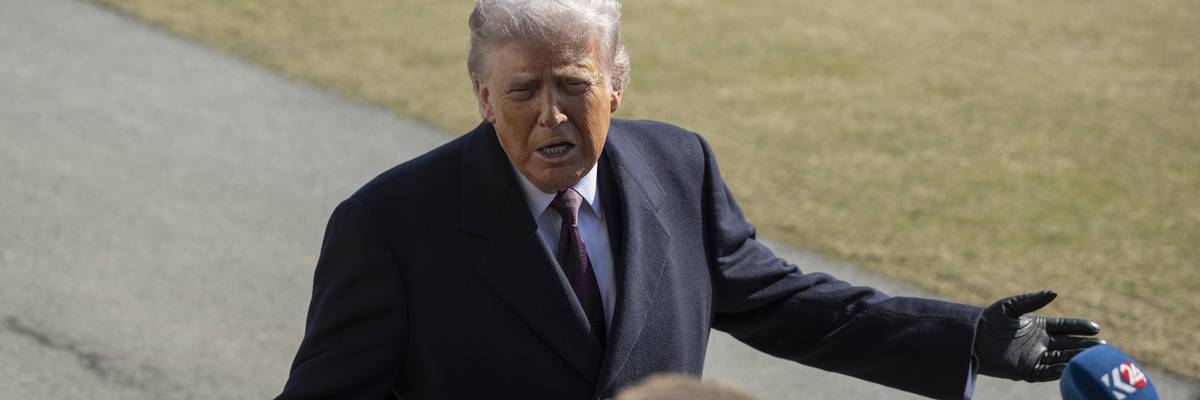
US President Donald Trump speaks to the press before he departs the White House in Washington, DC en route to Corpus Christi, Texas on February 27, 2026.(Photo by Celal Gunes/Anadolu via Getty Images)
“Trump ran on an explicitly anti-interventionist platform when he ran for president,” noted one critic. “He lied to the American people.”
As the world braces for a possible US war on Iran and people in Venezuela, Nigeria, and Yemen still reel from recent US attacks, President Donald Trump—the self-proclaimed “peace president” who has bombed more countries than any other American administration—said Friday that the United States may launch a “friendly takeover” of Cuba.
“The Cuban government is talking with us, they’re in a big deal of trouble, as you know,” Trump told reporters outside the White House before departing for Texas. “They have no money. They have no anything right now. But they’re talking to us, and maybe we’ll have a friendly takeover of Cuba.”
“We could very well end up having a friendly takeover of Cuba,” he added.
BREAKING: Trump floats a “friendly takeover” of Cuba while he pushes the U.S. closer to war in Iran. Trump ran on an explicitly anti-interventionist platform when he ran for president. He lied to the American people. pic.twitter.com/zs58bXb7Mw
— Trump Lie Tracker (Commentary Account) (@MAGALieTracker) February 27, 2026
Cuban Deputy Foreign Minister Carlos Fernández de Cossío posted on social media Friday that “the US maintains its fuel embargo against Cuba in full force, and its impact as a form of collective punishment is unwavering.”
“Nothing announced in recent days changes this reality,” he added. “The possibility of conditional sales to the private sector already existed and does not alleviate the impact on the Cuban population.”
Trump’s comments sparked criticism on social media, with one X user writing: “A ‘friendly takeover’ is an interesting phrase in international diplomacy. If the US is discussing Cuba’s future, I’m sure [Russian President] Vladimir Putin is suddenly very interested in the definition of friendly’ too.”
University of North Texas, Dallas political science professor Orlando Pérez said on X that “more often than not, [Trump’s] mouth is his worst enemy.”
“This BS plays into the hands of hard-liners on both sides of the Florida Straits and reduces chances of a negotiated deal,” he added. “Why would anyone in Cuba agree to a deal that leads to a US ‘takeover’?”
Meanwhile, dozens of civil society groups on Friday sent a letter to Congress urging lawmakers “to press the Trump administration to reverse its aggressive policy towards Cuba.”
“Instead, Congress should call on the administration to expand humanitarian relief, support political and economic engagement, and foster a more vibrant private sector that can deliver a better quality of life for the Cuban people,” added the groups, which include Alianza Americas, American Friends Service Committee, CodePink, Demand Progress, Peace Action, Presbyterian Church USA, RootsAction, United Church of Christ, and Win Without War.
Trump’s remarks Friday came in response to a question from NBC News senior White House correspondent Gabe Gutierrez regarding Wednesday’s incident in which Cuban maritime defense forces killed four men and captured six others during a shootout with a Florida-registered speedboat allegedly carrying weapons intended for what Havana called “an infiltration for terrorist purposes.” South Florida has long been a base for right-wing Cuban exiles who have launched numerous terror attacks against the Cuban people and international tourists on the island, including by speedboat strafings.
Trump did not clarify his comments, seemingly suggesting that moves to topple Cuba’s socialist government—which has outlasted a dozen US presidents—could be freshly afoot. Since Cubans overthrew a brutal US-backed dictatorship in 1959, the United States or allied exile forces tried to assassinate former Cuban President Fidel Castro hundreds of times, backed an ill-fated invasion at Bay of Pigs, served as a base for perpetrators of some of the hemisphere’s worst terror attacks, and even hatched a plan to detonate a nuclear bomb high above the island to convince its people that the return of Jesus Christ was nigh and the only thing standing in the way of the so-called “Second Coming” was Castro.
A 64-year US economic embargo on Cuba, which Trump recently worsened by cutting off fuel, has been a leading force crippling Cuba’s economy and is now being blamed for a soaring infant mortality on the island.
Friday’s remarks by Trump came as Iranians and people across the Middle East and beyond are bracing for a possible US attack on Iran—the second in as many years—and less than than two months after the president ordered the bombing and invasion of Venezuela during an operation that ended with Venezuelan President Nicolás Maduro abducted and jailed in United States, where he is expected to face trial for dubious narco-trafficking charges.
If the US strikes Cuba, it will be the 11th country attacked during Trump’s two terms in office. The president—who says he deserves a Nobel Peace Prize—has ordered attacks on Afghanistan, Iran, Iraq, Libya, Nigeria, Pakistan, Somalia, Syria, Venezuela, and Yemen, and has bombed dozens of boats allegedly transporting drugs in international waters in the Caribbean Sea and Pacific Ocean.
Donald Trump explains why he established his Bored of PeaceOrcas discuss how Trump was re-elected and him being an obviously insane, xenophobic Fascist.Elon Musk urges you to be a Fascist like him, says that you can ignore facts and reality then.
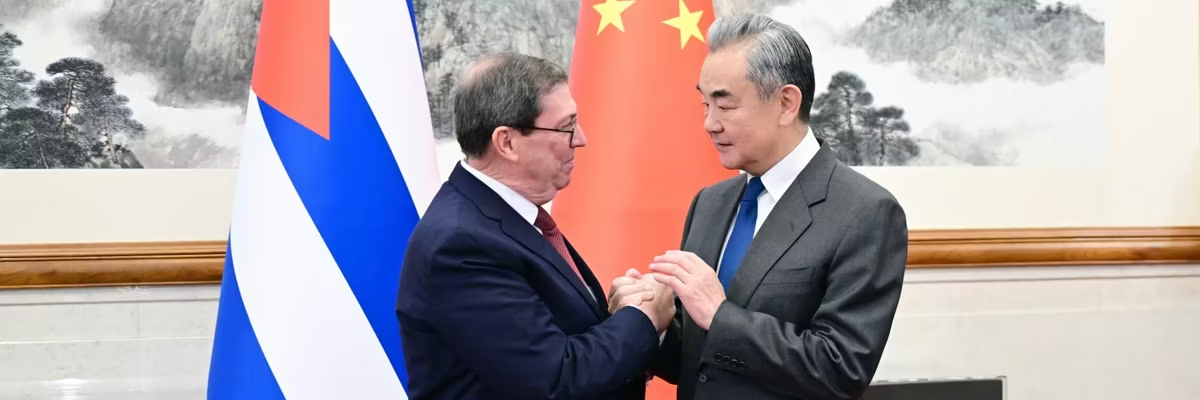
Chinese Foreign Minister Wang Yi shakes hands with his Cuban counterpart, Bruno Rodríguez Parrilla, in Beijing on February 5, 2026. (Photo by Lin Jian/X)
“China firmly supports Cuba in safeguarding national sovereignty and security and opposing external interference,” a Beijing spokesperson said.
As the Trump administration weaponizes its economic privation of the Cuban people in hopes of ousting their socialist government, China on Tuesday reaffirmed its pledge to help alleviate the island’s worsening oil shortage.
Emboldened by his recent abduction of socialist Venezuelan President Nicolás Maduro on legally dubious “narco-terrorism” charges, President Donald Trump is ratcheting up pressure on a people already ravaged by 64 years of what many critics call Washington’s “economic terrorism” and decades of actual terrorism committed by US-based right-wing Cuban exiles.
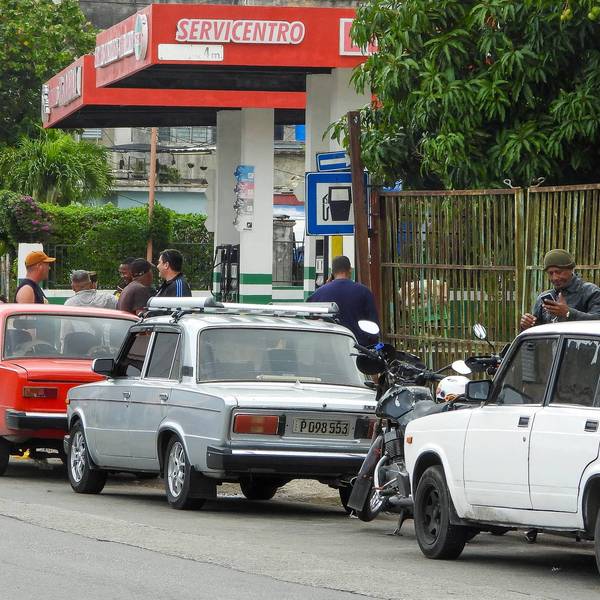
Cut off from the Venezuelan petroleum that provided around 75% of Cuba’s imported oil just a few years ago, the island is suffering a worsening energy emergency. The Cuban government has responded by strictly rationing fuel and seeking alternate sources of oil such as Mexico and, to a lesser extent, Russia.
“I would like to stress again that China firmly supports Cuba in safeguarding national sovereignty and security and opposing external interference,” Chinese Foreign Ministry spokesperson Lin Jian said during a press conference.
“China stands firmly against the inhumane actions that deprive the Cuban people of their right to subsistence and development,” he added. “China will, as always, do our best to provide support and assistance to Cuba.”
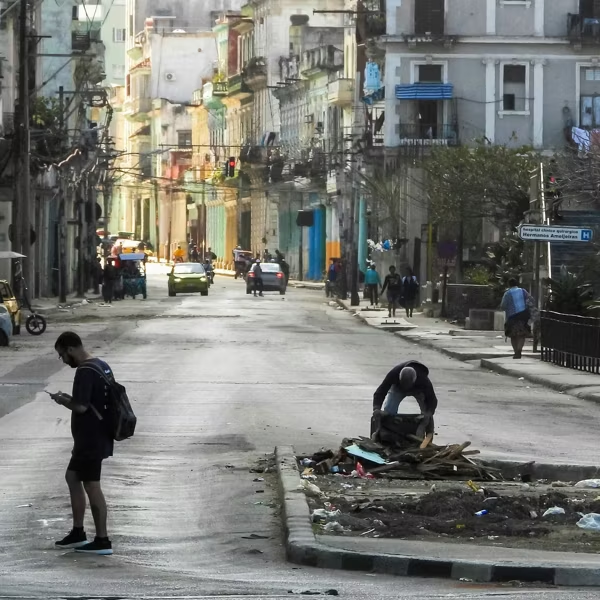
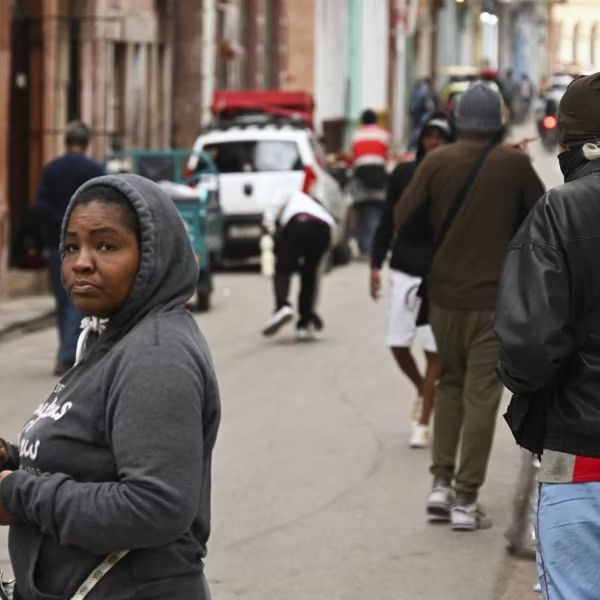
As is usually the case when Washington tightens the screws on Cuba, everyday Cubans are suffering the most.
“You can’t imagine how it touches every part of our lives,” Marta Jiménez, a hairdresser in Cuba’s eastern city of Holguín, told CodePink co-founder and frequent Common Dreams opinion contributor Medea Benjamin, who traveled to Cuba last week with a group to deliver 2,500 pounds of lentils.
“It’s a vicious, all-encompassing spiral downward,” Jiménez continued. “With no gasoline, buses don’t run, so we can’t get to work. We have electricity only three to six hours a day. There’s no gas for cooking, so we’re burning wood and charcoal in our apartments. It’s like going back 100 years.”
“The blockade is suffocating us—especially single mothers,” she added, “and no one is stopping these demons, Trump and [Secretary of State] Marco Rubio.”
The United Nations General Assembly has voted overwhelmingly every year but once since 1992 to condemn the US blockade on Cuba. Last October, the UNGA voted 165-7 against the embargo, with 12 abstentions.
Orcas discuss how Trump was re-elected and him being an obviously insane, xenophobic Fascist.Donald Fuhrump says that Amerikkka doesn’t bother with crimes or charges anymore, not being 100% Amerikkkan and opposing his real estate intentions is enough.Elon Musk urges you to be a Fascist like him, says that you can ignore facts and reality then.
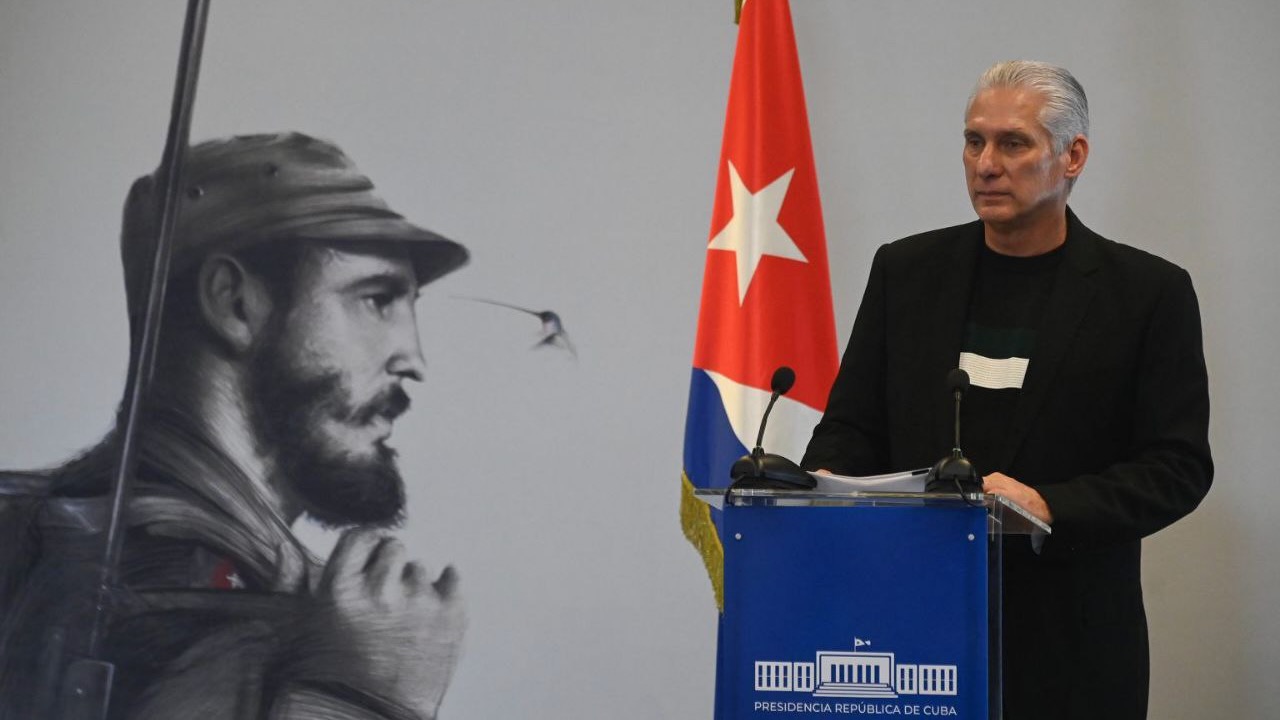
Cuban President Miguel Díaz-Canel addresses nation. Photo: Presidencia Cuba
The Cuban president emphasized to the press that his country does not pose a threat to US security. He reported on the hardships Cubans are facing as a result of the Trump administration’s latest decisions.
Cuban President Miguel Díaz-Canel spoke to the press on Thursday, February 5, about the situation facing the island in the wake of the latest measures imposed by Washington.
Following the seizure of Venezuelan tankers bound for Cuba by the United States Military, the Trump administration increased pressure on the island, which has been under an economic and commercial blockade for more than 60 years, by threatening to increase tariffs on any country that sells fuel to Cuba.
The US military campaign against Venezuela, including a naval blockade on oil and the kidnapping of the president and the first lady, cut off one of Cuba’s only alternatives for obtaining oil.
In his address, the president reported that no fuel has entered Cuba since December.
The loss of fuel supply severely complicates the electricity supply on which schools, transportation, and vital health infrastructure depend. In view of this, several analysts have called Trump’s latest measure against the Cuban people “genocidal”.
“Cuba is not a threat to the United States”
Díaz-Canel said he is aware of the difficulties and painful hardships that the Cuban people are going through following a decision that Washington justifies based on an alleged threat that Cuba poses to its national security, something that has been widely questioned by various analysts and politicians around the world.
On this subject, a deeply moved Díaz-Canel said during his appearance: “Cuba is not a terrorist country, nor is it a threat to the security of the United States. Cuba has never carried out, nor proposed, nor organized any aggressive action that puts at risk the territorial integrity, the security, or the stability of the government of the United States.”
He added: “We do not protect terrorists, and there are no military forces in Cuba from other nations or from other groups. In Cuba, there is indeed a military base – an illegal military base – and it is an illegal United States military base on Cuban soil, in the province of Guantánamo, against the will of the Cuban people.”
Cuba proposes dialogue “between equals”
In response, he affirmed that Cuba has always been and remains willing to engage in dialogue with Washington, although he clarified that “dialogue under pressure is not dialogue.” In this regard, he said that Cuba advocates civilized relations between neighbors, but rejects blackmail, threats, and impositions by some countries on others as a method of negotiation. He thus demanded respect for Cuban sovereignty.
Díaz-Canel said that his government is willing to meet with officials from the Trump administration to discuss the situation between the two countries: “Cuba is open to dialogue on any issue that needs to be debated or discussed, as long as there is no pressure or preconditions, in a situation of equality and respect for our sovereignty, independence, and self-determination.”
The theory of collapse
According to Cuban Foreign Minister Bruno Rodríguez, between March 2024 and February 2025 alone, the damage caused by the economic blockade of Cuba amounts to 7.556 billion USD, which represents a 49% increase compared to the previous period, showing that the blockade causes greater damage over time.
For his part, the Cuban president recalled that the US strategy of applying pressure until the country collapses is not new, and that despite all the difficulties Cuba has had to endure, it is not a failed state, as claimed by the White House: “The theory of collapse and the insistence on it is related to a whole set of constructs that the US government has tried to use to characterize the Cuban situation. This theory of collapse is associated with one of the currents in which the US government is determined to overthrow the Cuban revolution.”
Currently, he said, Cuba is enduring not only a series of mechanisms that seek to suffocate the Caribbean country, combined with the constant threat of military aggression, but also a media campaign that combines slander, hatred, and psychological warfare to justify various US attacks.
However, the Cuban president also pointed out that, despite the new conditions following the attack on Venezuela on January 3, there are several signs of international solidarity with his government: “Cuba is not alone, and we know that there are countries and companies willing to continue working with the largest of the Antilles.”
The revolutionary government’s decisions: savings and defense
Faced with this difficult situation, Díaz-Canel outlined the decisions his government has taken to tackle this new onslaught: “We have had to make a series of assessments in the Political Bureau, the Executive Committee of the Council of Ministers, and the National Defense Council, and we have just had a meeting in the Council of Ministers to update the plan to be implemented based on government directives to address an acute fuel shortage.”
Cuba has implemented fuel rationing to ensure the functioning of essential and basic activities for the Cuban population, although he acknowledged that the difficulty has been enormous, considering that no oil shipments have arrived in Cuba throughout 2026. This will mean a reduction in public transportation and an increase in blackouts on the island, which have already broken records.
In response, the Cuban president raised the possibility of increasing other types of energy sources, such as renewable energies, although this process will take time. Therefore, he said, the government must now demonstrate enormous creativity to overcome this new barrier that the United States, the most powerful country on earth, is unilaterally imposing on a country of just 10 million inhabitants.
In addition, Díaz-Canel stated that following the attack on Venezuela, in which more than 30 Cuban combatants on security missions in the South American country were killed, Cuba has prepared itself to face possible US military aggression: “One of the priorities we established was to deploy a defense preparedness plan.”
According to Díaz-Canel, in the event of military aggression, Fidel Castro’s old military principle of “war by the entire people” will be used against external aggressors. This, however, does not mean that the country is entering a “state of war”, but rather that it is preparing for the moment when that step must be taken, the president said.
In this regard, Foreign Minister Rodríguez said on Telegram: “The US seeks to impose its will on the rights of sovereign states and has been using force and aggression against Cuba for 67 years. On its side is enormous military power and the size of its economy, plus vast experience in aggression and crimes. On our side is reason, international law, and the patriotic spirit of a people.”
He added: “We Cubans are not willing to sell our country or give in to threats and blackmail, nor are we willing to renounce the inalienable prerogative with which we build our own destiny, in peace with the rest of the world. We will defend Cuba. Those who know us know that this is a firm, categorical, and proven commitment.”
Orcas discuss Donald Trump and the killer apes’ concept of democracy. Front Orca warns that Trump is crashing his country’s economy and that everything he does he does for the fantastically wealthy.Donald Fuhrump says that Amerikkka doesn’t bother with crimes or charges anymore, not being 100% Amerikkkan and opposing his real estate intentions is enough.Elon Musk urges you to be a Fascist like him, says that you can ignore facts and reality then.
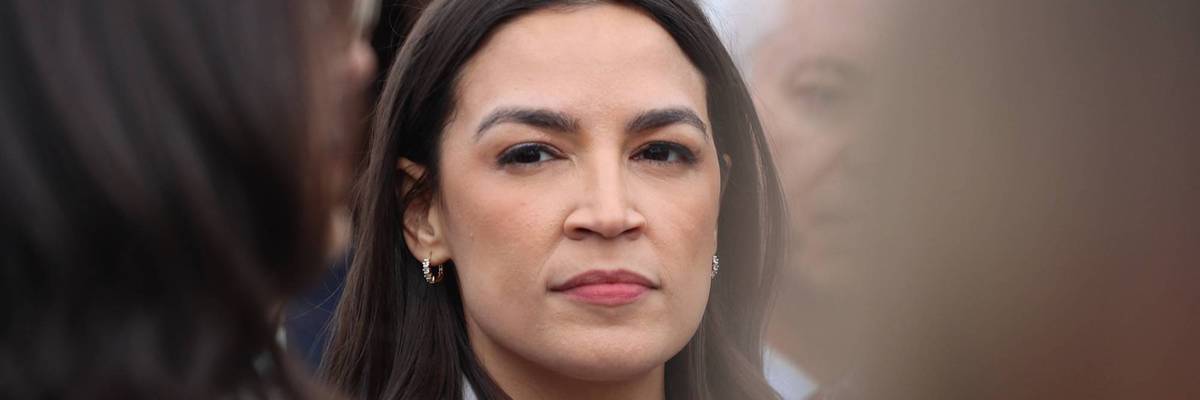
US Rep. Alexandria Ocasio-Cortez (D-NY) speaks at a press conference in Washington, DC, on January 22, 2026. (Photo by Alex Wroblewski/AFP via Getty Images)
“This is a new kind of era of depravity opened up,” said the congresswoman. “There was this stated commitment on human rights—that innocent civilians were almost exempt from the rules of war, from blockades.”
As the Cuban government announced Monday that the Trump administration’s oil blockade on the country would soon leave airlines without jet fuel, US Rep. Alexandria Ocasio-Cortez warned that the international community has become far too accepting of acts of economic warfare that collectively punish an entire population, not just government officials.
Ocasio-Cortez (D-NY) told Drop Site News reporter Julian Andreone that the stage for the worsened suffering of Cuban people was set in Gaza, where both Republican and Democratic US officials have backed Israel’s starvation policy and military assault since October 2023.
“This is what we’ve seen with Gaza, right, this is a new kind of era of depravity opened up, where there used to be—or there was this stated commitment on human rights—that innocent civilians were almost exempt from the rules of war, from blockades,” Ocasio-Cortez said.
🎥 WATCH | Rep. Alexandria Ocasio-Cortez (NY) reacted to Drop Site News reporting on internal divisions in the Trump administration’s Cuba policy by pointing to Gaza as evidence of a broader collapse in Western human rights norms.
Cuban people have long been victimized by the US government’s decadeslong, illegal trade embargo. But Trump’s decision to cut off Cuba’s oil supply from Venezuela, which was its largest energy supplier, and threaten to slap tariffs on any country that provides oil to the island nation, has left families facing lengthy blackouts and the threat that Cuba’s healthcare system could soon grind to a halt without fuel to keep hospitals running.
Trump has claimed he aims to punish the Cuban government, which he said last month constitutes “an unusual and extraordinary threat” to the US. He accused the country, without evidence, of harboring terrorists. Cuban officials have vehemently condemned the accusations.
Ocasio-Cortez compared Trump’s economic attack on Cuba to the catastrophe the US-backed Israeli military has imposed on Gaza since 2023, when it began its assault and humanitarian aid blockade in retaliation for a Hamas-led attack on southern Israel. A “ceasefire” deal was reached in October, but hundreds of Palestinians have been killed by the Israel Defense Forces since then and Israel has continued to block aid.
While persistently claiming Hamas is the target of the assault—which international experts and human rights groups have called a genocide—the Israeli military, with US support, has killed more than 71,000 Palestinians and has bombed homes, schools, hospitals, and other civilian infrastructure.
“What has transpired is that now it’s kind of become acceptable that the entire Western world will look the other way as they starve and deprive a people because they find political actors or political regimes in that country to be objectionable,” said Ocasio-Cortez. “What we are seeing here is the possible precipice of hospitals running out of fuel… We’re talking about innocent children, women that could be put in harm’s way.”
“It’s incumbent upon all of us to defend human rights no matter where they are,” she added.
Trita Parsi, executive vice president of the Quincy Institute for Responsible Statecraft, agreed with the congresswoman’s analysis.
“Gaza was not just a genocide,” he said, but was meant to further Israel’s goal “to destroy much of international law and the norms around the use of force in order to make increasingly inhumane use of violence and coercion against CIVILIANS permissible.”
Dylan Williams, vice president for government affairs at the Center for International Policy, added that Ocasio-Cortez was “rightly picking up the banner of a rules-based international consensus” on human rights, which was abandoned by the Biden administration when it gave financial and political support for Israel’s assault on Gaza.
Ocasio-Cortez echoed the concerns voiced earlier this week by Pierre-Emmanuel Dupont, an international expert on sanctions law, who told the Cuban storytelling outlet Belly of the Beastthat the Trump administration was “posing the risk of imminent humanitarian collapse in relation to the lack of fuel, which may gravely affect basically all human rights of the civilian population there.”
“Sanctions should be expected to be limited to officials,” said Dupont. “They are not supposed to apply bluntly to the whole population—which they do. They constitute collective punishment to the extent that they hit each and every Cuban citizen irrespective of their relationship with the government or regime.”
Donald Fuhrump says that Amerikkka doesn’t bother with crimes or charges anymore, not being 100% Amerikkkan and opposing his real estate intentions is enough.Keir Starmer objects to criticism of the IDF. He asks how could anyone object to them starving people to death, forced marches like the Nazis did, bombing Gaza’s hospitals and universities, mass-murdering journalists, healthworkers and starving people queuing for food, killing and raping prisoners and murdering children. He calls for people to stop obstructing his genocide for Israel.Orcas discuss Genocide-supporting and complicit Zionists. Donald Trump, Keith Starmer, David Lammy, Rachel Reeves, Angela Rayner and Wes Streeting are acknowledged as evil genocide-complicit and supporting cnuts.
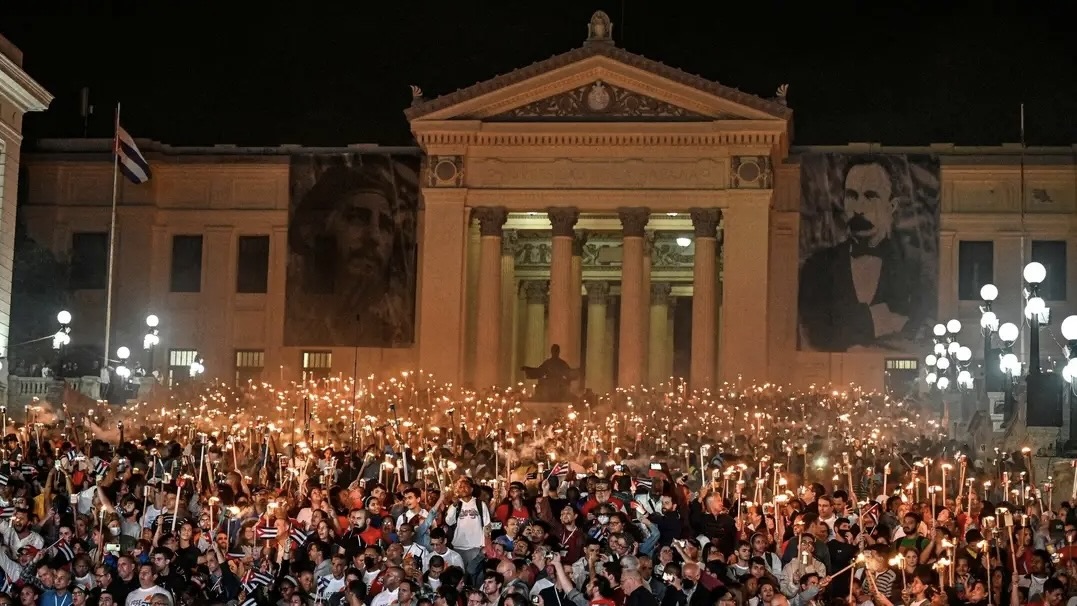
Thousands marched on January 26, 2026 in Havana, Cuba, to honor José Martí’s legacy. Photo: Progressive International
Claims by officials in Washington that “Cuba’s collapse is imminent” usually coincide with a tightening of the blockade. Yet, once again, Cubans have reaffirmed their commitment to the revolution and their creative resistance in the face of the latest US attacks.
The halls of power in Washington are echoing with a familiar, predatory chorus. Once again, the White House, various think-tank experts, and US politicians are predicting the “imminent collapse” of Cuba. This is a tune the world has heard for over sixty years, usually sung at its highest volume whenever the United States decides to tighten the economic noose around the island’s neck. However, in 2026, the rhetoric has shifted from sanctions to an overt campaign of total strangulation. Under a new executive order signed in late January, the second Trump administration has escalated the decades-long blockade into a proactive fuel blockade.
Cuban President Miguel Díaz-Canel laid bare the intended consequences in a press conference on February 5, 2026: “Not allowing a single drop of fuel to enter our country will affect transportation, food production, tourism, children’s education, and the healthcare system.” The objective is clear: to induce systemic failure, sow popular discontent, and create conditions for political destabilization. The White House rhetoric confirms this intent. Press Secretary Karoline Leavitt’s statement on the same day, that “the Cuban government is on its last leg and its country is about to collapse,” is not an analysis but public signaling, a psychological operation meant to reinforce the narrative of inevitable doom and pressure Cuban leadership into unilateral concessions.
This policy is not merely a “sanction” in the traditional sense; it is a calculated attempt to suffocate a nation by blocking every drop of fuel from reaching its shores. The administration has authorized aggressive tariffs and sanctions on any foreign country or company that dares to trade oil with the island, effectively treating Cuban territorial waters as a zone of exclusion. Since December, multiple oil tankers headed to Cuba have been seized by US naval forces in the Caribbean or forced to return to their ports of origin under threat of asset forfeiture. In direct response to this intensifying siege, Cuba has announced sweeping fuel rationing measures designed to protect essential services. The plan prioritizes fuel for healthcare, water, food production, education, public transportation, and defense, while strictly limiting sales to private drivers. To secure vital foreign currency, the tourism sector and key export industries, such as cigar production, will continue operating. Schools will maintain full in-person primary education, with hybrid systems implemented for higher levels. The leadership of the Cuban Revolution has affirmed that Cuba “will not collapse.”
To the planners in the White House, Cuba is a 67-year-old problem to be solved with starvation and darkness. But to the Cuban people, the current crisis is a continuation of a long-standing refusal to trade their sovereignty for Washington’s demands of submission.
The ghost of the “Special Period”
To understand why the Cuban people have not descended into the chaos Washington predicted, one must look to the historical precedent of the “Special Period in Time of Peace.” Following the collapse of the Soviet Union in 1991, Cuba experienced an economic shock that would have toppled almost any other modern state. Overnight, the island lost 85% of its international trade and nearly all of its subsidized fuel imports. The resulting statistics were staggering: the Gross Domestic Product plummeted by 35%, and the daily caloric intake of the average citizen dropped from over 3,000 calories to roughly 1,800. During this era, the lights went out across the island for more than 16 hours a day, and the bicycle became the primary mode of transportation as the public transit system collapsed.
At the same time, Washington escalated its assault through the Torricelli Act (1992) and the Helms-Burton Law (1996), each tightening the noose around Cuba’s economy. However, instead of fracturing under the weight of this tightened blockade, Cubans developed “Option Zero”, a survival plan designed to keep hospitals running and children fed without any fuel, and the Cuban social fabric tightened. The government prioritized the distribution of remaining resources to the most vulnerable, ensuring that infant mortality rates remained lower than those in many parts of the United States despite the scarcity. This period proved that when a population is politically conscious of the external forces causing their suffering, they become extraordinarily resilient. The “Special Period” was not just a time of hunger; it was a period of forced innovation that gave rise to the world’s first national experiment in organic urban farming and mass-scale energy conservation.
The return of the energy crisis
The crisis of 2026 is, in many ways, a sequel to the 1990s, but with higher stakes and more advanced technological targets. The roots of the current energy shortage can be traced back to the first Trump administration’s decision in 2019 to target Cuban oil imports as a means of punishing the island for its solidarity with Venezuela. By designating Cuba as a “State Sponsor of Terrorism” and activating Title III of the Helms-Burton Act, the US successfully scared off international shipping lines and insurance companies. This was followed by a focused campaign against the PDVSA (Venezuela’s state oil company) and the shipping firms involved in the trade agreement between countries in the region known as ALBA-TCP.
By 2025, the impact on Cuba’s energy grid was catastrophic. The island’s thermal power plants, most of which were built with aging Soviet technology, were never designed to burn the heavy, sulfur-rich crude that Cuba produces domestically without constant maintenance and expensive imported additives. The lack of foreign exchange, caused by the tightening of the blockade, meant that spare parts were non-existent. By the time the 2026 fuel blockade began, the national grid was already operating at 25% below its required capacity. President Miguel Díaz-Canel has been transparent with the public, noting that without fuel, everything from the morning school bus to the refrigeration systems for the nation’s advanced biotech medicines is under constant threat, a reality that has now precipitated the stringent new rationing regime.
The threat of intervention: from Caracas to Havana
The current US stance toward Cuba cannot be viewed in isolation from its recent military interventions in the Middle East and Latin America. The “regime change” efforts in Cuba are being modeled after the maximum pressure campaigns used against Iran and the military incursions seen in Venezuela on January 3, 2026. The threat of a US military attack is no longer a rhetorical flourish used by Havana to drum up nationalism; it is a documented strategic option discussed in Washington.
The logic behind such an intervention is twofold. First, there is the ideological drive to eliminate the “contagion” of a country that questions the Monroe Doctrine and US domination in the region. Cuba’s existence serves as a reminder that sovereignty is possible even in the shadow of a superpower. Second, and more pragmatically, the US is motivated by a thirst for strategic minerals. Cuba sits on some of the world’s largest reserves of nickel and cobalt, essential components of lithium-ion batteries that power the global transition to electric vehicles and advanced weaponry. In a world where the US is scrambling to compete with China for control of the mineral and energy supply chain, a sovereign Cuba that controls its own mines is seen as an obstacle to American hegemony. If the US can force a collapse, these minerals would no longer belong to the Cuban people; they would be auctioned off to US corporations as it was before 1959.
The new resistance: extraordinary efforts in renewable energy
However, the Cuban response to this renewed strangulation is not a white flag of surrender. Recognizing that fossil fuel dependence is a vulnerability the US will always exploit, Cuba has, in recent years, launched an extraordinary national effort to transform its energy matrix. Building on this momentum, the country completed 49 new solar parks in 2025 alone. This massive undertaking added approximately 1,000 megawatts of power to the national grid, marking a 7% increase in total grid capacity and accounting for a remarkable 38% of the nation’s energy generation. By the end of March 2026, with support from China, the island is on track to add over 150 MW of renewable power to its grid through the rapid deployment of solar parks.
The strategy is clear: if the empire can shut off the oil, Cuba will harvest the sun. “The way the US energy blockade has been implemented reinforces our commitment to the renewable energy strategy,” President Miguel Díaz-Canel declared. The government has committed to a plan to generate 24% of the country’s electricity from renewable sources by 2030, with a long-term goal of achieving total energy independence. This involves not just large-scale solar farms, but the decentralization of the grid through the installation of thousands of small-scale solar panels on homes and state buildings. This “energy sovereignty” movement is the 21st-century equivalent of the 1990s urban gardens. It is a way of overcoming the US blockade by removing the very commodity, oil, that Washington uses as a leash.
The narrative of Cuba’s “imminent collapse” has been written a thousand times by people who do not understand the depth of the island’s historical memory. The 2026 fuel blockade is a brutal crime against a civilian population, designed to create the very chaos that the US media then reports on as “proof” of government failure. It is the arsonist blaming the house for being flammable. The newly imposed fuel rationing is not a sign of surrender, but a tactical maneuver of national defense, a structured effort to outlast the assault while safeguarding the pillars of Cuban society that precisely make it an alternative to the US model.
Yet, Cuba’s message to the world remains consistent. They are willing to talk and trade, but not to be owned or become a neo-colony of the United States. The story of Cuba is not one of a failed state, but of a people who have decided that the most potent fuel for their future isn’t oil, it’s the will to remain independent. As the sun rises over the new solar arrays in the Cuban countryside, it serves as a silent, glowing testament to a nation that refuses to disappear.
Manolo De Los Santos is Executive Director of The People’s Forum and a researcher at Tricontinental: Institute for Social Research. His writing appears regularly in Monthly Review, Peoples Dispatch, CounterPunch, La Jornada, and other progressive media. He coedited, most recently, Viviremos: Venezuela vs. Hybrid War (LeftWord, 2020), Comrade of the Revolution: Selected Speeches of Fidel Castro (LeftWord, 2021), and Our Own Path to Socialism: Selected Speeches of Hugo Chávez (LeftWord, 2023).
Donald Fuhrump says that Amerikkka doesn’t bother with crimes or charges anymore, not being 100% Amerikkkan and opposing his real estate intentions is enough.Elon Musk urges you to be a Fascist like him, says that you can ignore facts and reality then.