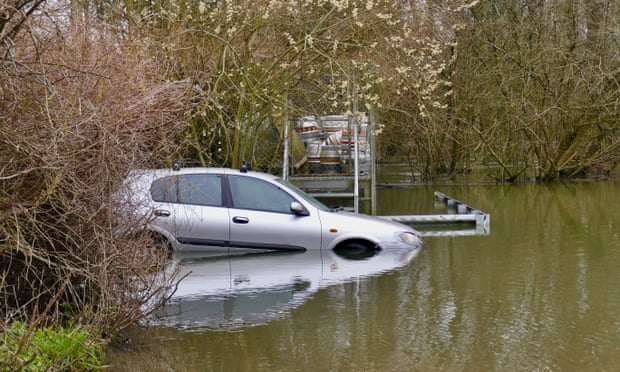
A car gets submerged in flood waters in a pub car park in Sonning on Thames, Berkshire, UK. Photograph: Geoffrey Swaine/REX/Shutterstock
Government has no credible plan for effects of extreme weather, says Committee on Climate Change
The UK’s plans for adapting to the effects of the climate crisis “fall far short” of what is required, the government’s statutory adviser has said.
The Climate Change Committee (CCC) has examined the national adaptation programme published by ministers last July, intended to set out how people, buildings and vital national infrastructure such as water, transport, energy and telecommunications networks could be protected from the increasing severity of storms, floods, heatwaves and droughts that are afflicting the UK as a result of global heating.
In a damning verdict delivered on Wednesday, the committee found that the government had no credible plan for making the UK resilient to the increasing effects of extreme weather.
Julia King, chair of the adaptation subcommittee of the CCC, said: “The evidence of the damage from climate change has never been clearer, but the UK’s current approach to adaptation is not working.”
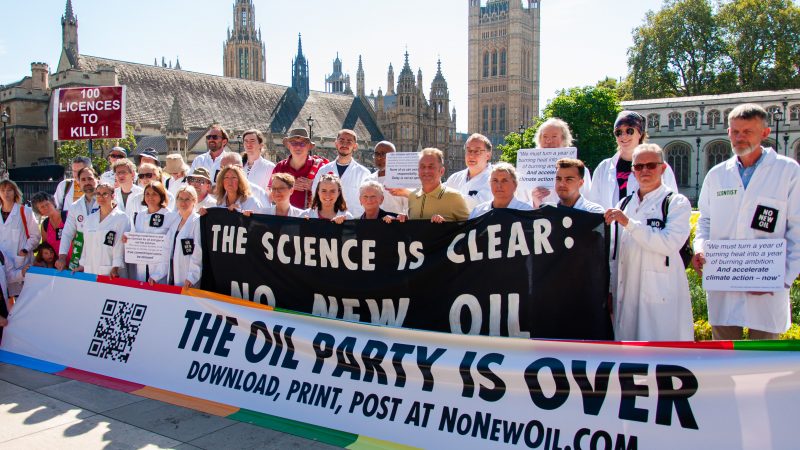
Scientists protest at UK Parliament 5 September 2023.
“The unprecedented temperatures for the time of year observed in September—following a record summer—have broken records by an extraordinary amount.”
Europe’s Copernicus Climate Change Service said Thursday that 2023 is on track to be the hottest year ever recorded following a string of scorching months, including an unusually warm September that stunned scientists.
Copernicus director Carlo Buontempo toldThe Associated Press that September was “just mindblowing” and that he has “never seen anything like that in any month in our records,” echoing the sentiments of other experts.
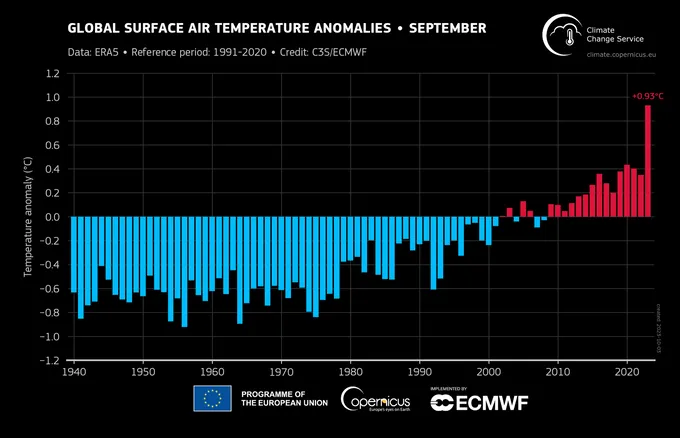
The European climate agency said Thursday that last month was the warmest September on record globally and “the most anomalous warm month of any year” in its dataset going back to 1940.
“The month as a whole was around 1.75°C warmer than the September average for 1850-1900, the preindustrial reference period,” the agency noted. “The global temperature for January-September 2023 was 0.52°C higher than average, and 0.05°C higher than the equivalent period in the warmest calendar year (2016).”
Samantha Burgess, Copernicus’ deputy director, said in a statement that “the unprecedented temperatures for the time of year observed in September—following a record summer—have broken records by an extraordinary amount.”
“This extreme month has pushed 2023 into the dubious honor of first place—on track to be the warmest year and around 1.4°C above preindustrial average temperatures,” Burgess added. “Two months out from COP28—the sense of urgency for ambitious climate action has never been more critical.”
(Credit: Copernicus Climate Change Service/ECMWF)
The new Copernicus data came hours after the release of a United Nations report that called on nations worldwide to end fossil fuel exploration by 2030, warning that countries are not acting with sufficient urgency to rein in planet-heating pollution.
Simon Stiell, the U.N. climate chief, said the report “puts the cards on the table—except this is not a game.”
“We know that we as the global community are not on track towards achieving the long-term goals of the Paris Agreement and that there is a rapidly closing window of opportunity to secure a livable and sustainable future,” said Stiell.
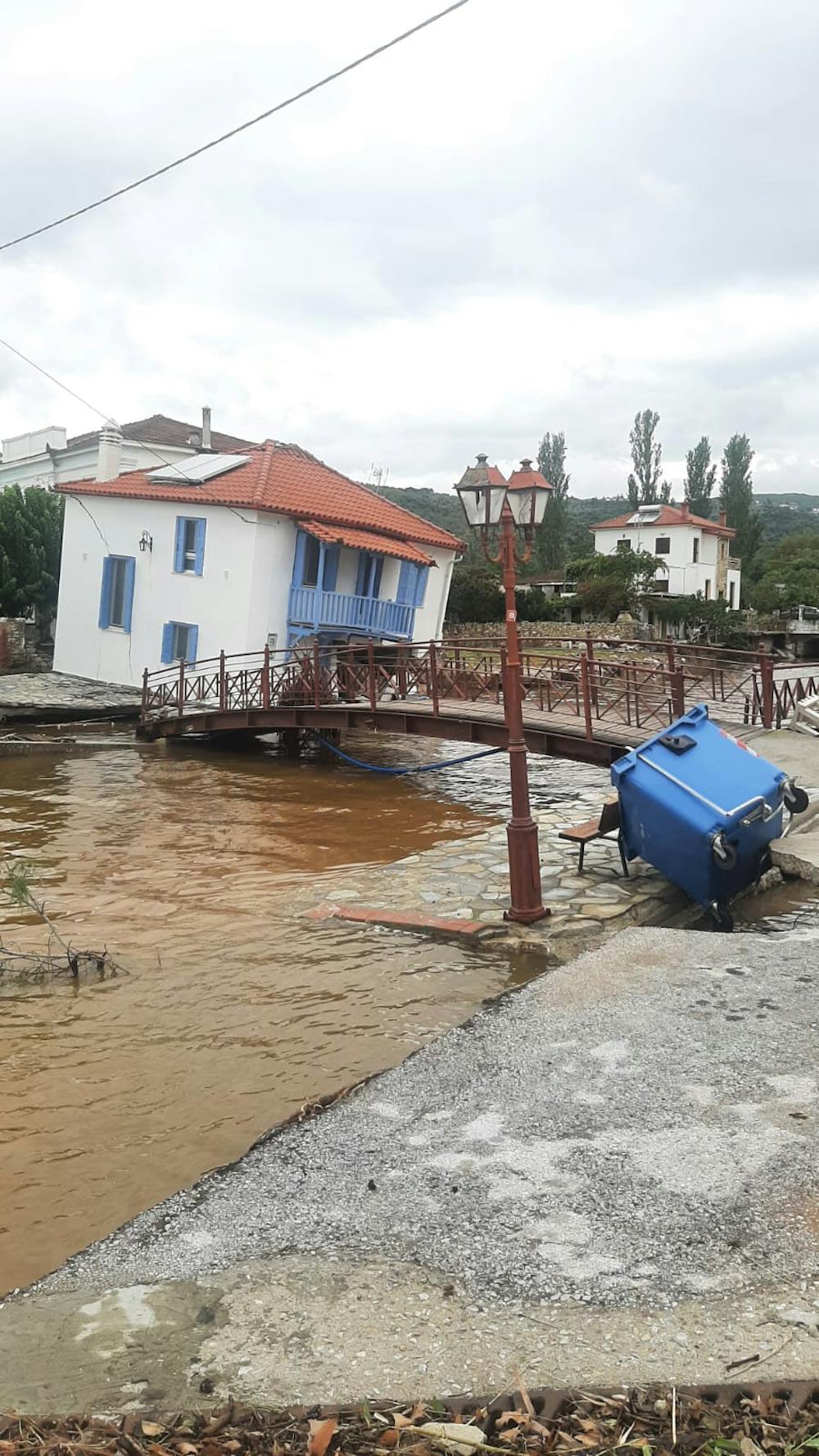
Recent images of the devastating flash floods caused by Storm Daniel in Greece hit close to home literally and figuratively. As a Greek who has completed a PhD and worked for the past eight years on flash floods, the scenes unfolding across my homeland are painfully real: a stark reminder of the broader environmental challenges we face both on a local and a global scale.
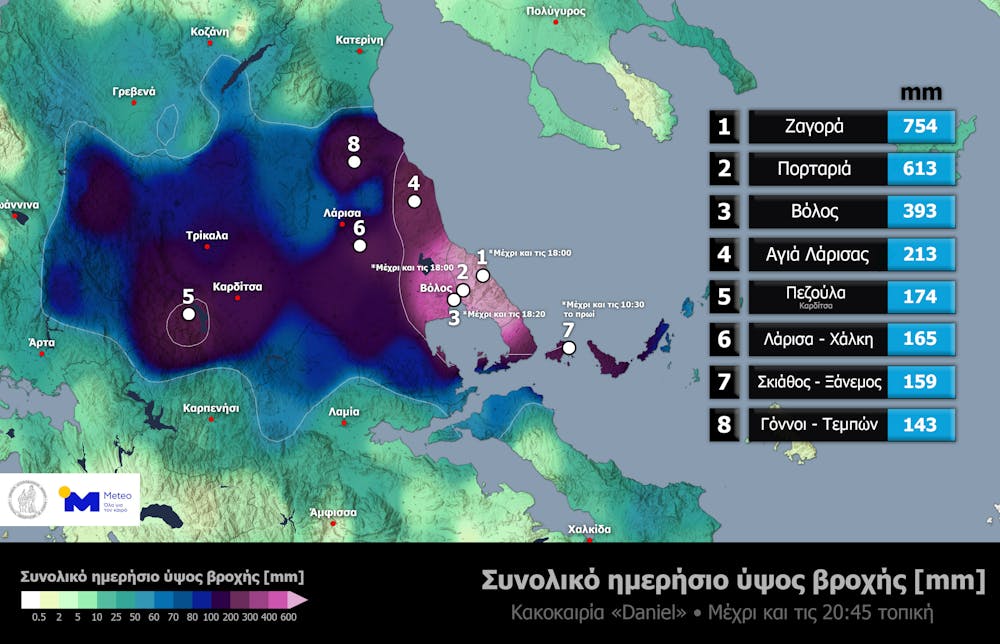
These unprecedented flash floods were triggered by rainfall from the arrival of Storm Daniel on Monday September 4 which also affected Turkey and Bulgaria. The following day, in the village of Zagora, a record-breaking 754mm of rain fell in just 18 hours, leaving parts of the region of Thessaly in crisis and unable to respond.
To put this in perspective, London gets about 585mm of rain over the course of a year while Thessaly gets 495mm, meaning that on Tuesday September 5, about 1.5 years’ worth of rain fell in 18 hours. Imagine the most torrential rain you have ever experienced, perhaps a cloudburst lasting 20 minutes or so. Now imagine it raining that hard but without pause for an entire day.
Flash flooding is short in duration but extremely intense, and typically happens within six hours of heavy rainfall. Unlike regular floods, which develop more slowly and can be predicted in advance, flash floods catch people off guard due to their rapid onset and are rarely recorded in the field.
Across the three affected countries the floods have killed at least 18 people, with many others seeking refuge on their rooftops. There are ongoing power and water outages, infrastructure has been damaged, houses and even entire villages have been completely submerged.
I asked Andrew Barnes, an academic at the University of Bath with expertise in using AI to analyse extreme events why this event was so exceptional. He told me that throughout Tuesday, a strong low-pressure centre formed across the south of Greece creating a large rotating weather system known as a cyclone.
This cyclone carried large rain clouds from both the Mediterranean and Aegean Sea between Greece and Turkey. But it did not dissipate, and instead its low-pressure centre moved southwest and settled just south of Italy, with its bands of rain clouds also moving south and covering most of mainland Greece.
Trending across the region
It is crucial to emphasise that flash floods are not confined to Greece alone. They are in fact part of a broader pattern of extreme weather that has become more intense and frequent across the Mediterranean region.
The author’s friend saw this flooding in the village of Chorto. Irini Arabatzi
Researchers who looked at 150 years of flood data in the Mediterranean found that most were flash floods, with their highest occurrence during the summer and autumn months. The region is particularlysusceptible to these floods due to the combined effects of climate change and urbanisation. The latter has increased urban development in flood-prone areas and increased impervious surfaces (like roads and pavements), preventing the natural absorption of water into the ground.
The Intergovernmental Panel on Climate Change’s chapter on the Mediterranean region issued a warning that extreme rainfall events are going to occur more often and be even more intense, elevating the risk of flash floods. This warning, in combination with records of flash floods in 2023 in Spain, Italy, Turkey, Bulgaria, France and Greece, underscores the urgent need for proactive measures to address these climate-related challenges.
Research is advancing
Flash floods might be rare, but they are severe enough to be a matter of significant concern. Fortunately, research has advanced considerably in recent years. We’re now better able to forecast when flash floods might happen, which areas might be susceptible, and to assess their impact in real-time.
My colleagues and I are working on a project that combines historical documentary sources and modern hydraulic modelling. This way we can shed light on past floods and better understand the risks they pose, helping us design effective mitigation strategies for the future. Practically, in the case of a flash flood some basic but very important actions can be found on the poster below.
Tips from a flash floods expert. Ioanna Stamataki
A complete eradication of flooding is neither technically feasible nor economically affordable. Instead on a larger scale it is key to start identifying flash-flood prone areas especially in catchments with historical flash floods. We should then focus on advocating for climate action and resilience measures, which can be anything from “hard” defences like new flood walls, through to policies and better public awareness of the risks. Only this will offer hope of a safer and more resilient future.
Don’t have time to read about climate change as much as you’d like?
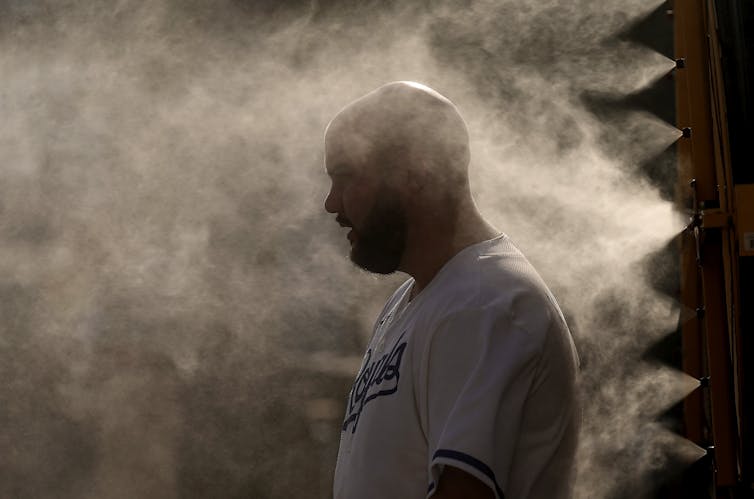
Consider this analogy from the world of sports: Suppose a baseball player is having a great season, and his batting average is twice what it was last year. If he hits a ball out of the park on Tuesday, we don’t ask whether he got that hit because his batting average has risen. His average has gone up because of the hits, not the other way around. Perhaps the Tuesday homer resulted from a fat pitch, or the wind breaking just right, or because he was well rested that day. But if his batting average has doubled since last season, we might reasonably ask if he’s on steroids.
Unprecedented heat and downpours and drought and wildfires aren’t “caused by climate change” – they are climate change.
The rise in frequency and intensity of extreme events is by definition a change in the climate, just as an increase in the frequency of base hits causes a better’s average to rise.
And as in the baseball analogy, we should ask tough questions about the underlying cause. While El Niño is a contributor to the extreme heat this year, that warm event has only just begun. The steroids fueling extreme weather are the heat-trapping gases from burning coal, oil and gas for energy around the world.
Nothing ‘normal’ about it
A lot of commentary uses the framing of a “new normal,” as if our climate has undergone a step change to a new state. This is deeply misleading and downplays the danger. The unspoken implication of “new normal” is that the change is past and we can adjust to it as we did to the “old normal.”
Unfortunately, warming won’t stop this year or next. The changes will get worse until we stop putting more carbon dioxide and other greenhouse gases into the atmosphere than the planet can remove.
The excess carbon dioxide humans have put into the atmosphere raises the temperature – permanently, as far as human history is concerned. Carbon dioxide lingers in the atmosphere for a long time, so long that the carbon dioxide from a gallon of gasoline I burn today will still be warming the climate in thousands of years.
That warming increases evaporation from the planet’s surface, putting more moisture into the atmosphere to fall as rain and snow. Locally intense rainfall has more water vapor to work with in a warmer world, so big storms drop more rain, causing dangerous floods and mudslides like the ones we saw in Vermont, California, India and other places around the world this year.
By the same token, anybody who’s ever watered the lawn or a garden knows that in hot weather, plants and soils need more water. A hotter world also has more droughts and drying that can lead to wildfires.
So, what can we do about it?
Not every kind of bad weather is associated with burning carbon. There’s scant evidence that hailstorms or tornadoes or blizzards are on the increase, for example. But if summer 2023 shows us anything, it’s that the extremes that are caused by fossil fuels are uncomfortable at best and often dangerous.
Without drastic emission cuts, the direct cost of flooding has been projected to rise to more than US$14 trillion per year by the end of the century and sea-level rise to produce billions of refugees. By one estimate, unmitigated climate change could reduce per capita income by nearly a quarter by the end of the century globally and even more in the Global South if future adaptation is similar to what it’s been in the past. The potential social and political consequences of economic collapse on such a scale are incalculable.
Fortunately, it’s quite clear how to stop making the problem worse: Re-engineer the world economy so that it no longer runs on carbon combustion. This is a big ask, for sure, but there are affordable alternatives.
Clean energy is already cheaper than old-fashioned combustion in most of the world. Solar and wind power are now about half the price of coal- and gas-fired power. New methods for transmitting and storing power and balancing supply and demand to eliminate the need for fossil fuel electricity generation are coming online around the world.
Just as the summer of 2023 was among the hottest in thousands of years, 2024 will likely be hotter still. El Niño is strengthening, and this weather phenomenon has a history of heating up the planet. We will probably look back at recent years as among the coolest of the 21st century.
Analysts estimate the category 3 storm has already racked up a preliminary cost of $9.36bn, straining the insurance industry
Hurricane Idalia could become the costliest climate disaster to hit the US this year, analysts say, with massive implications for insurance and risk management industries.
The category 3 storm that barreled into Florida’s west coast from the Gulf of Mexico on Wednesday, then carved a path of destruction and flooding through Georgia and the Carolinas, has a preliminary price tag of $9.36bn, based on early estimates, according to risk analysts at UBS.
It follows 15 previous “individual weather and climate disasters” recorded in the US already this year by the National Oceanic and Atmospheric Administration (Noaa) as unprecedented heat, wildfires, storms and floods escalate.