Tag: extreme weather

  • Greece’s record rainfall and flash floods are part of a trend – across the Mediterranean, the weather is becoming more dangerous

    Spread the love


    Ioanna Stamataki, University of Greenwich

    Recent images of the devastating flash floods caused by Storm Daniel in Greece hit close to home literally and figuratively. As a Greek who has completed a PhD and worked for the past eight years on flash floods, the scenes unfolding across my homeland are painfully real: a stark reminder of the broader environmental challenges we face both on a local and a global scale.

    These unprecedented flash floods were triggered by rainfall from the arrival of Storm Daniel on Monday September 4 which also affected Turkey and Bulgaria. The following day, in the village of Zagora, a record-breaking 754mm of rain fell in just 18 hours, leaving parts of the region of Thessaly in crisis and unable to respond.

    To put this in perspective, London gets about 585mm of rain over the course of a year while Thessaly gets 495mm, meaning that on Tuesday September 5, about 1.5 years’ worth of rain fell in 18 hours. Imagine the most torrential rain you have ever experienced, perhaps a cloudburst lasting 20 minutes or so. Now imagine it raining that hard but without pause for an entire day.

    Flash flooding is short in duration but extremely intense, and typically happens within six hours of heavy rainfall. Unlike regular floods, which develop more slowly and can be predicted in advance, flash floods catch people off guard due to their rapid onset and are rarely recorded in the field.
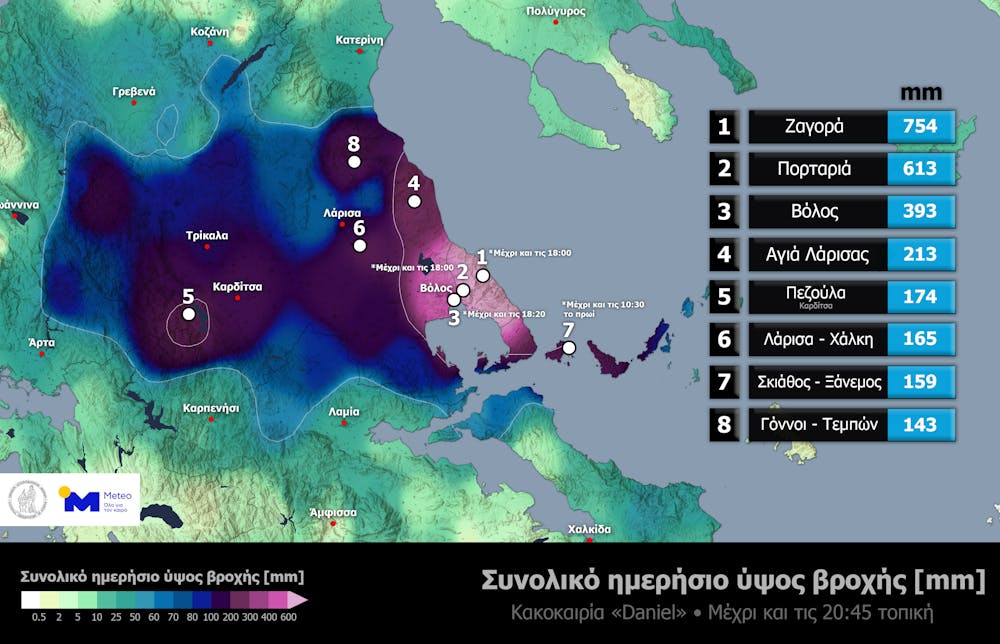
    Annotated map of central Greece
    Greece’s daily rainfall record was broken with 754 mm of rain in the village of Zagora – more than double the UK’s equivalent record.
    National Observatory of Athens/meteo.gr, CC BY-SA

    Catastrophic effects

    Across the three affected countries the floods have killed at least 18 people, with many others seeking refuge on their rooftops. There are ongoing power and water outages, infrastructure has been damaged, houses and even entire villages have been completely submerged.

    I asked Andrew Barnes, an academic at the University of Bath with expertise in using AI to analyse extreme events why this event was so exceptional. He told me that throughout Tuesday, a strong low-pressure centre formed across the south of Greece creating a large rotating weather system known as a cyclone.

    This cyclone carried large rain clouds from both the Mediterranean and Aegean Sea between Greece and Turkey. But it did not dissipate, and instead its low-pressure centre moved southwest and settled just south of Italy, with its bands of rain clouds also moving south and covering most of mainland Greece.

    Trending across the region

    It is crucial to emphasise that flash floods are not confined to Greece alone. They are in fact part of a broader pattern of extreme weather that has become more intense and frequent across the Mediterranean region.
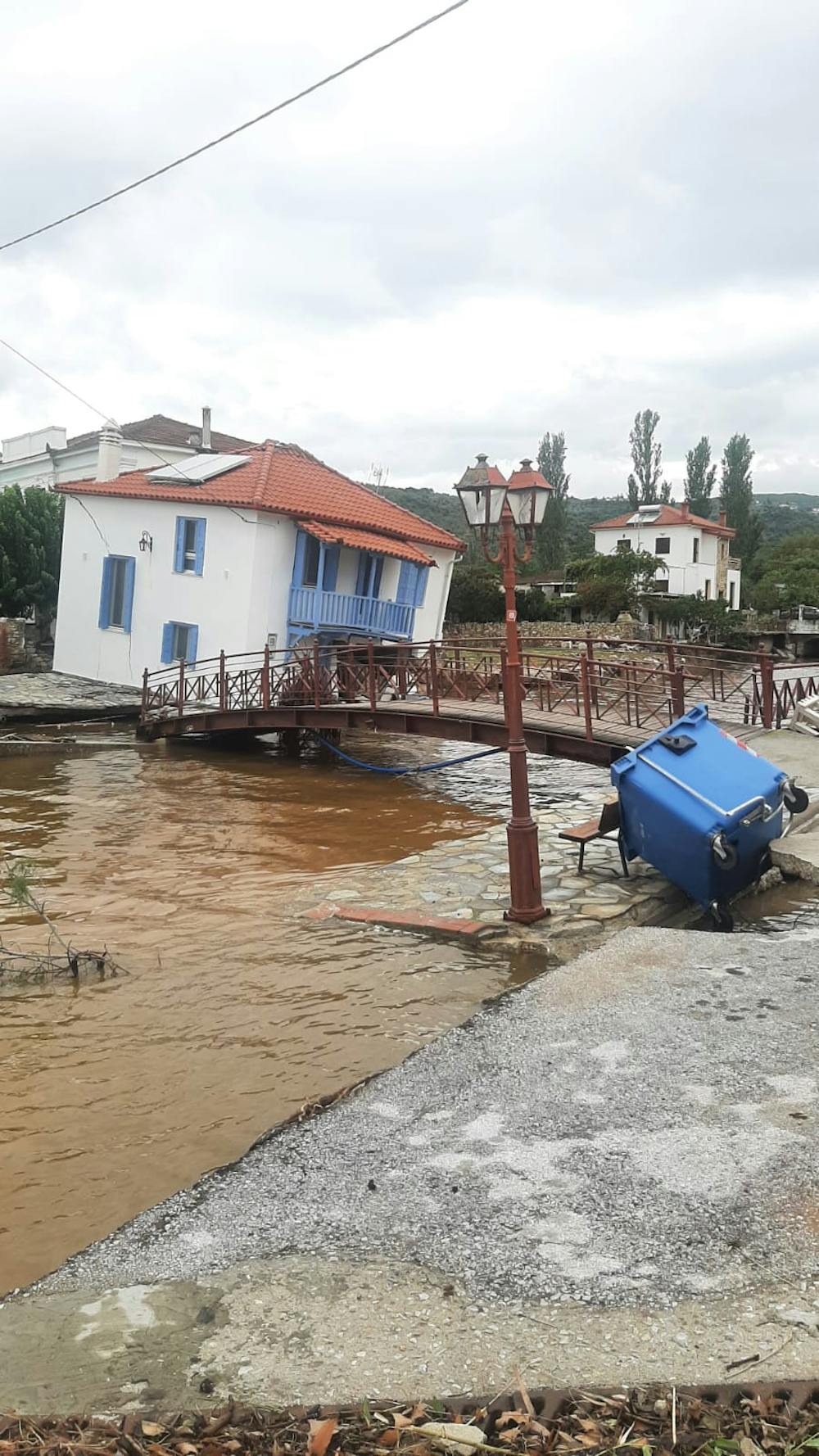
    The author’s friend saw this flooding in the village of Chorto.
    Irini Arabatzi

    Researchers who looked at 150 years of flood data in the Mediterranean found that most were flash floods, with their highest occurrence during the summer and autumn months. The region is particularly susceptible to these floods due to the combined effects of climate change and urbanisation. The latter has increased urban development in flood-prone areas and increased impervious surfaces (like roads and pavements), preventing the natural absorption of water into the ground.

    The Intergovernmental Panel on Climate Change’s chapter on the Mediterranean region issued a warning that extreme rainfall events are going to occur more often and be even more intense, elevating the risk of flash floods. This warning, in combination with records of flash floods in 2023 in Spain, Italy, Turkey, Bulgaria, France and Greece, underscores the urgent need for proactive measures to address these climate-related challenges.

    Research is advancing

    Flash floods might be rare, but they are severe enough to be a matter of significant concern. Fortunately, research has advanced considerably in recent years. We’re now better able to forecast when flash floods might happen, which areas might be susceptible, and to assess their impact in real-time.

    My colleagues and I are working on a project that combines historical documentary sources and modern hydraulic modelling. This way we can shed light on past floods and better understand the risks they pose, helping us design effective mitigation strategies for the future. Practically, in the case of a flash flood some basic but very important actions can be found on the poster below.

    infographic with important actions to take
    Tips from a flash floods expert.
    Ioanna Stamataki

    A complete eradication of flooding is neither technically feasible nor economically affordable. Instead on a larger scale it is key to start identifying flash-flood prone areas especially in catchments with historical flash floods. We should then focus on advocating for climate action and resilience measures, which can be anything from “hard” defences like new flood walls, through to policies and better public awareness of the risks. Only this will offer hope of a safer and more resilient future.


    Imagine weekly climate newsletter

    Don’t have time to read about climate change as much as you’d like?

    Get a weekly roundup in your inbox instead. Every Wednesday, The Conversation’s environment editor writes Imagine, a short email that goes a little deeper into just one climate issue. Join the 20,000+ readers who’ve subscribed so far. The Conversation


    Ioanna Stamataki, Lecturer in Hydraulics and Water Engineering, University of Greenwich

    This article is republished from The Conversation under a Creative Commons license. Read the original article.

    Related: Faster disaster: climate change fuels ‘flash droughts’, intense downpours and storms
  • Summer 2023 was the hottest on record – yes, it’s climate change, but don’t call it ‘the new normal’

    Spread the love

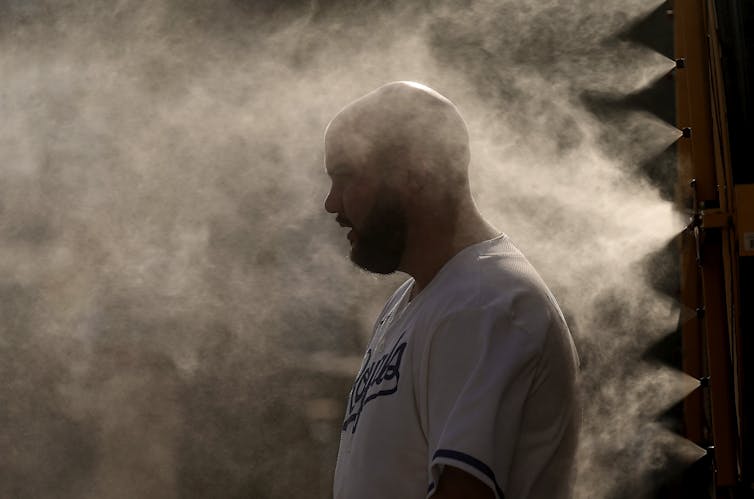
    Kansas City’s baseball stadium ran misters to cool people off in heat near 100 degrees on June 28, 2023.
    AP Photo/Charlie Riedel

    Scott Denning, Colorado State University

    Summer 2023 has been the hottest on record by a huge margin. Hundreds of millions of people suffered as heat waves cooked Europe, Japan, Texas and the Southwestern U.S. Phoenix hit 110 degrees Fahrenheit (43 degrees Celsius) for a record 54 days, including a 31-day streak in July. Large parts of Canada were on fire. Lahaina, Hawaii, burned to the ground.

    As an atmospheric scientist, I get asked at least once a week if the wild weather we’ve been having is “caused” by climate change. This question reflects a misunderstanding of the difference between weather and climate.

    Consider this analogy from the world of sports: Suppose a baseball player is having a great season, and his batting average is twice what it was last year. If he hits a ball out of the park on Tuesday, we don’t ask whether he got that hit because his batting average has risen. His average has gone up because of the hits, not the other way around. Perhaps the Tuesday homer resulted from a fat pitch, or the wind breaking just right, or because he was well rested that day. But if his batting average has doubled since last season, we might reasonably ask if he’s on steroids.

    Unprecedented heat and downpours and drought and wildfires aren’t “caused by climate change” – they are climate change.

    The rise in frequency and intensity of extreme events is by definition a change in the climate, just as an increase in the frequency of base hits causes a better’s average to rise.

    And as in the baseball analogy, we should ask tough questions about the underlying cause. While El Niño is a contributor to the extreme heat this year, that warm event has only just begun. The steroids fueling extreme weather are the heat-trapping gases from burning coal, oil and gas for energy around the world.

    Nothing ‘normal’ about it

    A lot of commentary uses the framing of a “new normal,” as if our climate has undergone a step change to a new state. This is deeply misleading and downplays the danger. The unspoken implication of “new normal” is that the change is past and we can adjust to it as we did to the “old normal.”

    Unfortunately, warming won’t stop this year or next. The changes will get worse until we stop putting more carbon dioxide and other greenhouse gases into the atmosphere than the planet can remove.

    The excess carbon dioxide humans have put into the atmosphere raises the temperature – permanently, as far as human history is concerned. Carbon dioxide lingers in the atmosphere for a long time, so long that the carbon dioxide from a gallon of gasoline I burn today will still be warming the climate in thousands of years.

    That warming increases evaporation from the planet’s surface, putting more moisture into the atmosphere to fall as rain and snow. Locally intense rainfall has more water vapor to work with in a warmer world, so big storms drop more rain, causing dangerous floods and mudslides like the ones we saw in Vermont, California, India and other places around the world this year.

    By the same token, anybody who’s ever watered the lawn or a garden knows that in hot weather, plants and soils need more water. A hotter world also has more droughts and drying that can lead to wildfires.

    So, what can we do about it?

    Not every kind of bad weather is associated with burning carbon. There’s scant evidence that hailstorms or tornadoes or blizzards are on the increase, for example. But if summer 2023 shows us anything, it’s that the extremes that are caused by fossil fuels are uncomfortable at best and often dangerous.

    Without drastic emission cuts, the direct cost of flooding has been projected to rise to more than US$14 trillion per year by the end of the century and sea-level rise to produce billions of refugees. By one estimate, unmitigated climate change could reduce per capita income by nearly a quarter by the end of the century globally and even more in the Global South if future adaptation is similar to what it’s been in the past. The potential social and political consequences of economic collapse on such a scale are incalculable.

    Fortunately, it’s quite clear how to stop making the problem worse: Re-engineer the world economy so that it no longer runs on carbon combustion. This is a big ask, for sure, but there are affordable alternatives.

    Clean energy is already cheaper than old-fashioned combustion in most of the world. Solar and wind power are now about half the price of coal- and gas-fired power. New methods for transmitting and storing power and balancing supply and demand to eliminate the need for fossil fuel electricity generation are coming online around the world.

    In 2022, taxpayers spent about $7 trillion subsidizing oil and gas purchases and paying for damage they caused. All that money can go to better uses. For example, the International Energy Agency has estimated the world would need to spend about $4 trillion a year by 2030 on clean energy to cut global emissions to net zero by midcentury, considered necessary to keep global warming in check.

    Just as the summer of 2023 was among the hottest in thousands of years, 2024 will likely be hotter still. El Niño is strengthening, and this weather phenomenon has a history of heating up the planet. We will probably look back at recent years as among the coolest of the 21st century. The Conversation

    Scott Denning, Professor of Atmospheric Science, Colorado State University

    This article is republished from The Conversation under a Creative Commons license. Read the original article.

  • Hurricane Idalia could become 2023’s costliest climate disaster for the US

    Spread the love

    https://www.theguardian.com/us-news/2023/aug/31/hurricane-idalia-cost-update-category-3-florida-georgia

    Analysts estimate the category 3 storm has already racked up a preliminary cost of $9.36bn, straining the insurance industry

    Hurricane Idalia could become the costliest climate disaster to hit the US this year, analysts say, with massive implications for insurance and risk management industries.

    The category 3 storm that barreled into Florida’s west coast from the Gulf of Mexico on Wednesday, then carved a path of destruction and flooding through Georgia and the Carolinas, has a preliminary price tag of $9.36bn, based on early estimates, according to risk analysts at UBS.

    It follows 15 previous “individual weather and climate disasters” recorded in the US already this year by the National Oceanic and Atmospheric Administration (Noaa) as unprecedented heat, wildfires, storms and floods escalate.

    Cumulatively, Noaa said that by the end of July, which Nasa said was Earth’s hottest month on record, the total estimated cost of the damage caused by the disasters was $39.7bn. That figure does not include the estimated $5.5bn cost to rebuild the town of Lahaina following devastating wildfires that razed the Hawaii island of Maui this month.

    …

    https://www.theguardian.com/us-news/2023/aug/31/hurricane-idalia-cost-update-category-3-florida-georgia

  • Winter heatwave in Andes is sign of things to come, scientists warn

    Spread the love

    https://www.theguardian.com/environment/2023/aug/06/winter-heatwave-andes-sign-things-come-scientists-warn

    Human-caused climate disruption and El Niño push temperature in mountains to 37C

    Exceptional winter heat in the Andean mountains of South America has surged to 37C, prompting local scientists to warn the worst may be yet to come as human-caused climate disruption and El Niño cause havoc across the region.

    The heatwave in the central Chilean Andes is melting the snow below 3,000 metres (9,840ft), which will have knock-on effects for people living in downstream valleys who depend on meltwater during the spring and summer.

    Tuesday was probably the warmest winter day in northern Chile in 72 years, according to Raul Cordero, a climate scientist at the University of Groningen, who said the 37C recorded at the Vicuña Los Pimientos station in the Coquimbo region was caused by a combination of global heating, El Niño and easterly gusts, known by locals as Terral winds that bring hot, dry weather.

    Dozens of meteorological monitoring stations at more than 1,000 metres altitude recorded temperatures above 35C in winter, according to the Extreme Temperatures Around The World blog.

    …

    https://www.theguardian.com/environment/2023/aug/06/winter-heatwave-andes-sign-things-come-scientists-warn

    One of 2023’s most extreme heatwaves is happening in the middle of winter

  • ‘Gleefully Encouraging the Arsonists’: UK Government Commits to More Fossil Fuel Drilling

    Spread the love

    Original article by JAKE JOHNSON republished from Common Dreams under Creative Commons (CC BY-NC-ND 3.0).

    “The U.K. government is blatantly in denial about climate breakdown.”

    U.K. Prime Minister Rishi Sunak announced Monday that his government will approve hundreds of new licenses for oil and gas drilling in the North Sea, drawing anger from climate advocates who say he’s doing the bidding of the fossil fuel industry amid a nightmarish wave of extreme weather.

    Paying lip service to the nation’s net-zero emissions target, the Tory leader also laid out plans for two new carbon capture and storage facilities in Northeast Scotland and the Humber, lining up behind an oil industry-backed approach to reining in pollution that critics say is a false solution to the global climate crisis.

    “Burning oil and gas is driving extreme weather and killing people on every continent, yet Rishi Sunak is gleefully encouraging the arsonists to go and put more fuel on the fire,” said Mary Church, a campaigner with Friends of the Earth Scotland. “By committing to future licensing rounds on the same day, it’s clear to see that carbon capture is little more than a greenwashing tactic by Big Oil to try and keep their climate-wrecking industry in business.”

    Major fossil fuel giants such as Shell and BP have maintained oil and gas facilities in the North Sea for years. According to a recent analysis by Greenpeace, oil and gas licenses approved by the U.K. government over the past two years are set to generate as much carbon dioxide as Denmark emits annually—roughly the equivalent of 14 million cars.

    “History will view this as an act of gross criminality. Our future sacrificed for the profits of a tiny elite.”

    Philip Evans of Greenpeace U.K. said Monday that Sunak’s new announcements are “nothing but a cynical political ploy to sow division, and the climate is collateral damage.”

    “Just as wildfires and floods wreck homes and lives around the world, Rishi Sunak’s government has decided to row back on key climate policies, attempted to toxify net zero, and recycled old myths about North Sea drilling,” said Evans. “Relying on fossil fuels is terrible for our energy security, the cost of living, and the climate. Our sky-high bills and recent extreme weather have demonstrated that.”

    “Rishi Sunak knows that any oil and gas from the North Sea will just be sold on the international market, making oil companies even richer at the expense of the rest of us. How will this help our bills exactly?” Evans asked, countering the prime minister’s claims that new drilling will enhance the U.K.’s “energy security.”

    “If Sunak were serious about boosting our energy security while keeping energy bills down,” Evans continued, “he’d remove the absurd barriers holding back cheap, homegrown renewables and launch a nationwide insulation program to tackle energy waste in our homes.”

    Nick Dearden, director of the U.K.-based advocacy group Global Justice Now, wrote that “history will view this as an act of gross criminality. Our future sacrificed for the profits of a tiny elite.”

    “The talk of securing our independence couldn’t be further from the truth,” Dearden added. “This leaves us on the hook for £billions, even if the next govt rescinds these contracts, as they must, the fossil fuel elite will pocket a fortune at our expense.”

    In addition to the new drilling license commitments, the Financial Times reported Sunday that the U.K. government has “made it cheaper for industry to pollute in Britain compared with the E.U. by watering down reforms to the carbon market.”

    “The U.K. government is blatantly in denial about climate breakdown,” said Church.

    Original article by JAKE JOHNSON republished from Common Dreams under Creative Commons (CC BY-NC-ND 3.0).