Deadly heat waves in Mecca and Greece underscore climate crisis

Spread the love

https://www.axios.com/2024/06/17/heat-waves-greece-mecca-saudi-arabia-climate-crisis

As the U.S. faces another potentially record heat wave this week, the Middle East and Europe’s Mediterranean have endured extreme temperatures that have proven deadly.

The big picture: Multiple heat-related deaths have been reported in Greece during the country’s earliest heat wave on record and Jordan’s official news agency said Sunday “14 Jordanian pilgrims died and 17 others were missing” in the searing heat while on the Islamic Hajj pilgrimage to Mecca in Saudi Arabia.

Tourists outside the Acropolis during high temperatures in Athens, Greece, on June 12, when authorities announced the closure of the ancient site for five hours due to soaring temperatures that also shut schools. Photo: Hilary Swift/Bloomberg via Getty Images
  • The heat waves sweeping these regions this month have been made “at least five times more likely” because of human-caused climate change, per new Climate Central analysis.

Context: Climate Central’s analysis is based on the group’s Climate Shift Index (CSI), which compares observed or forecast temperatures with simulations of the same weather conditions minus excess atmospheric greenhouse gases, per Alex Fitzpatrick.

  • The idea is to compare real-world conditions with what might have been the case had human-caused climate change been absent.
  • Saudi Arabia had a CSI of 5, meaning that human-caused climate change made a given daily average temperature five times more likely as of Monday morning. Greece, which has endured two weeks of extreme heat, had a CSI of 5 last week and 2 on Monday. Parts of Turkey had a CSI of 5.

Between the lines: Greece has been among the worst-affected European countries for extreme weather caused by the climate crisis in recent months, enduring an intense heat wave, severe wildfires and heavy rains flooding the country’s streets last year.

  • A joint report by UN and European Union agencies found in April that Europe’s temperatures are rising about twice as fast the global average due to human-caused climate change — making it the fastest-warming continent on Earth.

Continues at https://www.axios.com/2024/06/17/heat-waves-greece-mecca-saudi-arabia-climate-crisis

Continue ReadingDeadly heat waves in Mecca and Greece underscore climate crisis

Climate change made UK’s waterlogged winter worse

Spread the love

https://www.bbc.co.uk/news/articles/cp992nxxe7do

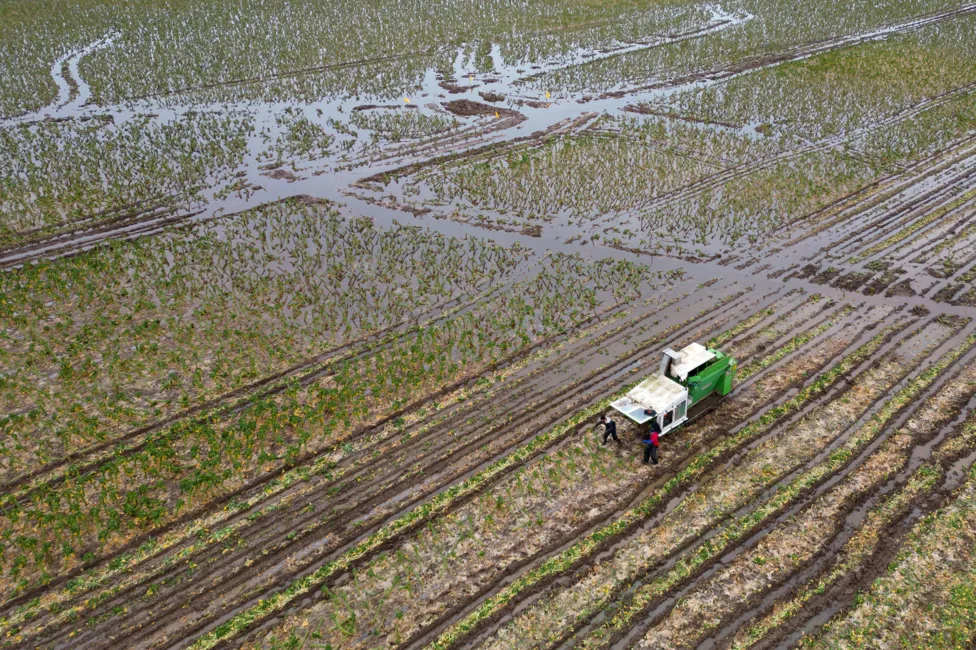
Brussel sprout crops have been hit by the wet weather. Joe Gidden/PA

Climate change is a major reason the UK suffered such a waterlogged winter, scientists have confirmed.

It was the country’s second wettest October to March period on record and a disaster for farmers, who faced flooded fields during a key planting period.

Global warming due to humans burning fossil fuels made this level of rainfall at least four times more likely, according to the World Weather Attribution group.

One farmer in Lincolnshire told the BBC that a third of his farm could not be planted in time this year.

Colin Chappell, a fourth generation farmer on the banks of the River Ancholme in Lincolnshire, who produces food including peas, oil and wheat, says he will only produce half what he would usually expect.

“There are some farms in the valley that will not see a harvest at all this year. That hasn’t happened here since 1948,” he says.

He believes the future for many farmers is bleak.

Article continues at https://www.bbc.co.uk/news/articles/cp992nxxe7do

Continue ReadingClimate change made UK’s waterlogged winter worse

‘An Affront to the World’: Shell Posts Billions in Profits as Planet Burns

Spread the love

Original article by OLIVIA ROSANE republished from Common Dreams under Creative Commons (CC BY-NC-ND 3.0). 
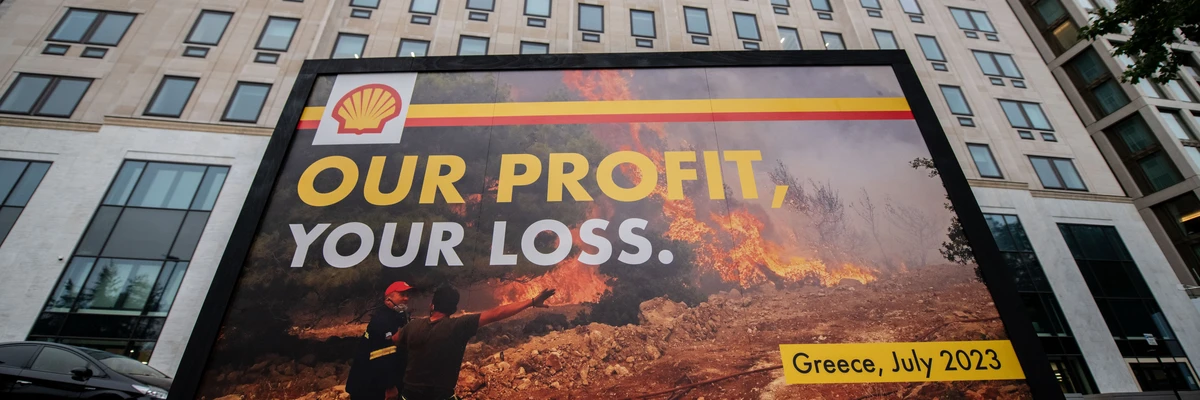
Greenpeace activists display a billboard during a protest outside Shell headquarters on July 27, 2023 in London.
Greenpeace activists display a billboard during a protest outside Shell headquarters on July 27, 2023 in London. (Photo: Handout/Chris J. Ratcliffe for Greenpeace via Getty Images)

“The grotesque wealth that this Earth-wrecking company continues to accumulate is something we cannot allow ourselves to accept as normal,” one campaigner said.

Oil major Shell announced $7.7 billion in profits during the first quarter of 2024 on Thursday, as well as a $3.5 billion share buyback program.

The news comes as every month covered by the period was the hottest of its kind on record. The three-month period also saw the second-largest wildfire in Texas history, extreme heat in West Africa and the Sahel, and the beginning of the Great Barrier Reef’s fifth mass bleaching event in eight years. Scientists have clearly linked global heating, and the weather disasters it exacerbates, to the climate crisis driven primarily by the burning of fossil fuels.

“As extreme weather accelerates and the cost-of-living crisis rumbles on, Shell’s latest billion-pound profits are an affront to the world,” Izzie McIntosh, climate campaign manager at Global Justice Now, said in a statement. “The grotesque wealth that this Earth-wrecking company continues to accumulate is something we cannot allow ourselves to accept as normal.”

“This is the sad irony of the global energy system in which those causing chaos are the ones getting rich.”

Shell’s profits for the first three months of 2024 were around 20% lower than for the same time in 2023, CNBC reported. However, the company brought in $1.2 billion more than analysts had predicted. The world’s largest oil firms, including Shell, saw record profits in 2022 following Russia’s invasion of Ukraine and the energy crisis that followed.

“Shell has beaten expectations by a reasonable margin, despite the impact of lower gas prices during the first quarter,” Stuart Lamont, an investment manager at RBC Brewin Dolphin, said in a statement shared by CNBC.

Global Witness pointed out that Shell’s earnings to date amounted to over $58,000 a minute, more than the average U.K. nurse makes in a year.

“Shell continuing to rake in huge sums of money shows us that huge polluter profits were not a one-off but are the twisted reality of an energy system that benefits climate-wrecking companies to the cost of everyone else,” Global Witness fossil fuel campaigner Alexander Kirk said in a statement.

Shell announced its profits one day after the U.S. Senate held a hearing on how large oil and gas companies, including Shell, have continued to deceive the public about the dangers of their products, moving from outright climate denial into making commitments they don’t intend to keep or touting false solutions like carbon capture and storage that they then fail to develop. Shell, according to the testimony of Rep. Jamie Raskin (D-Md.), spent only 11% of its capital on low-carbon technologies between 2009 and 2023.

The hearing sparked calls for accountability from the fossil fuel industry—such as mechanisms to make climate polluters pay for the transition to renewable energy—and the news of Shell’s profits generated more.

In the U.K., Labor Shadow Energy and Climate Minister Ed Miliband proposed increasing the tax on energy company profits. Shell paid the U.K. government around $1.4 billion in taxes in 2023, of which around $300 million went to the Energy Profits Levy, according toThe Guardian. Also last year, it paid its shareholders $23 billion, nine times more than it invested in its “Renewables and Energy Solutions” program.

“These results show yet again why it is so damning [that Prime Minister] Rishi Sunak refuses to bring in a proper windfall tax on the oil and gas giants,” Miliband said. “These are companies that have made record profits at the expense of working people. Labor says tax these companies fairly so we can invest in clean homegrown energy that will end the cost of living crisis and make Britain energy independent.”

Greenpeace U.K. called Shell’s latest profits “shameless.”

“Their reckless hunt for profits needs to end,” the environmental advocacy group wrote on social media. “When will world leaders find their backbone and make polluters pay?”

When one commenter suggested governments held back out of desire to keep collecting Big Oil’s taxes, Greenpeace fired back, “What taxes?” and noted that Shell avoided paying U.K. taxes for years.

“At the end of the day we want clean, cheap renewable energy not to face the worst impacts of climate change,” Greenpeace continued. “Solutions exist, we just need the political and industrial will to get them in place.”

Global Witness and Global Justice Now also took the opportunity to call for an energy transition.

“This is the sad irony of the global energy system in which those causing chaos are the ones getting rich,” Kirk said. “This spiral won’t stop until we make the urgent switch to a fairer renewable energy system that puts both people and planet first.”

McIntosh concluded: “We urgently need to bring a fair and organised end to the fossil fuel era, and that means companies like Shell must stop trying to extract new oil and gas, and start paying what they owe for the loss and damage they’ve caused. Profit announcements like this for a corporate dinosaur like Shell need to become a thing of the past.”

Original article by OLIVIA ROSANE republished from Common Dreams under Creative Commons (CC BY-NC-ND 3.0). 
Continue Reading‘An Affront to the World’: Shell Posts Billions in Profits as Planet Burns

Report Outlines Which Companies Are Most Responsible for Climate Crisis

Spread the love

Original article by THOR BENSON republished from Common Dreams under Creative Commons (CC BY-NC-ND 3.0).

“It is morally reprehensible for companies to continue expanding exploration and production of carbon fuels in the face of knowledge now for decades that their products are harmful,” said Richard Heede, who established the Carbon Majors dataset.

report released by Carbon Majors on Thursday says that 57 companies were responsible for 80% of the world’s CO2 emissions from fossil fuel and cement production between 2016 to 2022.

Saudi Aramco, Russia’s state-owned energy company Gazprom, and state-owned producer Coal India were at the top of the list. Carbon Majors has been keeping track of which companies are contributing the most to the climate crisis since 2013.

“The Carbon Majors research shows us exactly who is responsible for the lethal heat, extreme weather, and air pollution that is threatening lives and wreaking havoc on our oceans and forests,” Tzeporah Berman, international program director at Stand.earth and chair at Fossil Fuel Non-Proliferation Treaty, said in a statement. “These companies have made billions of dollars in profits while denying the problem and delaying and obstructing climate policy.”

The report states that nation-state producers account for 38% of CO2 emissions in the database. That’s the highest percentage of any of the types of companies listed in the database.

“The Carbon Majors database finds that most state- and investor-owned companies have expanded their production operations since the Paris agreement. Fifty-eight out of the 100 companies were linked to higher emissions in the seven years after the Paris agreement than in the same period before,” the report reads.

In terms of investor-owned companies, Chevron, ExxonMobil, and BP contributed the most to CO2 emissions. ExxonMobil alone was responsible for 3.6 gigatons of CO2 emissions over a seven-year period.

“It is morally reprehensible for companies to continue expanding exploration and production of carbon fuels in the face of knowledge now for decades that their products are harmful,” said Richard Heede, who established the Carbon Majors dataset, told The Guardian. “Don’t blame consumers who have been forced to be reliant on oil and gas due to government capture by oil and gas companies.”

Original article by THOR BENSON republished from Common Dreams under Creative Commons (CC BY-NC-ND 3.0).
Continue ReadingReport Outlines Which Companies Are Most Responsible for Climate Crisis

‘In Even the Best Coverage There Is No Accountability for the Fossil Fuel Industry’

Spread the love

Original article by JANINE JACKSON republished from FAIR under a Creative Commons Attribution-NonCommercial-NoDerivs 3.0 Unported License.

CounterSpin interview with Evlondo Cooper on climate coverage

Janine Jackson interviewed Media Matters’ Evlondo Cooper about climate coverage for the March 22, 2024, episode of CounterSpin. This is a lightly edited transcript.

Audio Player

00:00

00:00

Use Up/Down Arrow keys to increase or decrease volume. [Available at the original article]

Media Matters (3/14/24)

Janine Jackson: Climate disruption is, of course, one of the most disastrous phenomena of today’s life, affecting every corner of the globe. It’s also one of the most addressable. We know what causes it, we know what meaningful intervention would entail. So it’s a human-made tragedy unfolding in real time before our eyes.

To understate wildly, we need to be talking about it, learning about it, hearing about it urgently, which is why the results of our next guest’s research are so alarming. I’ll just spoil it: Broadcast news coverage of the climate crisis is going down.

Evlondo Cooper is a senior writer with the Climate and Energy Program at Media Matters for America. He joins us now by phone from Washington state. Welcome to CounterSpin, Evlondo Cooper.

Evlondo Cooper: Thank you for having me. I’m excited about our conversation today.

JJ: We’re talking about the latest of Media Matters’ annual studies of climate crisis coverage. First of all, just tell us briefly what media you are looking at in these studies.

EC: So we’re looking at corporate broadcast network coverage. That’s ABC, CBS and NBC. And for the Sunday morning shows, we also include Fox BroadcastingFox News Sunday.

JJ: All right. And then, for context, this decline in coverage that you found in the most recent study, that’s down from very little to even less.

Media Matters (3/14/24)

EC: Yeah, so a little context: 2021 and 2022 were both record years for climate coverage, and that coverage was a little bit more than 1%. This year, we saw a 25% decrease from 2022, which brought coverage to a little bit less than 1%. We want to encourage more coverage, but even in the years where they were doing phenomenal, it was only about 1% of total coverage. And so this retrenchment by approximately 25% in 2023 is not a welcome sign, especially in a year where we saw record catastrophic extreme weather events, and scientists are predicting that 2024 might be even worse than ’23.

JJ: Let’s break out some of the things that you found. We’re talking about such small numbers—when you say 1%, that’s 1% of all of the broadcast coverage; of their stories, 1% were devoted to the climate crisis. But we’ve seen, there’s little things within it. For example, we are hearing more from actual climate scientists?

EC: That was a very encouraging sign, where this year we saw 41 climate scientists appeared, which was 10% of the featured guests in 2023, and that’s up from 4% in 2022. So in terms of quality of coverage, I think we’re seeing improvements. We’re seeing a lot of the work being done by dedicated climate correspondents, and meteorologists who are including climate coverage as part of their weather reports and their own correspondents’ segments, a bigger part of their reporting.

So there are some encouraging signs. I think what concerns us is that these improvements, while important and necessary and appreciated, are not keeping up with the escalating scale of climate change.

Media Matters (3/14/24)

JJ: It’s just not appropriate to the seriousness of the topic. And then another thing is, you could say the dominance of white men in the conversation, which I know is another finding, that’s just kind of par for the elite media course; when folks are talked to, they are overwhelmingly white men. But it might bear some relation to what you’re seeing as an underrepresentation of climate-impacted populations, looking at folks at the sharp end of climate disruption. That’s something you also consider.

EC: Yeah, we look at coverage of, broadly, climate justice. I think a lot of people believe it’s representation for representation’s sake, but I think when people most impacted by climate change—and we’re talking about communities of color, we’re talking about low-income communities, we’re talking about low-wealth rural communities—when these folks are left out of the conversation, you’re missing important context about how climate change is impacting them, in many cases, first and worse. And you’re missing important context about the solutions that these communities are trying to employ to deal with it. And I think you’re missing an opportunity to humanize and broaden support for climate solutions at the public policy level.

So these aren’t communities where these random acts of God are occurring; these are policy decisions, or indecisions, that have created an environment where these communities are being most harmed, but least talked about, and they’re receiving the least redress to their challenges. And so those voices are necessary to tell those stories to a broad audience on the corporate broadcast networks.

JJ: Yes, absolutely.

CBS (7/17/23)

Another finding that I thought was very interesting was that extreme weather seemed to be the biggest driver of climate coverage, and that, to me, suggests that the way corporate broadcast media are coming at climate disruption is reactive: “Look at what happened.”

EC: Totally.

JJ:  And even when they say, “Look at what’s happening,” and you know what, folks pretty much agree that this is due to climate disruption, these houses sliding into the river, it’s still not saying, “While you look at this disaster, know that this is preventable, and here is who is keeping us from acting on it and why.”

EC: Yeah, that is so insightful, because that’s a core critique of even the best coverage we see, that there is no accountability for the fossil fuel industry and other industries that are driving the crisis. And then there’s no real—solutions are mentioned in about 20% of climate segments this year. But the solutions are siloed, like there are solution “segments.”

But to your point, when we’re talking about extreme weather, when you have the most eyeballs hearing about climate change, to me, it would be very impactful to connect what’s happening in that moment—these wildfires, these droughts, these heat waves, these hurricanes and storms and flooding—to connect that to a key driver, fossil fuel industry, and talk about some potential solutions to mitigate these impacts while people are actually paying the most attention.

CNN (3/3/23)

JJ: And then take it to your next story about Congress, or your next story about funding, and connect those dots.

EC: Exactly. I mean, climate is too often siloed. So you could see a really great segment, for instance, on the Willow Project, at the top of the hour—and this is on cable, but the example remains—and then later in the hour, you saw a story about an extreme weather event. But those things aren’t connected, they’re siloed.

And so a key to improving coverage in an immediate way would be to understand that the climate crisis is the background for a range of issues, socioeconomic, political. Begin incorporating climate coverage in a much broader swath of stories that, whether you know it or not, indirectly or directly, are being impacted by global warming.

JJ: It’s almost as though corporate media have decided that another horrible disaster due to climate change, while it’s a story, it’s basically now like a dog-bites-man story. And if they aren’t going to explore these other angles, well, then there really isn’t anything to report until the next drought or the next mudslide. And that’s just a world away from what appropriate, fearless, future-believing journalism would be doing right now.

Evlondo Cooper: “It doesn’t have to be about just showing the destruction and carnage. There are ways that you can empower people to take action.”

EC: It’s out of step, right? Pull up the poll showing bipartisan support for government climate action, because, whether people know it or not, as far as the science, —and there’s some deniers out there, but anecdotally, people know something is happening, something is changing in their lives. We’re seeing record-breaking things that no one’s ever experienced, and they want the government to do something about it.

And so it’s important to cover extreme weather and to cover these catastrophes. And I know there’s a range of thought out there that says if you’re just focusing on devastating impacts, it could dampen public action. But to me, to your point, report on it and connect it to solutions, empower people to call their congressperson, their representative, their senator, to vote in ways that have local impacts to deal with the local climate impacts.

It doesn’t have to be about just showing the destruction and carnage. There are ways that you can empower people to take action in their own lives, and to galvanize public support.

And the public wants it. The public is asking for this. So I think just being responsive to what these polls are showing would be a way to immediately improve the way that they cover climate change right now.

JJ: All right, then. We’ve been speaking with Evlondo Cooper of Media Matters for America. You can find this work and much else at MediaMatters.org. Evlondo Cooper, thank you so much for joining us this week on CounterSpin.

EC: Thank you for having me.

Original article by JANINE JACKSON republished from FAIR under a Creative Commons Attribution-NonCommercial-NoDerivs 3.0 Unported License.

Continue Reading‘In Even the Best Coverage There Is No Accountability for the Fossil Fuel Industry’