BP Condemned Over ‘Mammoth Profits’ as Fossil Fuels Wreak Havoc on the Planet
Spread the love
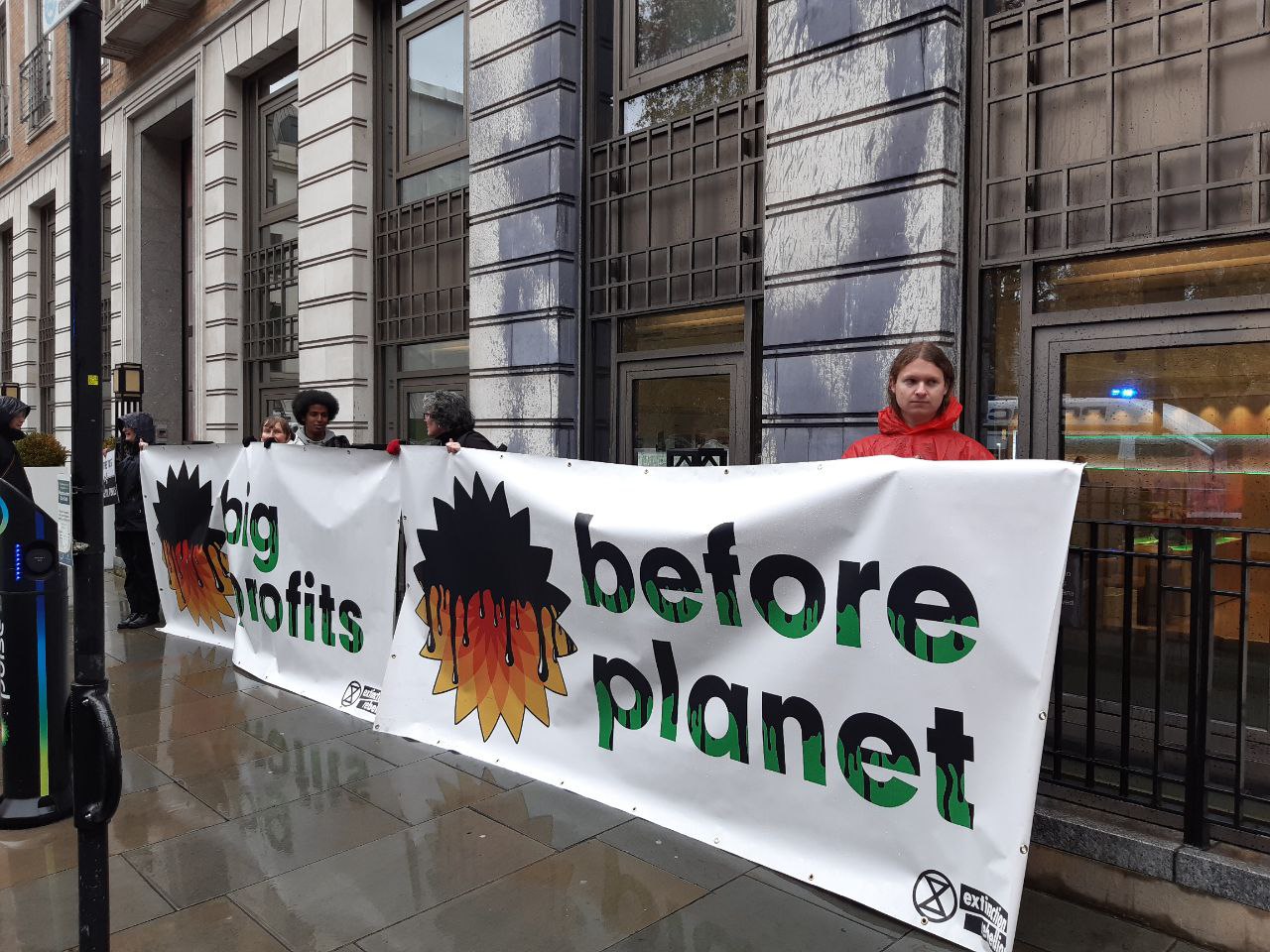
Extinction Rebellion protests at BP
Extinction Rebellion protests at BP London. Banner reads big profits before planet

“The world can no longer afford fossil fuel companies putting short-term profits above people and planet.”

The London-based oil giant BP announced Tuesday that it hauled in $2.8 billion in profit during the second quarter of the year as the world faced the consequences of the fossil fuel industry’s business model in the form of record-shattering heat, devastating wildfires, and other weather extremes.

The company’s second-quarter profit surpassed analysts’ expectations and brought its total profit for the first half of 2024 to $5.5 billion. BP on Tuesday also announced a 10% dividend increase, an expansion of its stock buyback program, and a green light for a new drilling platform in the Gulf of Mexico, even as international scientists say any new fossil fuel production is incompatible with critical warming targets set out by the Paris climate accord.

BP said that once completed, the new floating platform would have the capacity to produce 80,000 barrels of crude oil daily.

Chiara Liguori, Oxfam Great Britain’s senior climate justice policy adviser, said in a statement that “the world can no longer afford fossil fuel companies putting short-term profits above people and planet.”

“It is inexcusable that BP, one of the world’s most polluting and profitable fossil fuel companies, continues to rake in billions of pounds while low-income countries are in urgent need of funds to tackle the devastating impacts of the climate crisis despite doing the least to cause it,” said Liguori. “The costs of inaction are already here with deadly heat waves, wildfires, flooding, and drought, but it is people living in poverty who are left paying the highest price.”

BP’s profit report came weeks after the company, now under the leadership of CEO Murray Auchincloss, announced it would pause new offshore wind projects and put fresh “emphasis on oil and gas amid investor discontent over its energy transition strategy,” as Reuters reported last month. The move came over a year after the company rolled back its plan to curtail oil and gas production.

Extreme weather driven by the burning of fossil fuels, meanwhile, continued to wreak havoc across the globe.

“As global temperatures spiked to their highest levels in recorded history [last Monday], ambulances were screaming through the streets of Tokyo, carrying scores of people who had collapsed amid an unrelenting heat wave,” wrote The Washington Post‘s Sarah Kaplan over the weekend. “A monster typhoon was emerging from the scorching waters of the Pacific Ocean, which were several degrees warmer than normal. Thousands of vacationers fled the idyllic mountain town of Jasper, Canada ahead of a fast-moving wall of wildfire flames.”

“By the end of the week—which saw the four hottest days ever observed by scientists—dozens had been killed in the raging floodwaters and massive mudslides triggered by Typhoon Gaemi,” Kaplan continued. “Half of Jasper was reduced to ash. And about 3.6 billion people around the planet had endured temperatures that would have been exceedingly rare in a world without burning fossil fuels and other human activities, according to an analysis by scientists at the group Climate Central.”

Izzie McIntosh, a climate campaigner at the United Kingdom-based advocacy group Global Justice Now, said Tuesday that BP’s “mammoth profits” come “at the expense of our climate, communities, and the Global South facing the most brutal impacts of a climate crisis they did not cause.”

“Labour has made some promising signals about a move toward green energy—it now needs to throw its weight behind tackling the rampant profiteering of oil and gas companies,” McIntosh said of the newly elected U.K. government. “It can do this by introducing a windfall tax and other measures to fund the U.K.’s contribution to a globally just fossil fuel phaseout that works for workers and communities in the U.K. and around the world.”

Original article by JAKE JOHNSON republished from Common Dreams under Creative Commons (CC BY-NC-ND 3.0). 

Original article by JAKE JOHNSON republished from Common Dreams under Creative Commons (CC BY-NC-ND 3.0). 

‘Twisted’: BP And Shell CEOs See Pay Double As Workers Struggle To Heat Homes ›

Continue ReadingBP Condemned Over ‘Mammoth Profits’ as Fossil Fuels Wreak Havoc on the Planet

June 2024 was the hottest on record: Greenpeace calls for making polluters pay the mounting bill for extreme weather

Spread the love

Reacting to data from the Copernicus Climate Change Service that June 2024 was the hottest June on record, which makes it the 13th consecutive month for which the global average temperature reached a record.

Ian Duff, Head of Greenpeace International’s Stop Drilling Start Paying campaign said:

“Survivors of extreme weather over the last month are in the millions. From China and India to Greece and Italy, from Saudi Arabia to Jamaica and the US, floods, fires, and heat waves have shattered homes, claimed lives and hurt people’s health, costing the world over USD 41 billion in damages in the first months of the year, according to a recent Christian Aid report. This is happening while Big Oil is making huge profits while people are suffering – reportedly over USD 2.8 billion every day for the past 50 years.

“Yet, climate change’s perpetrators are but a few. A handful of international oil and gas companies are chiefly responsible for fuelling extreme weather events. Not only did they deny climate science, they actively slowed down the solutions and now the expansion plans by Big Oil’s executives are a reckless assault on our planet. 

“Greenpeace is campaigning to finally push governments to hold the oil and gas industry accountable for the loss and damage it creates, while it is raking up trillions in profits. Big Oil might have bought the media, they might have bought politicians – but our future and our heritage are not for sale. Through legislation, litigation and nonviolent action, we join youth groups, senior citizens, Indigenous Peoples and many others to restore justice and secure a stable climate.”

Continue ReadingJune 2024 was the hottest on record: Greenpeace calls for making polluters pay the mounting bill for extreme weather

13 Months of Record-Smashing Heat Called ‘Another Red Alert’ for Humanity

Spread the love

Original article by BRETT WILKINS republished from Common Dreams under Creative Commons (CC BY-NC-ND 3.0).

Rescuers carry away a man, affected by the scorching heat, on a stretcher as Muslim pilgrims arrive to perform the symbolic “stoning of the devil” ritual as part of the Hajj pilgrimage in Mina, Saudi Arabia on June 16, 2024. (Photo: Fadel Senna/AFP via Getty Images)

“This alarming record underlines the need to urgently phase out fossil fuels, and to hugely increase climate finance,” said one campaigner.

Scientists on Monday underscored the urgent need to accelerate the transition from fossil fuels to renewable energy following the publication of data from the European Union’s climate change monitor showing that last month was the hottest June ever recorded and that 2024 is likely to be the planet’s hottest year on record.

Each month since June 2023 has been the hottest since records have been kept, the European Union’s Copernicus Climate Change Service (C3S) said last week in its latest monthly bulletin.

According to the agency, June “was 1.50°C above the estimated June average for 1850-1900, the designated preindustrial reference period, making it the 12th consecutive month to reach or break the 1.5°C threshold.”

“European temperatures were most above average over southeast regions and Turkey, but near or below average over western Europe, Iceland, and northwestern Russia,” C3S noted. “Outside Europe, temperatures were most above average over eastern Canada, the western United States and Mexico, Brazil, northern Siberia, the Middle East, northern Africa, and western Antarctica.”

“Temperatures were below average over the eastern equatorial Pacific, indicating a developing La Niña, but air temperatures over the ocean remained at an unusually high level over many regions,” the agency added.

C3S Director Carlo Buontempo said in a statement Monday that “even if this specific streak of extremes ends at some point, we are bound to see new records being broken as the climate continues to warm.”

“This is inevitable unless we stop adding greenhouse gases into the atmosphere and the oceans,” he stressed.

In an interview with The Associated Press published Monday, C3S climate scientist Nicolas Julien called the new data “a stark warning that we are getting closer to this very important limit set by the Paris agreement.”

“The global temperature continues to increase,” he added. “It has at a rapid pace.”

Zeke Hausfather, a researcher at the California-based nonprofit Berkeley Earth, told Reuters, “I now estimate that there is an approximately 95% chance that 2024 beats 2023 to be the warmest year since global surface temperature records began in the mid-1800s.”

As Reuters reported Monday:

The changed climate has already unleashed disastrous consequences around the world in 2024. More than 1,000 people died in fierce heat during the Hajj pilgrimage last month. Heat deaths were recorded in New Dehli, which endured an unprecedentedly long heatwave, and amongst tourists in Greece.

“This is not good news at all,” Aditi Mukherji, who co-authored the most recent Intergovernmental Panel on Climate Change (IPCC) report, told The Guardian.

“We know that extreme events increase with every increment of global warming,” she added, “and at 1.5°C, we witnessed some of the hottest extremes this year.”

The Guardian surveyed hundreds of IPCC authors earlier this year. Three-quarters of them said they expect Earth to heat by at least 2.5°C by the end of this century. Half of the surveyed scientists expect temperatures to rise above 3°C by 2100.

“It is a crisis,” said Mukherji, and one that has a clear solution, given that burning fossil fuels is the leading cause of global heating.

Antonia Juhasz, a senior researcher on fossil fuels at Human Rights Watch, told Nation of Change that “as a result of the burning of fossil fuels, heatwaves are becoming more common, and intense heatwaves are more frequent.”

“We can break the cycle, we can make oil companies stop burning fossil fuels,” she added.

Reacting to the latest C3S data, Amnesty International climate adviser Ann Harrison said on social media that “this alarming record underlines the need to urgently phase out fossil fuels, and to hugely increase climate finance.”

Original article by BRETT WILKINS republished from Common Dreams under Creative Commons (CC BY-NC-ND 3.0).

Continue Reading13 Months of Record-Smashing Heat Called ‘Another Red Alert’ for Humanity

Thousands Evacuated Amid Northern California Wildfire and Heatwave

Spread the love

Original article by BRETT WILKINS republished from Common Dreams under Creative Commons (CC BY-NC-ND 3.0).

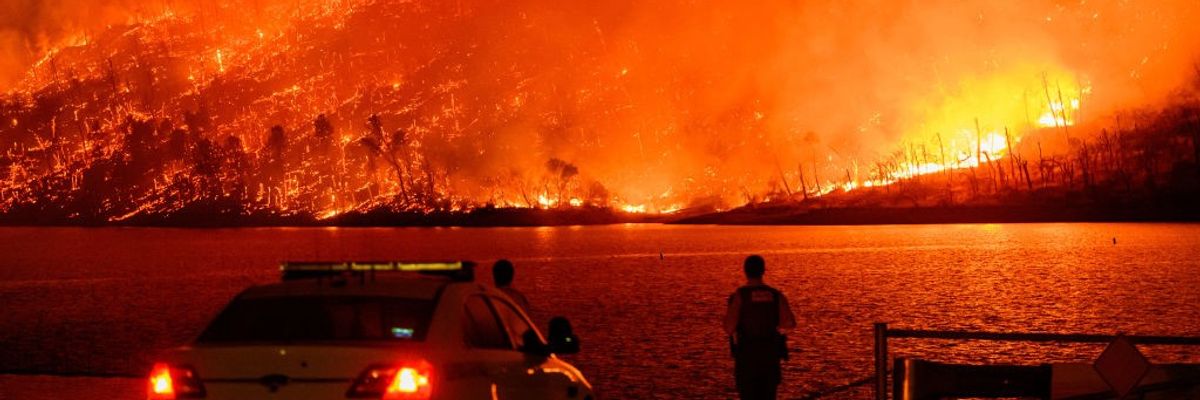
Law enforcement officers watch as the Thompson Fire burns over Lake Oroville in Oroville, California on July 2, 2024.  (Photo: Josh Edelson/AFP via Getty Images)

“It cannot be stressed enough that this is an exceptionally dangerous and lethal situation,” the National Weather Service warned.

California Gov. Gavin Newsom on Wednesday declared a state of emergency in a northern county where a major wildfire has burned thousands of acres and forced the evacuation of thousands of residents amid near-record heat throughout much of the Golden State fueled by human-caused global heating.

The California Department of Forestry and Fire Protection (CAL FIRE) said shortly after noon local time Wednesday that the Thompson Fire, which began Tuesday morning in Butte County, had burned 3,568 acres with no containment in and around the city of Oroville, home to more than 20,000 people.

Citing an “imminent threat to life,” Newsom, a Democrat, issued an emergency declaration and said that “we are using every available tool to tackle this fire and will continue to work closely with our local and federal partners to support impacted communities.”

CAL FIRE said that more than 1,400 firefighters using 199 engines, 46 dozers, eight helicopters, and other equipment are battling the blaze. More than 28,000 Oroville area residents have been evacuated.

Red flag conditions are being exacerbated by low humidity and near-record temperatures throughout California. Oroville is expected to hit a high of 110°F on Wednesday, with daytime highs forecast to remain in the 110s through the holiday weekend. Dozens of daily, monthly, and all-time records could be broken throughout the state.

“It cannot be stressed enough that this is an exceptionally dangerous and lethal situation,” the National Weather Service’s (NWS) San Francisco Bay Area branch cautioned as it extended the red flag warning through Friday while preparing the public for the possibility of further extensions.

Daniel Swain, a climate scientist at the University of California, Los Angeles, said during a video briefing, “I’m not so sure that really any of us will have seen this many days at this sustained level of heat, both daytime and most importantly nighttime heat.”

Commenting on the wildfire and heatwave, Fossil Free Media director Jamie Henn said on social media that “we need the California Legislature to pass their climate superfund bill NOW to #MakePollutersPay for these fossil-fueled disasters.”

Introduced in April by California state Sen. Caroline Menjivar (D-20) but shelved the following month, S.B. 1497—the Polluters Pay Climate Cost Recovery Act—would require major fossil fuel producers to pay for their historic carbon emissions.

The NWS said that as of Wednesday, more than 110 million people across the United States were facing either a heat advisory, watch, or warning. So far, 2024 has been the hottest year on record. Climate Central, a nonprofit news organization focusing on the worsening planetary emergency, said climate change has made the current California heatwave at least five times likelier.

Original article by BRETT WILKINS republished from Common Dreams under Creative Commons (CC BY-NC-ND 3.0).

Continue ReadingThousands Evacuated Amid Northern California Wildfire and Heatwave

‘Historic’ Category 5 Hurricane Beryl Offers Terrifying View of Future

Spread the love

Original article by JESSICA CORBETT republished from Common Dreams under Creative Commons (CC BY-NC-ND 3.0).

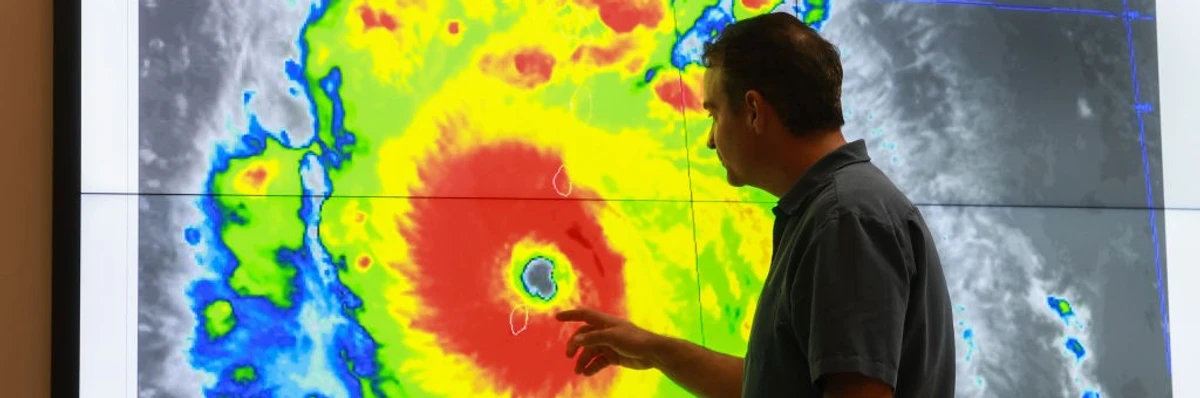
John Cangialosi, senior hurricane specialist at the National Hurricane Center, inspects a satellite image of Hurricane Beryl on July 1, 2024 in Miami, Florida.
 (Photo: Joe Raedle/Getty Images)

“Beryl isn’t ‘unbelievable,'” one expert said. “it’s what happens when you heat up the planet with fossil fuel pollution for decades.”

As Hurricane Beryl barreled toward Jamaica on Tuesday after killing at least four people in the Caribbean’s Windward Islands, climate scientists warned the record-breaking Category 5 storm is a present-tense example of what’s to come on a rapidly heating planet.

Even before the Atlantic hurricane season began on June 1, the U.S. National Oceanic and Atmospheric Administration predicted an 85% chance of above-normal activity and 17-25 total named storms this year. Matthew Cappucci, a meteorologist for The Washington Post‘s Capital Weather Gang, highlighted some records Beryl has already broken.

“There is a strong, well-documented link between the effects of human-induced climate change and the development of stronger, wetter storms that are more prone to rapidly intensify,” he wrote Tuesday. “Beryl sprung from a tropical depression to a Category 4 hurricane in just 48 hours, the fastest any storm on record has strengthened before the month of September.”

Beryl is also the earliest Category 4 and 5 hurricane on record in the Atlantic, Cappucci pointed out. Previously, the earliest storm to reach the top level of the Saffir-Simpson Hurricane Wind Scale was Emily, in mid-July of 2005.

The Capital Weather Gang reported that Beryl “strengthened more Monday night, its peak winds climbing to 165 mph. It has surpassed Emily (2005) as strongest July hurricane on record. It’s early July but Atlantic is acting like late August.”

Certified consulting meteorologist Chris Gloninger emphasized that “the climate crisis has led to well-above-average ocean water temperatures and helped this storm explode.”

As Stefan Rahmstorf of the Potsdam Institute for Climate Impact Research and Potsdam University explained: “The heat in the upper ocean is the energy source for tropical cyclones. This heat is at record level, mainly caused by emissions from burning fossil fuel. That’s why an extreme hurricane season has been predicted for this year. It’s off to a bad start!”

Colorado State University meteorologist Philip Klotzbach on Monday shared graphics showing that “Caribbean ocean heat content today is normally what we get in the middle of September.”

While some expressed disbelief over the storm, CNN extreme weather editor Eric Zerkel stressed that “Beryl isn’t ‘unbelievable’ or ‘defying all logic,’ it’s what happens when you heat up the planet with fossil fuel pollution for decades. The oceans store roughly 90% of that excess heat. The ocean is as warm as it typically is… when Category 4 storms form. June is now August.”

Acknowledging Beryl’s strength, Steve Bowen, a meteorologist who serves as chief science officer at the global reinsurance firm Gallagher Re, concluded that “this is a massive warning sign for the rest of the season.”

Looking beyond this hurricane season, which ends in November, University of Hawaii at Mānoa professor and [C]Worthy co-founder David Ho said, “Let’s remember that things are just going to get [worse] as we continue to consume nearly 100 million barrels of oil every day.”

The “historic” storm is sparking calls for action to phase out fossil fuels across the globe. Noting how Beryl “is breaking records and leaving a trail of destruction throughout the Caribbean,” the U.S.-based Sunrise Movement argued that “we must prosecute Big Oil for their role in causing devastation like this.”

In response to a climate scientist who shared a photo of some damage Beryl has already caused, Rahmstorf expressed hope that people around the world won’t “wait with voting for climate stabilization until extremes hit their homes.”

Beryl made landfall Monday as a Category 4 hurricane on Carriacou, a Grenada island, and also affected St. Vincent and Grenadines. According to The Associated Press, at least four people were killed.

The U.S. National Hurricane Center said Tuesday afternoon that on its current path, “the center of Beryl will move quickly across the central Caribbean Sea today and is forecast to pass near Jamaica on Wednesday and the Cayman Islands on Thursday. The center is forecast to approach the Yucatan Peninsula of Mexico on Thursday night.”

Original article by JESSICA CORBETT republished from Common Dreams under Creative Commons (CC BY-NC-ND 3.0).

Continue Reading‘Historic’ Category 5 Hurricane Beryl Offers Terrifying View of Future