‘This Is Unprecedented’: Several Horrific Wildfires Ravage Los Angeles

Spread the love

Original article by Jake Johnson republished from Common Dreams under Creative Commons (CC BY-NC-ND 3.0).

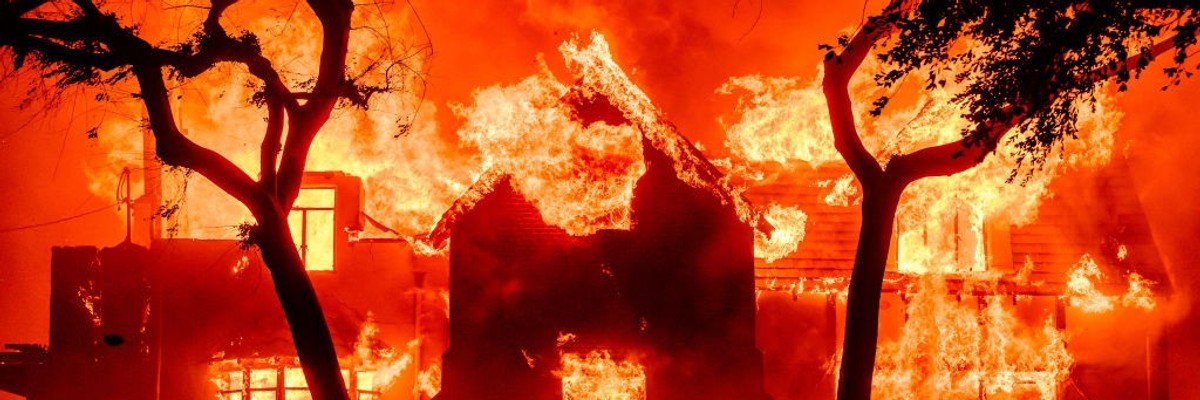
Flames from the Palisades fire burn homes on January 7, 2025 in the Pacific Palisades neighborhood of Los Angeles, California. (Photo: Eric Thayer/Getty Images)

“There is no ‘firefighting’ in these kinds of conditions,” said one meteorologist. “There is only saving as many lives as possible and getting the heck out of the fire’s way.”

Several major wildfires burned out of control in California’s Los Angeles County on Wednesday as roaring winds fueled the rapid spread of the blazes, forcing tens of thousands to evacuate as state, local, and federal officials mobilized resources to confront the emergency.

Los Angeles Mayor Karen Bass wrote on social media late Tuesday that the city is “working aggressively” to stem the wildfires, which scientists and government officials characterized as uniquely devastating.

“Emergency officials, firefighters, and first responders are all hands on deck through the night to do everything possible to protect lives,” California Gov. Gavin Newsom said early Wednesday. The governor noted that more than 1,400 firefighting personnel have been deployed to “combat these unprecedented fires.”

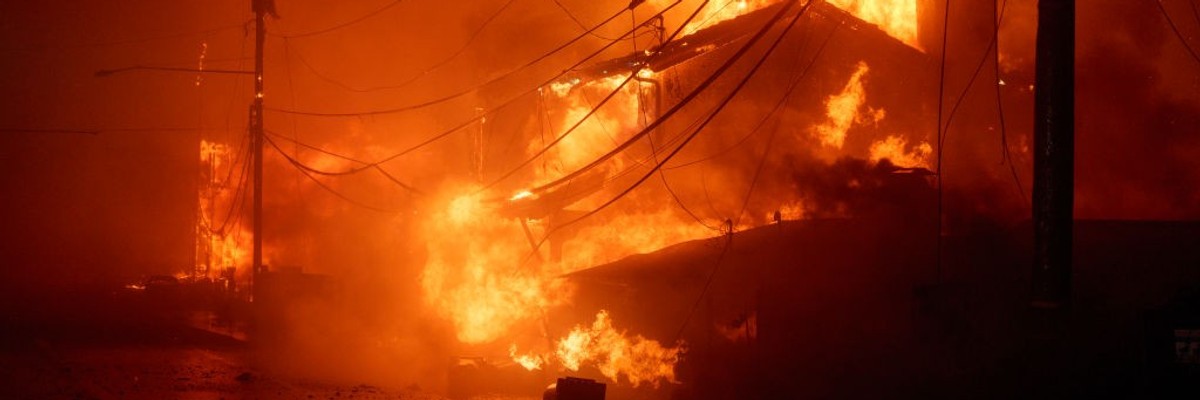
The PalisadesEaton, and Hurst fires broke out on Tuesday. It quickly exploded amid what the National Weather Service described as “extremely critical fire weather,” with wind gusts up to 99 mph propelling the devastating blazes. The extreme winds forced emergency crews to ground aircraft that were working to contain the fires.

“For some context, fire crews are up against near hurricane-force winds occurring mid-winter in rugged terrain during a drought at night,” wrote meteorologist Eric Holthaus. “There is no ‘firefighting’ in these kinds of conditions. There is only saving as many lives as possible and getting the heck out of the fire’s way.”

“The emergence of extreme wintertime wildfires in California presents one of those classic ‘this is climate change’ moments.”

The Eaton fire, which broke out Tuesday evening in the Pasadena area, “spread so rapidly that staff at a senior living center had to push dozens of residents in wheelchairs and hospital beds down the street to a parking lot,” The Los Angeles Times reported.

“The residents waited there in their bedclothes as embers fell around them until ambulances, buses, and even construction vans arrived to take them to safety,” the newspaper added.

The three fires have together burned thousands of acres so far and destroyed or endangered tens of thousands of homes and buildings, according to Newsom’s office. So far, at least 19 school districts have announced complete or partial closures due to the fires.

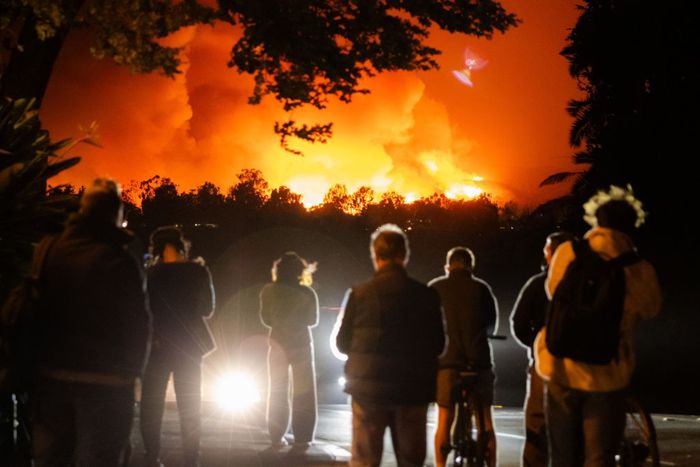
Video footage posted to social media showed residents watching in horror as flames surrounded their homes:

https://twitter.com/i/status/1876845562328146405

Sorry, this content could not be embedded.
X

Another video shows residents attempting to salvage as many belongings as possible before fleeing:

https://twitter.com/i/status/1876845004745748780

Sorry, this content could not be embedded.
X

“There has been a recent massive increase in wildfires in California but really, a fire this big in January? This is unprecedented,” scientist Hayley Fowler wrote on social media. “One of many extreme events fueled by the climate crisis.”

Holthaus wrote Tuesday that Southern California is “facing a rare and dangerous juxtaposition of extreme winds and midwinter drought,” the meteorologist described as “a worrying example of the state’s expanding wildfire threat as climate change worsens.”

“The National Weather Service defines ‘extremely critical’ fire weather as sustained winds over 30 mph and relative humidity of less than 10% in drought conditions and temperatures warmer than 70 degrees,” Holthaus observed. “This is the first time in history these criteria have been met anywhere in the United States during January.”

“The emergence of extreme wintertime wildfires in California,” he added, “presents one of those classic ‘this is climate change’ moments: A specific set of weather conditions are now occurring in such a way to produce the potential for rare disasters to become much more common.”

Original article by Jake Johnson republished from Common Dreams under Creative Commons (CC BY-NC-ND 3.0).
Continue Reading‘This Is Unprecedented’: Several Horrific Wildfires Ravage Los Angeles

From a Trump presidency to ‘game-changing’ lawsuits: Seven big climate and nature moments coming in 2025

Spread the love

[I’m only able to quote a small part of this copyrighted article, read it here.]

https://www.bbc.com/future/article/20250107-the-key-climate-and-nature-moments-to-look-out-for-in-2025

Donald Trump has voiced plans to withdraw the US from the Paris Agreement, and possibly from the entire UNFCCC, after assuming the US presidency this year (Credit: Getty Images)

Yearlong: Extreme weather continues

As these global opportunities to make a difference on climate roll around, there is another certainty running through the calendar year: climate-driven extreme weather. 

In 2024, billions of people around the world experienced heatwaves and extreme weather, including deadly floods in Spainhurricanes in the US and severe drought in the Amazon. In fact, 2024 was the hottest year on record, with global temperatures breaching the critical 1.5C threshold for a full year for the first time. 

As long as we continue to burn fossil fuels, headlines in 2025 and beyond will continue to be dominated by large death tolls, suffering and destruction due to ever more extreme weather events – Friederike Otto

What’s harder to know is exactly when disasters will hit. But 2025 is also expected to be a scorcher: it will be one of the three hottest years on record globally, according to an outlook from the UK’s Met Office, falling just behind 2024 and 2023. Warm temperatures are forecast in 2025 despite the Pacific Ocean moving into a La Niña phase, in which sea surface temperatures are lower than usual and conditions overall are cooler. 

“Years such as 2025, which aren’t dominated by the warming influence of El Niño, should be cooler,” Adam Scaife, head of long-range prediction at the Met Office, stated in the outlook. 

Still, the Met Office expects average global temperature in 2025 to be 1.29C to 1.53C above pre-industrial temperatures. 

The world experienced an additional 41 days of dangerous heat due to climate change last year, according to a report by the World Weather Attribution group at Imperial College London, and the non-profit Climate Central.

Friederike Otto, who leads World Weather Attribution group, says the La Niña predictions mean 2025 “might be cooler than 2024” but argues “this is really irrelevant” if natural climate variability is masking the overall warming trend. 

https://www.bbc.com/future/article/20250107-the-key-climate-and-nature-moments-to-look-out-for-in-2025

Continue ReadingFrom a Trump presidency to ‘game-changing’ lawsuits: Seven big climate and nature moments coming in 2025

UN Chief’s Message to the World as Blistering 2024 Ends: ‘We Must Exit This Road to Ruin’

Spread the love

Original article by Jake Johnson republished from Common Dreams under Creative Commons (CC BY-NC-ND 3.0). 
United Nations Secretary-General António Guterres speaks at the U.N. headquarters on February 22, 2023. 
(Photo: Lev Radin/Pacific Press/LightRocket via Getty Images)

“This is climate breakdown—in real time,” said United Nations Secretary-General António Guterres.

United Nations Secretary-General António Guterres said in a year-end message on Monday that “we have no time to lose” in the face of the worsening global climate crisis, which pushed temperatures to a record high this year and supercharged deadly extreme weather around the world.

“Today, I can officially report that we have just endured a decade of deadly heat,” Guterres said in a video message posted to social media. “The top 10 hottest years on record have happened in the last 10 years, including 2024.”

“This is climate breakdown in real time. We must exit this road to ruin,” he continued. “In 2025, countries must put the world on a safer path by dramatically slashing emissions and supporting the transition to a renewable future. It is essential—and it is possible.”

https://twitter.com/i/status/1873655412198916332

Sorry, this content could not be embedded.
X

Guterres’ call to action came in the waning days of what scientists say is almost certain to be the hottest year on record and the first full year to breach the critical 1.5°C temperature threshold.

Celeste Saulo, secretary-general of the World Meteorological Organization (WMO), echoed Guterres’ warning about the dire consequences of the status quo, saying in a statement Monday that “if we want a safer planet, we must act now.”

“It’s our responsibility. It’s a common responsibility, a global responsibility,” Saulo said. “Every fraction of a degree of warming matters, and increases climate extremes, impacts, and risks. Temperatures are only part of the picture. Climate change plays out before our eyes on an almost daily basis in the form of increased occurrence and impact of extreme weather events.”

Last month, with emissions continuing to surge as the rich nations most responsible for the climate emergency refuse to ditch fossil fuels, world leaders convened for a U.N. climate summit in Azerbaijan that was swarmed by oil and gas lobbyists. The key gathering ended with a deal that climate advocates described as a step backward in the necessary push to rein in fossil fuel emissions.

Climate-denier and fossil fuel booster Donald Trump’s looming return to office in the U.S.—the world’s largest historical emitter—has campaigners and scientists increasingly concerned about the future of existing global climate agreements such as the Paris accord, from which the president-elect has pledged to withdraw once again.

One recent analysis projected that a second Trump administration could unleash an additional 4 billion tonnes of carbon dioxide equivalent by 2030, which would inflict $900 billion in global climate damages and deal a devastating blow to efforts to forestall runaway warming.

Throughout 2024, Guterres used his role as head of the U.N. to sound the alarm about the world’s dangerous trajectory, saying in an October address that “there is a direct link between increasing emissions and increasingly frequent and intense climate disasters.”

“We’re playing with fire,” he said, “but there can be no more playing for time.”

Original article by Jake Johnson republished from Common Dreams under Creative Commons (CC BY-NC-ND 3.0). 
Continue ReadingUN Chief’s Message to the World as Blistering 2024 Ends: ‘We Must Exit This Road to Ruin’

26 Climate-Fueled Extreme Weather Events Killed at Least 3,700 People in 2024: Report

Spread the love

Original article by Jake Johnson republished from Common Dreams under Creative Commons (CC BY-NC-ND 3.0).

Residents collect garbage and debris to burn in the town of Acoua after Cyclone Chido wreaked havoc on the French island territory of Mayotte on December 25, 2024. (Photo: Patrick Meinhardt/AFP via Getty Images)

“This exceptional year of extreme weather shows how dangerous life has already become… and highlights the urgency of moving away from planet-heating fossil fuels as quickly as possible.”

Just over two dozen climate-fueled extreme weather events killed at least 3,700 people worldwide and displaced millions in 2024, according to a report published Friday as the hottest year on record drew to a close.

The new analysis from World Weather Attribution (WWA) and Climate Central states that extreme weather “reached dangerous new heights in 2024” as “record-breaking temperatures fueled unrelenting heatwaves, drought, wildfire, storms, and floods that killed thousands of people and forced millions from their homes.”

“This exceptional year of extreme weather shows how dangerous life has already become with 1.3°C of human-induced warming, and highlights the urgency of moving away from planet-heating fossil fuels as quickly as possible,” said the two organizations, which examined 26 destructive weather events that occurred in 2024—a fraction of the hundreds that took place globally this year.

Those 26 events—from Hurricane Helene in the United States to the typhoon that hammered the Philippines, China, and Taiwan— caused close to 4,000 deaths, according to WWA and Climate Central.

“It’s likely the total number of people killed in extreme weather events intensified by climate change this year is in the tens, or hundreds of thousands,” the analysis states.

“Extremes will continue to worsen with every fraction of a degree of fossil fuel warming.”

Around the world, the fossil fuel-driven climate emergency added, on average, 41 additional days of dangerous heat this year, Climate Central found.

“The countries that experienced the highest number of dangerous heat days are overwhelmingly small island and developing states, who are highly vulnerable and considered to be on the frontlines of climate change,” the analysis says.

WWA and Climate Central said their findings should spur global action to shift away from fossil fuel, the burning of which is “the primary reason extreme weather is becoming more severe,” they said.

“Extremes will continue to worsen with every fraction of a degree of fossil fuel warming,” WWA and Climate Central added. “A rapid move to renewable energy will help make the world a safer, healthier, wealthier, and more stable place.”

Original article by Jake Johnson republished from Common Dreams under Creative Commons (CC BY-NC-ND 3.0).

Continue Reading26 Climate-Fueled Extreme Weather Events Killed at Least 3,700 People in 2024: Report

Climate crisis deepens with 2024 ‘certain’ to be hottest year on record

Spread the love

https://www.theguardian.com/environment/2024/dec/09/climate-crisis-deepens-with-2024-certain-to-be-hottest-year-on-record

A wildfire in California this year. Fires driven by severe droughts have affected the western US, Canada, the Amazon forest and particularly the Pantanal wetlands. Photograph: David McNew/Getty Images

Average global temperature in November was 1.62C above preindustrial levels, bringing average for the year to 1.60C

This year is now almost certain to be the hottest year on record, data shows. It will also be the first to have an average temperature of more than 1.5C above preindustrial levels, marking a further escalation of the climate crisis.

Data for November from the EU’s Copernicus Climate Change Service (C3S) found the average global surface temperature for the month was 1.62C above the level before the mass burning of fossil fuels drove up global heating. With data for 11 months of 2024 now available, scientists said the average for the year is expected to be 1.60C, exceeding the record set in 2023 of 1.48C.

Fossil fuel emissions must fall by 45% by 2030 to have a chance of limiting heating to 1.5C. The recent Cop29 climate summit failed to reach an agreement on how to push ahead on the transition away from coal, oil and gas. The C3S data showed that November 2024 was the 16th month in a 17-month period for which the average temperature exceeded 1.5C.

The supercharging of extreme weather by the climate crisis is already clear, with heatwaves of previously impossible intensity and frequency now striking around the world, along with fiercer storms and worse floods.

https://www.theguardian.com/environment/2024/dec/09/climate-crisis-deepens-with-2024-certain-to-be-hottest-year-on-record

Continue ReadingClimate crisis deepens with 2024 ‘certain’ to be hottest year on record