A photo shows a World Food Program vehicle damaged by Israeli gunfire. (Photo: World Food Program)
“This is totally unacceptable and the latest in a series of unnecessary security incidents that have endangered the lives of WFP’s team in Gaza.”
The World Food Program said Wednesday that it was forced to suspend the movement of its employees in Gaza after the Israeli military fired on one of the United Nations agency’s teams as its clearly marked vehicle advanced toward an Israeli checkpoint in the Palestinian enclave.
The agency said in a statement that the WFP team was returning from a mission with two armored vehicles “after escorting a convoy of trucks carrying humanitarian cargo routed to Gaza’s central area.”
“Despite being clearly marked and receiving multiple clearances by Israeli authorities to approach, the vehicle was directly struck by gunfire as it was moving towards an Israeli Defence Forces (IDF) checkpoint,” WFP said. “It sustained at least ten bullets: five on the driver’s side, two on the passenger side, and three on other parts of the vehicle. None of the employees onboard were physically harmed.”
While the WFP’s statement doesn’t explicitly attribute the gunfire to Israeli forces, U.N. spokesperson Stéphane Dujarric told reporters Wednesday that the food agency’s vehicle was “struck 10 times by IDF gunfire, including with bullets targeting front windows.”
Cindy McCain, WFP’s executive director, said the attack was “totally unacceptable and the latest in a series of unnecessary security incidents that have endangered the lives of WFP’s team in Gaza.”
“As last night’s events show, the current deconfliction system is failing and this cannot go on any longer,” said McCain. “I call on the Israeli authorities and all parties to the conflict to act immediately to ensure the safety and security of all aid workers in Gaza.”
The Israeli military’s latest attack on aid workers in Gaza came as famine continued to spread across the strip, which Israel has strangled with a blockade that has restricted the flow of food and other necessities.
Kenneth Roth, the former executive director of Human Rights Watch, characterized the WFP attack as part of “Israel’s starvation strategy.” Israeli forces have repeatedly targeted humanitarian workers in Gaza, making the enclave the most dangerous place in the world for aid agency employees.
Chef José Andrés, the founder of a nonprofit whose Gaza team came under deadly attack by Israeli forces earlier this year, expressed solidarity with the WFP in a social media post late Wednesday.
No NGO employees or civilians or press corps can be never ever be targeted by anyone while delivering humanitarian aid! My support to @WFP @WFPChief @UN for their efforts and proud that we’ve work side by side in many countries! https://t.co/jl2hzplsyB
WFP did not say how long its pause on employee movement would stay in place, but any disruption to the agency’s humanitarian operations could be disastrous for starving Palestinians.
In its statement Wednesday, the U.N. food agency said that Israel’s “frequent and ongoing evacuation orders continue to uproot both families and food relief operations intended to support them.”
“Last week, WFP lost access to its third and last operational warehouse in Gaza’s middle area, while five of WFP’s operated community kitchens had to be evacuated,” the agency said. “This week, on Sunday 25 August, the evacuation orders impacted the main WFP operating hub in Deir al-Balah, forcing our team to relocate for the third time since the war started.”
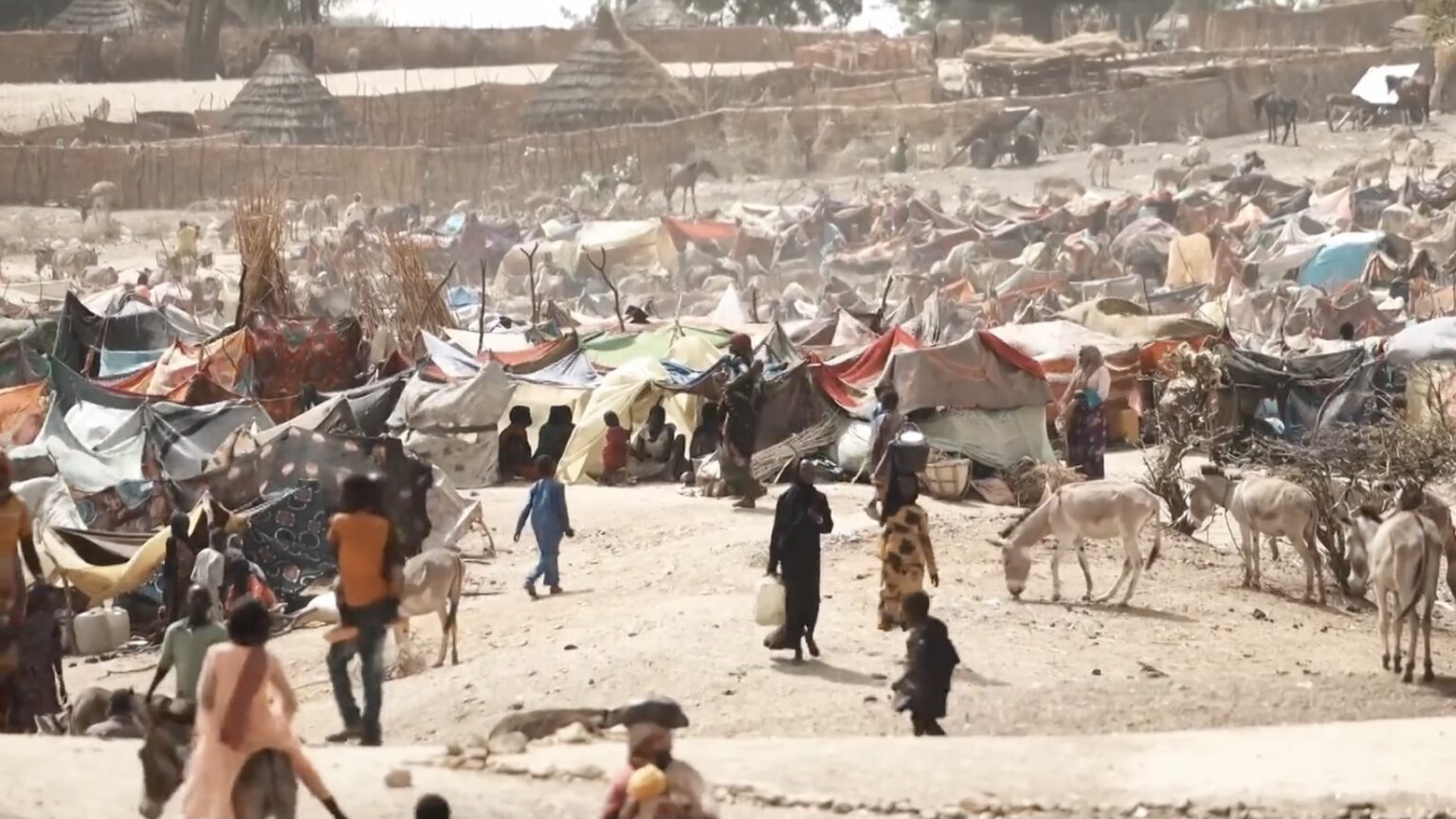
Sudanese refugees in Chad. Over 10 million people have been forcibly displaced in over a year of war in Sudan. Photo: Wikimedia commons
Famine looms in Sudan, forcing people to flee to neighboring countries, while talks between warring parties and a UN envoy are still under way in Geneva
The governments of 15 Arab and African countries issued a statement on Tuesday, July 16, expressing their deep concerns regarding the escalating food security crisis in war-torn Sudan. The countries included the United Arab Emirates, Jordan, Morocco, Mauritania, Chad, Comoros, Guinea-Bissau, Benin, Seychelles, Senegal, Kenya, Sierra Leone, Uganda, Mozambique and Nigeria.
The statement came as a reaction to the Integrated Food Security Phase Classification (IPC) report, which was published on June 27, 2024. “Fourteen months into the conflict, Sudan is facing the worst levels of acute food insecurity ever recorded by the IPC in the country,” the report said, pointing out that more than half of the population in Sudan have experienced severe hunger, which makes Sudan the world’s largest hunger crisis.
The number of starving people is estimated at 25.6 million people, with 14 areas at the risk of famine including greater Darfur, Greater Kordofan, Al Jazirah and some hotspots in Sudan’s capital Khartoum. Many starving Sudanese people have been reportedly fleeing Sudan to seek asylum in neighboring countries due to hunger and looming famine.
The countries who issued the statement expressed their concern about what was set out in the IPC report as a “stark and rapid deterioration” in food security, and its dire impact on the safety and well-being of civilians, including thousands of children, who have suffered from severe acute malnutrition.
According to a Save the Children report published on July 7, due to the war in Sudan 30% of children are acutely malnourished and 20% of the overall population is facing extreme food shortages.
Since the conflict between the Sudanese Armed Forces (SAF) and the Rapid Support Forces (RSF) began in April 2023, the destruction caused by the fighting resulted in a sharp decrease in the agricultural production, and therefore a hike in food prices and food scarcity. The hunger crisis in Sudan has been further deepened by the severe restriction on the movement of food and aid convoys due to the ongoing conflict.
Reiterating the United Nations Security Council’s call from June of 2023, the countries urged all the parties to the conflict to ensure immediate, safe, and unrestricted access to civilian humanitarian aid. They also called on the conflicting parties to adhere to international humanitarian law and to comply with all relevant Security Council resolutions.
The statement also addressed foreign actors requesting them to stop providing armed or material support to the parties involved in the conflict and to refrain from any action which may ignite the conflict. Furthermore, it called on the international community for immediate and coordinated international response to tackle the urgent needs of the affected Sudanese population. The countries encouraged the international community to scale up the humanitarian assistance it provides, and to support the IPC recommendations for increasing nutrition interventions, restoring productive systems and improving data collection.
While the humanitarian situation in Sudan is constantly deteriorating, talks between a United Nations envoy and delegations from both conflicting parties continue in Geneva this week. The talks started last Thursday, focusing on humanitarian aid and the protection of civilians.
There were a few “promising signs” emerging from Monday’s talks in Geneva, the Representative of the World Health Organization (WHO) in Sudan, Shible Sahbani commented. “Let’s wait for the coming hours and days, and we hope that if we don’t get a ceasefire, at least we can get the protection of civilians and the opening of humanitarian corridors,” he added.
U.S. troops prepare components of the Gaza aid pier on March 15, 2024. (Photo: United States Naval Institute)
“The entire operation was a failed exercise in public relations by the Biden administration,” said one observer.
After failing to re-anchor its “humanitarian pier” in Gaza, the Pentagon said Thursday that the much-ballyhooed project—which critics dismissed as a “public relations ploy” that did next to nothing to stop the deadly starvation spreading in the besieged Palestinian enclave—would shut down indefinitely.
Pentagon Press Secretary Maj. Gen. Patrick Ryder said U.S. troops had failed to reconnect the floating Trident Pier to Gaza’s shore due to “technical and weather-related issues,” according to The Washington Post.
The $320 million project—which consists of a floating offshore barge and 1,800-foot causeway to the shore—was touted as eventually being able to accommodate up to 150 aid trucks per day. Instead, it facilitated the shipment of the equivalent of about a single day’s worth of prewar food deliveries while operating for a total of less than three weeks.
“As a pier, it’s shutting down. As a metaphor, it will live forever,” said Tom Philpott, a senior researcher at Johns Hopkins University’s Center for a Livable Future.
Well, that was a waste. The U.S. pier for Gaza "delivered the equivalent of a single day’s pre-war land aid deliveries in two months" and will now be shut down. All to avoid real pressure on Netanyahu (by stopping his aid) to end his obstruction.https://t.co/3811Lhtw0m
Stephen Semler, co-founder of the Security Policy Reform Institute, welcomed the project’s demise.
“The U.S. pier was never supposed to work. It was designed to give a humanitarian gloss to [U.S. President Joe] Biden’s pro-genocide policy in Gaza,” he said on social media. “Good riddance to this failed PR stunt.”
However, during a Thursday press conference, National Security Adviser Jake Sullivan defended the pier, arguing that it “has made a difference in trying to deal with the heartbreaking humanitarian situation in Gaza.”
“I see any result that produces more food, more humanitarian goods getting to the people of Gaza, as a success,” he asserted. “It is additive. It is something additional that otherwise would not have gotten there when it got there. And that is a good thing.”
Even if the pier had achieved its expected capacity, it would still have been far fewer than the prewar daily mean of more than 500 truckloads that U.S. and United Nations officials said are required to meet the needs of a population facing critical shortages of food, water, medicine, and other lifesaving supplies.
The pier was in operation for only about 20 days in May before it broke apart during stormy conditions. The structure was subsequently repaired, but then was dismantled just a week after reopening in June due to more rough seas.
It is also likely that the pier was used for military purposes during the June raid by Israel Defense Forces troops, who killed or wounded hundreds of Palestinians—including many women and children—during the rescue of four Israelis kidnapped by Hamas militants on October 7.
“It seems clear that the entire operation was a failed exercise in public relations by the Biden administration, which has sat on its hands while the extremist Netanyahu cabinet, full of the Israeli equivalent of neo-Nazis, has half-starved or in some instances whole-starved the Palestinians of Gaza,” Middle East expert Juan Cole wrote Friday, referring to the far-right government of Israeli Prime Minister Benjamin Netanyahu.
At least dozens of Palestinians, mostly children, have died in Gaza due to a lack of food, water, and medical treatment. Palestinian and international agencies say that Israel’s 280-day war on Gaza has left at least 137,500 people dead, maimed, or missing; around 90% of the embattled strip’s population forcibly displaced; and hundreds of thousands of Palestinians starving.
“A U.S. administration has to have an answer when reporters ask it why it is allowing Palestinian children to become emaciated, and the pier was an attempted answer,” Cole added. “The other possibility was for the Biden administration to man up and just tell Netanyahu and his rogues’ gallery cabinet that they cannot starve innocent civilians as part of their campaign against Hamas, and that if they do not cut it out there will be hell to pay. But Biden is in the tank for the Israeli government.”
U.N. experts and others have called Israel’s forced starvation of Palestinians in Gaza “a form of genocidal violence and has resulted in famine.”
The International Court of Justice—which is weighing whether Israel is committing genocide in Gaza—has ordered Israel to prevent genocidal acts in the embattled enclave, to “immediately halt” its offensive in Rafah, and to stop blocking humanitarian aid from entering Gaza in the face of worsening “famine and starvation.” Israel is accused of flouting all three ICJ orders.
Meanwhile, International Criminal Court Prosecutor Karim Khan accused top Israeli officials of using “starvation as a weapon of war” and “extermination” in his May application for arrest warrants for Netanyahu and Israeli Defense Minister Yoav Gallant. Khan is also seeking to arrest three Hamas leaders for alleged crimes including extermination and rape.
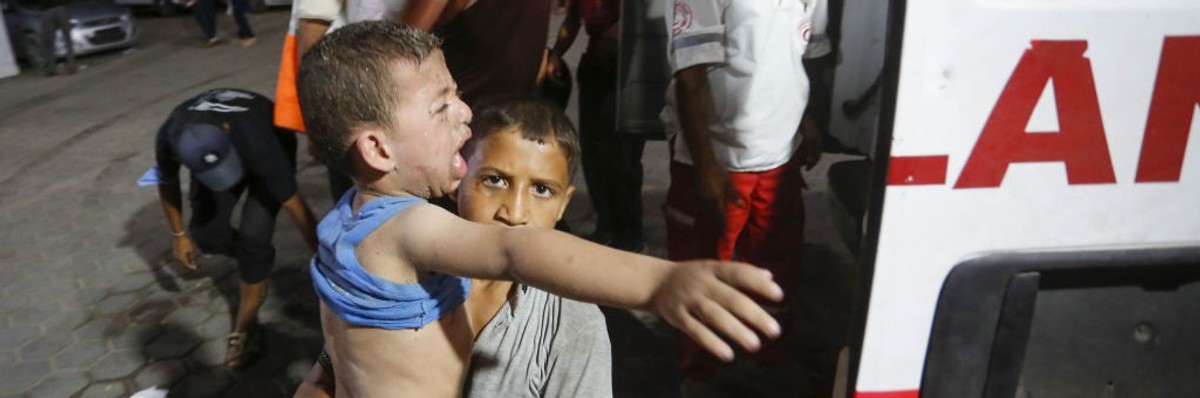
Injured Palestinians, including children, are brought to Al-Aqsa Martyrs Hospital for treatment after an Israeli attack on July 9, 2024 in Deir Al-Balah, Gaza. (Photo: Ashraf Amra/Anadolu via Getty Images)
While the report stresses that “Israel has an inherent right to defend itself,” a related press release doesn’t mention Gaza. One expert said, “I guess they left out the genocide they’re arming and funding.”
The Biden administration broadly and the State Department in particular have faced intense criticism throughout the U.S.-backed Israeli war on the Gaza Strip, and Wednesday was no exception, as an annual genocide report was sent to Congress.
The State Department report is required under the Elie Wiesel Genocide and Atrocities Prevention Act of 2018, named for a Holocaust survivor who wrote about his experiences at the Auschwitz and Buchenwald Nazi concentration camps.
A department press release explains that the report “details U.S. interagency efforts to address genocide, war crimes, and crimes against humanity around the world. It also chronicles whole-of-government work over the past year to promote atrocity prevention programs, protect civilians at risk, and hold perpetrators accountable in places where some of the most heinous crimes have been committed.”
“Our government cannot continue cherry-picking what war crimes and genocide they choose to acknowledge.”
The Intercept‘s Prem Thakker shared the department’s full three-paragraph statement about the report on social media and pointed out that the two nations mentioned are Sudan, where there is a civil war, and Ukraine, which is battling a Russian invasion.
Notably missing—though mentioned in the report—is Israel’s nine-month assault on Gaza, which has been enabled by U.S. diplomatic and weapons support, and is the subject of a South Africa-led genocide case before the International Court of Justice.
Responding to Thakker’s posts, Assal Rad, an expert in Middle East history, said, “I guess they left out the genocide they’re arming and funding.”
Justice Democrats declared: “This is shameful. Our government cannot continue cherry-picking what war crimes and genocide they choose to acknowledge—especially not when we’re the ones funding it.”
The 23-page report includes three paragraphs on Israel and Gaza:
Hamas is a brutal terrorist organization that has vowed to annihilate Israel and repeat the October 7, 2023 massacre, during which it murdered almost 1,200 Israelis, took more than 240 people hostage, and committed horrific acts of sexual violence. In response, Israel has engaged in military actions in Gaza with the stated intent of defending itself against future Hamas attacks. By the end of the reporting period, tens of thousands of Palestinians were killed and over a million displaced as a result of Israel’s military actions.
Israel has an inherent right to defend itself consistent with international law, in response to the October 7 attack, and the United States has made clear that Israel has a moral obligation and a strategic imperative to protect civilians, investigate allegations of any wrongdoing, and ensure accountability for any abuses or violations of international human rights law and violations of [international humanitarian law, or IHL]. As President [Joe] Biden stated in his 2024 State of the Union address: “Israel has an added burden because Hamas hides and operates among the civilian population. But Israel also has a fundamental responsibility to protect innocent civilians in Gaza. This war has taken a greater toll on innocent civilians than all previous wars in Gaza combined.” Secretary [of State Antony] Blinken has urged Israel to do everything possible to avoid civilian casualties and has consistently reiterated at the highest levels that Israel’s military operations in Gaza must comply with IHL.
The Department of State provides a variety of assistance for those impacted in Israel, the West Bank, and Gaza through U.N. Women, U.N. Food and Agriculture Organization, U.N. Development Program, U.N. Population Fund, U.N. Children’s Fund, Office for the U.N. High Commissioner for Human Rights, other U.N. agencies, and international organizations that operate in Israel and Gaza. Additionally, the Department of State hosted U.N. Special Representative of the Secretary-General on Sexual Violence in Conflict Pramila Patten in March to discuss her report and recommendations following her fact-finding visit to Israel and the West Bank regarding allegations of [gender-based violence].
As of Wednesday, Israel’s war has killed at least 38,243 people in Gaza and injured another 88,243, according to health officials in the Hamas-governed Palestinian enclave. Thousands more remain missing and presumed dead. Israeli forces have devastated civilian infrastructure, leaving a trail of bombed-out homes, hospitals, schools, and mosques.
In a letter published in the medical journal The Lancet last week, three public health experts wrote that “applying a conservative estimate of four indirect deaths per one direct death to the 37,396 deaths reported, it is not implausible to estimate that up to 186,000 or even more deaths could be attributable to the current conflict in Gaza.”
Matt Miller called out by @samhusseini for his ‘creepy smirking’ when he mentions the 10s of 1000s of Palestinian ppl massacred by the israelis pic.twitter.com/92vo7AQURI
Israel has also limited the flow of humanitarian aid into Gaza. Although the United Nations has not formally declared a famine, 10 top U.N. experts said Tuesday that “we declare that Israel’s intentional and targeted starvation campaign against the Palestinian people is a form of genocidal violence and has resulted in famine across all of Gaza.”
Since October, multiple U.S. government employees, including State Department officials, have resigned over the administration’s complicity in genocide, including weapons support—which the department previously addressed in a May report to Congress.
The May report—the release of which was blasted as a “Friday news dump”—says that it “is reasonable to assess” that U.S. weapons “have been used by Israeli security forces since October 7 in instances inconsistent with its IHL obligations or with established best practices for mitigating civilian harm,” but concludes that Israel can continue receiving arms support.
The earlier report also expresses “deep concerns” about Israel’s actions regarding relief efforts but states that “we do not currently assess that the Israeli government is prohibiting or otherwise restricting the transport or delivery of U.S. humanitarian assistance within the meaning of Section 620I of the Foreign Assistance Act.”
Wow, watch this
Reporter: IPC report says 96% of Gaza faces acute food insecurity, US continues to be biggest funder of 🇮🇱 military and US law says any country receiving support can’t obstruct flow of aid. Every major rights group says 🇮🇱 is using starvation as a tactic of war,… pic.twitter.com/z8WmBuxPk0
Later that month, Stacy Gilbert, one of the State Department officials who resigned, said that “there is consensus among the humanitarian community” that Israel has obstructed relief efforts, adding: “That’s why I object to that report saying that Israel is not blocking humanitarian assistance. That is patently false.”
Fatma Hijazi, the mother of 10-year-old Palestinian boy Mustafa Hijazi, who died due to malnutrition and lack of medication, holds the lifeless body of her child in Deir al-Balah, Gaza on June 14, 2024. (Photo: Ashraf Amra/Anadolu via Getty Images)
The starvation of Palestinians in Gaza “is a form of genocidal violence,” said 10 rights experts.
While the United Nations still has not formally declared a famine in Gaza after nine months of Israel’s near-total blockade on humanitarian aid, 10 top U.N. experts on Tuesday said they have seen enough.
“We declare that Israel’s intentional and targeted starvation campaign against the Palestinian people is a form of genocidal violence and has resulted in famine across all of Gaza,” said the experts.
Michael Fakhri, special rapporteur on the right to food, was joined in the statement by other experts including Francesca Albanese, special rapporteur on the situation of human rights in the Palestinian territory occupied since 1967, and Paula Gaviria Betancur, special rapporteur on the human rights of internally displaced persons.
They said the recent deaths of three children in various parts of the enclave led the experts, who do not speak on behalf of the United Nations as a whole, to declare a famine has taken hold.
“Fayez Ataya, who was barely six months old, died on May 30, 2024 and 13-year-old Abdulqader Al-Serhi died on June 1, 2024 at the Al-Aqsa Hospital in Deir Al-Balah,” said the experts. “Nine-year-old Ahmad Abu Reida died on June 3, 2024 in the tent sheltering his displaced family in Al-Mawasi, Khan Younis. All three children died from malnutrition and lack of access to adequate healthcare.”
“With the death of these children from starvation despite medical treatment in central Gaza, there is no doubt that famine has spread from northern Gaza into central and southern Gaza,” they continued.
We are now seeing famine across the whole of Gaza. All houses destroyed, food systems destroyed and healthcare destroyed. And kids are dying. Is there any humanity left? https://t.co/jjI5ZHAvbA
— UN Special Rapporteur on the right to housing (@adequatehousing) July 9, 2024
At least 34 Palestinians in Gaza—the majority being children—have now died from malnutrition since October, when Israel began its bombardment of the enclave in retaliation for a Hamas-led attack and Defense Minister Yoav Gallant announced there would “be no electricity, no food, no fuel” allowed in to Gaza.
Israeli officials said in response to Tuesday’s statement that it has increased the aid allowed into Gaza recently, but hundreds of delivery trucks remain stranded in Egypt and a floating pier built by the U.S. has not significantly improved the humanitarian crisis.
The U.N. experts said that with the first death of a child from malnutrition and dehydration, it should have been considered “irrefutable that famine has taken hold.”
“When a two-month-old baby and 10-year-old Yazan Al Kafarneh died of hunger on February 24 and March 4, respectively, this confirmed that famine had struck northern Gaza,” they said. “The whole world should have intervened earlier to stop Israel’s genocidal starvation campaign and prevented these deaths… Inaction is complicity.”
The Integrated Food Security Phase Classification, which is backed by the U.N., said last month that Gaza is at high risk for famine and that nearly half a million people were facing “catastrophic” food insecurity, with an extreme lack of food.
In May, Human Rights Watch co-founder Aryeh Neier, who had previously hesitated to say Israel was committing genocide in Gaza, said Israel’s “sustained policy of obstructing the movement of humanitarian assistance into the territory” ultimately convinced him that Israeli officials are “engaged in genocide.”
In March, the International Court of Justice ordered Israel to ensure its military refrain from violating the Genocide Convention by preventing humanitarian aid from reaching people in Gaza, saying that “the catastrophic living conditions of the Palestinians in the Gaza Strip have deteriorated further” and that “famine is setting in.”
A woman named Ghaneyma Joma told Reuters on Monday at a hospital in Khan Younis that she feared her son would soon die of starvation.
“It’s distressing to see my child… lying there dying from malnutrition because I cannot provide him with anything due to the war, the closing of crossings, and the contaminated water,” she told the outlet.
The Council on American-Islamic Relations called on the U.S. government, the biggest international funder of Israel’s military and a persistent defender of its actions in Gaza, to ensure that a cease-fire agreement is reached and that Palestinians receive necessary humanitarian aid.
“The intentional starvation of the Palestinian people in Gaza can only occur with the active complicity of the Biden administration in Israel’s campaign of genocide,” said Ibrahim Hooper, national communications director for the group. “This complicity must end, and the Palestinian people must be offered a future in which they are free of occupation and can live in dignity.”
Zionist Keir Starmer is quoted “I support Zionism without qualification.” He’s asked whether that means that he supports Zionism under all circumstances, whatever Zionists do.